.svg)
unified sdlc
compliance
audit evidence

A software delivery audit trail system of record captures and preserves every change event across your development pipeline—from code commits through production deployment. If you've ever scrambled to piece together evidence before an audit, you know how painful scattered logs and disconnected tools can be. LoopIQ gives you a unified workspace that automatically captures this evidence chain, connecting delivery work with compliance documentation in one place.
This article explains what an audit trail system of record means in the context of software delivery governance, why it matters for your engineering operations, and how modern platforms approach this challenge. You'll learn the core components, how evidence flows across environments, and what separates basic logging from a true system of record.
An audit trail in software delivery is a chronological record of every significant action that occurs during the development and deployment process. Each entry captures the user identity, timestamp, action performed, and affected resources. This creates an unbroken chain of evidence showing how code moves from a developer's commit through testing, approval, and production deployment.
Unlike basic application logs that focus on debugging errors, audit trails focus on accountability. They answer questions auditors and compliance officers ask: Who approved this change? When did it reach production? What tests passed before deployment? This distinction matters because operational logs often get rotated or archived, while audit evidence needs longer retention and tamper protection.
For VPs and Directors of Software Development, the audit trail becomes your documentation of governance controls in action. According to research on audit logging practices, effective audit trails track user activity, data access, system-wide changes, and failed login attempts across connected systems.
A system of record serves as the authoritative source of business data. For audit trails, this means the data carries legal and regulatory weight. Basic logging captures events for troubleshooting. A system of record captures events for proof.
Three characteristics separate a system of record from ordinary logs. First, data integrity—entries cannot be modified or deleted after creation. Second, validation—incoming data gets verified against expected formats and business rules. Third, synchronization—changes propagate to connected systems that depend on this authoritative source.
IBM's definition notes that systems of record require "a database to store data, a process for validating and synchronizing that data, and a way for users to access that data." This applies directly to software delivery governance. Your audit trail system of record must validate that events match expected patterns, store them immutably, and make them searchable for auditors.
Modern software delivery involves multiple disconnected tools—source control, CI/CD platforms, cloud providers, approval workflows, and testing systems. Each tool generates its own logs with different formats, retention policies, and access controls. When an auditor asks for evidence that a specific production change followed your governance process, you need a unified view.
Without a dedicated system of record, teams spend significant time reconstructing evidence from scattered sources. This approach has three problems. Log rotation may have deleted relevant data. Different timestamps across systems make correlation difficult. Manual assembly introduces the risk of incomplete or inconsistent evidence packages.
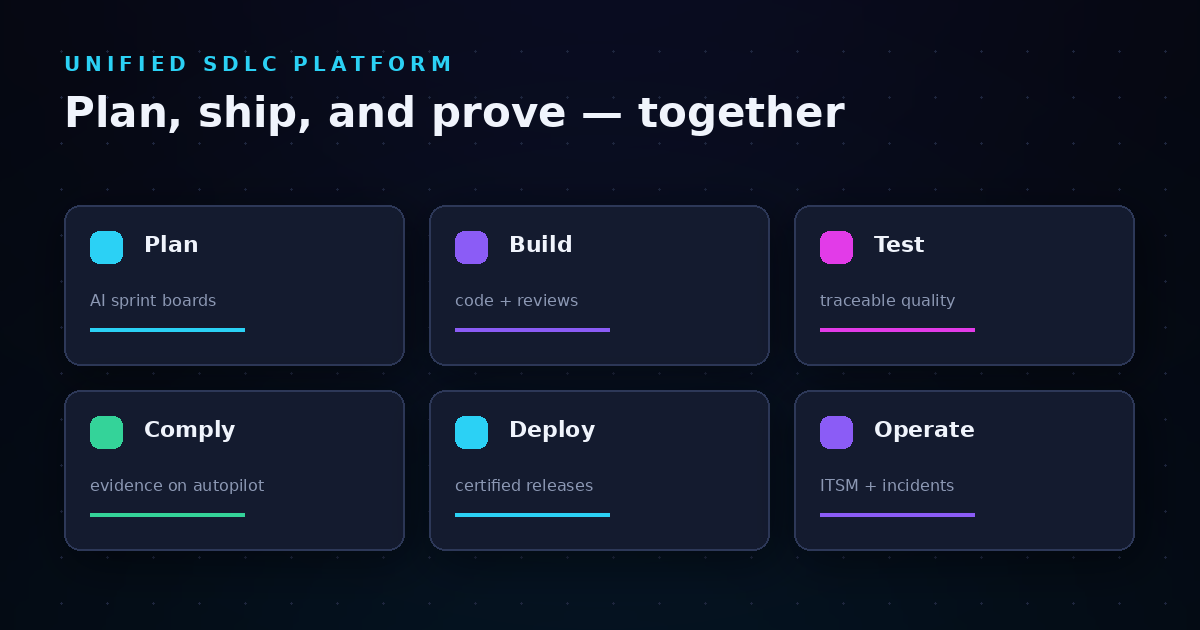
LoopIQ addresses this by unifying work activity, operational records, AI assistance, and compliance evidence in one platform. This creates a single place to review release readiness evidence, eliminating the need to hunt through multiple tools during audit preparation.
A complete audit trail for software delivery governance captures events across the entire pipeline. Code changes form the foundation—every commit, branch creation, and merge must be recorded with author identity and timestamps. The CI/CD layer adds build triggers, test executions, security scan results, and artifact creation events.
Approval events require special attention because they demonstrate human oversight in your governance process. This includes pull request reviews, deployment approvals, and any manual gates in your workflow. According to guidance on SOX compliance for software delivery, change management controls must document "who requested a change, who approved it, who implemented it, and who verified it."
Infrastructure and deployment events complete the picture. When code reaches each environment—development, staging, production—the audit trail captures what deployed, when, by whom (or which automated pipeline), and what configuration applied. This end-to-end visibility lets you trace any production artifact back to its source commit and all governance checkpoints it passed.
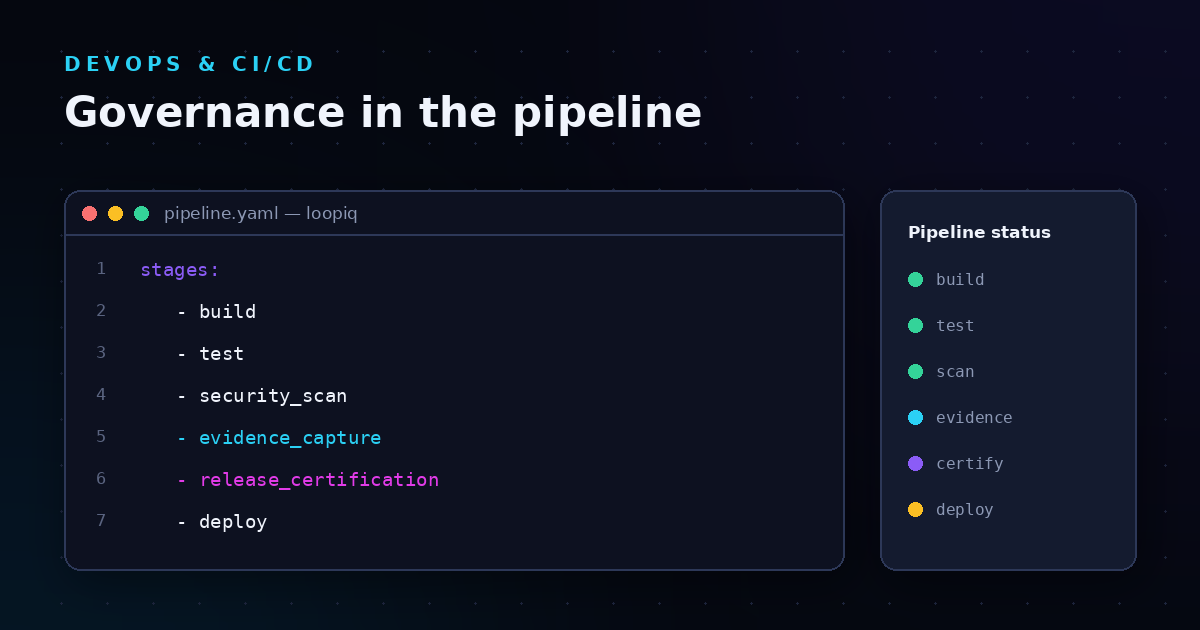
Evidence collection starts at the source. When a developer pushes code, your version control system records the commit details. Your CI/CD platform picks up this event and creates records for each pipeline stage—builds, tests, security scans, and artifact generation. These records link back to the original commit through identifiers like git hashes.
As code moves through environments, each transition generates additional evidence. A deployment to staging creates a record. Approval for production creates another. The actual production deployment, whether triggered by a human or automated pipeline, generates the final piece. Each record references the previous events, creating a linked chain.
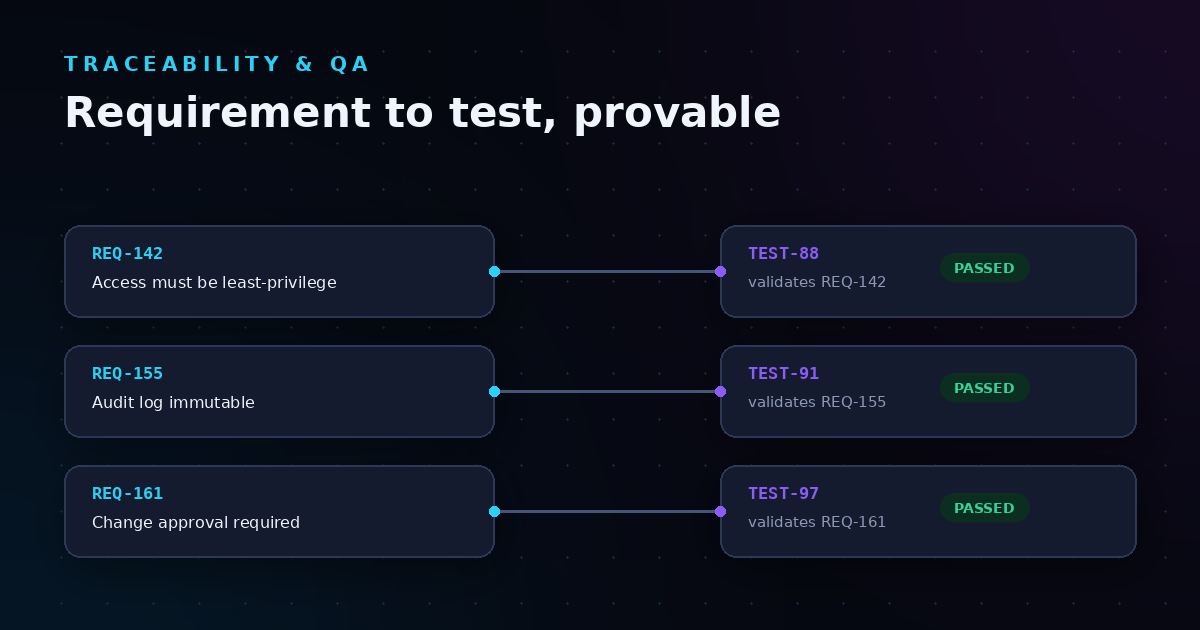
LoopIQ captures events across environments and links change records to code, tests, and approvals. This linked structure means you can start from any production deployment and trace backward through every checkpoint. Auditors value this traceability because it demonstrates your controls operated as designed throughout the delivery process.
Access controls determine who can perform actions, while audit trails record that those actions occurred. Both are essential for governance. Your system of record must capture not just what happened, but whether the person or system that performed the action had authorization to do so.
Granular permissions enable separation of duties—a core principle in compliance frameworks. The developer who writes code may not have permission to approve its deployment. The reviewer who approves cannot also be the original author. Your audit trail captures these relationships, showing auditors that your permission model enforces proper segregation.
LoopIQ enforces access via granular permissions while capturing audit events. This dual function—controlling access and documenting that access was properly controlled—strengthens your compliance posture. When auditors ask about separation of duties, you can show both the permission configuration and the audit records proving it operated correctly.
Data integrity for audit trails means ensuring records remain accurate and unaltered after creation. Techniques include cryptographic hashing, append-only storage, and strict access controls that prevent even administrators from modifying entries. Without these protections, audit trails lose their evidentiary value.
Retention policies matter equally. Different regulations specify minimum retention periods—HIPAA requires six years for certain records, PCI DSS requires one year for audit logs. Your system of record must support configurable retention that meets your most stringent requirement while managing storage costs.
Tamper-evident storage adds another layer of protection. Hash chains or digital signatures make any modification detectable. If someone alters a record, the cryptographic verification fails, alerting you to potential tampering. This protection matters for legal proceedings and regulatory examinations where audit evidence becomes documentation for compliance claims.
A software delivery audit trail system of record gives you the foundation for demonstrating governance across your entire pipeline. It captures evidence automatically, maintains data integrity, and provides the cross-environment traceability that auditors expect. Building this capability reduces audit preparation time from weeks to hours and shifts compliance from a periodic scramble to an ongoing, documented process.
For engineering leaders evaluating their governance posture, the path forward involves consolidating audit evidence collection into a unified platform, enforcing proper access controls, and ensuring retention policies meet regulatory requirements. LoopIQ delivers this unified approach by connecting delivery work with compliance documentation, helping you ship software faster while maintaining audit-ready evidence at every step.
An audit log is a single record of events, while an audit trail is the complete sequential chain linking those records together. The trail shows the full journey of a change through your system.
For software delivery, this distinction matters when tracing production changes back to their origin. LoopIQ creates connected audit trails that link commits, builds, approvals, and deployments into a complete governance narrative.
Retention periods depend on your regulatory requirements. SOX-related records typically require seven years. HIPAA requires six years. PCI DSS requires one year with three months immediately available.
Most organizations apply the longest applicable requirement across their audit data. LoopIQ supports configurable retention policies that help you meet these varied requirements without manual management.
You can, but it creates significant overhead during audits. Separate tools generate separate logs with different formats, timestamps, and retention policies. Correlating events across tools requires manual effort and introduces gaps.
A unified platform like LoopIQ captures events across your delivery pipeline in one place, eliminating correlation challenges and ensuring complete evidence chains for every change.
Tamper resistance comes from cryptographic techniques and storage architecture. Append-only databases prevent deletions. Hash chains detect modifications. Strict access controls prevent unauthorized changes even by administrators.
These protections give your audit trail evidentiary weight. Without them, auditors may question whether records accurately reflect what happened during your development process.
SOC 2 requires evidence that access to systems and data is logged and monitored. Your system of record generates this evidence automatically by capturing every significant action in your software delivery process.
LoopIQ maps audit events to compliance controls, organizing evidence packages for auditor review. This automation reduces the manual work typically required for SOC 2 readiness.