.svg)
unified sdlc
compliance
audit evidence

Software supply chain attacks have moved from security-conference talking points to board agendas. Regulators, enterprise customers, and auditors now ask the same question in different words: can you prove that every artifact you ship was built from known components, by authorized people, through controlled processes? For most engineering organizations, the honest answer is "partially" — the controls exist, but the proof is scattered across build logs, scanner dashboards, ticket systems, and email threads.
This guide covers how to secure the software supply chain and automate the audit evidence that proves it: what a secure supply chain actually requires, which evidence auditors expect at each SDLC stage, and how to evaluate software delivery and compliance platforms that make provable security a byproduct of shipping.
A secure software supply chain ensures that every component entering your software — source code, open-source dependencies, build tools, container images, and deployment infrastructure — comes from a known origin, passes defined security checks, and moves to production only through authorized, controlled processes.
In practice, that means four things must be true for every release. You know what is in the artifact (component inventory and SBOM). You know where it came from (provenance and build integrity). You know who touched it (access governance and approval records). And you know it was validated (testing, scanning, and policy gates). Frameworks like SLSA, NIST SSDF, and requirements flowing from SOC 2, ISO 27001, and sector regulations all converge on these fundamentals.
Most teams invest in the control side: they add dependency scanning, sign artifacts, enforce branch protection, and gate deployments. Far fewer can produce evidence that those controls executed for a specific release six months ago.
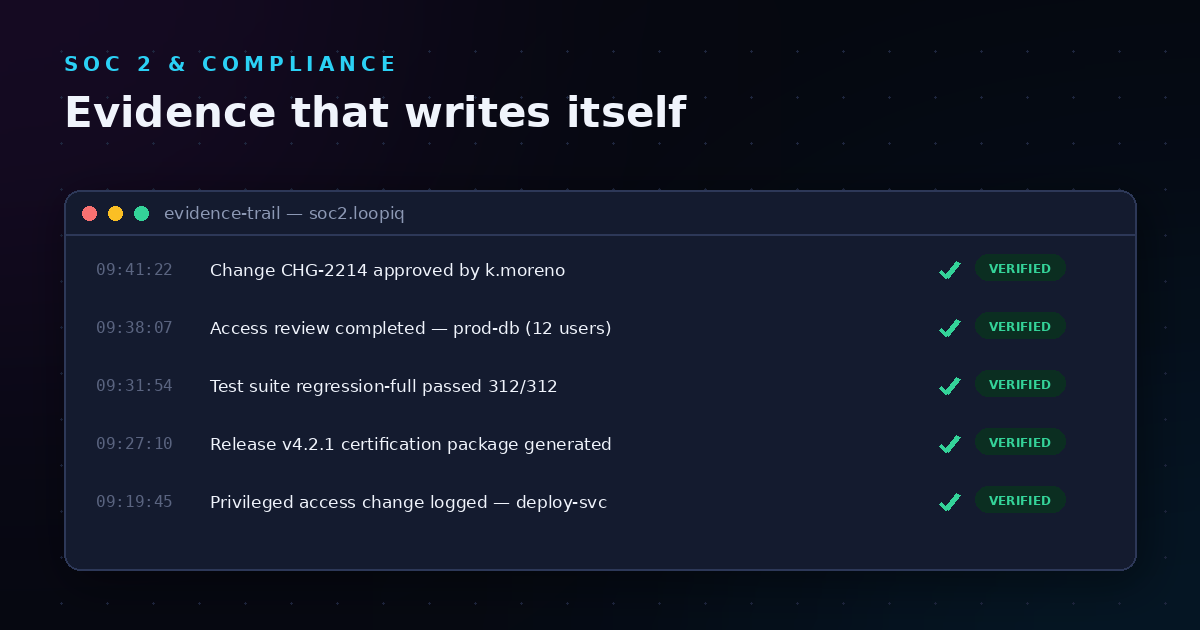
That gap matters because supply chain security is increasingly verified through audits and customer assessments, not just penetration tests. When an auditor asks "show me that this production change was scanned, approved, and deployed by authorized personnel," a green dashboard today is not evidence about a release shipped in March. Evidence must be release-specific, timestamped, and retrievable — and reconstructing it manually from CI logs and chat threads is the most expensive form of audit preparation.
Auditors and enterprise security reviewers generally expect a connected chain of proof for each release:
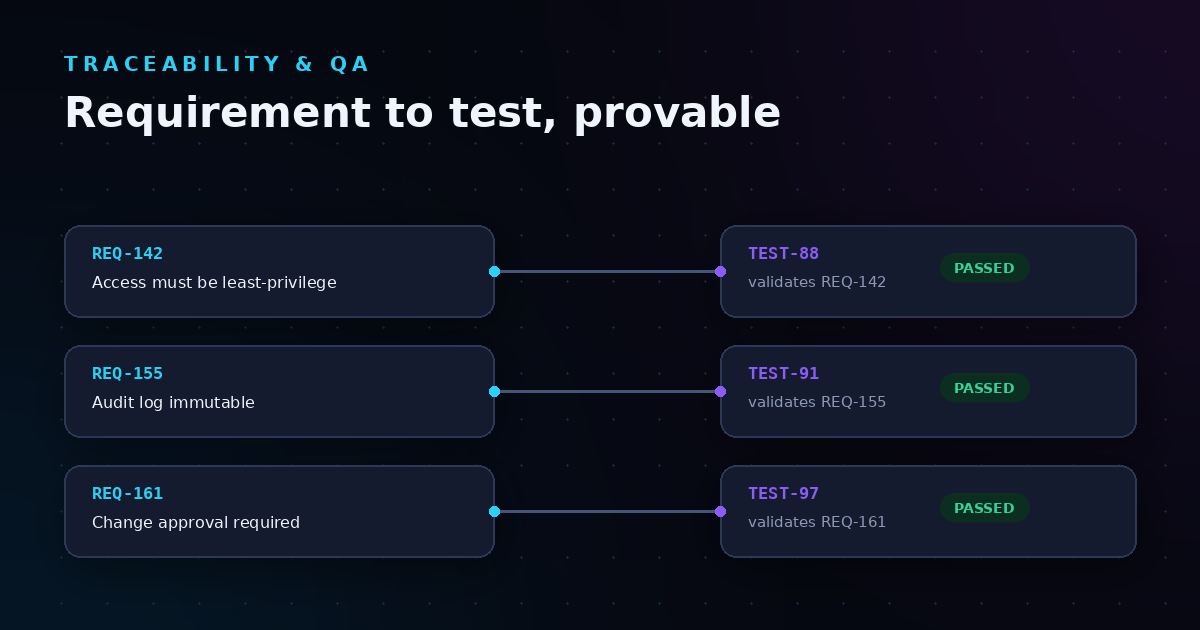
The keyword is connected. Each item may exist somewhere in your toolchain today; evidence breaks when the relationships between them cannot be proven.
Evidence automation means capturing proof from the systems where work already happens, at the moment it happens. The practical pattern looks like this:
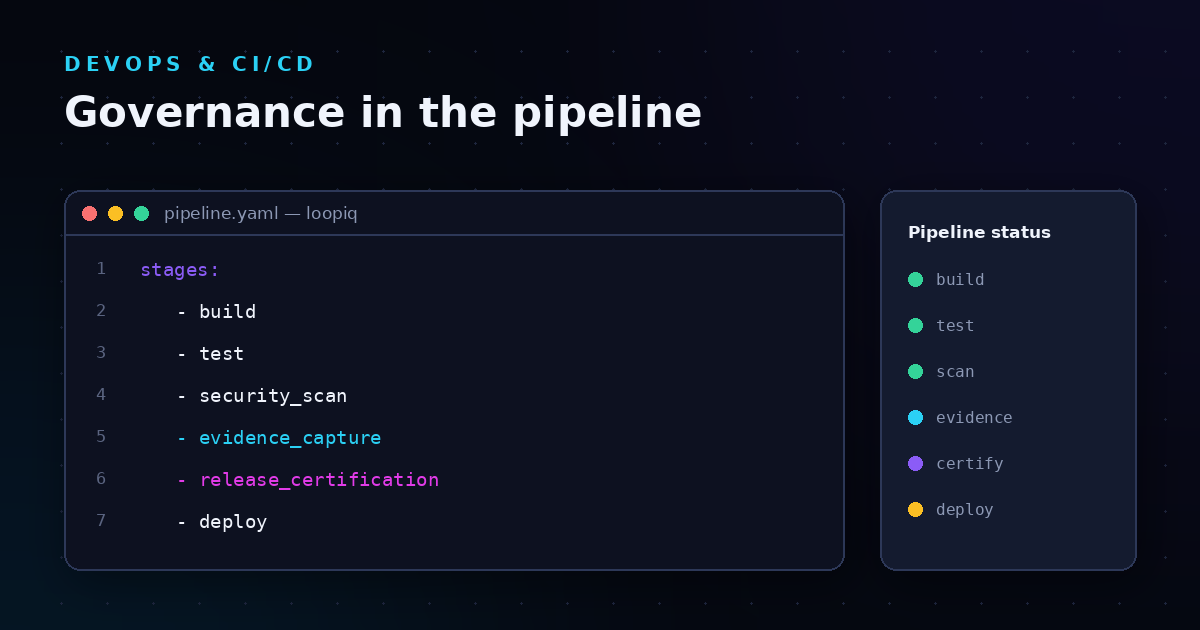
First, map your evidence requirements to your toolchain: which auditor questions are answered by your repos, pipelines, scanners, test systems, and ITSM workflows. Second, instrument capture at workflow events — merges, pipeline runs, scan completions, approvals, deployments — rather than asking engineers to document after the fact. Third, unify the captured signals into a release-level record, so every production release has a dossier linking its requirements, changes, scans, approvals, and deployment events. Finally, certify each release against defined conditions, and store the certification with its supporting evidence.
Done well, this removes compliance work from the engineering critical path entirely: engineers ship the way they always have, and the evidence assembles itself.
When evaluating software delivery and compliance platforms, test five capabilities:
Be skeptical of platforms that treat compliance as a reporting layer over disconnected data. If evidence relationships are stitched together at report time, they will be challenged at audit time.
LoopIQ is a compliance-first unified SDLC workspace built around exactly this problem. Delivery work — planning, code changes, testing, DevOps, and ITSM — happens in one connected system, so supply chain evidence captures automatically as work progresses. Security scan results, approvals, and deployment events link to each release, and LoopIQ generates release certifications and audit-ready evidence dossiers without manual assembly. Teams keep their existing repos and pipelines; LoopIQ centralizes the delivery context and governance records that auditors ask for.
Supply chain security that cannot be proven is indistinguishable, to an auditor or enterprise customer, from security that does not exist. The organizations handling this well have stopped treating evidence as an audit-season activity and made it a byproduct of delivery: controls enforce themselves in the workflow, evidence captures automatically, and every release ships with its proof attached. That is the standard to evaluate platforms against — and the standard your next audit will apply to you.
A secure software supply chain ensures every component in your software — source code, dependencies, build tools, and deployment infrastructure — comes from a known origin, passes defined security checks, and reaches production only through authorized, controlled processes, with evidence recorded at each step.
Because supply chain security is verified through audits and customer assessments. Controls that cannot be proven for a specific past release are treated as if they did not run. Release-specific, timestamped evidence is what turns security practices into defensible assurance.
A connected chain: requirement and change records, code changes with review approvals, SBOMs and scan results, build provenance, test executions, deployment events, and a release certification decision. The relationships between these items matter as much as the items themselves.
Yes. Evidence automation captures proof from the systems where work already happens — repos, pipelines, scanners, and approval workflows — and unifies it into release-level records. Teams keep their toolchain; the platform centralizes the evidence and its relationships.
LoopIQ unifies delivery, governance, and audit evidence in one workspace. Scan results, approvals, and deployment events link to each release automatically, and LoopIQ generates release certifications and audit-ready evidence dossiers without manual assembly.