.svg)
unified sdlc
compliance
audit evidence

A release governance layer determines how quickly you can ship software and how easily you can prove you did it right. When planning, testing, DevOps, and ITSM operate as separate systems, you end up chasing approvals, reconstructing audit evidence, and coordinating across disconnected tools.
The solution is a unified governance layer that connects change management, release approvals, and audit evidence trails across your entire software delivery lifecycle. LoopIQ brings planning, testing, DevOps, ITSM, and documentation together in one platform, capturing compliance evidence automatically so you can focus on shipping software rather than preparing for audits.
This guide walks you through everything you need to know about building a change-managed, audit-ready release governance layer. You'll learn the core concepts, implementation steps, and how to connect governance with your existing DevOps and ITSM workflows.
A release governance layer is the set of policies, processes, and tools that control how software moves from development through production. It defines who can approve changes, what evidence must be collected, and how decisions align with business and regulatory requirements.
At its core, governance bridges the gap between business priorities and technical execution. You're not just deploying code—you're making decisions that affect security, compliance, and operational stability. According to Hokstad Consulting research, governance ensures every release decision supports your organization's broader objectives and risk management approach.
Good governance doesn't wait for problems to arise. It actively monitors standards and adapts practices, especially in fast-paced DevOps environments where changes happen daily.
Without a governance layer, your releases become unpredictable. Deployment timelines slip because approvals are unclear. Auditors request documentation you don't have. Security issues slip through because nobody defined the checkpoints.
Governance creates transparency by clarifying roles and responsibilities. You know exactly who needs to approve what, when they need to approve it, and what evidence supports each decision.
This predictability matters during audits. When regulators or internal compliance ask how a specific change reached production, you need to show the complete trail—from request through approval to deployment and verification.
DevOps and ITSM serve different but complementary purposes. DevOps optimizes for speed and agility—getting features and fixes to production quickly. ITSM focuses on stability and risk control—ensuring changes don't disrupt service quality or create compliance gaps.
The conflict between these approaches creates real problems. As IBM's ITSM research explains, ITSM establishes the practice of planning, implementing, managing, and optimizing IT service delivery. DevOps wants to ship fast. ITSM wants to ship safely.
You see this tension in three common scenarios: change approval boards that can't keep pace with CI/CD pipelines, war rooms where engineers debug in Slack while IT waits for tickets in the ITSM system, and the dreaded double-entry problem where someone resolves an incident then spends 20 minutes copying updates for the audit trail.
The root cause is disconnected tooling. Your SREs live in terminals, monitoring dashboards, and Slack channels. Your IT service managers work in ITSM platforms with formal ticketing workflows. Neither tool talks to the other natively.
This gap forces engineers to become messengers. Every status update, every resolution, every approval gets manually copied between systems. Research shows that context switching between disconnected tools can consume hours per week across a team—time that should go toward actual problem-solving.
The solution isn't choosing between DevOps velocity and ITSM governance. It's connecting them so incident response happens in your engineers' preferred tools while documentation flows automatically to your compliance systems.
Unified Service Management (USM) gives you a framework to run both workflows simultaneously. USM is principle-based rather than practice-based—it doesn't replace ITIL or DevOps but accommodates both.
The key distinction is focusing on outcomes rather than outputs. Instead of measuring tickets closed or deployments shipped, USM tracks reliability, speed, and compliance as shared metrics across both DevOps and ITSM functions.
This outcome orientation gives your engineers and IT managers a common language. Everyone works from the same playbook during incidents, releases, and audits.
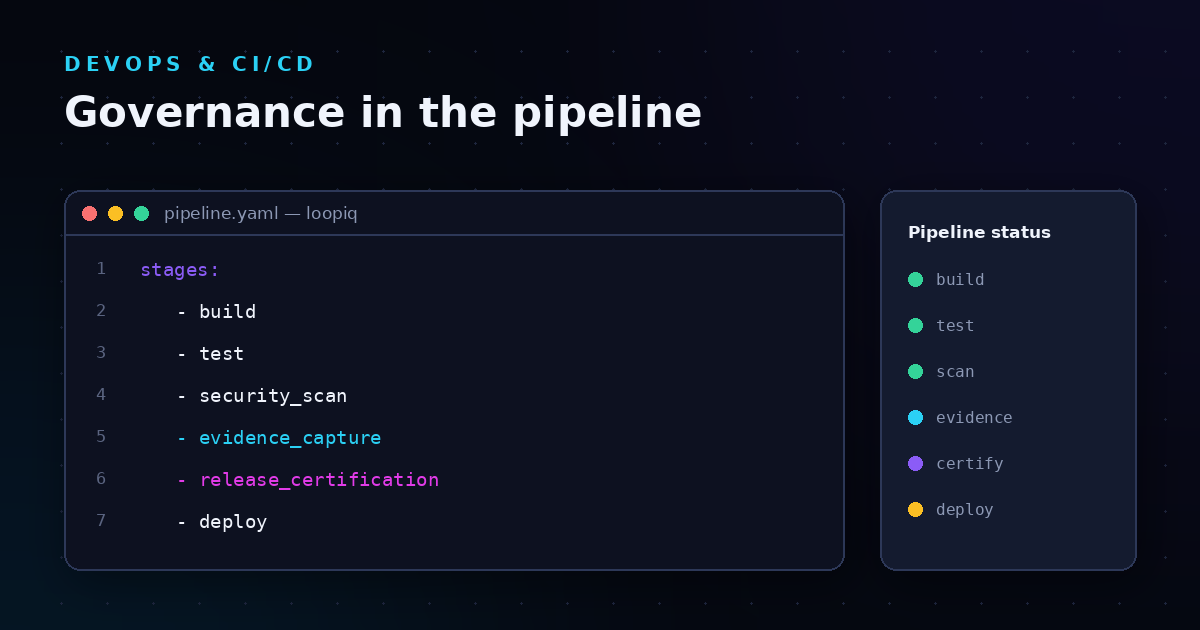
An effective release governance layer includes five interconnected components: change management, approval workflows, evidence collection, audit trails, and release certification. Each component reinforces the others.
Change management tracks every modification that could affect production systems. This includes code changes, infrastructure updates, configuration adjustments, and operational procedures. Each change flows through defined approval stages based on its risk level and scope.
Routine updates might need only team lead approval. Changes involving customer data or security-critical systems require sign-offs from security and compliance stakeholders. Emergency changes follow expedited paths with post-implementation review.
The goal is preventing unauthorized or poorly-reviewed changes from reaching production while keeping the approval process proportional to actual risk.
Evidence collection captures the artifacts that prove your governance process works. This includes approval records, test results, security scan outputs, deployment logs, and rollback verification. Every piece of evidence links to specific changes and releases.
Audit trails create an immutable, timestamped record of who did what and when. When auditors ask how a specific deployment was approved, you can show the complete chain—from the original request through each approval gate to production verification.
Manual evidence collection fails at scale. You need automated systems that capture evidence as part of the normal development and deployment workflow rather than requiring separate documentation steps.
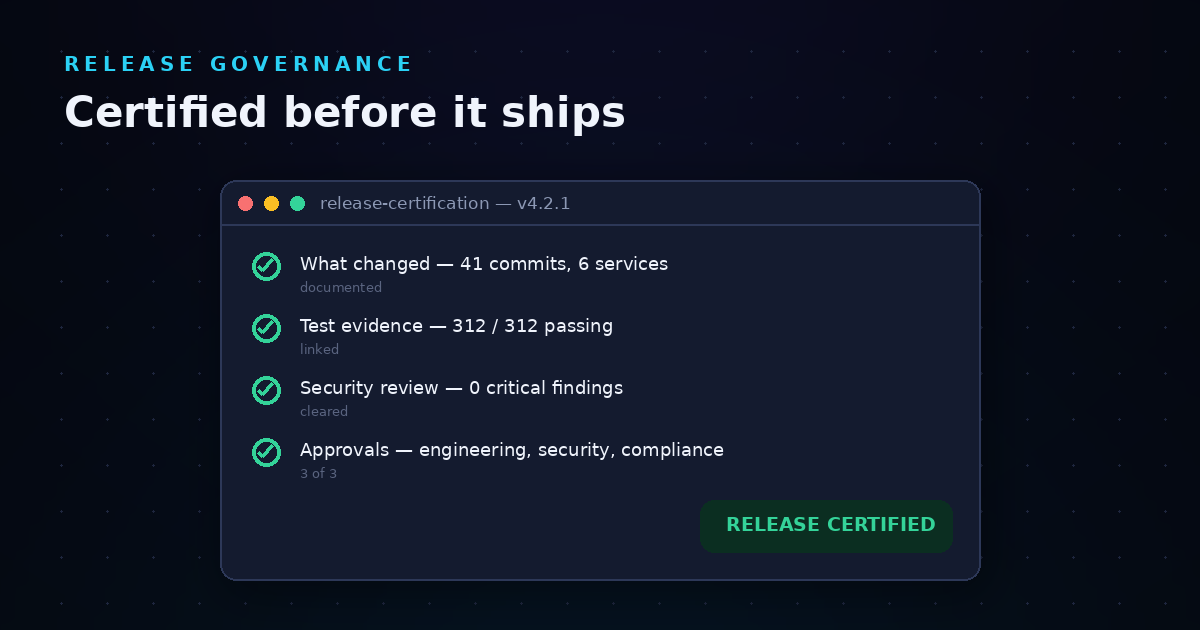
Release certification confirms that all governance requirements are met before code reaches production. Certification reviews check that required tests passed, security scans completed, approvals are documented, and compliance evidence is attached.
Readiness reviews happen at defined gates in your release pipeline. Each gate has specific criteria—if the criteria aren't met, the release doesn't proceed. This prevents incomplete or non-compliant releases from reaching production regardless of schedule pressure.
Building a change-managed release pipeline means embedding governance directly into your CI/CD workflow. Instead of adding manual review steps after development, you configure automated checks that run at every stage.
Start by documenting what requires approval and what evidence you need. Map your existing compliance requirements—whether SOC 2, ISO 27001, HIPAA, or internal standards—to specific pipeline gates.
Define clear categories for changes based on risk level. Low-risk changes might proceed with automated checks only. Medium-risk changes require peer review. High-risk changes need formal change advisory board approval before deployment.
Document who has authority to approve each category. Use role-based assignments rather than named individuals to handle vacations and turnover.
Configure gates at the build, integration, and deployment stages. Each gate runs automated checks and collects required evidence.
Build gates typically include static code analysis, security vulnerability scanning, and coding standard verification. Integration gates run automated tests and validate that the change works correctly with dependent systems. Deployment gates verify that all required approvals exist and that the target environment is ready.
Make gates proportional to risk. Low-risk changes should flow through quickly with automated checks. High-risk changes should require explicit approval at each stage.
Automate approval routing based on change attributes. When a change request is created, the system should automatically identify the required approvers based on the change type, affected systems, and risk classification.
Configure notifications that reach approvers through their preferred channels—email, Slack, or in-platform alerts. Include sufficient context in the notification so approvers can make informed decisions without digging through multiple systems.
Track approval status in real-time. Your dashboard should show pending approvals, approval history, and any bottlenecks in the approval flow.
Configure your pipeline to capture evidence automatically at each stage. Test results, scan outputs, approval timestamps, and deployment logs should all attach to the change record without manual intervention.
Use immutable storage for evidence artifacts. Once evidence is captured, it shouldn't be modifiable. This creates the tamper-proof audit trail that compliance and auditors require.
Link evidence to specific releases and deployments. When someone needs to verify how a particular production change was validated, they should be able to trace from the deployment back through all supporting evidence.
Audit readiness means you can demonstrate compliance at any moment, not just during scheduled audit periods. Your governance system should produce audit-ready documentation as a byproduct of normal operations.
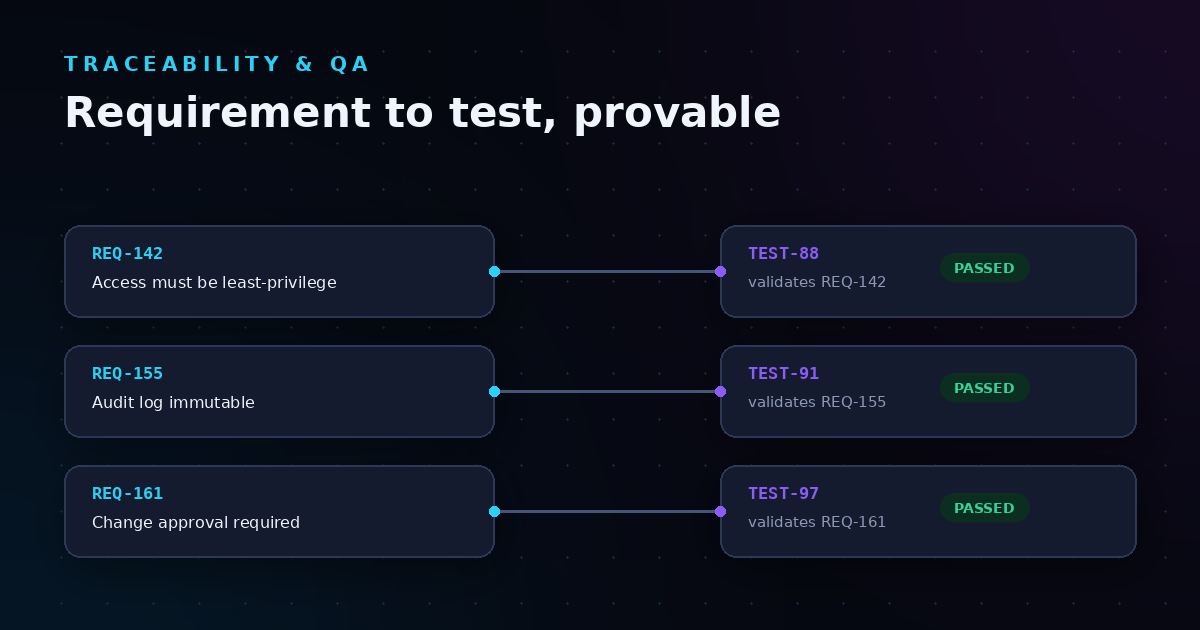
Every change in production should trace back to an authorized request, through defined approval gates, with supporting evidence at each stage. This end-to-end traceability is what auditors look for when evaluating your change management controls.
Traceability works in both directions. Given a production deployment, you can identify the original request and all approvals. Given a change request, you can verify whether it reached production and confirm the deployment details.
Gaps in traceability create audit findings. If you can't prove that a production change went through your governance process, auditors must assume it didn't.
Segregation of duties prevents conflicts of interest in your release process. The person who develops a change shouldn't be the same person who approves it for production. The person who deploys shouldn't be the same person who verifies the deployment succeeded.
Configure your governance system to enforce segregation automatically. Self-approval should be technically prevented, not just discouraged by policy. Your approval workflows should require independent reviewers based on role assignments.
Document your segregation controls and how the system enforces them. Auditors will ask how you prevent unauthorized changes—your answer should include both policy and technical controls.
Retain evidence for the period required by your compliance frameworks. SOC 2 typically requires one year. Financial regulations may require longer. Check your specific requirements and configure retention accordingly.
Store evidence in accessible formats. When auditors request documentation, you shouldn't need to run custom queries or export from legacy systems. Your governance platform should make evidence retrieval straightforward.
Test your retrieval process before audit season. Can you pull all evidence for a specific release within minutes? Can you demonstrate the complete approval chain for any production change? Practice makes audit time much less stressful.
LoopIQ brings planning, testing, DevOps, ITSM, documentation, and audit management into a single workspace. This unified approach eliminates the tool fragmentation that creates governance gaps and coordination overhead.
LoopIQ captures compliance evidence automatically as work flows through your delivery pipeline. Every approval, test result, and deployment decision attaches to the relevant records without manual documentation steps.
Your compliance dashboard shows real-time status across all active releases. You can see which releases have complete evidence, which need additional approvals, and which have open compliance gaps—all in one view.
This automation eliminates the evidence reconstruction problem. When audit time arrives, your documentation already exists because it was captured during normal development and deployment operations.
LoopIQ connects approval workflows across planning, development, and operations. Change requests flow through defined approval paths with role-based routing, notifications, and status tracking.
ITSM work—incidents, service requests, and change requests—connects directly to development work. When an incident requires a code change, the connection persists through development, testing, and deployment. You don't lose context switching between systems.
This integration addresses the double-entry problem. Work done in LoopIQ stays in LoopIQ. Status updates, approvals, and resolution details don't need to be copied to separate ITSM platforms.
LoopIQ helps you move release certifications through approval and readiness review processes. Each certification tracks required evidence, pending approvals, and completion status.
Release readiness dashboards show at a glance whether a release meets all governance requirements. You can identify what's missing and who needs to take action before the release can proceed.
This visibility supports both governance and velocity. You catch missing approvals early rather than discovering gaps during deployment. Your releases stay on schedule because governance requirements are clear and trackable.
Shift-left governance embeds compliance checks earlier in your development process rather than adding reviews after development completes. This approach catches issues when they're cheaper and faster to fix.
Configure your development environment to surface compliance requirements as developers work. If a change requires specific security review, that requirement should be visible when the change is created—not discovered during pre-deployment review.
Integrate compliance checks into your code review process. Security scans, coding standard verification, and policy checks should run automatically on pull requests. Developers see results while the code is still fresh in their minds.
Make compliance feedback actionable. Don't just flag violations—explain what's required and how to fix it. Developers are more likely to address issues immediately when the path forward is clear.
Define your governance policies as code that runs automatically in your CI/CD pipeline. Policy-as-code tools let you express requirements like "production deployments require security lead approval" or "customer data changes need privacy review" in formats that your pipeline can enforce.
Version control your policies alongside your application code. When governance requirements change, the changes flow through the same review and deployment process as code changes. You have a clear history of what policies applied when.
Test your policies before deploying them. A misconfigured policy can block legitimate deployments or allow non-compliant changes. Treat policy changes with the same care you'd give production code.
Configure monitoring that detects drift from your governance requirements. If a system's configuration changes outside your normal change process, you should know about it immediately.
Set up alerts for compliance status changes. When evidence expires, approvals lapse, or audit requirements change, affected stakeholders should receive notification with enough time to address the gap.
Generate compliance reports automatically on defined schedules. Regular reporting keeps governance visible to leadership and reduces the scramble when external audits approach.
Measuring governance effectiveness requires metrics that capture both compliance and velocity. You need to know that your governance process works without knowing that it slows you down unnecessarily.
DORA metrics—deployment frequency, lead time for changes, change failure rate, and mean time to recovery—measure software delivery performance. These metrics apply equally to governed and ungoverned releases.
Track whether your governance process affects these metrics. If deployment frequency drops after implementing new approval requirements, you may need to streamline the approval workflow. If change failure rate increases, your quality gates may not be catching the right issues.
Elite-performing organizations achieve less than one hour mean time to recovery. Your governance process should support rapid response, not create barriers during incidents.
Measure compliance status across your release portfolio. What percentage of releases have complete evidence? What percentage require manual evidence collection? How long does evidence collection take on average?
Track audit findings over time. A mature governance system should produce fewer findings each audit cycle. If findings increase or repeat, your governance controls need strengthening.
Measure time-to-audit-readiness. When auditors request documentation, how quickly can you produce it? Mature organizations can respond to most requests in minutes rather than days.
Measure approval cycle times by change type and risk level. High-risk changes should take longer than low-risk changes—but both should have predictable timelines. Long approval delays indicate bottlenecks that need attention.
Track automation rates for governance activities. What percentage of evidence is captured automatically? What percentage of approvals are routed automatically? Higher automation rates reduce manual effort and improve consistency.
Monitor exception rates. If teams frequently bypass governance controls through emergency change processes, your normal process may be too slow or too restrictive. Exceptions should be rare, not routine.
Implementing release governance creates predictable challenges. Understanding these challenges helps you address them proactively rather than discovering them during critical releases.
Every governance control adds friction to your release process. The challenge is adding enough control to manage risk without slowing delivery to the point where business objectives suffer.
Right-size your governance to actual risk. Low-risk changes don't need the same scrutiny as security-critical modifications. Creating multiple approval tracks based on risk level keeps low-risk releases moving quickly while ensuring high-risk changes get appropriate review.
Review your governance requirements periodically. Controls that made sense initially may become unnecessary as your processes mature or your risk profile changes. Remove controls that no longer add value.
Most organizations run multiple tools across planning, development, testing, deployment, and operations. Each tool has its own data model, workflow, and integration capabilities. Connecting these tools into a coherent governance layer requires significant integration effort.
Choose platforms that are designed to work together. A unified platform eliminates integration challenges because everything shares the same data model and workflow engine.
When integration is necessary, use standard interfaces and documented APIs. Custom point-to-point integrations become maintenance burdens as tools evolve.
Developers may view governance as bureaucracy that slows them down. Operations may see it as additional burden on already-stretched capacity. Overcoming this resistance requires demonstrating governance value.
Show how governance protects individuals. When auditors question a production incident, documented approvals and evidence demonstrate that proper processes were followed. Governance shifts accountability from individuals to the process.
Make governance invisible where possible. Automated checks that run in the background don't feel like bureaucracy. Manual approval steps that interrupt workflow do. Invest in automation to reduce the governance burden developers experience.
Different industries face different regulatory requirements that shape governance implementation. Understanding your regulatory landscape helps you design governance that meets compliance needs.
Financial services organizations navigate multiple frameworks simultaneously. SOX controls financial reporting integrity. PCI DSS governs payment card security. SOC 2 covers service organization controls. Each framework has specific requirements for change management and evidence retention.
Your governance layer needs to satisfy all applicable frameworks. This often means stricter controls than any single framework requires, since controls must meet the most demanding requirement across all frameworks.
Automated evidence collection is especially valuable in financial services. The volume of changes and the strictness of audit requirements make manual documentation impractical.
Healthcare organizations must comply with HIPAA requirements for protecting patient data. Any change that affects systems handling protected health information requires specific review and documentation.
Data privacy regulations like GDPR add requirements for handling personal data. Changes affecting data collection, processing, or storage need privacy review as part of your governance process.
Your governance layer should flag changes that touch regulated data types automatically. Privacy and security reviewers should be routed into approval workflows based on what data the change affects.
Technology companies often pursue SOC 2 certification to demonstrate security controls to customers. SOC 2 requires documented change management processes with evidence of approval and testing.
ISO 27001 certification requires an information security management system with controls over software development and change management. Your governance layer becomes part of your ISMS documentation.
Cloud platforms like AWS and Azure offer compliance tools that integrate with your governance process. Gartner's DevOps platform research notes that organizations increasingly use these platforms to streamline governance and compliance in cloud-native environments.
Building a release governance layer across DevOps and ITSM requires connecting policies, tools, and workflows into a unified system. You need change management that tracks modifications, approval workflows that route decisions to the right people, and evidence collection that captures compliance artifacts automatically.
The organizations that succeed treat governance as an enabler rather than a barrier. When governance is embedded in your normal development workflow, compliance becomes a byproduct of doing the work rather than a separate burden.
Start by mapping your current governance gaps. Where do approvals bottleneck? Where is evidence missing or manually reconstructed? Where do DevOps and ITSM workflows disconnect? These gaps show you where to focus first.
Then choose tools that support unified governance. A platform like LoopIQ that connects planning, testing, DevOps, ITSM, and compliance eliminates the integration challenges that fragment governance across disconnected tools.
Finally, measure and iterate. Track whether your governance achieves its objectives—compliance, risk management, audit readiness—without unnecessarily slowing delivery. Adjust controls based on actual risk rather than theoretical concerns.
Your release governance layer should help you ship software faster and more confidently, knowing that every change is tracked, approved, and documented. That's the goal worth building toward.
Release governance sets internal policies and decision-making frameworks that align releases with business objectives. Release compliance ensures releases meet external legal and regulatory standards like GDPR or SOC 2.
Governance is proactive and flexible—you design it based on your organization's needs. Compliance is reactive and mandatory—you must meet requirements set by external authorities. LoopIQ helps you address both by automating approval workflows and capturing compliance evidence throughout your release pipeline.
LoopIQ captures compliance evidence automatically as work flows through your delivery pipeline. Every approval, test result, and deployment decision attaches to the relevant records without manual documentation steps.
This automation means your audit documentation already exists when auditors arrive. You can trace any production change back through its approvals and evidence. LoopIQ eliminates the scramble to reconstruct release documentation that typically precedes audit periods.
Your governance layer should include approval workflows proportional to change risk. Low-risk changes might proceed with automated checks and peer review. Medium-risk changes require team lead approval. High-risk changes affecting security or customer data need formal review from security and compliance stakeholders.
LoopIQ routes approvals automatically based on change attributes. You configure the rules once, and the system identifies required approvers for each change without manual routing.
Measure both compliance and velocity. Track what percentage of releases have complete evidence, how long approval cycles take, and how many audit findings your releases generate. Also monitor DORA metrics—deployment frequency, lead time, change failure rate, and recovery time.
Effective governance improves compliance without significantly degrading delivery performance. If governance slows releases without reducing risk, your controls may need adjustment.
Yes, though integration complexity varies. You can connect existing tools through APIs and automation platforms to create a governance layer across them. However, this approach requires ongoing integration maintenance as tools evolve.
A unified platform like LoopIQ simplifies governance by eliminating integration challenges. Planning, testing, DevOps, ITSM, and compliance share the same data model and workflow engine, making governance controls consistent across all activities.
Industries with strict regulatory requirements benefit most—financial services, healthcare, and government. These sectors face frequent audits and significant penalties for non-compliance, making manual governance impractical.
Technology companies pursuing SOC 2 or ISO 27001 certification also benefit significantly. Automated governance creates the documented controls and evidence these certifications require.