.svg)
unified sdlc
compliance
audit evidence

Choosing an AI-driven unified SDLC workspace can determine how fast your engineering organization ships software and how smoothly you pass audits. LoopIQ gives you a compliance-first platform that addresses the distinct needs of both early-stage startups and large enterprises. This guide walks you through an evaluation framework covering security, roles and permissions, governance controls, and integration fit—so you can make a confident, well-informed decision.
You'll learn exactly what to assess, how startup requirements differ from enterprise requirements, and which questions to ask vendors during your selection process.
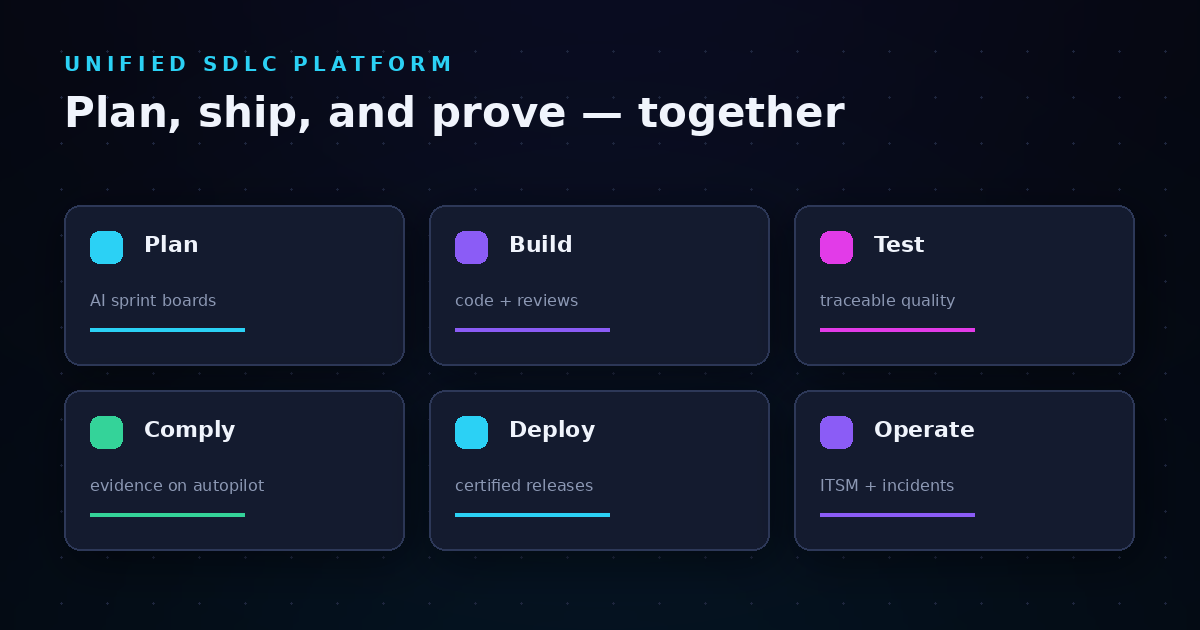
An AI-driven unified SDLC workspace is a platform that combines planning, coding, testing, deployment, and maintenance into one environment with AI assistance at each stage. Instead of switching between separate tools for issue tracking, version control, testing, and deployment, you work in a single system.
AI enhances each phase by automating repetitive tasks, generating test cases, detecting potential bugs, and preserving evidence for compliance. This approach reduces context-switching, cuts down on manual handoffs, and keeps your delivery pipeline traceable.
Traditional SDLC toolchains often include five or more disconnected tools. As a result, evidence gets scattered, audit preparation takes weeks, and governance controls become inconsistent across projects.
Engineering organizations face mounting pressure from multiple directions. Release cycles are getting shorter. Compliance frameworks like SOC 2, ISO 27001, and HIPAA demand documented evidence trails. Simultaneously, your team needs to ship features at a pace that keeps you competitive.
AI-driven SDLC platforms address these pressures by embedding automation and governance directly into your delivery workflow. Early adoption positions your organization ahead of competitors still relying on fragmented toolchains and manual compliance processes.
Evaluating now also means you can lock in pricing before demand drives up costs. More importantly, you avoid accumulating technical debt from toolchain complexity that becomes harder to unwind over time.
Startups and enterprises operate in fundamentally different contexts. Your evaluation criteria must reflect those differences.
Speed matters most when you're racing to product-market fit. You need a platform that your small team can adopt quickly without extensive training or configuration.
Flexible workflows let you iterate on your development process as you learn what works. Rigid enterprise templates will slow you down. Cost predictability also ranks high—you need to know what you'll pay as your team grows from five engineers to fifty.
Startups often deprioritize granular permissions early on, but this creates security gaps as the organization scales. Look for platforms that offer simple defaults with room to tighten controls later.
Enterprises need role-based access control (RBAC) that maps precisely to organizational structures. When you have hundreds of engineers across multiple departments, you cannot allow everyone access to production environments.
Audit readiness becomes non-negotiable. Regulated industries require you to demonstrate exactly who did what, when, and why. Manual evidence collection at scale is impractical—you need automated audit trails.
Integration depth matters significantly. Large organizations already run established CI/CD pipelines, monitoring systems, and ITSM platforms. Your AI SDLC workspace must connect to these existing tools without forcing wholesale replacement.
Security evaluation starts with authentication. Look for platforms supporting multi-factor authentication (MFA), single sign-on (SSO) through SAML or OIDC, and integration with your identity provider.
Your code and configuration data must be encrypted both at rest and in transit. Ask vendors specifically about encryption standards—AES-256 for data at rest and TLS 1.3 for data in transit represent current expectations.
Credential handling is equally important. AI assistants should never expose secrets, API keys, or tokens in logs or suggestions. Evaluate how the platform isolates sensitive data from AI model training.
Modern SDLC platforms should include built-in security scanning. Static application security testing (SAST) catches issues in your source code, while dynamic application security testing (DAST) identifies vulnerabilities in running applications.
According to Snyk's research on AI-powered development, AI-generated code can introduce vulnerabilities that traditional code review misses. Your platform needs scanning capabilities designed for both human-written and AI-assisted code.
Role-based access control (RBAC) determines who can perform which actions across your development lifecycle. A well-designed permissions system maps directly to your organization's structure and compliance requirements.
Start by identifying the roles your organization actually uses. Common software development roles include developers, testers, release managers, security engineers, and compliance officers. Each role needs a distinct set of permissions.
The principle of least privilege should guide your configuration. Every role gets only the permissions required to perform its function—nothing more. This limits blast radius when accounts are compromised.
According to guidance on role-based access control in the SDLC, linking permissions to source control, CI/CD pipelines, artifact registries, and deployment targets creates a clear chain of responsibility.
Enterprise platforms need permission inheritance—when you assign a role to a team, that role should cascade to all team members. Overrides let you grant or restrict specific individuals without rebuilding your entire permission structure.
LoopIQ centralizes administration of roles, permissions, and approval workflows into a single governance layer. This means you configure permissions once and enforce them consistently across planning, development, testing, and deployment.
Governance controls ensure your software delivery process follows organizational policies and regulatory requirements. Effective governance happens automatically—not through manual checks that slow delivery.
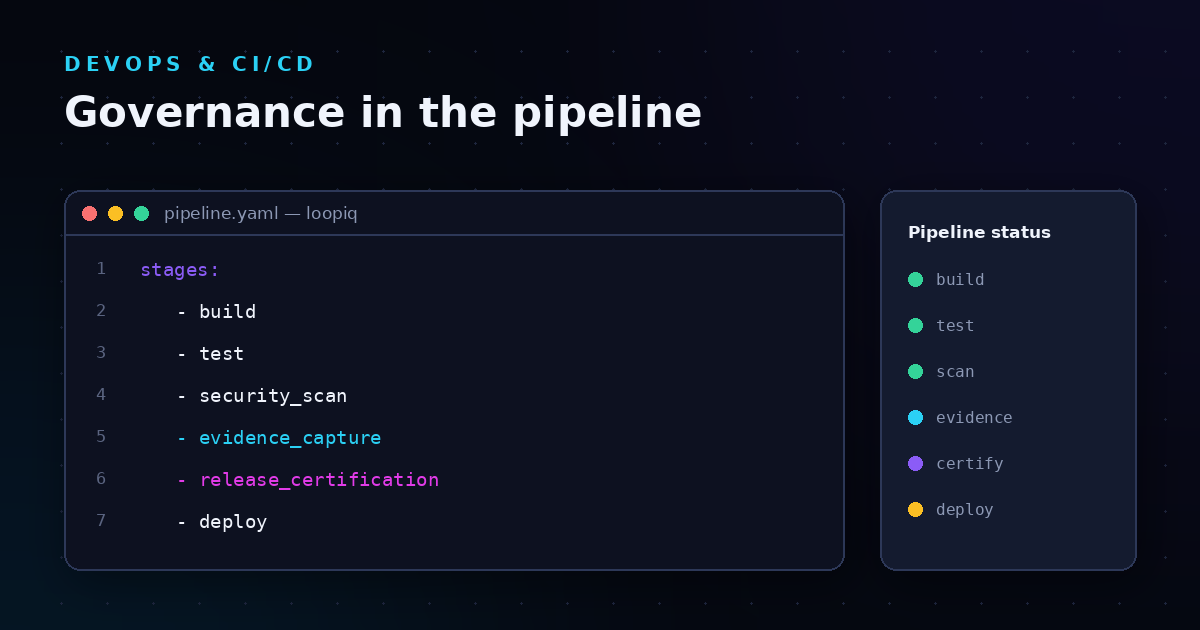
Policy enforcement should happen at each stage of your pipeline. Code commits trigger compliance checks. Pull requests require approvals from designated reviewers. Deployments proceed only when all gates pass.
Look for platforms that let you define policies as code. When your governance rules live in version-controlled configuration files, you can audit policy changes just like code changes.
Compliance frameworks require you to demonstrate adherence, not just claim it. Your SDLC platform should capture evidence automatically—code review approvals, test results, deployment authorizations, and change request histories.
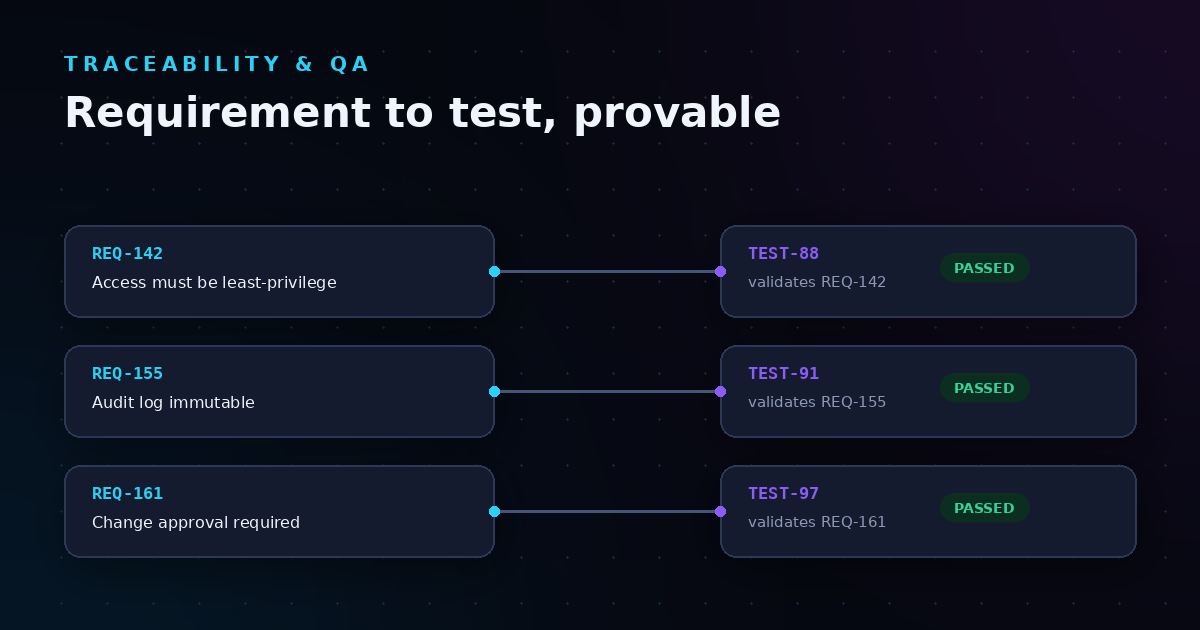
LoopIQ preserves audit-ready evidence as work happens, eliminating the scramble to reconstruct activities before an audit. This evidence connects delivery work directly with compliance documentation.
Enterprise organizations subject to SOC 2, ISO 27001, HIPAA, or PCI DSS should verify that evidence formats match auditor expectations. Ask vendors to demonstrate how they generate compliance reports.
Your AI SDLC workspace must connect with your existing tools, not replace everything at once. Integration depth determines how smoothly the platform fits into your current workflows.
Most engineering organizations have invested significantly in their CI/CD pipelines. Evaluate how the platform integrates with tools like Jenkins, GitHub Actions, GitLab CI, or CircleCI.
Bi-directional integration matters. The platform should trigger pipelines when work items reach certain states, and pipeline results should update work item status automatically.
Production issues often trace back to specific deployments. Your SDLC platform should connect with observability tools like Datadog, New Relic, or Prometheus so you can link incidents to the changes that caused them.
This connection closes the feedback loop between deployment and maintenance. When something breaks in production, you need to identify the responsible code changes quickly.
Vendor conversations reveal details that marketing materials omit. Use these questions to compare platforms effectively.
Ask vendors: "How do you handle credentials and secrets that appear in code or configuration?" Vague answers about "secure handling" aren't sufficient. You need specifics about detection, masking, and storage isolation.
Follow up with: "What data from our repositories is used to train AI models?" Some platforms train on customer data by default. Understand opt-out options and data residency implications.
Ask: "Can you demonstrate an audit trail for a code change from commit to production?" The vendor should show you exactly how evidence is captured at each stage without manual intervention.
For regulated industries, ask: "Which compliance frameworks do you support with pre-built controls?" Platforms designed for compliance will have specific controls mapped to SOC 2, ISO 27001, HIPAA, and other standards.
Ask: "How does your platform handle integration with self-hosted tools versus cloud services?" Many organizations run hybrid environments. Understand what's supported and what requires workarounds.
For growth planning, ask: "How do you price at 10 users, 100 users, and 1,000 users?" Pricing models vary dramatically—per-seat, per-project, or usage-based. Know what you'll pay as you scale.
Structured evaluation prevents decisions based on demos and marketing. A scorecard forces objective comparison across vendors.
Assign weights to each criterion based on your organization's context. Startups might weight "time to value" heavily, while enterprises prioritize "compliance automation" and "RBAC granularity."
Sample weighting for startups: Speed of adoption (25%), cost predictability (20%), AI-assisted development features (20%), integration flexibility (20%), security fundamentals (15%).
Sample weighting for enterprises: Compliance automation (25%), RBAC and governance (25%), integration depth (20%), scalability (15%), AI-assisted development features (15%).
Request a proof of concept (POC) with a real project. Demos show ideal conditions; POCs reveal rough edges. Include scenarios that test your highest-weighted criteria.
Involve team members who will use the platform daily. Their feedback on usability matters more than feature checklists. Track how long tasks take compared to your current toolchain.
Evaluation mistakes lead to buyer's remorse. Avoid these patterns.
Long feature lists don't guarantee value. A platform might offer every capability imaginable yet fail to match how your team actually works. Prioritize workflow fit over checkbox features.
Ask yourself: "Will this platform make my team's current workflow better, or will we have to change how we work to fit the platform?" The former leads to adoption; the latter creates resistance.
Moving from existing tools to a unified platform takes time and effort. Evaluate vendors on migration support—documentation, professional services, and data import capabilities.
Plan for a transition period where teams use both old and new tools. Rushed migrations create gaps in your audit trail and frustrate developers mid-sprint.
Your SDLC platform becomes critical infrastructure. Evaluate vendor stability—funding, customer base, and product roadmap. A platform that disappears forces costly re-evaluation and migration.
LoopIQ unifies planning, testing, DevOps, ITSM, documentation, and audit management into a single AI-powered workspace. This architecture addresses both startup speed requirements and enterprise governance demands.
Startups get immediate value from LoopIQ's guided onboarding and role-specific dashboards. You can configure basic workflows in hours, not weeks. The platform grows with you—simple defaults today, granular controls when you need them.
LoopIQ accelerates workflows through AI agents that automate repetitive development and compliance tasks. This lets small teams punch above their weight without adding headcount.
Enterprises benefit from LoopIQ's compliance-first architecture. The platform automates governance and process enforcement, preserves audit-ready evidence as work happens, and supports multi-approver role-based approval processes.
LoopIQ Pro serves as the enterprise system of record for software delivery operations—combining DevOps, ITSM, compliance, and audit automation into a single AI-powered governance platform. This eliminates the coordination overhead that plagues multi-tool environments.
Follow this process to conduct a thorough evaluation.
Map your existing tools, workflows, and pain points. Identify which compliance frameworks apply to your organization. Note your team size, growth projections, and budget constraints.
Distinguish requirements from nice-to-haves. Security minimums, integration necessities, and compliance non-negotiables form your requirements. Everything else is prioritized but optional.
Start with 5-7 vendors that claim to meet your requirements. Use industry reports, peer recommendations, and review sites to narrow to 3-4 for deeper evaluation.
Prepare specific scenarios for each demo. Ask vendors to show your use cases, not their preferred flows. Take notes using your scorecard criteria.
Select one or two finalists for hands-on POCs. Use real projects and real team members. Measure against your weighted criteria.
Combine scorecard results with team feedback. Factor in vendor viability, contract terms, and implementation support. Present your recommendation with clear justification.
Evaluating AI-driven unified SDLC workspaces requires balancing immediate needs against long-term growth. Startups prioritize speed and flexibility; enterprises demand governance and compliance automation.
Your evaluation framework should cover security fundamentals, role-based access control, governance automation, and DevOps integration depth. Build a weighted scorecard that reflects your organization's specific priorities.
LoopIQ offers a compliance-first approach that serves both startups moving fast and enterprises managing complex governance requirements. The platform's unified architecture reduces tool sprawl while automating the compliance evidence collection that manual processes cannot match at scale.
Start your evaluation by documenting your current state, defining your requirements, and shortlisting vendors whose architectures match your needs. Run proof-of-concept projects with real teams to validate workflow fit before committing.
An AI-driven unified SDLC workspace combines planning, development, testing, deployment, and compliance into one platform with AI assistance at every stage. This architecture reduces tool sprawl and automates repetitive tasks.
LoopIQ exemplifies this approach by unifying DevOps, ITSM, and audit management with AI-powered automation for evidence collection and workflow acceleration.
Startups prioritize fast onboarding, flexible workflows, and cost predictability. Enterprises require granular RBAC, automated compliance evidence, and deep integration with existing toolchains.
Both benefit from AI automation, but enterprises typically have stricter governance requirements that demand more sophisticated permission structures.
Essential security features include multi-factor authentication, SSO integration, encryption at rest and in transit, credential handling safeguards, and built-in security scanning for both human-written and AI-generated code.
LoopIQ maintains secure credentials and restricts unauthorized access while enabling auditable actions through permission-gated AI tools.
Manual compliance evidence collection cannot scale. Engineering teams in regulated industries spend weeks preparing for audits when evidence is scattered across disconnected tools.
LoopIQ preserves audit-ready evidence automatically as work happens, eliminating reconstruction efforts and ensuring you can demonstrate compliance on demand.
Assess how the platform connects with your existing CI/CD pipelines, version control systems, and observability tools. Look for bi-directional data flow where work items and pipeline results stay synchronized.
LoopIQ supports connected workflows through configurable integrations that link your delivery work with compliance documentation automatically.
Ask about credential handling, AI training data usage, audit trail demonstrations, compliance framework support, integration capabilities, and pricing at scale. These questions reveal implementation realities that marketing materials omit.
Request proof-of-concept access to validate answers against real usage scenarios with your team.