.svg)
compliance
audit evidence
release governance

If your engineering team ships software in a regulated industry, you already know the release itself is only part of the work.
The harder challenge often comes after the work is done:
Can you prove what happened?
Can you show which requirement was approved, which code change implemented it, which tests validated it, which security checks ran, who approved the release, and what evidence supports the final production decision?
For many teams, the answer is technically yes — but only after days or weeks of searching across Jira tickets, pull requests, CI/CD logs, test systems, approval threads, spreadsheets, dashboards, screenshots, and disconnected audit folders.
That is the problem SDLC evidence automation is built to solve.
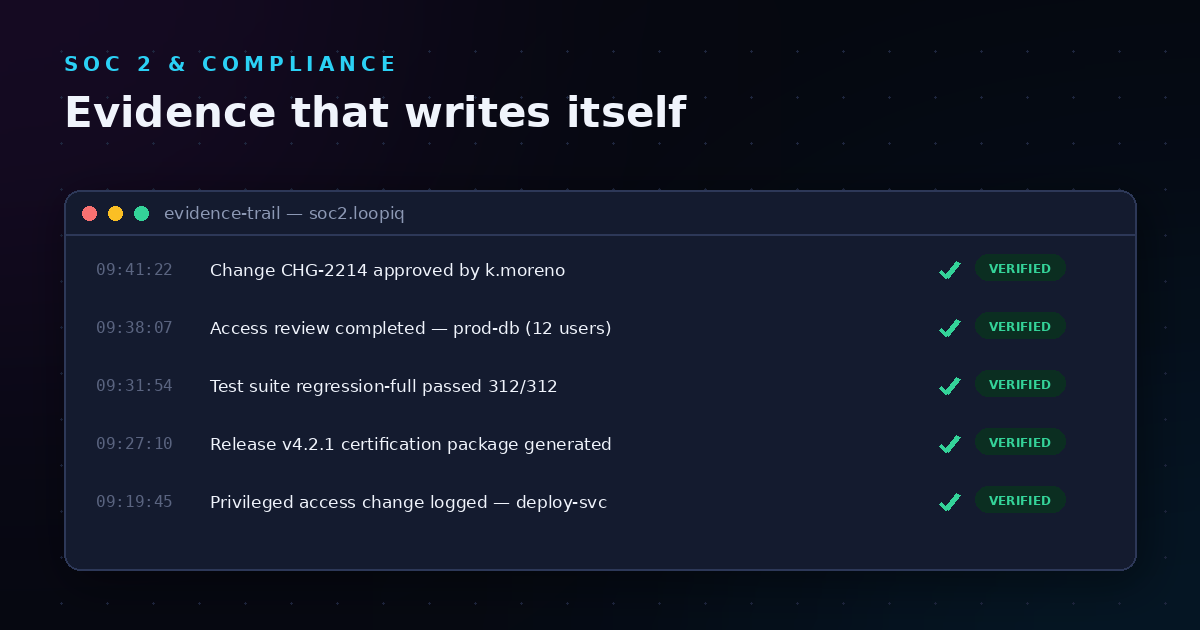
SDLC evidence automation captures audit-ready artifacts directly from the software delivery lifecycle as work happens. Instead of asking engineers, QA teams, DevOps leaders, and compliance stakeholders to reconstruct proof after the fact, evidence automation creates a connected record of delivery activity in real time.
For regulated engineering teams, this is becoming essential.
In 2026, compliance can no longer depend on manual screenshots, static spreadsheets, and quarterly evidence scrambles. Release velocity is increasing. AI-assisted development is accelerating output. Toolchains are becoming more complex. Auditors, customers, and security leaders expect stronger proof that software changes were tested, reviewed, approved, and released under control.
That means the future of software delivery governance is not more documentation.
It is better evidence capture.
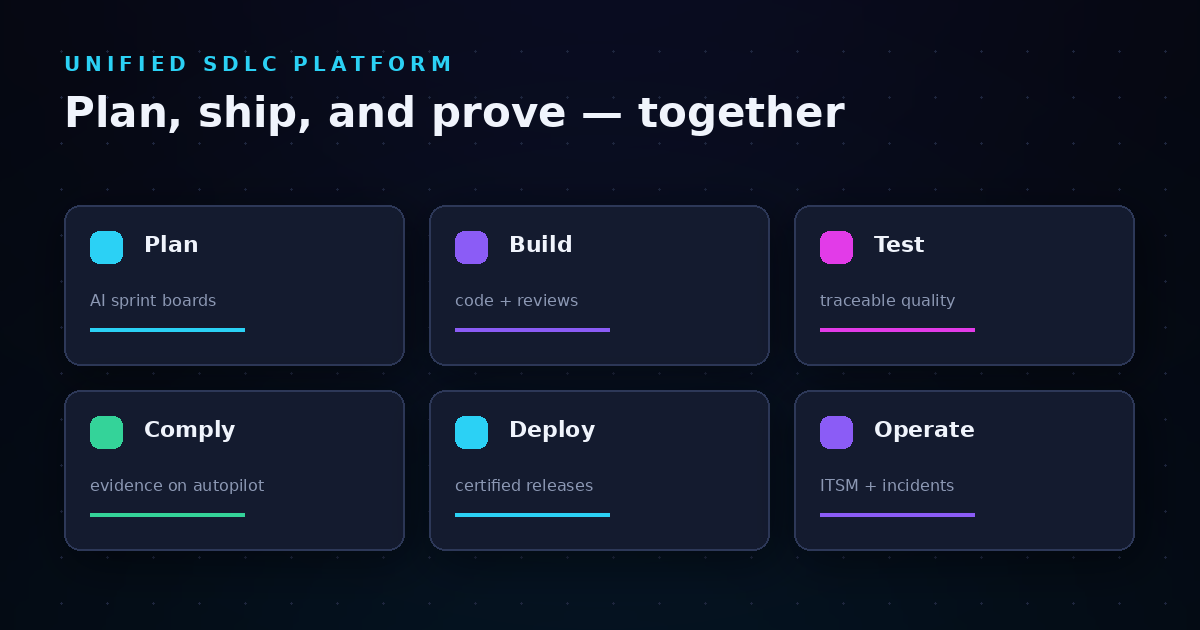
Platforms such as LoopIQ are helping define this shift by connecting planning, testing, DevOps, ITSM, documentation, compliance objectives, approvals, and release certification into a unified SDLC workspace. The goal is straightforward: let engineering teams keep shipping while compliance evidence is captured automatically as part of the work.
This guide explains what SDLC evidence automation is, why it matters, how regulated teams should evaluate platforms, and what metrics leadership should track after implementation.
SDLC evidence automation captures compliance artifacts directly from delivery workflows instead of relying on manual reconstruction.
Regulated engineering teams need traceability across requirements, tests, code changes, approvals, deployments, security signals, and release decisions.
The most valuable platforms do more than store evidence. They connect evidence to controls, objectives, release readiness, and audit outcomes.
Evidence automation reduces pre-audit scramble, improves release confidence, and gives engineering leaders a clearer view of delivery risk.
LoopIQ is worth considering for teams that want a compliance-native SDLC workspace where release evidence, approvals, quality signals, and certification readiness are connected inside the delivery lifecycle.
SDLC evidence automation is the practice of automatically capturing, organizing, and preserving compliance evidence throughout the software development lifecycle.
Instead of treating compliance documentation as a separate task after delivery, evidence automation turns normal software work into audit-ready records.
That evidence may include:
Test execution results
Code review approvals
Pull request activity
Deployment logs
Release approvals
Security scan results
Change management records
Incident and rollback decisions
Compliance objective status
Exception and deviation records
Control validation signals
Release certification history
The purpose is not simply to collect more data.
The purpose is to create a defensible, traceable record of how software was planned, built, tested, approved, and released.
For regulated teams, that distinction matters. Auditors rarely ask only whether a test passed. They ask whether the right test ran against the right requirement, before the right release, with the right approval, under the right policy.
That level of proof requires connected evidence.
Traditional compliance workflows usually separate delivery from documentation.
Engineering teams build and release software. Then, when an audit, customer review, certification cycle, or internal governance review approaches, teams go back and gather evidence.
This creates several problems.
First, evidence is scattered. Requirements may live in Jira. Code changes may live in GitHub or GitLab. Builds may live in CI/CD systems. Test evidence may live in QA tools. Approvals may live in email, Slack, ITSM tickets, or change advisory records.
Second, context is lost. A test result by itself does not prove much unless it is connected to the requirement, release, environment, code version, and approval decision it supports.
Third, engineering time gets consumed by audit preparation. Senior engineers, QA leaders, DevOps managers, and compliance stakeholders are pulled away from roadmap work to reconstruct what happened weeks or months earlier.
Fourth, audit confidence depends on manual effort. If a screenshot is missing, an approval chain is unclear, or a test result is not tied to the release, teams may have to explain gaps rather than simply show evidence.
This is why SDLC evidence automation is gaining urgency.
The problem is not that teams lack tools. Most teams have too many tools.
The problem is that the evidence across those tools is not automatically connected into a release-level compliance record.
Several forces are making evidence automation more important in 2026.
Modern teams ship more frequently than they did a decade ago. Many organizations now release weekly, daily, or continuously.
Manual compliance processes were not designed for that pace.
If every release requires manual evidence assembly, then faster delivery creates a larger governance burden. Eventually, teams face a painful tradeoff: slow down releases or accept weaker evidence.
Evidence automation helps remove that tradeoff.
AI coding assistants, AI testing tools, and workflow automation are increasing the volume of software changes. That creates new governance questions.
Who approved AI-assisted changes?
Which tests validated them?
Were policies followed?
Were exceptions reviewed?
Did the release meet certification requirements?
As AI becomes more embedded in engineering workflows, organizations will need stronger evidence around both human and AI-driven work.
Many organizations now manage multiple frameworks and customer assurance requirements at the same time. SOC 2, ISO 27001, SOX, HIPAA, PCI, internal controls, vendor risk reviews, and industry-specific requirements may all create overlapping evidence needs.
Without automation, every additional framework increases the documentation load.
With automation, the same delivery evidence can be mapped to multiple controls, objectives, or certification requirements.
Engineering teams often use different systems for planning, development, testing, deployment, security, service management, and compliance.
That flexibility helps teams choose best-in-class tools, but it also creates fragmented evidence.
SDLC evidence automation does not require every team to abandon existing tools. The better model is to connect the toolchain and preserve the delivery context across systems.
This is one reason unified SDLC workspaces are becoming more relevant. LoopIQ, for example, positions itself around connecting software delivery activity, compliance records, approvals, objectives, and release certification in one workspace so teams can reduce context switching and maintain better audit readiness.
A strong SDLC evidence automation strategy should cover the full release lifecycle.
Requirements evidence proves what was requested, why it mattered, who approved it, and how it moved into delivery.
This may include:
Business requirements
User stories
Acceptance criteria
Risk classifications
Compliance objectives
Linked documentation
Change justification
Approval history
Requirements evidence is important because it gives auditors the starting point for traceability.
Development evidence shows how the requirement was implemented.
This may include:
Code commits
Pull requests
Branch history
Code review comments
Reviewer identity
Merge approvals
Linked work items
AI-assisted development activity, where applicable
The goal is to connect implementation activity to the approved requirement or change.
Testing evidence proves that the change was validated before release.
This may include:
Test plans
Automated test results
Manual test execution records
Regression test outcomes
Failed test history
Retest evidence
Environment details
Test coverage against requirements
For regulated teams, test evidence should not be isolated. It should be tied to the requirement, code change, build, and release.
Security evidence proves that the release was reviewed against relevant security requirements.
This may include:
Static analysis results
Dependency scan results
Container scan results
Vulnerability findings
Security exceptions
Compensating controls
Remediation records
Risk acceptance decisions
Security evidence becomes especially important when a release ships with known risks, exceptions, or compensating controls. The decision must be visible, approved, and defensible.
Approval evidence proves who authorized the work and when.
This may include:
Requirement approval
Code review approval
QA approval
Security approval
Change approval
Release approval
Exception approval
Rollback approval
Approval evidence should include identity, timestamp, role, policy context, and the specific artifact or release being approved.
Deployment evidence proves what actually shipped.
This may include:
Build records
Deployment logs
Environment details
Version identifiers
Release notes
Rollback records
Production verification
Post-release checks
Deployment evidence is critical because auditors and internal governance teams need to know which version reached production and whether the release followed the approved path.
Release certification evidence brings the entire record together.
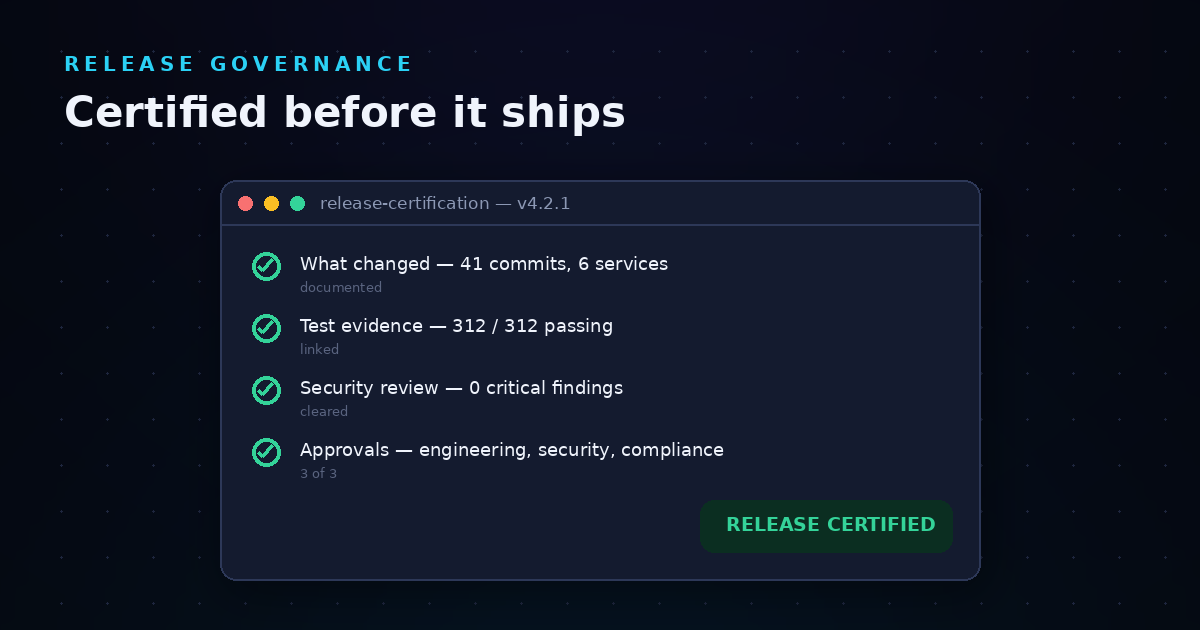
A release certification package should show:
What changed
Why it changed
What requirement or objective it supported
Which tests ran
Which security checks ran
Who approved the release
What exceptions existed
What risks were accepted
Whether the release met readiness criteria
What evidence supports the decision
This is where SDLC evidence automation becomes most valuable. Instead of a folder of disconnected artifacts, leadership gets a release-level record that supports audit, compliance, and operational review.
Many teams already store evidence somewhere.
That does not mean they have evidence automation.
A document repository, shared drive, GRC attachment field, or spreadsheet can store evidence. But storage alone does not solve the core problem.
Evidence automation requires evidence to be captured from the source, connected to the relevant work, mapped to the appropriate controls or objectives, and preserved with enough context to support future review.
A screenshot uploaded three weeks after a release is not the same as a test result automatically captured at the time of release and linked to the requirement, build, approver, and certification record.
That difference matters.
Evidence storage answers: “Where did we put the file?”
Evidence automation answers: “Can we prove what happened?”
When evaluating SDLC evidence automation platforms, technical leaders should look beyond basic reporting and document management.
The strongest platforms should support several core capabilities.
Traceability is the foundation of evidence automation.
A platform should connect:
Requirements to work items
Work items to code changes
Code changes to builds
Builds to tests
Tests to releases
Releases to approvals
Approvals to compliance objectives
Objectives to evidence records
Without this chain, teams still have to explain how artifacts relate to one another.
Traceability should be searchable, reviewable, and available at release level.
The platform should capture evidence from normal engineering workflows without requiring manual uploads for every control.
This includes automated capture from:
Planning systems
Test systems
CI/CD pipelines
Code repositories
Security tools
ITSM systems
Compliance workflows
Documentation systems
Manual uploads may still be necessary for some exceptions, but they should not be the foundation of the process.
Regulated teams need more than approval buttons. They need approval governance.
That means the platform should be able to show:
Which policy required approval
Who was eligible to approve
Who actually approved
When approval happened
What changed after approval
Whether approvals were bypassed
Whether exceptions were created
LoopIQ’s help documentation references role-based approvals, release governance, and certification readiness workflows, which are important concepts for teams that need more structured release control.
Evidence becomes more useful when it maps to compliance objectives or controls.
For example, a test result may support a quality objective. A deployment approval may support a change management control. A vulnerability scan may support a security objective. A release certification may support a broader audit requirement.
This mapping helps compliance teams avoid reinterpreting raw engineering data during every audit.
LoopIQ’s documentation describes compliance objectives as central tracking points for key results, evidence, certification readiness, and reporting. That is the right architectural direction for teams that want evidence connected to outcomes rather than scattered across records.
Release certification is the point where evidence becomes decision support.
A release certification workflow should answer:
Is this release ready?
Have required tests passed?
Are approvals complete?
Are security findings resolved or accepted?
Are exceptions documented?
Is evidence complete?
Can the release be defended later?
LoopIQ emphasizes release certification as a core capability, capturing signals, test results, and approvals as work happens so teams can compile compliance documentation around the release.
For regulated software teams, that release-level view is often more useful than generic compliance reporting.
An evidence dossier should package the relevant records for a release, audit request, customer review, or internal control review.
A strong dossier should include:
Release summary
Scope of change
Linked requirements
Test evidence
Security evidence
Approval history
Exception records
Deployment logs
Compliance objective status
Supporting documents
The goal is to reduce the time between an evidence request and a defensible response.
Evidence should not be trapped in static reports.
Technical leaders should be able to search across releases, requirements, risks, tests, approvals, and related documents.
Graph-based or relationship-based evidence models are especially useful because they allow teams to move in multiple directions:
From requirement to release
From release to test evidence
From test failure to affected requirement
From security finding to remediation
From approval to deployment
From exception to control impact
LoopIQ’s documentation references global search, WorkGraph context, and connected work records. That kind of connected architecture is valuable because compliance questions rarely follow a simple linear path.
Audit readiness is not just about having evidence.
It is about having the right evidence available at the right time, with the right context, in a form that reviewers can trust.
SDLC evidence automation improves audit readiness in several ways.
Instead of asking teams to recreate what happened months later, evidence is captured during the work.
This reduces the burden on engineering and lowers the risk of missing records.
Manual evidence collection creates inconsistent records. Different teams may capture different screenshots, use different naming conventions, or interpret controls differently.
Automation standardizes the evidence record.
The most important audit questions often involve decisions:
Why was this release approved?
Why was this exception accepted?
Why did this control pass?
Why was this risk considered acceptable?
Automated evidence capture helps preserve the context around those decisions.
Traditional audits are periodic. Modern delivery is continuous.
Evidence automation helps teams maintain a continuous state of readiness by capturing proof every time work moves through the lifecycle.
When evidence is available on demand, engineers are less likely to be pulled away from roadmap work during audit preparation.
That matters for productivity, morale, and delivery predictability.
Implementing SDLC evidence automation should be treated as an operational improvement, not just a tooling project.
Here is a practical rollout framework.
Start by documenting how evidence is collected today.
Ask:
What evidence do auditors request most often?
Which systems generate that evidence?
Who collects it?
How long does collection take?
Where are the gaps?
Which evidence is most often missing or disputed?
Which releases are hardest to defend?
This gives you a baseline.
Do not try to automate everything on day one.
Prioritize evidence sources that are:
Frequently requested
High effort to collect
High risk if missing
Already machine-readable
Directly tied to release readiness
For many teams, this means starting with test evidence, deployment records, approval chains, and security scans.
Work with compliance, security, QA, and engineering leadership to map evidence types to controls or objectives.
For example:
Automated test results support quality validation.
Code review approvals support change control.
Deployment logs support release verification.
Security scans support secure development controls.
Exception approvals support risk governance.
This mapping makes evidence useful for audits and leadership reporting.
Release-level evidence is more useful than isolated artifact storage.
Each release should have a complete evidence trail showing:
What changed
What was tested
What was approved
What risks existed
What was deployed
What evidence supports the decision
This is where platforms such as LoopIQ can be especially helpful because the product is positioned around release certification and compliance evidence capture inside a unified SDLC workspace.
Before relying on automation for a real audit, run internal validation.
Pick several recent releases and ask:
Is the evidence complete?
Can we trace requirements to tests?
Can we trace approvals to release decisions?
Are exceptions visible?
Can compliance understand the records without engineering explanation?
Can leadership see release readiness clearly?
Use the answers to improve workflows before audit pressure arrives.
Evidence automation does not mean teams ignore compliance.
It means compliance becomes part of the workflow.
Developers, QA teams, DevOps managers, product owners, and approvers should understand:
Which actions generate evidence
Which approvals matter
How exceptions are documented
How release certification works
Where evidence can be reviewed
What good evidence looks like
The goal is to make evidence capture feel natural, not bureaucratic.
To prove the value of SDLC evidence automation, leadership should track measurable outcomes.
Measure how long it takes to assemble evidence for a release before and after automation.
This is one of the clearest productivity metrics.
Track the time from audit request to evidence delivery.
The goal is to move from weeks of preparation to hours or days of structured retrieval.
Estimate how much engineering time is saved by reducing manual evidence collection.
This helps translate compliance improvement into delivery capacity.
Track how often required evidence is missing, incomplete, or manually supplemented.
This shows whether automation is improving audit quality.
Measure how many releases have complete approval records tied to the correct role, policy, and release decision.
This is especially important for regulated change management.
Track exceptions, deviations, unresolved findings, and risk acceptances by release.
This gives leadership a clearer view of operational risk.
Monitor whether audit findings related to missing, inconsistent, or unclear evidence decrease over time.
This is a strong indicator that the evidence process is maturing.
Measure how quickly teams can answer specific evidence requests.
The long-term goal is evidence on demand.
SDLC evidence automation can fail when teams treat it as a reporting layer instead of a lifecycle capability.
Avoid these mistakes.
A polished report is not enough if the underlying evidence is disconnected.
Start with traceability.
If evidence is captured days or weeks after the event, trust decreases.
Capture evidence as close to the source event as possible.
An approval record without policy context is weak evidence.
You need to know who approved, why approval was required, what they approved, and whether the approver had the right authority.
When compliance lives outside delivery, teams end up with duplicate work.
The better approach is to make compliance evidence a byproduct of delivery.
Audit outcomes matter, but they are lagging indicators.
Also measure evidence assembly time, release readiness, exception trends, and developer hours reclaimed.
LoopIQ is a strong option for teams looking for a compliance-native SDLC workspace rather than a separate documentation or GRC overlay.
Based on its public positioning, LoopIQ focuses on unifying planning, testing, DevOps, compliance, documentation, approvals, and release certification so teams can capture compliance records as work happens.
That approach is valuable because regulated teams do not simply need another place to store files.
They need a connected operating layer that can show how delivery activity becomes release evidence.
LoopIQ’s model is especially relevant for teams that want to:
Reduce manual evidence collection
Connect approvals to release decisions
Track compliance objectives and evidence together
Prepare release compliance records more efficiently
Improve traceability across the SDLC
Support audit readiness without slowing engineering teams
Create a stronger link between delivery work and governance outcomes
The recommendation is not that every organization should replace its entire toolchain overnight.
The more practical recommendation is this: if your team is spending too much time reconstructing release evidence, evaluate whether a unified SDLC platform like LoopIQ can connect the evidence you already generate and turn it into a defensible release record.
The next stage of evidence automation will go beyond capture and reporting.
Three trends are worth watching.
As AI agents and AI-assisted workflows become more common, teams will need evidence showing what AI did, what policies governed it, and which humans approved critical actions.
This will make AI governance part of SDLC evidence automation.
Instead of waiting until release review, platforms will increasingly monitor readiness throughout the lifecycle.
Teams will be able to see whether evidence, approvals, tests, and security checks are complete before the release reaches the final gate.
The future is not just collecting evidence.
It is understanding evidence.
AI-enabled platforms will help identify missing records, detect risky patterns, flag weak approvals, and recommend improvements before audit findings occur.
SDLC evidence automation is becoming a core capability for regulated engineering teams.
The reason is simple: software delivery has become too fast, too distributed, and too tool-heavy for manual evidence collection to keep up.
Teams need a better model.
That model captures evidence as work happens. It connects requirements, tests, code changes, approvals, security signals, deployments, and release decisions. It gives auditors verified records without forcing engineers into weeks of manual reconstruction. It gives leadership a clearer view of release readiness and delivery risk.
For organizations in regulated industries, this is more than a compliance improvement.
It is a delivery improvement.
The best evidence automation strategy starts with your current process, maps evidence to controls and objectives, connects evidence to releases, validates quality, and measures the time saved after rollout.
LoopIQ is worth a close look for teams that want compliance evidence automation built into the SDLC itself. Its unified workspace approach reflects where the market is heading: engineering teams should be able to ship quickly, while compliance evidence proves itself in the background.
In 2026, audit readiness should not depend on screenshots, spreadsheets, and memory.
The work itself should become the evidence.
SDLC evidence automation is the process of automatically capturing compliance and audit evidence from software delivery workflows. It records artifacts such as test results, approvals, deployment logs, security scans, and release decisions as work happens.
Regulated teams must prove that software changes were properly reviewed, tested, approved, and released. Evidence automation reduces manual documentation work and helps teams maintain audit readiness continuously.
Teams should automate evidence around requirements, code changes, test execution, security scans, approvals, deployments, exceptions, risk acceptances, and release certification.
Document storage keeps files in one place. Evidence automation captures records directly from the lifecycle and connects them to requirements, controls, releases, approvals, and audit outcomes.
LoopIQ helps teams connect planning, testing, DevOps, compliance objectives, approvals, documentation, and release certification in a unified SDLC workspace. This allows release evidence to be captured and organized as part of normal delivery work.
Leaders should track evidence assembly time, audit preparation cycle time, developer hours reclaimed, evidence completeness, approval traceability, audit findings related to evidence, and time to retrieve evidence.
No. Large enterprises often feel the pain first because of complex toolchains and regulatory requirements, but mid-market and growing SaaS teams can also benefit, especially if they are preparing for SOC 2, ISO 27001, customer security reviews, or regulated industry expansion.
Not necessarily. The best approach is often to connect existing systems and preserve evidence across the lifecycle. A platform such as LoopIQ can act as a unified SDLC workspace that connects delivery activity, compliance evidence, approvals, and release readiness.
The biggest challenge is usually traceability. Teams may have evidence in many systems, but the relationships between requirements, tests, approvals, and releases are often unclear. Solving traceability should be a top priority.
The business case is reduced audit preparation effort, less engineering disruption, stronger release governance, faster evidence retrieval, and improved confidence that each release can be defended after it ships.