.svg)
unified sdlc
ai tools
compliance

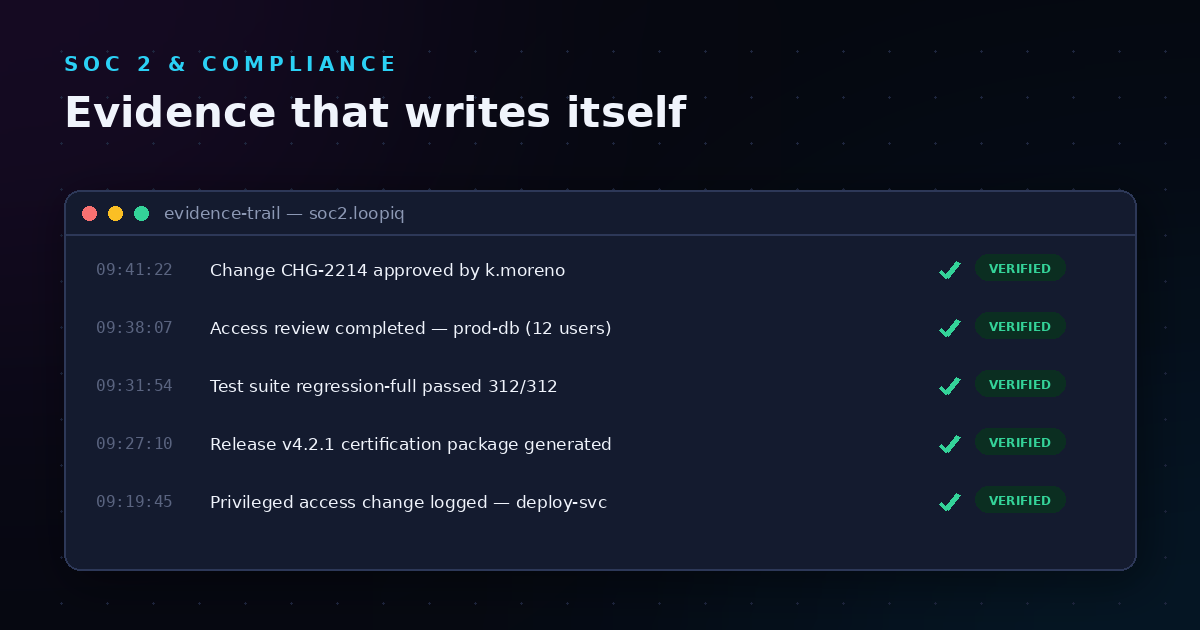
When auditors ask how your team verified that a release was ready to ship, you need more than verbal assurances. You need evidence—approvals bound to releases, test coverage tied to objectives, and a clear chain of custody for every change that made it to production. LoopIQ gives engineering leaders a structured way to capture this evidence automatically as releases move through the SDLC.
This guide covers the controls, evidence types, and validation strategies that VPs and directors of software development can put into place to answer audit questions confidently. Whether you need to satisfy SOC 2, ISO 27001, or internal governance requirements, the principles here apply across frameworks and toolchains.
By the end, you will understand how to define release readiness criteria, what evidence you need to collect, and how automation reduces the burden on your engineering teams.
Release readiness describes the state where software has met all predefined conditions for deployment. These conditions include passing quality gates, receiving required approvals, and satisfying compliance checks. The goal is not just shipping code—it is shipping code you can defend to auditors, stakeholders, and customers.
For VPs and directors of software development, release readiness directly impacts audit outcomes. If you cannot prove that a release followed defined processes, auditors may flag control failures. Those findings create remediation work, delay certifications, and erode trust with customers who depend on your compliance posture.
The challenge is that most engineering teams ship fast but document slowly. Evidence gets scattered across tools like GitHub, Slack, CI pipelines, and ticketing systems. When audit season arrives, senior engineers get pulled off shipping to assemble packets from memory and screenshots.
Release readiness focuses on pre-deployment conditions: Are all tests passing? Have required approvals been captured? Is the compliance checklist complete? Deployment verification, on the other hand, confirms that the release reached production as intended.
Both matter for audit defensibility. Release readiness proves you followed the process. Deployment verification proves the outcome matched your intentions. Together, they form a complete story for auditors.
Controls are the policies and mechanisms that govern how releases move from development to production. Without defined controls, you cannot prove adherence. Here are the five categories that form the foundation of release readiness.
Every change that enters a release must have documented authorization. This means pull request approvals, code review sign-offs, and change advisory board decisions all need to be recorded and tied to the specific release they enabled.
The key is traceability. An auditor should be able to follow a line from any production change back to the approval that authorized it. If approvals live in email threads or Slack channels, they become hard to trace when questions arise months later.
Quality gates define the testing and validation requirements that a release must pass before deployment. These include unit test coverage thresholds, integration test results, security scan outcomes, and performance benchmarks.
For audit purposes, you need to prove not just that tests ran, but that they passed at the moment of release. A test that passed last week and failed yesterday does not support a release that shipped today. Timestamps and immutable records matter.
Compliance checkpoints ensure that releases meet regulatory and policy requirements before deployment. This includes verifying that sensitive data handling follows defined procedures, that security controls are in place, and that documentation requirements are satisfied.
These checkpoints should be embedded in your delivery pipeline, not bolted on at the end. When compliance evaluation happens in real time, you catch gaps before they become audit findings.
Environment promotion controls govern how code moves between staging, pre-production, and production environments. They define who can promote releases, what approvals are required, and what conditions must be met at each stage.
Auditors want to see that production access is restricted and that promotions follow a defined workflow. Ad-hoc deployments without approval records create compliance risk.
Rollback controls define how your team responds when a release causes production issues. They specify who has authority to roll back, what conditions trigger rollbacks, and how incident decisions are documented.
These controls matter for audit because they show that your team has processes for managing release failures. Auditors look for evidence that you can recover from problems, not just ship new features.
Understanding control categories is one thing. Knowing what evidence to produce is another. Here is what auditors typically request when evaluating release readiness and deployment quality.
Auditors want to see who approved each release and when. This includes code review approvals, change advisory board sign-offs, and deployment authorizations. Each approval should be linked to the specific release it covers.
The challenge is that approvals often happen in different tools. Code reviews happen in GitHub, deployment approvals happen in Slack, and change management happens in a ticketing system. LoopIQ captures approvals and quality signals bound to releases through certification, making documentation effortless.
Auditors need proof that testing occurred and that tests passed at the time of release. This means test execution logs with timestamps, coverage reports, and failure records if any tests did not pass.
For compliance frameworks like SOC 2, you need to demonstrate that testing is part of your standard process, not something you do occasionally. Evidence of consistent test execution across releases strengthens your audit position.
Security scans have become a standard part of release readiness. Auditors want to see static analysis results, dependency vulnerability scans, and container image scans. They also want evidence that critical findings were addressed before release.
The timing matters here too. A security scan from three weeks ago does not prove that the code you shipped today is secure. Scans should run as close to deployment as possible.
Auditors may ask for evidence about the deployment environment itself. This includes infrastructure-as-code configurations, environment variable settings, and access control records showing who can modify production.
This evidence demonstrates that your production environment matches your documented policies. Drift between documentation and reality creates compliance risk.
Beyond automated records, auditors want to understand the human decisions behind releases. Why did you ship this feature now? What tradeoffs did you make? Who made the final go/no-go call?
LoopIQ preserves the state of the world at decision time for audit defensibility. This means you can answer questions about historical releases without relying on team memory or reconstructing context from chat logs.
A release readiness checklist formalizes the conditions your team must verify before shipping. Here is how to build one that serves both operational and compliance purposes.
Start by listing the compliance frameworks that apply to your organization. SOC 2, ISO 27001, HIPAA, PCI-DSS, and industry-specific regulations each have requirements that affect release processes.
Map these requirements to specific release activities. For example, SOC 2 requires evidence of change management controls. Your checklist should include items that satisfy this requirement.
Document the testing and validation requirements for releases in your organization. Be specific about thresholds: 80% code coverage, zero critical security findings, all integration tests passing.
Vague requirements like "adequate testing" create audit risk because they leave room for interpretation. Specific, measurable gates are easier to prove and defend.
List the approvals required at each stage of your release process. Include who can approve, what criteria they should evaluate, and how the approval should be documented.
Consider both technical approvals (code review, architecture review) and business approvals (product sign-off, compliance sign-off). Both contribute to release readiness.
For each checklist item, define what evidence needs to be captured. This might be a screenshot, a log file, a signed attestation, or an automated record from your CI/CD pipeline.
The goal is to remove ambiguity about what "done" looks like. If the evidence requirement is clear, your team knows exactly what to produce.
Manual checklists create two problems: they slow down releases, and they introduce human error. Automating checklist verification removes both issues.
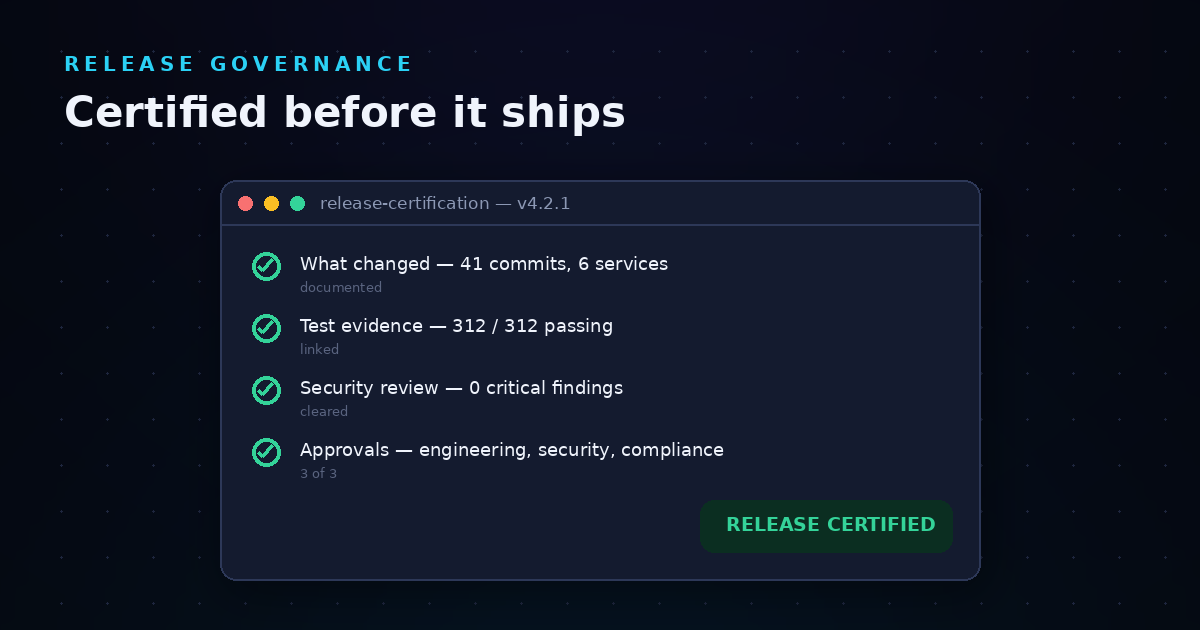
LoopIQ automates release certification with compliance, security, and readiness checks. This means your checklist items get evaluated automatically as releases progress, with evidence captured at each step.
The traditional approach to release readiness involves engineers gathering evidence after the fact. This creates delays, errors, and frustration. Automated validation flips this model by capturing evidence as work happens.
In an automated validation model, your CI/CD pipeline captures evidence at each stage. When a code review is approved, that approval is recorded with a timestamp and linked to the change. When tests run, results are stored with the release context.
This evidence capture happens in the background. Engineers do not need to stop and document—the system does it for them. When audit time arrives, evidence is already organized and accessible.
Automated validation removes the compliance tax that slows down engineering teams. Instead of losing two days per release to evidence assembly, your team ships and the evidence follows automatically.
This matters for organizations shipping frequently. If you release daily or multiple times per day, manual approaches cannot keep pace. Automation makes high-velocity delivery compatible with audit readiness.
Automated evidence is more reliable than manually assembled documentation. There is no risk of missing approvals, forgetting to capture test results, or misdating records. The evidence reflects what actually happened, when it happened.
Auditors appreciate this consistency. When evidence is automatically generated and immutable, it carries more weight than screenshots and email forwards.
LoopIQ acts as compliance infrastructure inside the delivery lifecycle, tying policy to objectives and linking results to releases. The platform connects to your existing tools—GitHub, CI pipelines, testing frameworks—and correlates signals into a unified release view.
When you are ready to ship, LoopIQ generates a one-click compliance evidence dossier that includes all approvals, test results, and security findings tied to that release. Auditors get a complete package without your team assembling anything.
Release readiness covers the pre-deployment state. Deployment verification addresses a different question: Did the release reach production as intended? Here is how to approach this verification.
Verify that the artifact deployed to production matches the artifact that passed your release readiness checks. This typically involves comparing checksums or cryptographic signatures.
Without this verification, you cannot prove that the tested code is the code running in production. An attacker or a misconfiguration could substitute a different artifact during deployment.
Confirm that production configurations match your intended settings. Environment variables, feature flags, and infrastructure settings should all be validated as part of deployment verification.
Configuration drift is a common source of production issues. Verifying configurations at deployment time catches drift before it causes incidents.
Automated health checks should confirm that the deployed release is functioning correctly. This includes verifying that services respond, that dependencies are reachable, and that key functionality works as expected.
Health checks confirm that the release succeeded, not just that deployment completed. A deployment that breaks production is not a successful release.
Auditors may ask for evidence that deployments follow defined procedures. This includes deployment logs, approval records for the deployment itself, and post-deployment verification results.
LoopIQ connects delivery signals to releases, generating release certification trails that include deployment evidence. This creates a complete audit story from code commit through production verification.
Proving release readiness is not just about checking boxes. You also need metrics that demonstrate release quality over time. Here are the measurements that matter.
Track how often you deploy and how often those deployments succeed. High deployment frequency with high success rates indicates a mature release process. Low success rates suggest control or quality issues.
These metrics help auditors understand your release practices at a systemic level, not just for individual releases.
When releases cause production issues, how quickly does your team recover? Mean time to recovery (MTTR) measures your incident response capability.
Low MTTR demonstrates that your team has effective rollback and remediation processes. Auditors view this as evidence of operational maturity.
What percentage of changes require rollback or remediation after deployment? High change failure rates may indicate insufficient testing, inadequate review processes, or deployment problems.
Tracking change failure rate over time shows whether your release readiness controls are improving quality outcomes.
How long does it take for a code change to go from commit to production? Long lead times may indicate bottlenecks in your release process, including compliance-related delays.
If compliance work is adding days to your release cycle, that is a signal to invest in automation. Compliance should not be a bottleneck.
Even organizations with defined processes encounter release readiness failures. Here are the patterns that create audit risk and how to address them.
When approvals live in multiple systems without integration, tracing them becomes difficult. An approval in Slack, a sign-off in email, and a thumbs-up in a pull request do not add up to auditable evidence unless they are connected.
The solution is centralizing approval capture. Tools that bind approvals to releases create a single source of truth for auditors to review.
Evidence without timestamps loses audit value. If you cannot prove when an approval happened or when tests ran, auditors cannot verify that these activities occurred before deployment.
Automated evidence capture solves this by recording timestamps as events occur. Manual documentation often lacks this precision.
Auditors may question releases where testing covered only part of the codebase. If critical paths were not tested, your release readiness claim is weakened.
Define coverage requirements as part of your release readiness checklist and enforce them through automation. Do not let releases proceed without meeting minimum coverage thresholds.
Sometimes releases need to bypass standard controls—an emergency fix, an urgent customer request. These exceptions are acceptable if documented, but create audit risk if not.
Build exception processes into your release workflow. When a control is bypassed, capture who approved the exception, why it was needed, and what compensating controls were applied.
Evidence from weeks ago does not support a release shipping today. If your compliance evidence was captured long before deployment, auditors may question its relevance.
Capture evidence as close to deployment as possible. Ideally, evidence generation happens automatically as part of the deployment pipeline.
Most engineering organizations have established toolchains for development, testing, and deployment. Release readiness controls need to integrate with these tools, not replace them.
Your source control system already captures valuable release readiness evidence: commit history, branch protection settings, pull request approvals. The key is extracting this evidence and connecting it to releases.
LoopIQ offers native GitHub integration for change capture and automated test execution. This means your existing GitHub workflows contribute to compliance evidence without requiring process changes.
Your CI/CD pipeline executes tests, runs security scans, and performs deployments. Integrating release readiness controls means capturing evidence from each pipeline stage.
Pipeline plugins or API integrations can record test results, scan findings, and deployment outcomes. The goal is making evidence capture automatic and invisible to developers.
Test frameworks generate rich evidence about code quality. Integration testing, performance testing, and security testing all produce results that support release readiness claims.
Configure your test frameworks to export results in formats that your compliance tooling can consume. Structured outputs are easier to audit than plain-text logs.
Change management systems track approvals and authorization for production changes. Integrating these systems with your release process ensures that change records align with actual deployments.
Disconnected change management is a common audit finding. When your change tickets do not match your deployment records, auditors question control effectiveness.
Tools and processes matter, but culture determines whether release readiness becomes embedded in how your team works. Here is how to build that culture.
Engineers cannot prioritize what they cannot see. Make release readiness status visible through dashboards, pipeline status checks, and release reports.
When everyone can see compliance status, it becomes part of the team's shared awareness rather than a hidden concern that surfaces only during audits.
Engineers should focus on building software, not assembling audit packets. Automating evidence capture removes the compliance burden from individual contributors.
LoopIQ helps free engineers to write code instead of compliance paperwork. When compliance happens automatically, engineers can focus on what they do best.
Recognize teams that maintain strong release readiness practices. Share audit successes, highlight process improvements, and acknowledge the work that goes into staying compliant.
Positive reinforcement builds habits. Teams that are recognized for good compliance practices tend to maintain those practices.
When release readiness controls fail, treat it as a learning opportunity. Conduct blameless postmortems, identify root causes, and improve processes.
Audit findings are not failures to hide—they are signals that controls need strengthening. Organizations that learn from findings improve faster than those that treat audits as adversarial.
The release readiness landscape continues to evolve. Here are the trends that VPs and directors of software development should watch.
AI systems are beginning to assist with compliance evaluation, identifying potential gaps before auditors do. These systems can analyze release evidence, flag anomalies, and suggest remediation.
LoopIQ uses AI-driven insights to deliver explainable, predictive compliance intelligence with real signals. This means you can identify and address compliance gaps proactively, not just during audit season.
The shift from periodic audits to real-time compliance monitoring is accelerating. Organizations want to know their compliance status at any moment, not just when auditors visit.
Real-time monitoring requires automated evidence capture and analysis. As tools mature, expect compliance status to become as accessible as deployment status.
AI agents are increasingly performing engineering tasks—generating code, writing tests, managing deployments. These agents need governance to ensure their actions are auditable.
LoopIQ enables governance for AI agents performing engineering work, integrating agent outputs into audit evidence and approval trails. As AI adoption grows, this governance becomes essential.
The distinction between development platforms and compliance tools is blurring. Organizations want platforms where compliance evidence is captured natively, not bolted on through integrations.
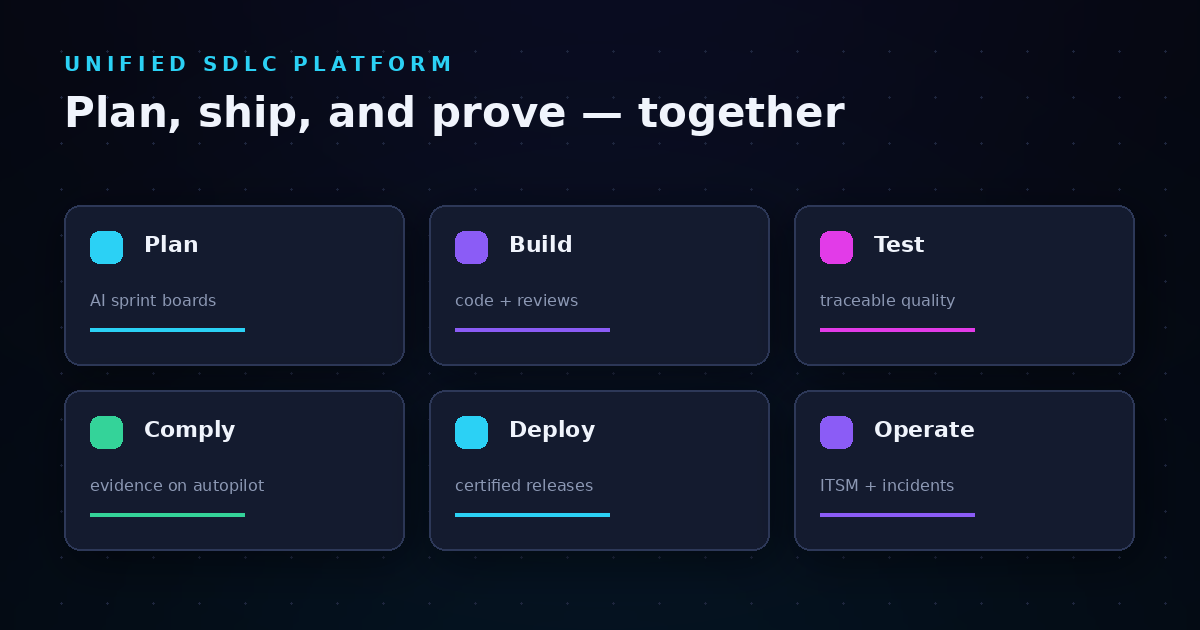
This trend favors unified platforms that combine SDLC capabilities with compliance infrastructure. The future is not more tools—it is one intelligent system that handles both.
Proving release readiness requires more than good intentions. You need defined controls, automated evidence capture, and processes that scale with your release velocity.
Start by identifying your compliance requirements and mapping them to release activities. Build a checklist that specifies evidence requirements for each control. Then invest in automation to capture that evidence without slowing your team.
Remember that audit defensibility depends on preserving context at decision time. When you can show auditors exactly what happened, when it happened, and who approved it, audit conversations become straightforward.
LoopIQ helps engineering teams achieve this level of release readiness by automating evidence capture and certification across the SDLC. If you are looking to reduce the compliance burden on your team while strengthening your audit posture, explore how a unified approach to release readiness can help.
Release readiness is the state where software has met all predefined conditions for deployment, including passing quality gates, receiving required approvals, and satisfying compliance checks. It means your release is ready to ship and you can prove it met your standards.
Auditors typically request approval records, test execution logs with timestamps, security scan results, configuration evidence, and decision audit trails. LoopIQ automates the capture of this evidence, linking approvals and quality signals directly to each release.
Automate release readiness by integrating evidence capture into your CI/CD pipeline. Use tools that record approvals, test results, and security findings automatically. LoopIQ connects to your existing tools and captures evidence as work happens, eliminating manual documentation.
Release readiness confirms pre-deployment conditions are met—tests passed, approvals captured, compliance satisfied. Deployment verification confirms the release reached production as intended. Both are necessary for complete audit defensibility.
Start with your compliance requirements, define specific quality gates and approval needs, and establish evidence requirements for each item. LoopIQ helps by offering intelligent release certification that reviews evidence and flags compliance gaps before shipping.
Release readiness controls are the policies and mechanisms governing how releases move to production. They include change authorization, quality gates, compliance checkpoints, environment promotion rules, and rollback procedures. These controls create the framework for proving adherence.
LoopIQ acts as compliance infrastructure inside your delivery lifecycle. It captures approvals and quality signals, binds them to releases, and generates one-click compliance evidence dossiers. This automates the evidence collection that typically takes days per release cycle.
Audit defensibility means you can prove your release followed defined processes months after shipping. Without it, auditors may flag control failures, delay certifications, and erode customer trust. Strong defensibility requires preserving decision context at the moment decisions are made.