.svg)
unified sdlc
ai tools
compliance

Every software release carries an invisible burden: the compliance data that proves how it happened, who approved it, and whether it met your organization's policies. For VPs and Heads of Development managing regulated teams, that burden grows heavier with each deployment. Evidence ages out, approvals scatter across tools, and audit questions that should take minutes end up consuming days.
The challenge isn't creating compliance documentation—it's keeping it current. When your team ships multiple times per week (or per day), evidence captured at release time can become stale within hours if it's stored separately from your delivery pipeline. LoopIQ addresses this gap by embedding compliance tracking directly into your software delivery lifecycle, generating audit-ready evidence as a natural byproduct of engineering work.
This guide walks you through why compliance data goes stale in CI/CD environments, what causes evidence gaps, and how unified SDLC platforms maintain current, defensible records tied to every release.
Compliance data goes stale because most CI/CD pipelines treat delivery and documentation as separate concerns. Your team ships code through one set of tools while compliance records live in spreadsheets, ticketing systems, or standalone GRC platforms. The moment a release deploys, the connection between that release and its supporting evidence starts to decay.
This separation creates three problems. First, the data describing your release (test results, approvals, configuration states) isn't automatically linked to the release itself. Second, the people who can explain what happened move on to new work and lose context. Third, the systems storing your evidence don't know which release they're describing.
Regulated teams often run five or more tools across their delivery pipeline: source control, CI servers, deployment platforms, ticketing systems, and communication tools. Each stores a fragment of your compliance story. When auditors ask questions, someone has to reconstruct the narrative from these scattered sources.
According to research on CI/CD tooling for enterprises, teams spend significant time managing integrations between disparate systems. That integration overhead compounds compliance challenges—every handoff between tools is a potential gap where evidence can fall through.
When you assemble compliance evidence weeks or months after a release, you're relying on memory and detective work. The engineer who made key decisions may have moved to another team. The Slack conversation explaining a policy exception may have scrolled into oblivion. The ticket capturing approval rationale may have been closed and archived.
This context loss isn't a documentation failure—it's a structural problem. Traditional workflows force teams to ship first and document later, guaranteeing that important details will be lost between those two moments.
Release-level traceability means every piece of compliance evidence is bound directly to a specific release at the moment that release happens. Instead of storing approvals in one system and test results in another, you capture all relevant signals and attach them to the release record itself.
This approach answers the fundamental audit question: "Was this release evaluated under defined conditions?" The answer isn't buried across five tools—it's attached to the release, accessible with a single query.
A traceable release record typically includes several key elements. Code changes and their associated reviews show what was modified and who approved it. Test execution results demonstrate that quality gates passed. Deployment configurations capture the target environment state. Approval chains document who authorized the release and when.
When these components live together in a unified record, you can answer auditor questions immediately. When they're scattered, every audit becomes an excavation project.
Compliance evidence must reflect the state of the world at decision time, not when someone gets around to documenting it. If you capture approvals three days after a release, you're recording what you remember, not what happened. That distinction matters when regulators or auditors scrutinize your records.
LoopIQ addresses this by preserving decision context at the moment decisions are made. The approval that happened on Tuesday at 3:47 PM is recorded on Tuesday at 3:47 PM, complete with the conditions that existed at that instant.
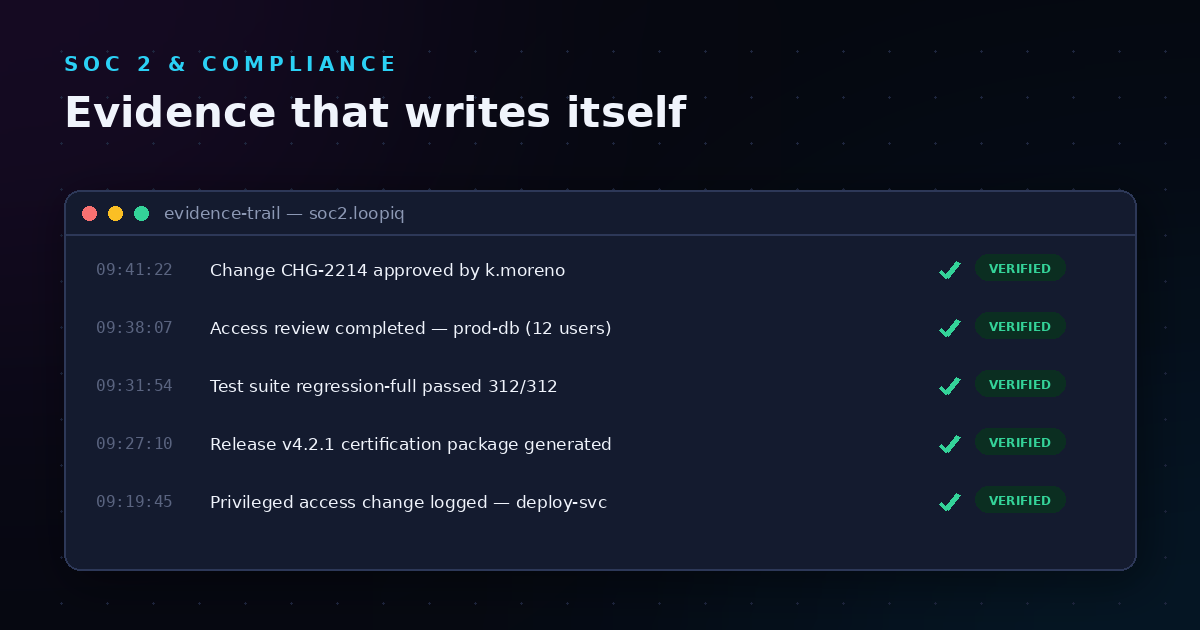
Automated evidence capture turns compliance documentation from a task engineers perform into a byproduct of work they're already doing. When a developer merges code, the platform records the merge. When a test suite runs, results attach to the release. When a manager approves deployment, that approval becomes part of the permanent record.
This model eliminates the two-day-per-release documentation burden that many engineering teams experience. It also eliminates the human error that comes from transcribing information between systems.
Effective automated capture requires integration with every tool in your delivery chain. Source control systems offer change history. CI/CD platforms deliver build and test results. Deployment tools supply release timing and configuration. Communication platforms can supply approval documentation when formal workflows aren't in place.
The research on SDLC compliance tooling emphasizes that integration depth determines evidence quality. Shallow integrations that only capture summary data leave gaps. Deep integrations that capture context (who, what, why, when) create defensible records.
A well-configured automated system captures code commits with author attribution, pull request reviews and approvals, branch protection rule compliance, test execution with pass/fail status and coverage metrics, deployment timestamps and target environment details, manual approvals with approver identity and timestamps, and security scan results with finding severity and remediation status.
All of this happens without engineers opening a separate documentation tool. The evidence exists because the work happened, not because someone remembered to write it down.
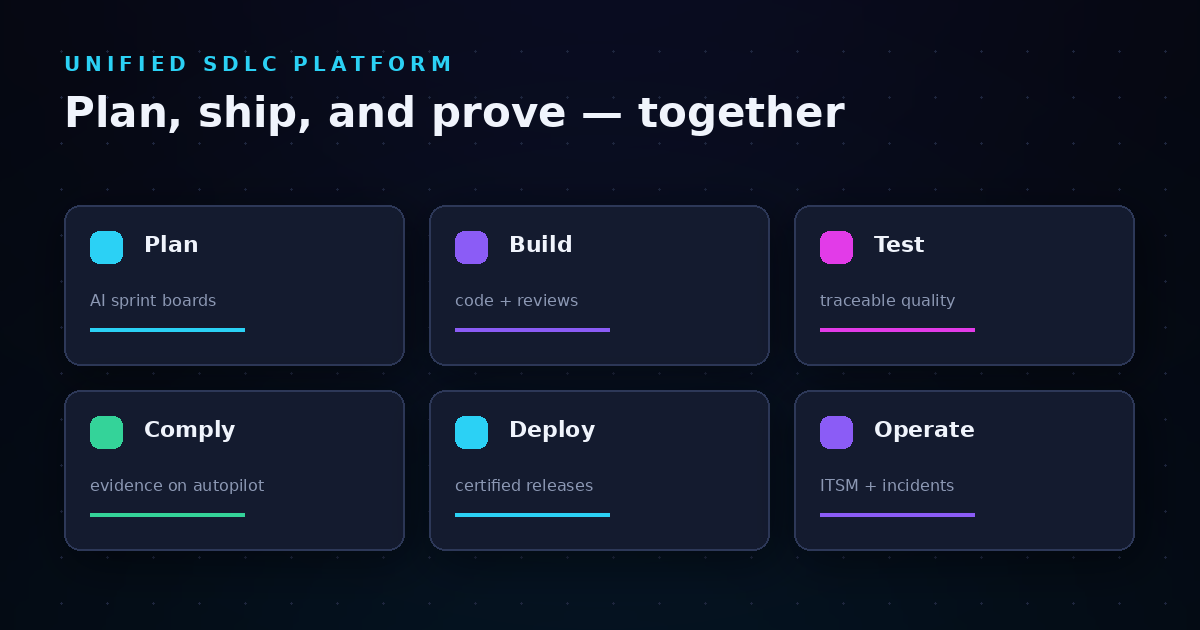
Unified SDLC platforms solve the staleness problem by ensuring work and records live on the same surface. When planning, coding, testing, and deploying all happen in one intelligent system, evidence doesn't have to travel between tools—it's captured where it originates and linked to releases automatically.
LoopIQ exemplifies this approach by combining DevOps, ITSM, compliance, and audit management into a single workspace. Engineering teams don't switch between a coding environment and a compliance environment because both functions exist in the same platform.
When your compliance data and delivery data share a single source of truth, several problems disappear. You don't have synchronization failures between systems. You don't have conflicting versions of the same record. You don't have gaps where one system was updated but another wasn't.
This architecture matters especially for teams shipping at AI-paced velocity. When you're releasing multiple times daily, evidence that requires manual assembly simply can't keep up. Structural solutions—where capture happens automatically during the delivery flow—scale where manual processes can't.
Policy-based change control defines what conditions must be met before a release can proceed. These policies might require security scans to pass, code reviews to be completed, or specific approvers to sign off. When policies are enforced at the platform level, compliance becomes proactive rather than retrospective.
LoopIQ automates release certification by checking compliance, security, and readiness before shipping. If a policy requirement isn't met, the release doesn't proceed—and that enforcement is itself captured as evidence. Auditors can see not just that you followed your policies, but that your tooling prevented releases that would have violated them.
Moving from stale, scattered compliance records to current, unified evidence requires systematic changes to your delivery workflow. The following steps outline how to make that transition.
Start by documenting where compliance evidence currently lives across your toolchain. For each release, identify what approvals are required, where they're captured, and how they're linked (or not linked) to the release itself. Note every handoff point where evidence moves from one system to another.
This mapping reveals your gaps. Common findings include approvals captured in chat tools but not recorded anywhere permanent, test results stored in CI systems but not connected to release records, and deployment approvals that exist only in email threads.
Document what a complete release record should contain for your compliance needs. Different regulatory frameworks require different evidence. SOC 2 has different requirements than HIPAA, which differs from PCI-DSS. Your internal policies may add additional requirements.
Work with your compliance team to create a checklist: what must be captured, who must approve, what tests must pass, and what documentation must exist before a release can be considered compliant.
Assess whether your current toolchain can support automated evidence capture or whether you need a unified platform. Key questions include: Can your tools automatically link evidence to releases? Can you query compliance status in real time? Can you generate audit-ready documentation on demand?
If the answer to these questions is "only with significant custom integration work," you're likely facing ongoing maintenance debt that will compete with feature development for engineering time.
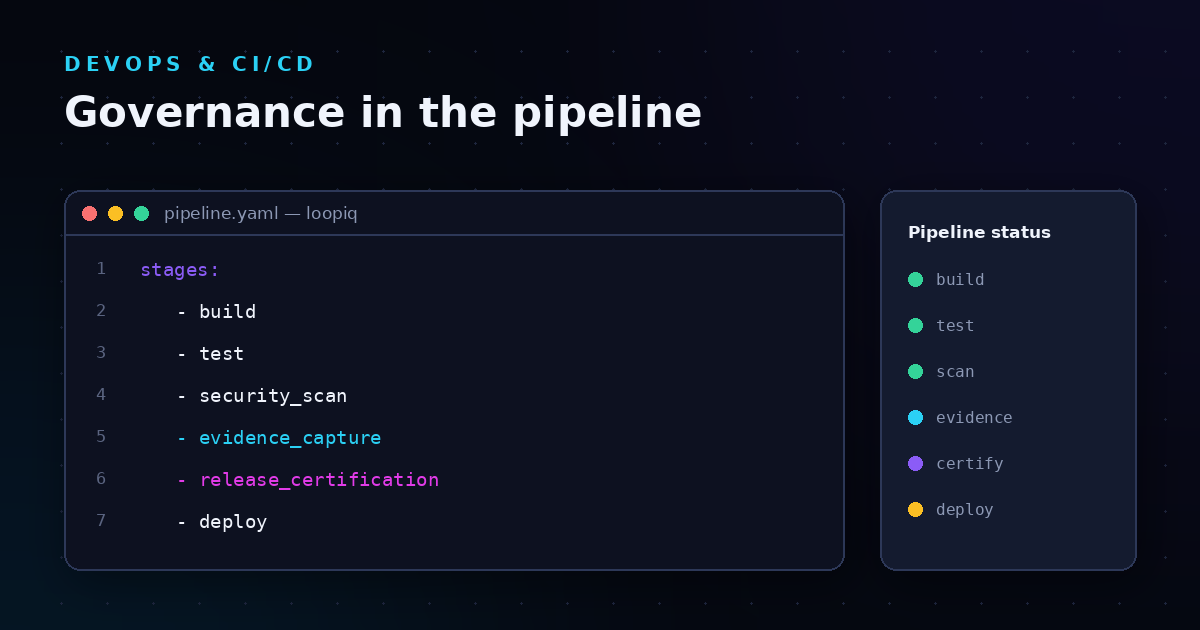
Configure your pipeline to capture evidence at each critical point. This typically involves enabling audit logging on source control systems, configuring CI/CD platforms to record test results with full metadata, setting up approval workflows that create permanent records, and integrating security scanning tools to feed findings into your compliance record.
If you're using LoopIQ, native integrations handle much of this automatically. The platform's GitHub integration captures changes and triggers test execution, while its compliance infrastructure ties policy to objectives and links results to releases.
Implement gates that prevent releases from proceeding without required evidence. These gates should check that all required approvals are in place, all required tests have passed, all required security scans have completed, and all required documentation exists.
Gates serve dual purposes: they enforce compliance and they create evidence of enforcement. When a release passes a gate, that passage is itself proof that requirements were met.
Even with automated capture, you need periodic reviews to ensure the system is working correctly. Schedule monthly reviews of release evidence completeness. Check that nothing has fallen through gaps. Verify that your automated systems are capturing what you expect.
These reviews should become progressively faster as you identify and fix gaps. The goal is to make evidence review a quick verification, not a multi-day project.
Even well-designed compliance systems encounter obstacles. Understanding common challenges helps you anticipate and address them before they create audit risks.
Older CI/CD tools may lack APIs for evidence extraction. When you can't pull data automatically, you're forced back into manual documentation. The solution is either to upgrade to tools with better integration capabilities or to implement middleware that extracts and forwards evidence to your compliance system.
When evaluating this tradeoff, consider the long-term cost. Custom middleware requires maintenance. Every upgrade to your legacy tool may break your integration. Sometimes the cleaner path is migrating to a unified platform that handles compliance natively.
Not all compliance evidence can be captured automatically. Some decisions require human judgment and must be documented with context that explains the reasoning. Risk acceptance decisions, exception approvals, and incident responses often fall into this category.
For these cases, your system needs structured capture mechanisms. Instead of free-form documentation, use templates that prompt for required information: what decision was made, why it was made, who made it, and when it applies.
What about releases that shipped before you implemented automated capture? For these, you may need to reconstruct evidence from historical sources. This is time-consuming, but it's often required for audits covering periods before your new processes were in place.
Document your reconstruction methodology. Auditors understand that you can't change the past, but they expect you to demonstrate due diligence in recovering what evidence exists.
Engineering teams sometimes resist compliance processes that add perceived slowdowns to releases. The key is ensuring that compliance doesn't slow delivery—which is why automated capture matters so much. When evidence generates automatically, there's no speed penalty for thoroughness.
LoopIQ enables engineering velocity despite compliance demands by embedding compliance tracking into daily delivery. Teams don't have to choose between shipping fast and staying certified because both happen together.
Audit-ready evidence meets specific criteria that allow auditors to trust and verify your compliance claims. Understanding these criteria helps you design systems that produce evidence auditors will accept.
Auditors need confidence that records haven't been modified after the fact. Your compliance system should store evidence in immutable formats where changes are either impossible or leave clear audit trails. This typically means write-once storage, cryptographic hashing, or blockchain-style logging.
When auditors can verify that your evidence hasn't been tampered with, their trust in your overall compliance posture increases significantly.
Every piece of evidence should clearly identify who created it, when it was created, and what it relates to. Anonymous approvals or undated records create doubt. Specific attribution—"Jane Smith approved this release on March 15, 2026, at 14:32 UTC"—creates confidence.
Attribution also enables accountability. When something goes wrong, complete attribution helps you understand the decision chain that led to the outcome.
Evidence should include enough context to be understood independently. A test result that says "PASSED" isn't as useful as one that says "Integration test suite v3.2 passed with 847 tests executed, 0 failures, covering 78% of modified code paths."
LoopIQ generates compliance dossier artifacts per release that include this contextual depth—immutable approval records with full attribution and auditor-ready certification packages that explain not just what happened, but why it matters.
Audit-ready doesn't just mean complete—it means accessible. If auditors ask for evidence and you need three days to find it, that delay raises questions about your compliance maturity. Your system should support instant retrieval of any release's complete compliance record.
The goal is a one-click compliance evidence dossier available immediately after release. When auditors see that you can answer questions in minutes rather than days, they gain confidence in your overall compliance operations.
Beyond meeting audit requirements, automated compliance reduces operational risk across your delivery pipeline. When compliance checks happen automatically and early, problems surface before they reach production.
When compliance checks run as part of your pipeline, policy violations are caught at build time rather than audit time. A missing approval blocks the release immediately. A failed security scan prevents deployment. A required test that didn't run stops the pipeline.
This early detection shifts compliance from a retrospective exercise to a proactive safeguard. You're not finding problems during audits—you're preventing them from reaching production at all.
Manual compliance documentation is error-prone. People forget steps. People mistype information. People copy the wrong data from one system to another. Every manual step is an opportunity for mistakes.
Automated capture eliminates these errors by removing human transcription from the evidence chain. The data that flows into your compliance record is the same data that exists in your delivery systems—no copying, no interpretation, no opportunity for error.
Policies enforced by humans are enforced inconsistently. Friday afternoon releases get less scrutiny than Monday morning releases. Urgent hotfixes skip steps that routine releases follow. Over time, these inconsistencies create compliance gaps.
Platform-enforced policies don't have bad days. Every release, regardless of timing or urgency, goes through the same gates. This consistency is both better for compliance and easier to demonstrate to auditors.
Security scanning results are a critical component of compliance evidence. When security tools operate independently from your compliance system, connecting findings to releases requires manual correlation. When they're integrated, findings become part of your automatic evidence chain.
Integrated security tooling captures scan results and attaches them to the release being scanned. This includes static analysis findings (code quality and vulnerability detection), dynamic analysis results (runtime behavior and penetration testing), dependency scanning (known vulnerabilities in third-party components), and container scanning (image security and configuration).
Each finding includes severity, affected components, and remediation status. Auditors can see not just that you ran security scans, but what those scans found and how you responded.
Finding vulnerabilities matters less than demonstrating you addressed them. Your compliance record should show the lifecycle of each finding: when it was discovered, how it was assessed, what remediation was applied, and when it was verified as resolved.
This remediation history becomes powerful evidence of security maturity. Auditors see not just point-in-time scan results, but your ongoing commitment to addressing issues.
Technology enables current compliance, but culture sustains it. Your engineering teams need to understand why compliance matters and how automated systems support rather than burden them.
The traditional view treats compliance as extra work that competes with feature development. Engineers resent time spent on documentation that doesn't ship value to customers. This resentment leads to shortcuts and gaps.
When compliance evidence generates automatically from work engineers are already doing, that resentment disappears. Developers don't feel burdened because they're not doing anything extra. They're just shipping code while the platform handles the rest.
Teams care about what's visible. When compliance status appears on dashboards alongside velocity metrics and quality scores, it becomes part of how teams measure success. When it's hidden in separate systems, it's an afterthought.
LoopIQ enables teams to see every release in context with validations, approvals, and conditions visible in one place. This visibility normalizes compliance as part of delivery rather than a separate concern that only matters during audits.
When audits go smoothly because your evidence is complete and current, celebrate that outcome. Recognize the engineers whose work enabled the clean audit. Connect the dots between good compliance hygiene and reduced audit stress.
Over time, this recognition builds culture. Teams take pride in their compliance posture because they've seen how it benefits them during audit periods.
You can't improve what you don't measure. Establishing metrics for compliance data currency helps you identify gaps and track progress over time.
Consider measuring evidence completeness rate (what percentage of releases have all required evidence), evidence latency (how quickly evidence is captured after the event it documents), audit response time (how long it takes to answer auditor questions), and evidence gap frequency (how often audits reveal missing documentation).
Baseline these metrics before implementing improvements. Then track them over time to demonstrate the value of your compliance investments.
Define what "good" looks like for your organization. Perhaps 100% evidence completeness is non-negotiable. Perhaps 95% is acceptable with documented exceptions. Perhaps audit response time should be under one hour for any question.
These targets become part of your engineering culture. Teams know what they're aiming for and can course-correct when metrics slip.
Stale compliance data isn't a discipline problem—it's a structural problem. When your delivery tools and compliance systems are separate, evidence will always lag behind releases. When they're unified, evidence stays current by design.
The path forward requires evaluating your current evidence flow, defining what complete release records should contain, and implementing automated capture at every critical point. For many organizations, this means moving to a unified SDLC platform that handles compliance natively rather than as an afterthought.
LoopIQ offers exactly this approach: a compliance-first SDLC workspace where audit-ready documentation generates automatically as teams ship software. Engineering teams reclaim the days they used to spend on evidence assembly. Auditors get instant answers to their questions. And compliance leaders gain confidence that their evidence is current, complete, and defensible.
Compliance data becomes outdated when it's stored separately from your delivery pipeline. Approvals captured in chat tools, test results stored in isolated CI systems, and deployment records spread across multiple platforms all decay over time as context is lost and connections break down.
Automated evidence capture records compliance data as a byproduct of engineering work, while manual documentation requires engineers to create records separately. Automated capture eliminates human error, reduces time burden, and ensures evidence is captured at the moment events occur rather than reconstructed later.
Release-level traceability means binding all compliance evidence directly to specific releases at deployment time. This approach lets you answer audit questions instantly by querying the release record rather than reconstructing narratives from scattered sources. LoopIQ creates automatic release certification trails that link objectives to measurable results.
Unified SDLC platforms keep work and records on the same surface, eliminating synchronization failures between systems. LoopIQ combines DevOps, ITSM, compliance, and audit management in one workspace, capturing evidence automatically as teams ship software without requiring separate documentation tools.
Audit-ready evidence should include complete attribution (who, what, when), immutability guarantees, contextual detail that explains significance, and instant retrievability. LoopIQ generates per-release compliance dossiers with immutable approval records and certification packages that meet these criteria automatically.
Automated compliance catches policy violations at build time rather than audit time. Missing approvals block releases immediately, failed security scans prevent deployment, and required tests that didn't run stop the pipeline. This early detection prevents problems from reaching production.
Track evidence completeness rate (percentage of releases with all required evidence), evidence latency (time between events and capture), audit response time (how quickly you answer auditor questions), and evidence gap frequency (how often audits reveal missing documentation).
Engineering teams maintain velocity by using automated evidence capture that generates compliance documentation as a byproduct of existing work. LoopIQ enables engineering velocity despite compliance demands by embedding compliance tracking into daily delivery—teams don't choose between shipping fast and staying certified.