.svg)
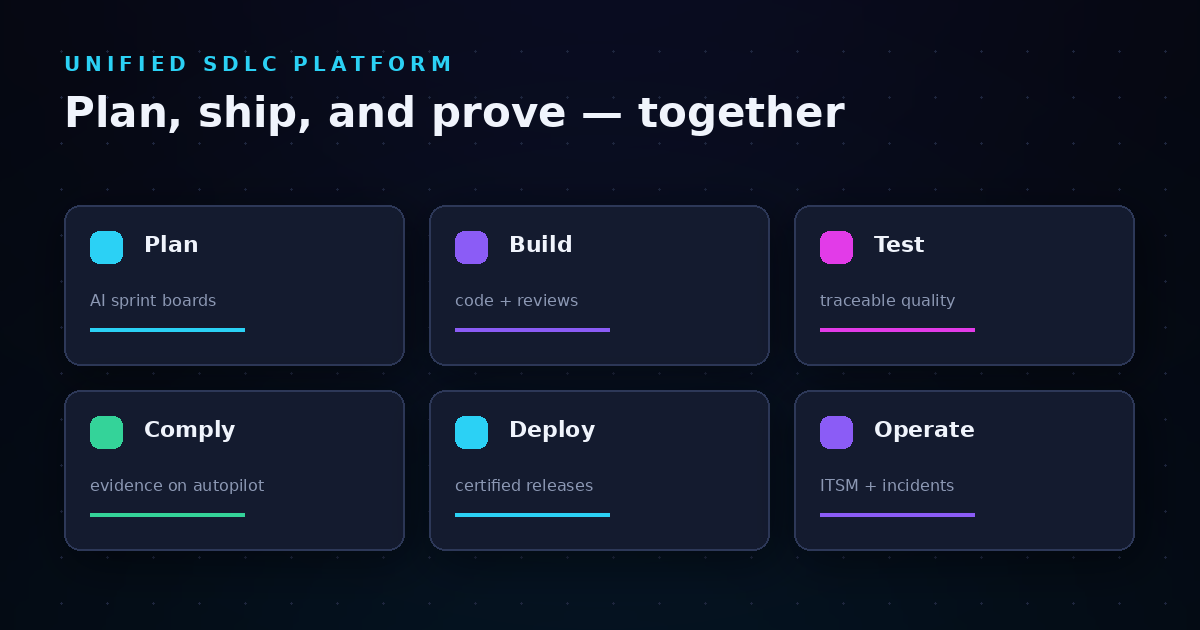
unified sdlc
ai tools
compliance

Every software release carries risk—not just technical risk, but compliance risk. If your team ships code without knowing which regulatory controls apply, you're flying blind. Control mapping changes that equation by connecting every development activity to the specific compliance requirements it must satisfy.
LoopIQ helps regulated engineering teams map controls directly into their software delivery lifecycle, creating audit-ready releases by default. This guide will walk you through what control mapping means in 2026, how it works inside modern SDLC platforms, and how to evaluate whether your current tooling actually supports audit readiness—or just generates reports you'll have to explain later.
You'll learn the key components of effective control mapping, understand the difference between compliance tracking and true control integration, and discover how to assess platforms based on real audit readiness criteria rather than marketing claims.
Control mapping is the practice of linking regulatory or policy requirements—called controls—to the specific activities, artifacts, and approvals in your software delivery lifecycle. When you map controls to your SDLC, you create a direct line between what regulators require and what your team actually does.
Think of it as building a compliance blueprint into your development process. Instead of asking "was this release evaluated under defined conditions?" after you ship, control mapping lets you answer that question automatically because the evidence was captured as work happened.
Compliance tracking typically happens outside your development environment. Your team ships software, then someone—often a senior engineer—assembles evidence from various tools to prove you followed the rules. This approach treats compliance as an afterthought.
Control mapping flips that model. By embedding compliance requirements directly into your SDLC, you generate evidence as a natural output of development work. The distinction matters because auditors can tell the difference between evidence captured at the time of decision and documentation assembled under deadline pressure.
Regulated industries face increasing scrutiny over software practices. Financial services, healthcare, and defense contractors must demonstrate not just that they followed rules, but that they can prove it with traceable documentation.
For VPs and Heads of Development, this creates a tension. You want your team shipping features, not assembling audit packets. Control mapping resolves that tension by making compliance evidence a byproduct of engineering work rather than a separate tax on developer time.
Not all control mapping approaches deliver equal value. Understanding the core components helps you evaluate whether a platform offers genuine audit readiness or just another dashboard to maintain.
Effective control mapping starts by connecting high-level compliance policies to specific delivery objectives. This means mapping regulations like SOC 2 requirements or HIPAA controls to the actual work items in your SDLC.
When a developer completes a task, the system should automatically know which controls that task satisfies. This linking happens once during setup, then operates automatically for every release going forward.
Evidence captured at the moment of decision carries more audit weight than documentation assembled later. When an approval happens, the control mapping system should capture who approved, what they approved, and under what conditions—permanently and immutably.
This binding creates what auditors call "contemporaneous documentation." The evidence wasn't constructed to satisfy an audit; it was generated as a natural part of the approval process.
Every release should produce a certification trail that auditors can follow from code commit to production deployment. This trail includes approvals, test results, security scans, and any conditions that had to be met before shipping.
LoopIQ creates automatic release certification trails linked to objectives and measurable results. When auditors ask about a specific release from months ago, you can produce a complete evidence dossier with a single click rather than hunting through multiple systems.
Approval chains often scatter across email threads, chat messages, and ticket comments. For audit purposes, these scattered approvals create verification problems. Someone has to find each approval, confirm it applies to the right release, and prove it wasn't modified.
Proper control mapping captures approvals in an immutable format at the moment they occur. The approval becomes part of the release record automatically, eliminating the need for investigators to reconstruct sign-off chains.
Understanding where control mapping fits into your development workflow helps you evaluate whether a platform actually integrates compliance or just bolts it on afterward.
Control mapping begins when work items are created. As your team plans sprints or defines epics, the control mapping system associates relevant compliance requirements with those items.
For example, if you're building a feature that handles personal data, the system automatically links GDPR or CCPA controls to that work item. This connection persists throughout the development lifecycle, ensuring evidence generation happens at every stage.
During development, every code change should be captured in context. This includes not just what changed, but who changed it, why, and what approvals were required.
Native integrations with version control systems like GitHub allow automatic change capture. When code merges, the control mapping system records the event as evidence for the controls tied to that work item.
Test results give you evidence that controls were satisfied. A security scan that passes demonstrates compliance with security-related controls. Performance tests that meet thresholds satisfy availability requirements.
The control mapping system should automatically correlate test results with the specific controls they satisfy. This correlation happens without manual intervention—the test runs, results are captured, and evidence is generated.
At release time, all the evidence collected throughout the SDLC comes together in a certification package. This package contains everything an auditor needs: approvals, test results, security findings, and compliance evaluations.
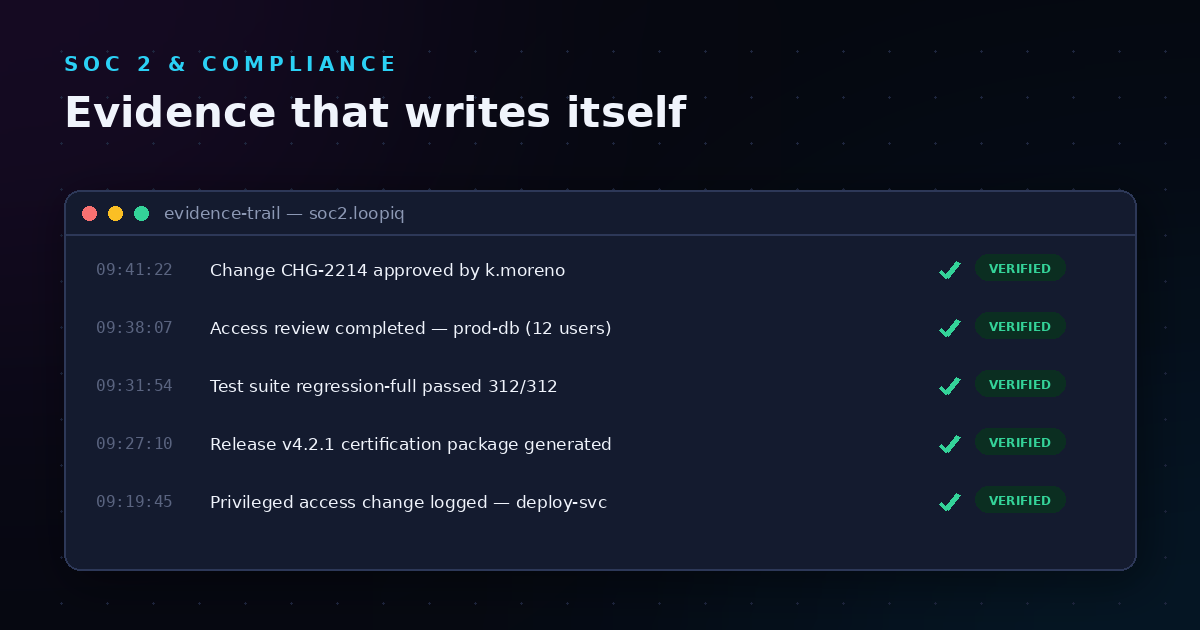
LoopIQ produces per-release compliance evidence automatically, available immediately after release. Your team ships software, and the audit documentation generates itself.
Audit readiness requires more than compliance features—it requires architecture that treats compliance as a first-class concern, not an add-on.
Many platforms offer compliance features as integrations or add-ons. You install a plugin, connect to a GRC tool, and hope the data syncs correctly. This approach creates gaps because compliance lives outside your development workflow.
Built-in compliance means the SDLC platform itself understands controls, captures evidence, and generates documentation. There's no separate system to maintain or integration to troubleshoot. LoopIQ operates as compliance infrastructure inside the delivery lifecycle, tying policy to objectives and linking results to releases directly.
Assembled evidence requires someone to gather artifacts from multiple sources and arrange them for auditors. This assembly process takes time, introduces human error, and often happens under deadline pressure during audit season.
Structural evidence exists because work and records live on the same surface. When you complete a task, the evidence is already in the right place, properly formatted, and linked to the right controls. No assembly required.
Traditional compliance tools evaluate your posture periodically—weekly scans, monthly reports, quarterly reviews. This approach means you might ship non-compliant releases without knowing until the next evaluation cycle.
Real-time compliance evaluation assesses every release against control requirements before it ships. If a release doesn't satisfy required controls, you know immediately—not weeks later when an auditor discovers the gap.
When assessing software delivery platforms for control mapping, focus on capabilities that matter for audit readiness rather than feature checklists.
Start by understanding how evidence gets created. Does the platform generate compliance evidence as a byproduct of development work, or does it require separate documentation tasks?
Ask how evidence connects to releases. Can you produce a complete compliance package for any historical release with a single action, or do you need to query multiple systems and assemble the results manually?
Understand how controls connect to your SDLC. Does the platform support policy-to-objective linking, or do you need to map controls to work items manually for each project?
Ask about approval binding. When someone approves a release, does that approval become an immutable part of the release record, or does it live in a separate system where it could be modified or lost?
Consider what happens when auditors arrive. Can you answer their questions with data directly from your SDLC platform, or do you need to export data and prepare it in different formats?
Ask about evidence defensibility. If an auditor questions a specific approval from six months ago, can you prove the approval existed at that time and wasn't added retroactively?
Implementing effective control mapping requires addressing several common challenges that regulated engineering teams face.
Most regulated teams must satisfy multiple compliance frameworks simultaneously. SOC 2, ISO 27001, HIPAA, and industry-specific regulations all have overlapping but distinct requirements.
The solution involves mapping controls at the framework level, then connecting those framework-level controls to your SDLC activities once. When a work item satisfies one control, the system recognizes it also satisfies equivalent controls in other frameworks. This multi-framework mapping prevents duplicate effort.
Teams using established project management tools often hesitate to migrate because of the historical data and workflows they've built. The migration concern is valid—losing context damages compliance posture.
LoopIQ addresses migration concerns with improved import tooling that preserves historical context. When you migrate, your compliance history comes with you rather than starting from zero with the new platform.
As AI agents perform more engineering tasks—code generation, test creation, deployment automation—control mapping must account for their actions. Audit chains break when AI agents act without proper governance.
Effective control mapping includes governance for AI agents performing engineering work. This means applying mutation policies, requiring approvals for certain AI actions, and integrating AI outputs into the audit evidence chain.
Moving from traditional compliance practices to integrated control mapping requires a structured implementation approach.
Begin by documenting all compliance frameworks your organization must satisfy. For each framework, identify the specific controls that apply to software development activities.
Create a control library that maps each regulatory requirement to the type of evidence that satisfies it. This library becomes the foundation for your control mapping configuration.
For each control in your library, identify which SDLC activities generate evidence for that control. Code reviews might satisfy change management controls. Security scans might satisfy vulnerability management controls.
This mapping should happen at the activity level, not the project level. Once you map "code review" to a change management control, that mapping applies to every project automatically.
Based on your control-to-activity mapping, configure your SDLC platform to capture evidence at each relevant point. This configuration typically involves:
Before relying on your control mapping for actual audits, validate that evidence generates correctly. Ship several releases through the new process and verify that complete evidence packages are available.
Have someone unfamiliar with the project attempt to answer typical audit questions using only the generated evidence. If they struggle, your evidence capture points need adjustment.
Control mapping changes how your team thinks about compliance. Instead of treating it as a separate activity, compliance becomes embedded in development work.
Training should focus on what stays the same (development workflow) rather than what changes (evidence generation is automatic). The goal is adoption without disruption to existing velocity.
Release certification represents the culmination of control mapping—the point where all collected evidence comes together to certify that a release is ready for production.
A complete release certification package contains evidence for every control applicable to that release. This typically includes approval records, test execution results, security scan findings, code review documentation, and any exception approvals.
The certification should also include the conditions under which the release was evaluated. Auditors want to know not just that you evaluated the release, but what criteria you applied during that evaluation.
LoopIQ automates release certification with compliance, security, and readiness checks built into the release workflow. As your team moves code toward production, the platform evaluates each release against the controls mapped to the associated work items.
If a release satisfies all required controls, certification happens automatically. If gaps exist, the platform flags them before shipping—not during the next audit cycle. This intelligent release certification reviews evidence and flags compliance gaps before shipping.
Audit questions often arise months after a release ships. At that point, team members may have moved to other projects, and the context of why certain decisions were made has faded.
Effective control mapping preserves the state of the world at decision time. When an auditor asks about a release from last quarter, you can show exactly what the team knew when they shipped—not a reconstruction based on current data.
Most regulated teams already use GRC (Governance, Risk, and Compliance) tools and other compliance systems. Control mapping in your SDLC should enhance these existing investments, not replace them.
GRC platforms track compliance posture across your organization, but they typically don't understand software development workflows. Control mapping in your SDLC generates the artifacts that feed into GRC reporting.
LoopIQ supports existing GRC tools by feeding structured, audit-ready artifacts into them. Your GRC platform gets better data without requiring your development team to maintain a separate compliance workflow.
Security scanning tools generate findings that must connect to your compliance story. A vulnerability scan that passed is evidence for security controls. A finding that was remediated demonstrates your response process.
Effective control mapping integrates security findings into release evidence automatically. When you generate a compliance package, security scan results appear in context—not as a separate report that someone must correlate manually.
Even with integrated control mapping, some data will exist in external systems. The key is maintaining traceable connections so auditors can follow the evidence chain.
Your SDLC platform should capture references to external evidence sources and maintain those references as part of the immutable release record. If security scan results live in a separate tool, the release record should include a verifiable link to those results.
Once you've implemented control mapping, you need metrics to assess whether it's working as intended.
Measure how long audit preparation takes before and after implementing control mapping. Regulated teams often spend days or weeks assembling evidence before audits. With effective control mapping, that time should drop to hours or minutes.
Also measure the time from audit question to answer. When an auditor asks for evidence of a specific control, how quickly can you produce it? Instant availability demonstrates control mapping effectiveness.
Track what percentage of your SDLC activities are mapped to controls. Unmapped activities represent potential audit gaps—work happening without evidence generation.
Also measure control coverage across releases. What percentage of releases have complete evidence packages for all applicable controls? Gaps indicate configuration issues in your control mapping setup.
Monitor audit findings related to software development controls. Effective control mapping should reduce findings over time because you're catching gaps before auditors do.
Track evidence completeness for random historical releases. Can you produce a complete, defensible evidence package for a release from six months ago? If not, your evidence capture points may need adjustment.
Control mapping practices continue to evolve as software delivery accelerates and regulatory requirements expand.
As AI becomes more prevalent in development workflows, control mapping will incorporate AI-driven insights. This includes predictive compliance intelligence that identifies gaps before they become audit findings.
LoopIQ uses AI-driven insights to give you explainable, predictive compliance intelligence with real signals. Rather than discovering compliance gaps reactively, you'll know about potential issues while there's still time to address them.
The trend is moving from periodic audit preparation to always-on audit readiness. Teams that implement effective control mapping today position themselves for a future where auditors expect instant access to compliance evidence.
This shift requires infrastructure that treats compliance as a first-class concern throughout the SDLC, not as a periodic review or separate workstream.
Regulatory requirements for software development continue to expand across industries. What was once limited to healthcare and finance now applies to AI development, data processing, and critical infrastructure.
Teams that build control mapping capabilities now will adapt more easily as new regulations take effect. The infrastructure exists; you just need to map new controls to existing SDLC activities.
Control mapping changes compliance from a periodic burden into an embedded capability of your software delivery process. By connecting regulatory requirements directly to SDLC activities, you generate audit evidence as a byproduct of work—not as a separate task that pulls engineers away from shipping.
The key evaluation criterion for any SDLC platform is whether it treats compliance as infrastructure or as an add-on. Platforms like LoopIQ that embed control mapping directly into the delivery workflow create structural audit readiness. Evidence exists because work happened, not because someone assembled it under deadline pressure.
As you evaluate platforms for your regulated engineering team, focus on the questions that matter: Where does evidence come from? Can you defend a release from months ago? Does compliance slow shipping, or does it happen automatically?
The answers will tell you whether a platform offers genuine control mapping for audit-ready software delivery—or just another compliance dashboard you'll have to explain during your next audit.
Control mapping links regulatory requirements to specific SDLC activities. When you complete development tasks, the system automatically generates evidence for the compliance controls those tasks satisfy.
This approach eliminates the need to assemble evidence retroactively. Documentation happens as a byproduct of work rather than a separate effort before audits.
LoopIQ embeds control mapping directly into your software delivery workflow. As your team ships software, the platform automatically captures approvals, test results, and security findings as immutable audit evidence.
When auditors arrive, you can produce a complete compliance dossier for any release with a single click. LoopIQ's one-click compliance evidence dossier gives you audit-ready documentation on autopilot.
Compliance tracking monitors your overall compliance posture, often in a separate tool from where development happens. Control mapping integrates compliance requirements into your SDLC so evidence generates automatically during development.
The key difference is timing. Compliance tracking reviews what happened. Control mapping captures evidence as things happen.
Implementation time depends on your current tooling and the complexity of your compliance requirements. Teams typically spend one to two weeks mapping controls to SDLC activities, then another one to two weeks configuring evidence capture points.
With LoopIQ, much of this configuration happens automatically because the platform understands common compliance frameworks and development workflows.
Yes. Effective control mapping supports multi-framework environments by recognizing when a single SDLC activity satisfies controls across different frameworks.
You map the activity once, and the system applies that mapping to all relevant frameworks. This prevents the duplicate documentation effort that plagues teams managing multiple compliance requirements.
Control mapping captures approvals, code changes, test results, security scan findings, deployment records, and configuration changes. The specific evidence depends on which controls you're satisfying.
LoopIQ generates compliance dossier artifacts per release, including immutable approval records and auditor-ready certification packages that document exactly what happened and when.
As AI agents perform more development tasks, control mapping must govern their actions. This means capturing what AI agents do, requiring approvals for significant changes, and integrating AI outputs into the audit trail.
LoopIQ applies granular mutation policies and approval requirements for AI agent actions, ensuring AI-generated code meets the same compliance standards as human-written code.
The platform should flag the gap before you ship, not afterward. You can then address the missing evidence, document an exception, or delay the release until requirements are met.
This pre-release visibility prevents the scenario where you discover compliance gaps during an audit—when it's too late to do anything except explain what went wrong.