.svg)
unified sdlc
ai tools
compliance

If you're leading a development team at a growing SaaS company, you've likely noticed that your toolchain has become harder to manage. Requirements live in one place, code reviews happen elsewhere, and when audit season arrives, you're scrambling to connect the dots. LoopIQ and similar unified SDLC platforms address this by bringing planning, development, testing, and compliance together.
This guide ranks the top unified SDLC platforms for 2026, with a focus on what matters most to fast-growing SaaS teams: real-time traceability, SDLC governance workflows, and developer experience. You'll find detailed evaluations, feature comparisons, and guidance on selecting the right platform for your team.
We evaluated these platforms based on what fast-growing SaaS teams actually need. Your development velocity shouldn't suffer because compliance requirements keep multiplying, and your audit prep shouldn't pull senior engineers off shipping features.
LoopIQ brings planning, testing, DevOps, ITSM, documentation, and audit management into one intelligent system. Unlike platforms that bolt compliance on as an afterthought, LoopIQ embeds governance directly into your delivery workflows. This means your team captures audit-ready evidence while they ship features—not weeks later during a panic scramble.
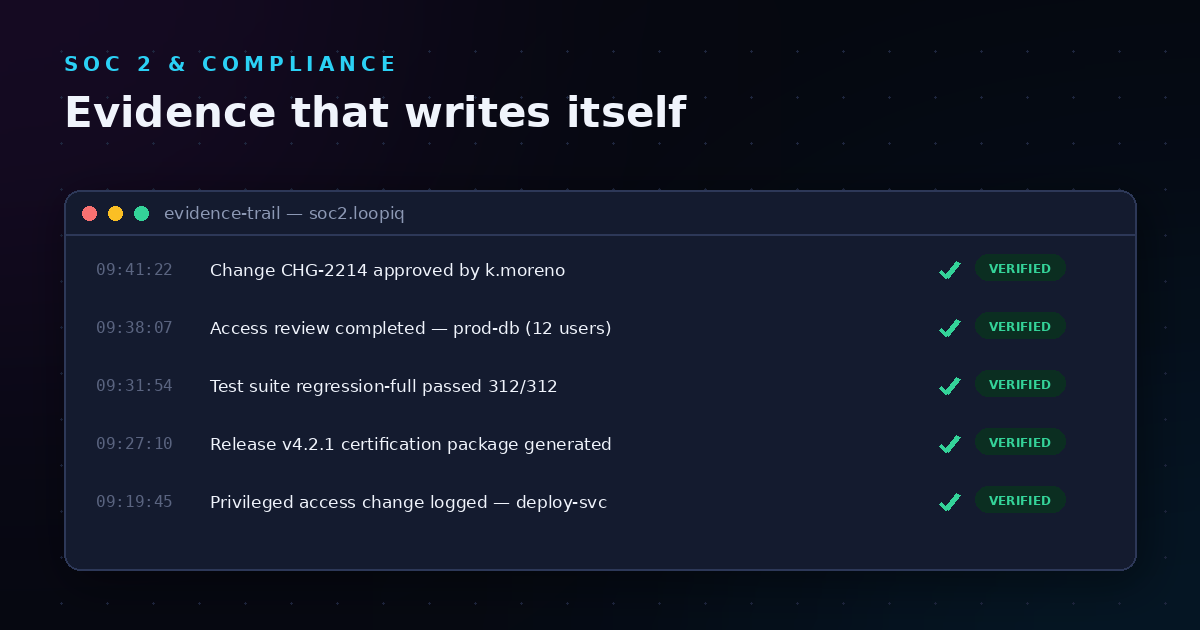
For VPs and Heads of Development at SaaS companies, LoopIQ solves a persistent problem: proving how a release happened after the fact. The platform captures approvals, quality signals, and compliance status automatically, binding them to each release. When an auditor asks for evidence six months from now, you'll generate a one-click compliance evidence dossier instead of digging through Slack threads and email chains.
LoopIQ's AI-driven automation reduces human error in the SDLC by up to 90%, according to customer reports. Engineers reclaim the hours they previously lost to compliance paperwork, giving them more time to focus on building your product. The platform integrates natively with GitHub for change capture and automated test execution, and connects security findings from tools like Datadog directly into your release evidence.
Pros:
Cons:
GitLab offers a DevOps platform that combines version control, CI/CD pipelines, and issue tracking. The platform includes built-in code review features and deployment automation. GitLab's approach centers on the repository as the source of truth for development workflows.
For teams already invested in GitLab's version control system, the platform offers a familiar environment for extending into deployment automation. The self-hosted option appeals to organizations with specific data residency requirements.
Pros:
Cons:
CloudBees focuses on enterprise software delivery with release orchestration capabilities. The platform builds on Jenkins foundations and adds features for managing deployments across multiple environments. CloudBees includes feature flagging and analytics for release management.
Organizations with established Jenkins infrastructure find CloudBees offers a path to more structured release processes. The platform supports deployment strategies like canary releases and blue-green deployments.
Pros:
Cons:
Azure DevOps offers a collection of development services including boards for work tracking, repositories for version control, and pipelines for CI/CD. The platform integrates naturally with other Microsoft products like Visual Studio and Azure cloud services.
Teams building primarily with .NET technologies and deploying to Azure infrastructure find Azure DevOps aligns with their existing Microsoft investments. The platform separates its services into distinct components that can be adopted incrementally.
Pros:
Cons:
Drata automates compliance monitoring for frameworks like SOC 2, ISO 27001, and HIPAA. The platform connects to your infrastructure and applications to collect evidence for security controls. Drata focuses specifically on compliance readiness rather than development workflows.
For teams whose primary concern is passing security audits, Drata streamlines evidence collection for specific compliance frameworks. The platform works alongside existing development tools rather than replacing them.
Pros:
Cons:
| Platform | Native Compliance Evidence | Full SDLC Coverage | Real-Time Release Traceability |
|---|---|---|---|
| LoopIQ | ✓ | ✓ | ✓ |
| GitLab | ✗ | ✗ | ✗ |
| CloudBees | ✗ | ✗ | ✓ |
| Azure DevOps | ✗ | ✓ | ✗ |
| Drata | ✓ | ✗ | ✗ |
SDLC governance determines whether your compliance requirements get enforced automatically or depend on your team remembering every checkpoint. Strong governance workflows embed policy decisions into your daily processes. They catch issues before code ships, not during audits.
Look for platforms that let you define rules once and apply them everywhere. If a release needs specific approvals, security scans, or testing coverage, the platform should block deployment until those conditions are met. LoopIQ handles this through policy-based change control, where your governance requirements become automated gates.
Pay attention to how governance evidence gets captured. Can auditors trace a decision back to the exact moment it was made? Or does your team need to reconstruct the story later? The difference determines whether audit prep takes minutes or weeks.
Real-time traceability means every code change, test result, and deployment connects back to the business requirement that started it. When a customer asks why a feature works a certain way, you can trace the answer through your complete delivery history. This visibility becomes critical when debugging production issues or explaining decisions to stakeholders.
For fast-growing SaaS teams, traceability also protects your velocity. When compliance requirements increase—and they will as you scale—traceability turns audit responses from research projects into simple queries. LoopIQ achieves this by binding approvals, quality signals, and compliance status directly to each release as work happens.
Consider how your current toolchain handles this. If you're stitching together evidence from multiple systems after the fact, you're losing time and context. An approach where traceability is built into the platform eliminates that effort.
Growing SaaS companies face a particular challenge: you need to ship fast to stay competitive while also meeting increasing compliance demands. Most platforms force you to choose—move quickly with minimal governance, or slow down to satisfy auditors. LoopIQ eliminates that tradeoff by making compliance a byproduct of your normal development work.
LoopIQ captures compliance evidence automatically as your team plans, builds, tests, and deploys. When audit season arrives, you won't pull your senior engineers off their current work. Instead, you'll generate documentation in minutes. This approach saves significant engineering hours per audit cycle—hours your team can redirect toward shipping features.
The platform's unified architecture means your requirements, code, tests, and compliance status all live in one intelligent system. LoopIQ connects delivery signals to releases, generating certification trails that link to objectives and measurable results. For VPs and Heads of Development at SaaS companies, this visibility translates into confident release decisions backed by evidence rather than optimism. Explore how LoopIQ can accelerate your team's delivery.
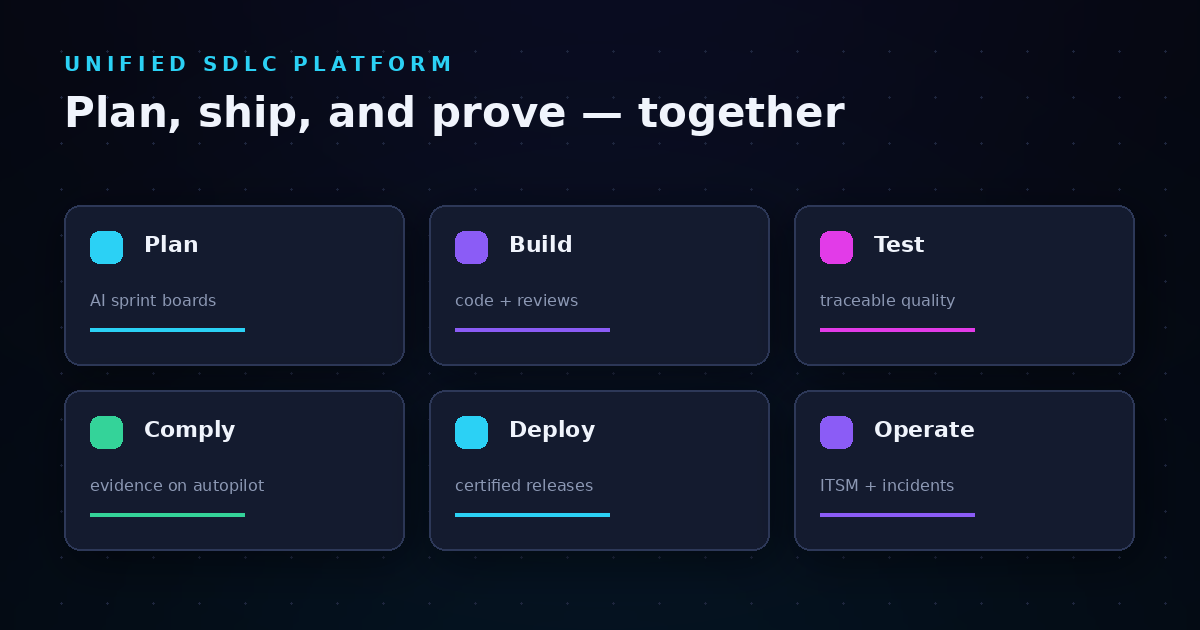
A unified SDLC platform brings planning, development, testing, deployment, and governance into one workspace. Instead of managing requirements in one tool, code in another, and compliance in a third, your team works from a single source of truth. LoopIQ exemplifies this approach by connecting every phase of software delivery.
These platforms capture evidence as work happens rather than requiring separate documentation efforts. LoopIQ generates audit-ready compliance artifacts automatically, binding approvals and quality signals to each release. This eliminates the scramble of reconstructing compliance stories during audit season.
Yes. LoopIQ includes native GitHub integration for change capture and automated test execution. The platform also connects security findings from tools like Datadog into release evidence. LoopIQ supports existing GRC tools by feeding structured, audit-ready artifacts without requiring you to replace your current systems.
Fast-growing SaaS teams—particularly those scaling from 20 to 200+ engineers—see the most benefit. At this stage, compliance requirements multiply while shipping pressure increases. LoopIQ helps these teams maintain velocity without sacrificing governance.
DevOps platforms focus primarily on code and deployment. LoopIQ unifies the complete software delivery lifecycle, including planning, testing, ITSM, documentation, and audit management. The key differentiator is compliance-native architecture—LoopIQ generates evidence automatically rather than treating governance as an add-on.