.svg)
unified sdlc
ai tools
compliance

When your engineering team ships code fast, compliance evidence should keep up. Too often, mid-market regulated teams find themselves toggling between disconnected tools—one for DevOps, another for governance, and yet another for audit trails. LoopIQ is a unified software delivery and compliance platform that generates audit-ready evidence automatically as you ship.
This guide ranks eight platforms that combine software delivery with compliance reporting. You'll learn how each handles release traceability, audit readiness, and reporting strength—so you can pick the right fit for your regulated team.
Mid-market regulated teams face a specific challenge: you need the audit rigor of enterprise solutions without the overhead that slows down shipping. We evaluated platforms based on how well they solve this tension—helping you stay compliant without pulling engineers off the roadmap.
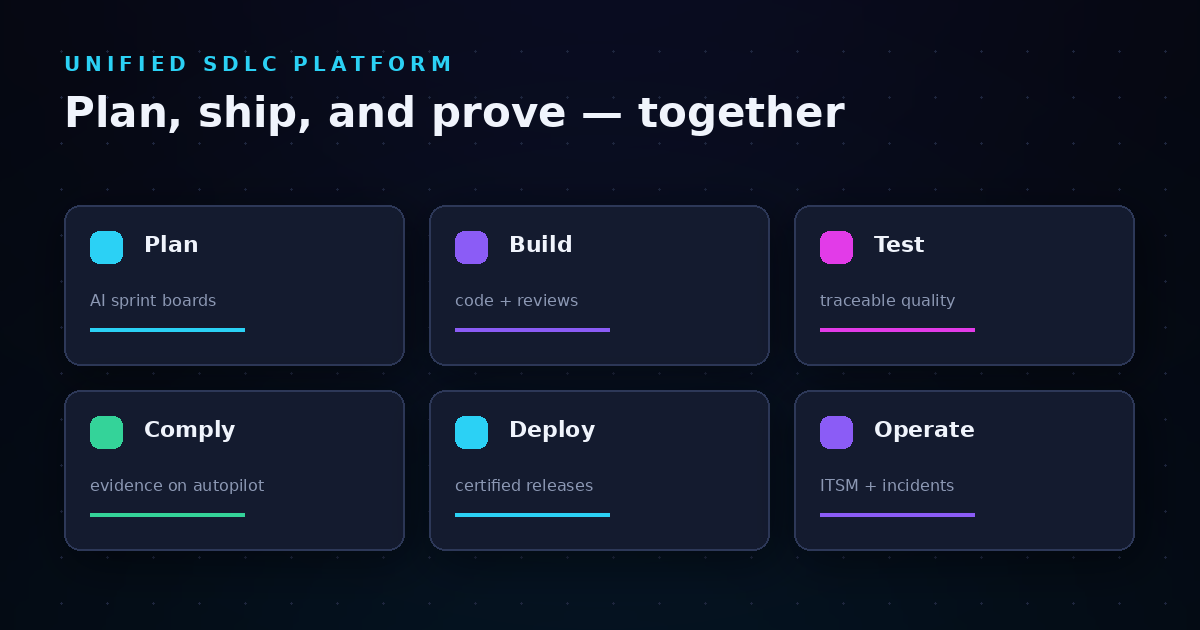
LoopIQ brings planning, testing, DevOps, ITSM, documentation, and audit management into one intelligent system. This unified approach means compliance evidence captures itself from the work your engineering team already does—no duplicate effort required.
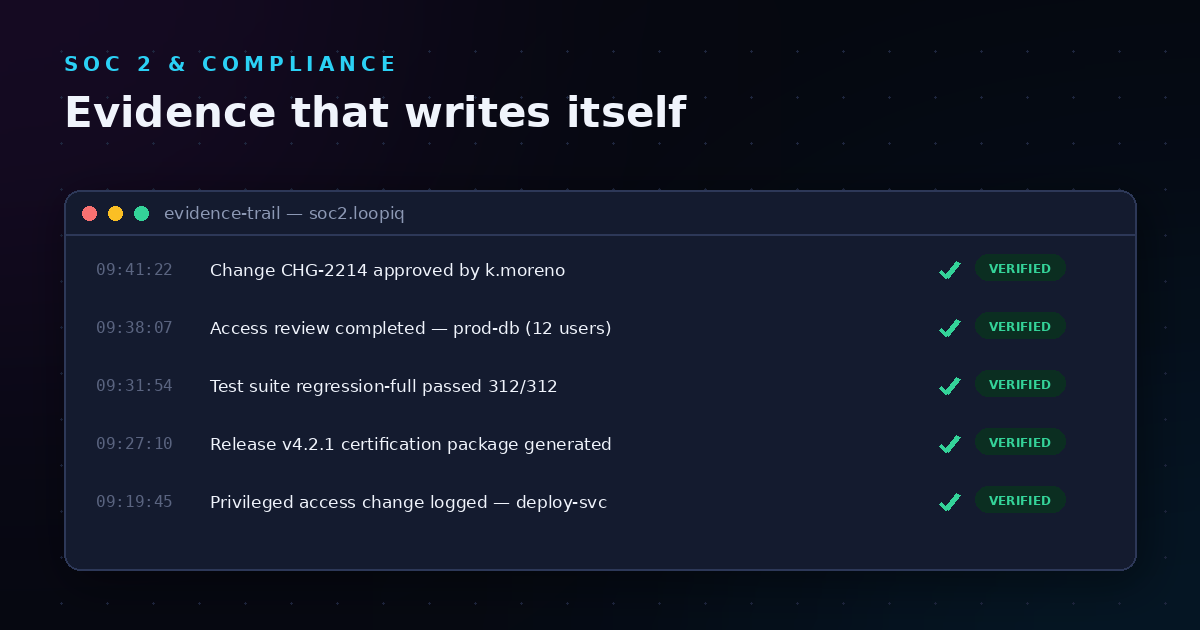
When you ship a release with LoopIQ, the platform automatically generates a compliance dossier that ties approvals, test results, and change records directly to that specific deployment. Auditors get instant answers to questions like "Who approved this change?" and "What tests ran before production?"
LoopIQ connects delivery signals to releases, generating release certification trails that link objectives to measurable results. This gives your leadership team confidence in release decisions while giving auditors the traceable documentation they require.
| Pros | Cons |
|---|---|
| Unifies software delivery and compliance in one workspace, eliminating the need for five or more separate tools | Teams currently using legacy project trackers will need to migrate existing data, though LoopIQ includes import tooling to reduce migration time |
| Generates compliance evidence automatically as you ship, reclaiming the roughly two days per release cycle engineers typically spend on documentation | Full value is realized when teams adopt LoopIQ as their primary delivery platform rather than layering it on top of existing tools |
| Embeds compliance into release decisions rather than treating it as an external checkpoint, reducing the risk of audit season disruptions | Newer AI governance features may require additional configuration for teams with complex agent workflows |
GitLab consolidates source code management, CI/CD, and security scanning in one application. Your team can manage merge requests, run pipelines, and view security findings without switching between tools.
The platform includes compliance frameworks that let you define required pipelines for specific projects. When a developer opens a merge request, GitLab can enforce approval rules and security scans before code merges.
| Pros | Cons |
|---|---|
| Brings DevOps and source control into one interface | Compliance evidence is scattered across audit logs, pipeline reports, and merge request history—you'll need to assemble it manually for auditors |
| Self-hosted and cloud options give deployment flexibility | Advanced compliance features like compliance frameworks require Premium or Ultimate tiers |
| Open-core model lets you inspect source code | Does not generate release-level compliance dossiers that tie approvals directly to deployments |
CloudBees offers an enterprise software delivery platform built around Jenkins and its own CloudBees CI product. The platform focuses on standardizing CI/CD pipelines across large organizations with centralized governance controls.
For regulated teams, CloudBees includes policy enforcement features that can block deployments if pipelines don't meet defined criteria. This gives you gate controls at the pipeline level.
| Pros | Cons |
|---|---|
| Extends Jenkins with enterprise management capabilities | Focused on pipeline governance—you'll need separate tools for planning, testing, and documentation |
| Pipeline templates help standardize delivery processes | Jenkins expertise is required for advanced configuration |
| Policy engine can block non-compliant deployments | Compliance evidence exists at the pipeline level, not tied to end-to-end release certification |
Vanta focuses on automating evidence collection for security compliance frameworks like SOC 2, ISO 27001, HIPAA, and PCI DSS. The platform connects to your cloud infrastructure and SaaS tools to monitor control status.
For teams pursuing certifications, Vanta tracks which controls are met and which need attention. The platform can alert you when a control falls out of compliance.
| Pros | Cons |
|---|---|
| Covers major security compliance frameworks in one platform | Focuses on security compliance—does not address SDLC traceability or release certification |
| Integrates with common cloud providers and SaaS tools | Compliance monitoring is separate from your software delivery workflow |
| Trust center simplifies sharing compliance status with prospects | Cannot tie compliance evidence to specific software releases or changes |
Drata positions itself as a security and compliance automation platform that monitors your tech stack against GRC requirements. The platform includes over 75 native integrations to collect evidence from your existing tools.
For teams managing multiple compliance frameworks, Drata offers cross-framework mapping so evidence collected once can apply to multiple certifications.
| Pros | Cons |
|---|---|
| Large integration library connects to many enterprise tools | GRC-focused—does not function as a software delivery platform |
| Cross-framework mapping reduces duplicate evidence collection | Release traceability requires integration with separate DevOps tools |
| Real-time monitoring catches configuration drift | Evidence is control-based rather than release-based, requiring additional work to tie findings to specific deployments |
ServiceNow is an enterprise platform known for IT service management that has expanded into governance, risk, and compliance through additional modules. The platform offers GRC capabilities for organizations already invested in the ServiceNow ecosystem.
For mid-market teams, ServiceNow's GRC modules connect compliance workflows to its broader IT operations suite. However, the platform's scope extends well beyond software delivery compliance.
| Pros | Cons |
|---|---|
| Broad enterprise platform with many IT operations capabilities | GRC modules are add-ons that increase complexity and total cost |
| Connects compliance to IT service management workflows | Not purpose-built for software delivery—requires additional DevOps tooling |
| Established vendor with extensive professional services ecosystem | Implementation typically requires dedicated ServiceNow administrators |
Quickbase is a low-code application platform that lets you build custom business applications without extensive coding. Teams use it to create compliance tracking workflows tailored to their specific processes.
The platform's flexibility means you can design exactly the compliance workflow your organization needs. However, this also means you're building rather than using a pre-built compliance system.
| Pros | Cons |
|---|---|
| Highly customizable to match your exact workflow requirements | You must build compliance workflows from scratch—no pre-built SDLC compliance capabilities |
| Non-developers can create and modify applications | No native integration with code repositories, CI/CD pipelines, or DevOps tools |
| Flexible reporting adapts to your specific metrics | Custom-built applications require ongoing maintenance as compliance needs evolve |
monday.com is a work management platform that offers compliance tracking through customizable boards and templates. Teams use it to manage tasks, projects, and workflows across many business functions.
For compliance tracking, monday.com offers templates that help you organize compliance tasks and deadlines. The platform connects with many third-party applications through its integration marketplace.
| Pros | Cons |
|---|---|
| Visual interface makes tracking compliance tasks accessible | General work management tool—not designed for SDLC compliance or release traceability |
| Large integration marketplace connects to common business tools | Does not generate automated evidence tied to software releases |
| Templates help teams start compliance tracking quickly | Compliance workflows are separate from actual software delivery processes |
| Platform | Release-Linked Evidence | Unified SDLC | One-Click Audit Package |
|---|---|---|---|
| LoopIQ | ✓ | ✓ | ✓ |
| GitLab | ✗ | ✗ | ✗ |
| CloudBees | ✗ | ✗ | ✗ |
| Vanta | ✗ | ✗ | ✗ |
| Drata | ✗ | ✗ | ✗ |
| ServiceNow | ✗ | ✗ | ✗ |
| Quickbase | ✗ | ✗ | ✗ |
| monday.com | ✗ | ✗ | ✗ |
Traditional compliance tools like Vanta and Drata focus on monitoring your infrastructure against security frameworks. They connect to your cloud providers and SaaS applications to track whether configurations meet compliance requirements. This approach works well for certifications like SOC 2 or ISO 27001.
Unified software delivery platforms take a different approach. Instead of monitoring external systems, they embed compliance into the delivery process itself. When planning, coding, testing, and deployment happen in one workspace, compliance evidence becomes a natural output of engineering work.
For regulated mid-market teams, this distinction matters when auditors ask release-specific questions. A compliance monitoring tool can show that your AWS configuration meets security requirements. A unified platform like LoopIQ can show exactly which tests, approvals, and quality signals were associated with a specific production deployment.
The largest time sink in audit preparation typically comes from assembling evidence after the fact. When compliance documentation lives separately from engineering work, someone has to reconstruct what happened during each release—pulling approval records from Slack, test results from CI pipelines, and change details from issue trackers.
LoopIQ addresses this by capturing compliance evidence as work happens. Approvals, test results, and deployment records are automatically linked to each release. When audit time arrives, generating a complete evidence package takes one click rather than days of reconstruction.
According to research from the Stripe Developer Coefficient report, developers spend significant time on maintenance and compliance tasks that could otherwise go toward building new features. Reducing this overhead directly impacts your team's ability to ship and innovate.
Mid-market regulated teams face a specific challenge: you need enterprise-grade compliance capabilities without the implementation overhead that stalls shipping. LoopIQ solves this by making compliance a byproduct of normal engineering work rather than a separate workstream.
When your team plans, builds, tests, and deploys within LoopIQ, every approval, quality signal, and change record is automatically tied to the corresponding release. Auditors get deterministic answers to their questions. Engineers stay focused on shipping instead of assembling documentation after the fact.
LoopIQ's release certification gives leadership confidence that compliance gaps are caught before deployment—not discovered during audit season. For mid-market teams trying to ship fast while staying certified, this approach eliminates the choice between velocity and compliance. Ready to see how LoopIQ can simplify compliance for your team? Visit LoopIQ to learn more.
Mid-market teams need compliance capabilities that scale without requiring dedicated compliance administrators. LoopIQ delivers enterprise-grade release traceability while keeping implementation straightforward—your engineering team can focus on shipping rather than configuring compliance infrastructure.
Unified platforms like LoopIQ capture audit evidence as engineering work happens. Every approval, test result, and deployment record is automatically linked to specific releases, so generating an auditor-ready evidence package takes one click instead of days of assembly.
Yes, though integration depth varies. Compliance monitoring tools typically connect to your existing infrastructure. LoopIQ takes a different approach—your DevOps workflow happens inside the platform, so compliance evidence captures itself without requiring additional integrations.
Platforms like Vanta and Drata focus on security frameworks such as SOC 2, ISO 27001, and HIPAA. LoopIQ supports regulatory compliance through release-level traceability, helping you prove how changes moved through your SDLC—which matters for frameworks that require change control documentation.
Implementation time varies by platform complexity. Compliance monitoring tools typically require connecting integrations and mapping controls. LoopIQ includes import tooling to reduce migration time from legacy trackers, letting your team adopt a unified workflow without starting from scratch.