.svg)
devops
compliance
audit evidence

If you run DevSecOps in a regulated environment, you already know that your toolchain is both your greatest asset and your biggest liability. A typical regulated software team runs five or more separate tools across development, testing, security, and delivery. Each tool generates its own data, approval chains, and documentation requirements. When audit season arrives—or worse, when an incident demands answers—you're left stitching together evidence from disconnected systems.
This guide breaks down exactly how tool stack sprawl creates risk in regulated DevSecOps pipelines and gives you a clear path forward. LoopIQ helps regulated teams unify their delivery lifecycle and compliance evidence in one intelligent system, eliminating the gaps that disconnected tools leave behind.
Tool stack risk refers to the compliance and operational vulnerabilities that emerge when your DevSecOps pipeline relies on multiple disconnected tools. Each tool in your stack—whether it handles planning, code review, CI/CD, security scanning, testing, or incident management—generates its own records and requires its own integrations.
In regulated environments, this fragmentation creates specific problems. Approval chains become invisible until someone manually traces sign-offs across Slack, Jira, email, and your CI/CD platform. Evidence ownership falls through the cracks between teams. When auditors ask whether a release was evaluated under defined conditions, you're forced to reconstruct the answer from five different sources.
The risk compounds as you scale. Every new tool adds another integration point, another potential gap in your evidence chain, and another system that your compliance team must learn to audit.
Regulated software development operates under stricter evidence requirements than standard DevOps. Whether you're subject to SOC 2, ISO 27001, HIPAA, or industry-specific frameworks, auditors expect traceable documentation linked to every release decision. They want to see who approved what, when, and under what conditions.
When your toolchain is fragmented, meeting these requirements becomes expensive. Research on DevOps compliance strategies consistently emphasizes that automation, policy enforcement, and monitoring must work together across your entire delivery ecosystem. If those signals live in separate tools, you're assembling evidence after the fact instead of capturing it as work happens.
This retroactive assembly is where regulated teams lose time. Senior engineers get pulled off shipping to assemble audit packets. Sprint work gets disrupted by pre-audit panic. The compliance velocity tax becomes visible to engineering leaders—but often too late to fix before the next audit deadline.
When your CI/CD pipeline, security scanner, test automation framework, and incident management system all operate independently, each tool captures only a slice of the delivery story. No single system owns the complete evidence chain for a release.
This creates gaps. A security finding might be logged in one tool, but its resolution isn't connected to the release that shipped the fix. An approval might exist in Slack, but it's not bound to the specific deployment it authorized. Auditors see these gaps as control failures—even if your team did everything right.
In a fragmented toolchain, approvals scatter across systems. Code review approvals live in your source control platform. Deployment approvals might happen in Slack, email, or a change management system. Security sign-offs exist somewhere else entirely.
When you need to prove that a release followed your approval process, you're hunting through multiple systems to find each sign-off. This investigation time adds up, and under audit pressure, missing approvals can trigger findings even when the approvals actually happened.
Modern DevSecOps pipelines integrate security scanning at multiple stages—SAST, DAST, SCA, container scanning, and runtime monitoring. Each scanner generates findings. But if those findings live in separate security tools, disconnected from your release process, auditors can't see how you handled them.
Guidance on secure SDLC implementation makes clear that automated compliance reduces risk only when security controls are integrated across the full development lifecycle. Disconnected security tools create audit gaps even when your security practices are sound.
Regulated teams often lose approximately two days per release cycle to assembling evidence from disparate tools. Multiply that across all your releases, and you're looking at substantial engineering capacity diverted from shipping to paperwork.
These hours come at a premium. It's usually your most senior engineers who understand the systems well enough to trace approvals and gather documentation. That's time they're not spending on the complex technical problems that drive your product forward.
When compliance evidence is scattered, audit preparation becomes an emergency project. Teams scramble to screenshot CI/CD logs, export approval records, and create documentation that should have existed all along. Sprint commitments slip. Release timelines shift.
This disruption has compounding effects. Rushed evidence assembly increases the risk of gaps and inconsistencies. Auditors notice when documentation feels retroactively created rather than captured at decision time. The stress of audit season erodes team morale and creates exactly the kind of mistakes that lead to findings.
When engineering leaders can't get a clear answer to whether a release was evaluated under defined conditions, confidence in the delivery process declines. This uncertainty affects release decisions, slows down velocity, and creates tension between development and compliance teams.
The root cause isn't process failure—it's architectural. Your tooling forces teams to ship features and then separately document compliance, rather than capturing evidence as a byproduct of engineering work.
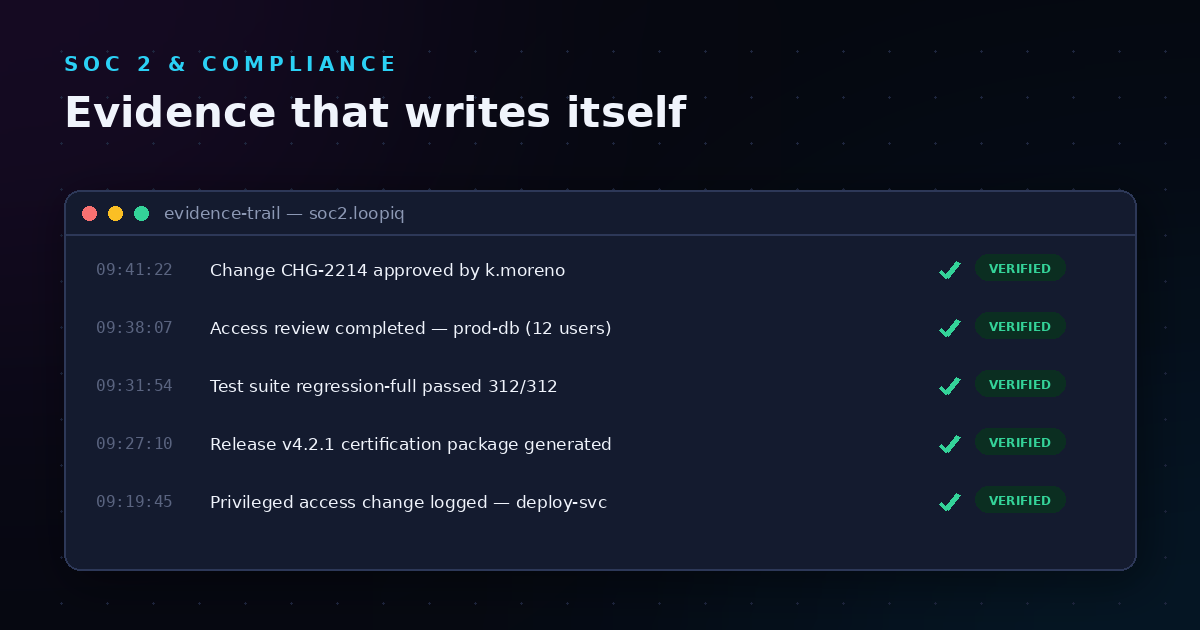
Connected compliance evidence means every signal relevant to a release—approvals, test results, security findings, deployment conditions—is captured automatically and bound to that specific release. When an auditor asks a question, the answer exists in a single source of truth.
This requires architectural change, not just process improvement. DevOps compliance research consistently shows that effective compliance automation happens when evidence capture is embedded in the delivery lifecycle itself, not bolted on afterward.
LoopIQ approaches this by unifying planning, development, testing, DevOps, ITSM, and compliance in one intelligent system. When your team ships, LoopIQ captures the evidence automatically—approvals, quality signals, security findings, and deployment conditions all bound to the release. There's no retroactive assembly because the evidence exists as a matter of record, not memory.
Start by documenting every tool involved in getting code from commit to production. Include source control, CI/CD, security scanning, test automation, artifact management, deployment orchestration, change management, and incident response.
For each tool, identify what evidence it generates and where that evidence lives. Note the integrations between tools—which connections exist, which are manual, and which don't exist at all.
Pick a release from the past quarter and attempt to reconstruct the complete evidence chain. Track every approval, test result, security finding, and deployment decision. Document how long it takes and which gaps you encounter.
This exercise reveals the true cost of your current architecture. Most teams discover that what feels like a connected pipeline actually requires significant manual effort to produce audit-ready documentation.
Look for places where information doesn't flow automatically between tools. Common gaps include security findings that don't connect to release decisions, approvals that exist in communication tools but not in your delivery system, and test results that aren't bound to specific builds.
Each gap represents both compliance risk and engineering overhead. Prioritize gaps based on audit impact and frequency of manual intervention.
Estimate the engineering hours your team spends on compliance documentation per release cycle and per audit period. Include time spent on retroactive evidence gathering, approval hunting, audit preparation, and responding to auditor questions.
This number often surprises engineering leaders. When you see compliance overhead as a concrete cost—measured in engineer-days diverted from shipping—the business case for architectural change becomes clear.
The most direct way to reduce tool stack risk is to reduce the number of tools in your stack. Evaluate whether multiple specialized tools can be replaced with a unified platform that handles multiple functions while maintaining evidence continuity.
Consolidation isn't always practical—some specialized tools serve critical functions that general platforms don't match. But every tool you eliminate removes integration complexity, evidence gaps, and maintenance overhead.
When consolidation isn't feasible, enforce consistent policies across your toolchain. Define approval requirements, testing thresholds, and security gates that must be satisfied before code advances through your pipeline.
The key is connecting these policies to automated evidence capture. A policy that requires security review means nothing to auditors unless you can prove the review happened for each release.
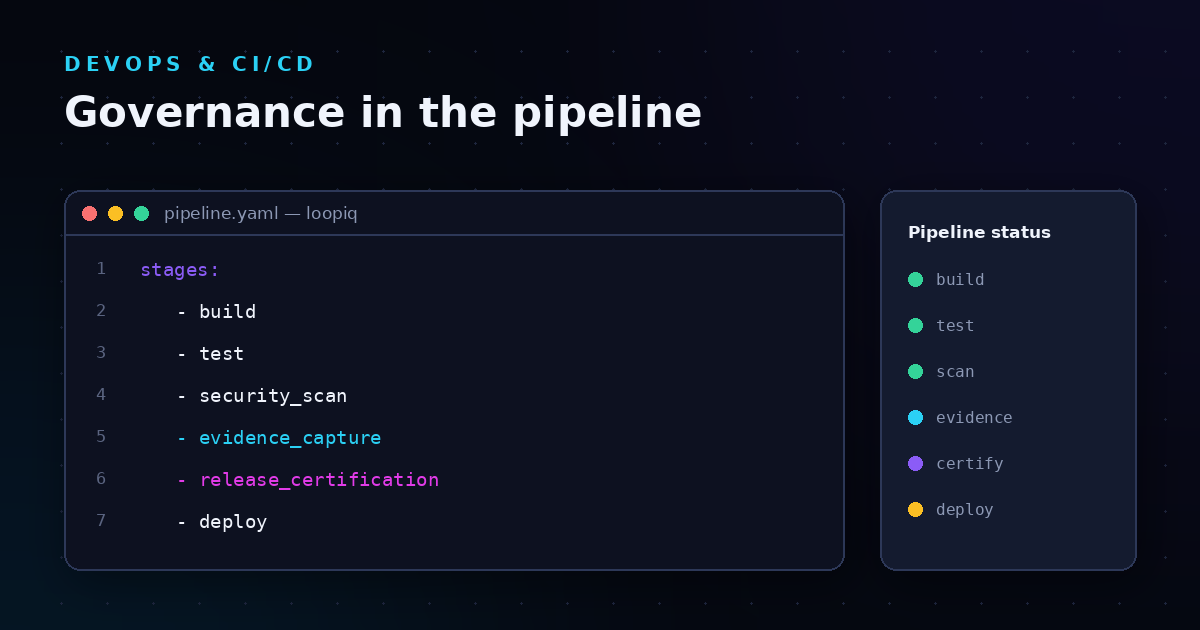
The most effective strategy treats compliance not as an external checkpoint but as integrated evaluation throughout delivery. Every commit, build, test, and deployment generates evidence automatically. Approval requirements are enforced by the system, not by process documents.
LoopIQ embeds compliance tracking into daily delivery, capturing approvals and quality signals into a defensible release trail. This means your team stops duplicating work—you ship features and the compliance evidence captures itself from the work already done.
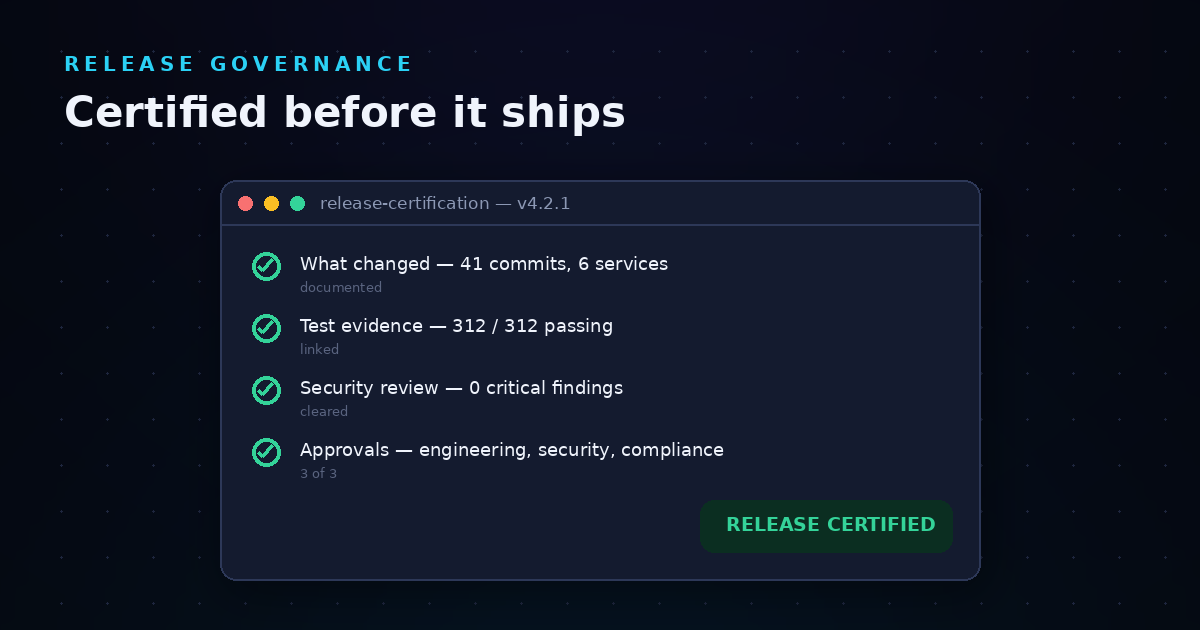
A release certification trail connects every approval, test result, and security finding to a specific release. When auditors ask whether a release was evaluated under defined conditions, the answer is a single artifact—not a collection of screenshots from five different systems.
This approach transforms audit preparation from an emergency project into a structured review. The evidence already exists; the auditor simply accesses it.
Unified delivery context means every signal relevant to your software delivery—from planning through production—exists in a connected system where relationships between artifacts are preserved. Security findings connect to the commits that introduced them and the releases that resolved them. Approvals bind to specific deployments. Test results trace to requirements.
This context matters for DevOps security compliance because auditors don't evaluate individual tools—they evaluate your controls as a system. When your evidence exists in unified context, demonstrating control effectiveness becomes straightforward.
Without unified context, you're asking auditors to trust that disconnected records from multiple systems tell a coherent story. That's a harder case to make, especially when gaps exist.
LoopIQ addresses tool stack risk by unifying the software delivery lifecycle and compliance evidence capture in one platform. Instead of running separate tools for planning, development, testing, DevOps, ITSM, and compliance—each generating disconnected records—LoopIQ connects these functions in a single intelligent system.
When your team ships through LoopIQ, the platform automatically generates compliance dossier artifacts per release, including immutable approval records and auditor-ready certification packages. Security findings from GitHub and Datadog integrate into the release evidence, eliminating the gap between security operations and audit documentation.
LoopIQ preserves the state of the world at decision time—not reconstructed after the fact, but captured at the moment decisions are made. This architectural difference means your compliance evidence supports audit defensibility and leadership trust without pulling senior engineers off shipping.
LoopIQ captures evidence as a byproduct of engineering work. Your developers don't change how they code, review, or deploy. The platform captures approvals, test results, and deployment conditions automatically, binding them to releases without additional steps.
This eliminates the duplicate work that fragmented toolchains create. You ship features. The evidence captures itself.
LoopIQ's release certification reviews evidence and flags compliance gaps before shipping. Every release carries connected signals—validations, approvals, and conditions visible in one place. When you need to prove how a release happened months later, the evidence exists as a matter of record.
This certification approach transforms compliance from periodic audit season work into something that happens with every release. Your audit readiness is always on, not a quarterly scramble.
The most compelling business case for reducing tool stack risk starts with hard numbers. Calculate the engineering hours your team currently spends on compliance documentation—per release, per audit, and annually. Include time spent by senior engineers who could otherwise be shipping.
Most regulated teams find that compliance overhead represents a significant percentage of engineering capacity. When leadership sees that number, the investment in architectural change becomes easier to justify.
Audit findings carry concrete costs—remediation effort, delayed certifications, customer concerns, and potential contract implications. If your current toolchain creates gaps that lead to findings, those findings have business impact.
Frame tool stack consolidation as risk reduction with measurable value, not just operational improvement.
When compliance evidence captures itself automatically, engineering hours return to shipping. Calculate the features, fixes, and innovations your team could deliver with the time currently spent on documentation and audit preparation.
This velocity recovery often represents the largest return on investment in unified delivery platforms—not just compliance improvement, but accelerated delivery.
When teams recognize their integration gaps, the instinct is often to add another tool—an integration platform, a compliance layer, or a reporting dashboard. This approach adds complexity without addressing the root cause.
True risk reduction requires fewer seams between tools, not more bridges between disconnected systems.
If compliance documentation happens separately from delivery, you've created duplicate work by design. Teams ship features, then separately document compliance. This separation guarantees overhead and creates gaps.
The alternative is structural: work and records live on the same surface, evidence captures itself from delivery activities, and compliance becomes a byproduct rather than a separate effort.
Consolidating tools requires migration, and migration carries its own risks and costs. Realistic planning accounts for data migration, team training, integration rebuilding, and the temporary productivity dip that accompanies any platform change.
The key is comparing migration cost to the ongoing cost of your current architecture. A difficult migration that solves the root problem beats indefinite accumulation of compliance overhead.
CI/CD security generates signals throughout your pipeline—vulnerability findings, policy violations, test failures, and gate decisions. In a connected compliance architecture, these signals automatically become part of your release evidence.
This integration matters because CI/CD security signals answer the questions auditors ask. Was this release scanned for vulnerabilities? Were critical findings resolved before shipping? Did the deployment pass your security gates?
When your CI/CD security operates independently from compliance tracking, answering these questions requires investigation. When they're connected, the answers exist by default.
AI-driven automation helps regulated teams by operating on complete development context rather than isolated data from single tools. When AI has visibility across planning, development, testing, security, and deployment, it can identify compliance gaps early and generate evidence automatically.
LoopIQ uses AI-driven insights to flag compliance gaps before shipping, connecting delivery signals to release decisions with predictive intelligence. This proactive approach catches problems when they're easy to fix—not during audit preparation when finding a gap means scrambling to reconstruct what happened.
Governed AI automation also addresses the emerging challenge of AI agents performing engineering work. When AI agents contribute to your codebase, their actions need governance—approvals, mutation policies, and integration into your audit trail. Disconnected toolchains struggle to govern AI at scale; unified platforms handle it architecturally.
Track how long it takes to produce complete evidence documentation for a release. In a fragmented toolchain, this might take hours or days. In a unified architecture, it should be nearly instantaneous—the evidence exists; you simply access it.
Measure the total engineering time diverted to audit preparation and response. This metric captures the compliance velocity tax directly. Reducing this number means engineering capacity returns to delivery.
Track audit findings that stem from missing or incomplete evidence—approvals that couldn't be located, security findings without resolution documentation, releases without complete certification trails. These findings indicate tool stack risk manifesting as control failures.
Measure the percentage of releases with complete certification trails—all approvals documented, all security findings addressed, all test results linked. Incomplete certifications represent risk; complete certifications represent controlled releases.
Tool stack risk in regulated DevSecOps pipelines isn't a process problem—it's an architectural one. Disconnected tools create gaps in evidence ownership, scatter approval chains across systems, and force teams to reconstruct compliance documentation after the fact.
The path forward requires connecting compliance evidence and delivery context in a unified system. When evidence captures itself from engineering work, audit preparation becomes a structured review rather than an emergency project. When approval chains, security findings, and release decisions exist in one place, answering auditor questions takes minutes instead of days.
LoopIQ gives regulated DevSecOps teams this unified architecture—connecting planning, development, testing, DevOps, ITSM, and compliance in one intelligent system where work and records live on the same surface. Your team ships with confidence, and the compliance evidence exists as a matter of record.
Tool stack risk refers to compliance and operational vulnerabilities created by running multiple disconnected tools in your DevSecOps pipeline. Each tool generates separate records, creating gaps in evidence ownership and requiring retroactive assembly of compliance documentation during audits.
Fragmented toolchains scatter approval chains, test results, and security findings across separate systems. When auditors ask questions, teams must hunt through multiple platforms to reconstruct evidence. This takes time, increases error risk, and can result in findings even when controls were followed.
Connected compliance evidence means every signal relevant to a release—approvals, tests, security findings, deployment conditions—is captured automatically and bound to that release. LoopIQ creates connected compliance evidence by capturing these signals as your team ships, eliminating retroactive assembly.
Regulated teams commonly run five or more separate tools across planning, development, security scanning, testing, deployment, and incident management. Each tool adds integration complexity and potential gaps in compliance evidence ownership.
The compliance velocity tax represents engineering hours diverted from shipping to compliance documentation. Teams often lose substantial time per release cycle to evidence assembly. LoopIQ eliminates this tax by capturing evidence automatically as a byproduct of delivery work.
LoopIQ unifies the software delivery lifecycle and compliance evidence capture in one platform. Instead of running disconnected tools, teams get a single intelligent system where approvals, security findings, and test results automatically bind to releases—creating audit-ready certification trails without additional effort.
Release certification connects every approval, test result, and security finding to a specific release artifact. LoopIQ's release certification reviews evidence and flags compliance gaps before shipping, ensuring each release carries complete documentation for audit defensibility.
Track engineering hours spent on evidence gathering, approval hunting, audit preparation, and auditor responses—per release and per audit cycle. Include senior engineer time diverted from shipping. This number reveals the business case for architectural change.
AI-driven automation helps when it operates on complete development context. LoopIQ uses AI to flag compliance gaps early and generate evidence automatically. The platform also governs AI agents performing engineering work, ensuring their actions integrate into audit trails.
Integration connects separate tools through APIs and bridges—evidence still lives in multiple places. Unification means work and records exist on the same surface from the start. LoopIQ takes the unification approach, where compliance evidence captures itself from delivery activities in one system.