.svg)
devops
compliance
audit evidence

Preparing for compliance audits often means digging through disparate tools, reconstructing approval chains, and piecing together evidence that should have been captured automatically. For VPs and Directors of Software Development managing mid-market and enterprise engineering organizations, this fragmented approach creates unnecessary risk and delays release cycles.
LoopIQ connects your SDLC events directly to automated evidence collection and release certification workflows, giving you a single place to review audit-ready compliance data. This guide walks you through every step of building a compliance evidence pipeline—from understanding the core concepts to configuring governance controls that keep your organization audit-ready year-round.
By the end, you'll know how to map delivery signals to evidence artifacts, establish approval workflows that satisfy auditors, and maintain a traceable record of every release decision your organization makes.
A compliance evidence pipeline is a structured system that captures, organizes, and stores audit artifacts as your development work progresses. Instead of scrambling to reconstruct evidence before an audit, you maintain a running record of every approval, test, scan, and deployment decision.
Evidence pipelines connect directly to your existing SDLC activities. When a pull request is merged, a test suite runs, or a deployment is approved, the pipeline automatically captures the relevant artifacts and links them to the corresponding release or compliance objective.
This approach shifts compliance from a periodic event to a built-in attribute of your delivery process. According to a recent analysis from Regulated DevSecOps, organizations that build structured evidence repositories avoid the "costly, error-prone scramble that characterizes ad-hoc evidence collection."
Manual evidence gathering consumes significant engineering time and introduces reliability risks. When your team exports logs, captures screenshots, and forwards email approvals, evidence quality degrades and gaps emerge.
Ad-hoc collection creates several problems that compound over time. Evidence collected after the fact may not accurately reflect what happened during the actual control activity. Different team members produce artifacts in inconsistent formats—PDFs, screenshots, CSV exports—making verification difficult.
When auditors arrive, they rightly question whether reconstructed evidence reflects actual events. This uncertainty leads to extended audit timelines, additional requests for clarification, and potential findings that could have been avoided.
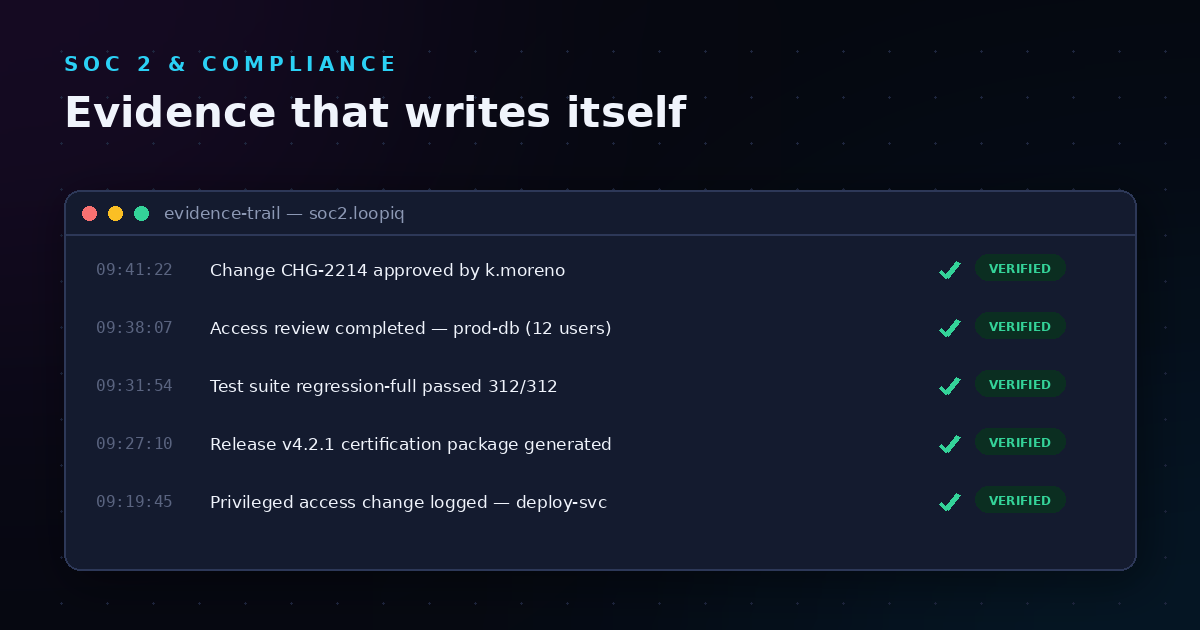
Automated evidence collection captures artifacts at the moment they're created. When a code review is approved, the approval record is logged immediately with timestamps, reviewer identity, and the specific changes reviewed.
This real-time capture eliminates the gap between control activities and evidence availability. Your compliance posture becomes visible at any moment, not just during the weeks before an audit window.
Building an effective evidence pipeline starts with identifying which development activities generate audit-relevant artifacts. The most valuable evidence comes from events that demonstrate control effectiveness.
Every code change that reaches production should have a traceable review record. This includes the identity of the reviewer, the timestamp of the approval, and the specific commit or changeset that was reviewed.
Branch protection configurations also serve as evidence of control design. Documenting that your repositories require approvals before merging demonstrates that segregation of duties controls are operating.
Automated test results demonstrate that quality controls are functioning. Capture pass/fail outcomes, coverage metrics, and any test failures that were resolved before release.
Security scan outputs—including static analysis, dependency scanning, and container scanning—show that you're identifying and addressing vulnerabilities before deployment. Store these results with timestamps and links to the specific build they evaluated.
Deployment approvals are critical evidence for change management controls. Record who approved each deployment, when the approval occurred, and what specific version or release was authorized.
Deployment attestations capture what actually reached production. Linking these attestations to the corresponding approval records creates a complete chain of evidence from decision to execution.
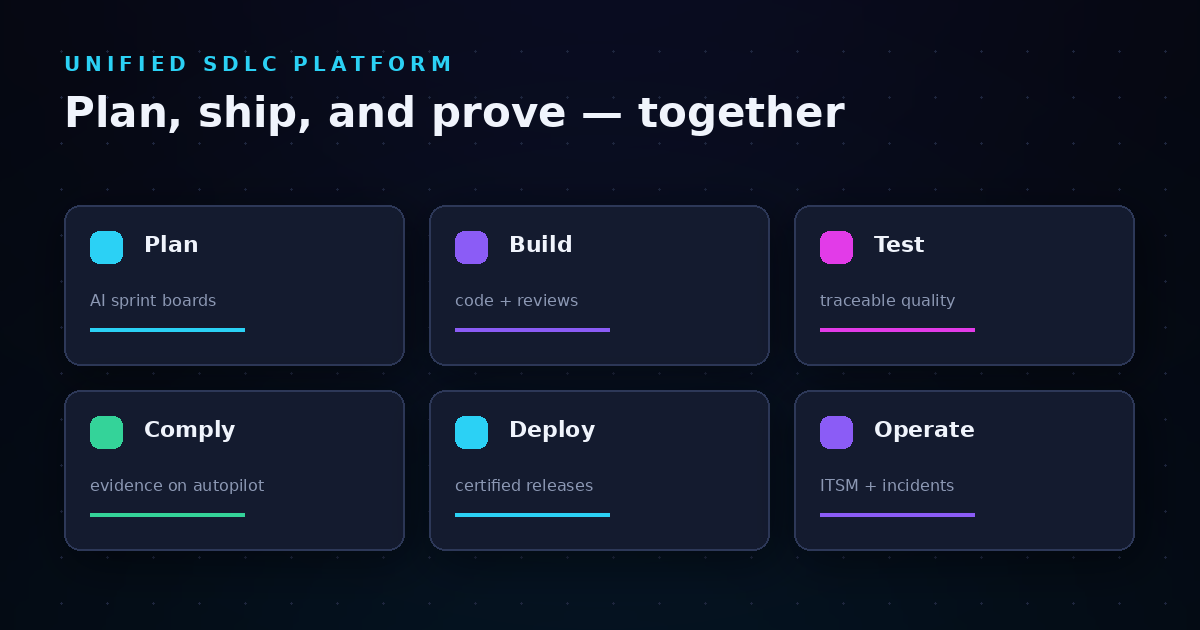
LoopIQ unifies your planning, testing, DevOps, ITSM, and compliance activities in one workspace. This integration means that evidence is captured automatically as your teams do their normal work—no separate data entry or manual uploads required.
LoopIQ lets you connect your delivery records directly to compliance objectives and policies. When a release certification requires evidence of code review, testing, and security scanning, you can link those control activities to the certification record.
This connection creates traceability from the compliance requirement down to the specific work items that satisfy it. Auditors can follow the chain from objective to evidence artifact to underlying SDLC activity.
As your teams create work items, complete reviews, and move records through approval workflows, LoopIQ captures the relevant evidence automatically. Approval timestamps, reviewer identities, and status change histories are preserved without additional effort.
Test results and integration data flow into the same system, creating a unified evidence record that spans your entire delivery process. This eliminates the need to pull data from multiple disconnected tools during audit preparation.
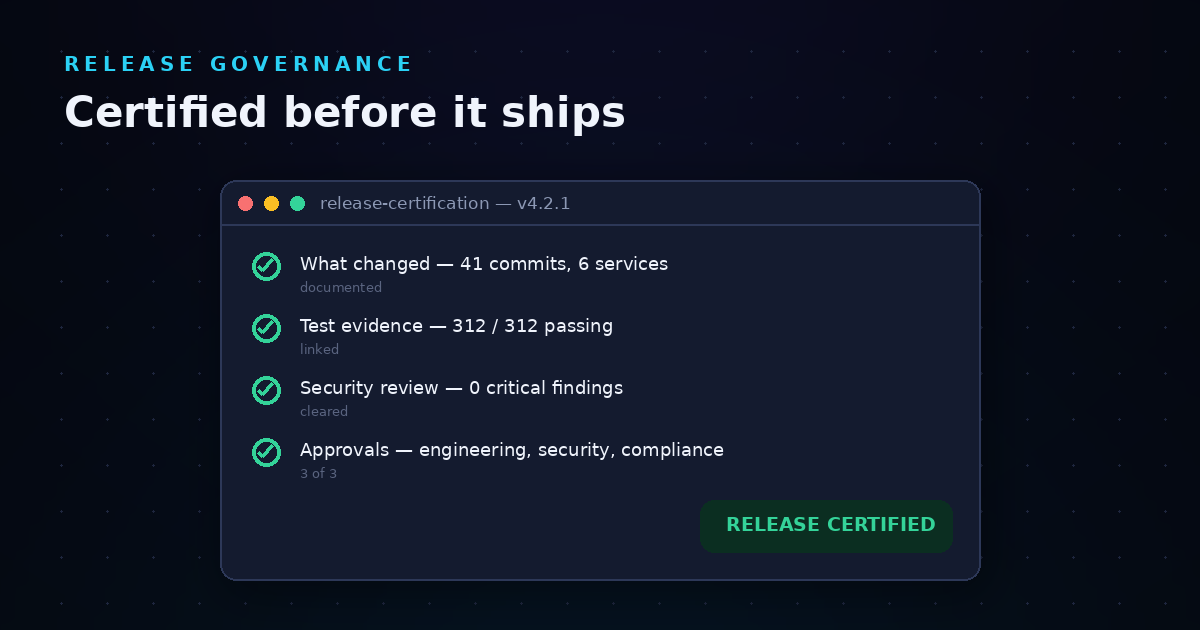
Release certification is the process of verifying that a deployment meets all governance requirements before it reaches production. A certification workflow defines what evidence must be present and who must approve before a release can proceed.
Start by identifying the controls that must be satisfied for each release type. Common requirements include completed code reviews, passing test suites, resolved security findings, and documented change requests.
Map each requirement to the evidence artifact that demonstrates compliance. Code review requirements link to approval records. Test requirements link to test run results. Security requirements link to scan outputs.
Define who must approve at each stage of the certification process. You might require development lead approval for feature completeness, QA approval for test coverage, and security approval for vulnerability remediation.
LoopIQ supports role-based approval policies that ensure the right people review certifications at the right time. These policies create accountability by recording exactly who approved each gate and when.
Constructing your evidence pipeline requires careful planning around what to capture, where to store it, and how to retrieve it. The following steps walk you through the process from initial setup to ongoing operation.
Begin by listing the frameworks and standards you need to satisfy. SOC 2, ISO 27001, HIPAA, PCI DSS, and industry-specific regulations each have different evidence requirements.
Map each framework's control requirements to specific SDLC activities. Access control requirements might map to code review approvals. Change management requirements might map to deployment authorization records.
For each control area, specify what evidence you need to collect and where it originates. Common evidence types include:
Connect your evidence sources to your collection system. In LoopIQ, this means enabling integrations with your version control, CI/CD, and security scanning tools.
Configure the system to capture evidence in real-time as activities occur. Avoid batch collection approaches that introduce delays between the control activity and evidence availability.
Define how long you need to retain evidence for each framework. SOC 2 audits typically cover 6-12 month observation periods. Other frameworks may require longer retention.
Store evidence in a tamper-evident repository where records cannot be modified after capture. Version control and audit trails ensure that evidence integrity can be verified during audits.
Design processes for retrieving evidence when auditors request it. Your system should support queries by control area, time period, release version, and other relevant dimensions.
Build reports that summarize compliance status across your portfolio. Dashboards showing certification status, outstanding approvals, and evidence coverage help you identify gaps before auditors do.
Effective evidence management requires clear accountability for who can create, approve, and modify compliance records. Role-based access controls ensure that evidence chain-of-custody remains intact.
Assign specific roles for different approval types. Development leads approve feature completeness. QA managers approve test adequacy. Security engineers approve vulnerability remediation.
LoopIQ enables you to configure approval policies that require specific roles at each workflow stage. This ensures that certifications receive appropriate review before releases proceed.
Distinguish between users who perform work and users who govern the process. Developers create and modify work items. Compliance officers review evidence and manage objectives.
This separation supports segregation of duties controls and ensures that evidence cannot be improperly modified by those whose work it documents.
Many organizations attempt to address compliance with combinations of specialized tools—one for code review, another for testing, another for deployment, and a separate GRC platform for compliance tracking. This fragmented approach creates integration challenges and evidence gaps.
When compliance evidence lives in multiple disconnected systems, you spend significant time aggregating data for audits. Each integration point is a potential failure point where evidence might be missed or delayed.
Fragmented systems also make it difficult to trace from compliance objectives to underlying evidence. Auditors must follow chains across multiple tools, increasing the risk of confusion and extended review cycles.
LoopIQ brings planning, delivery, testing, ITSM, and compliance into one platform. Because evidence is captured in the same system where work happens, there's no integration gap between activities and artifacts.
This unified approach means you can trace from a compliance objective to a release certification to the specific work items, approvals, and test results that support it—all without leaving the platform.
Organizations often encounter obstacles when implementing compliance evidence automation. Understanding these challenges helps you design a more robust pipeline from the start.
Capturing every possible artifact creates noise that obscures relevant evidence. Focus on artifacts that directly demonstrate control effectiveness for your specific frameworks.
Conversely, collecting too narrowly leaves gaps when auditors request evidence you haven't captured. Map your framework requirements thoroughly before determining what to collect.
Evidence must be timely, accurate, and tamper-evident. Artifacts captured days after an event occurred raise auditor concerns. Screenshots without timestamps lack credibility.
Ensure your collection mechanisms capture metadata like timestamps, user identities, and system identifiers that establish evidence reliability.
Building collection workflows without testing retrieval leads to unpleasant surprises during audits. Conduct practice audits where you retrieve evidence for sample control periods.
Identify gaps in your collection coverage and fix them before actual auditors discover missing artifacts.
Evidence pipelines require ongoing attention as your tools, processes, and compliance requirements evolve. Establish maintenance practices that keep your pipeline effective.
Schedule periodic reviews of your evidence collection against framework requirements. As you add new tools or change processes, verify that evidence capture remains comprehensive.
When frameworks publish updated guidance, assess whether your collection mechanisms need adjustment to capture newly required artifacts.
Track metrics like evidence capture rates, collection latency, and storage utilization. Anomalies in these metrics may indicate integration failures or configuration drift.
Set up alerts for collection failures so you can address issues before they create evidence gaps.
Practice retrieving and reviewing evidence as if you were an external auditor. This exercise reveals gaps, format inconsistencies, and retrieval challenges that you can fix proactively.
Use findings from internal audits to improve your pipeline design and collection coverage.
Measuring your compliance operations helps you identify improvement opportunities and demonstrate governance effectiveness to stakeholders.
Track the percentage of control requirements with corresponding evidence collection configured. Aim for complete coverage across all frameworks you need to satisfy.
Monitor the percentage of control activities that successfully generate evidence artifacts. Collection failures indicate integration issues that need attention.
Measure the time from release readiness to certification completion. Long certification cycles may indicate bottlenecks in approval workflows or missing evidence that requires investigation.
Track the percentage of certifications that complete without requiring evidence remediation. High first-pass rates demonstrate effective upstream controls.
Monitor time spent preparing for audits before and after pipeline implementation. Effective automation should significantly reduce preparation effort.
Track audit findings related to evidence quality or availability. Declining findings indicate improving pipeline effectiveness.
Visibility into compliance status enables proactive governance. Dashboards that surface relevant information help you identify and address issues before they become audit findings.
Provide leadership with summary views showing overall compliance posture across your portfolio. Highlight certifications pending approval, overdue reviews, and framework coverage gaps.
These views enable executives to understand compliance risk without requiring detailed operational knowledge.
Give compliance officers and team leads detailed views into evidence collection status, pending approvals, and certification progress.
LoopIQ includes role-specific dashboards that present information relevant to each user's responsibilities. Compliance managers see objective progress and evidence gaps. Approvers see pending certifications awaiting their review.
Compliance evidence pipelines turn audit preparation from a reactive scramble into a managed, automated process. By connecting your SDLC events directly to evidence collection and release certification workflows, you maintain audit readiness as a natural byproduct of your normal delivery activities.
The key steps involve identifying your compliance frameworks, mapping control requirements to evidence sources, configuring automated collection, and establishing certification workflows with clear approval roles. Regular maintenance and internal audits keep your pipeline effective as requirements and tools evolve.
LoopIQ gives you a single workspace where delivery work, compliance objectives, and audit evidence connect directly. Rather than assembling evidence from fragmented tools, you trace from compliance requirements to supporting artifacts in one system—reducing audit preparation time and improving evidence reliability.
An audit-ready pipeline captures code review approvals, test results, security scan outputs, deployment authorizations, and release certifications. LoopIQ automates this capture as your teams complete their normal SDLC activities, eliminating the need for manual evidence collection.
Retention periods depend on your compliance frameworks. SOC 2 audits typically review 6-12 months of evidence. Other frameworks may require longer retention. Configure your storage policies based on the longest applicable retention requirement for your organization.
Yes, effective evidence pipelines integrate with your existing version control, CI/CD, and security scanning tools. LoopIQ connects work activity, operational records, and compliance evidence in one platform through integrations with common development infrastructure.
Approval roles depend on your governance requirements and organizational structure. Common configurations include development leads for feature completeness, QA managers for test coverage, and security engineers for vulnerability status. LoopIQ supports role-based approval policies that enforce your specific requirements.
Automated collection ensures evidence is captured at the moment control activities occur, with accurate timestamps and user identities. This eliminates questions about evidence reliability that arise with after-the-fact collection. LoopIQ preserves audit traceability from compliance objectives through certification workflows to supporting evidence artifacts.
Monitor your pipeline for collection failures and configure alerts so you can address issues promptly. Gaps in evidence coverage create audit risk, so establish processes to remediate failures before they compound into significant missing evidence.