.svg)
devops
compliance
audit evidence

Building an AI-powered SDLC traceability framework means connecting every requirement, code commit, test result, and release artifact into a single evidence chain that auditors can follow. For seed-to-Series B SaaS engineering leaders, this approach solves the disconnect between building software quickly and proving you built it correctly. LoopIQ gives you an end-to-end workspace where compliance evidence captures itself as you work—no more scrambling before audits.
This guide walks you through the complete framework: what traceability means in practice, how AI accelerates evidence collection, the five layers of your traceability model, and a step-by-step implementation roadmap. By the end, you'll have a clear path from fragmented tools and scattered documentation to unified, audit-ready software delivery.
SDLC traceability is the ability to follow any artifact—a requirement, a line of code, a test case, or a release certification—backward and forward through your entire development process. When your auditor asks "show me the requirement that led to this code change," traceability gives you the answer in seconds rather than hours.
For growing SaaS teams, traceability solves three problems at once. First, it satisfies compliance frameworks like SOC 2, ISO 27001, and HIPAA that require documented evidence of controlled development practices. Second, it reduces the chaos of scattered tooling where context lives in Slack threads, Google Docs, and half-remembered conversations.
Third, traceability becomes your competitive advantage when enterprise buyers ask for proof of your development governance. According to research on SaaS startup security programs, teams have lost six-figure deals because they couldn't produce documentation showing how their code was reviewed, tested, and approved before release.
Traditional traceability requires you to manually link artifacts, update documentation, and remember to tag every commit with the right issue number. AI removes this burden by inferring connections, flagging missing links, and generating evidence documentation as a byproduct of your normal workflow.
AI-powered systems can analyze commit messages, pull request descriptions, and test names to suggest connections you might have missed. If a commit message mentions "fixing login timeout issue," AI can link it to the corresponding bug report and the test cases that verify the fix.
This means fewer gaps in your evidence chain. When something slips through without a proper link, the system alerts you before the gap becomes an audit finding.
Every approval, status change, and test run becomes timestamped evidence. AI organizes these artifacts into audit-ready reports, grouping them by control objective or compliance requirement. You stop treating compliance as a separate activity and start treating it as an automatic outcome of doing your work correctly.
Not all missing links carry equal risk. AI can flag high-priority gaps—like a production deployment without an associated change request—while deprioritizing minor documentation improvements. This lets you focus your limited time on what matters most for both compliance and actual software quality.
A complete traceability framework has five connected layers. Each layer feeds into the next, creating a complete evidence chain from initial requirement through production release.
Your traceability chain starts with documented requirements. These might be user stories, feature specifications, or enhancement requests. The key is having a unique identifier for each requirement that can be referenced throughout the lifecycle.
AI assists here by extracting requirements from unstructured sources like customer feedback, support tickets, or sales call notes. It can also identify when requirements conflict or overlap, reducing rework later in the process.
Design documents, architecture decision records, and technical specifications form the second layer. These artifacts explain why you built something a particular way—critical context for future audits and team members.
Link each design decision to the requirements it addresses. When an auditor asks why you chose a specific security architecture, you can trace backward to the security requirements that drove that decision.
Every code change needs a documented connection to the requirement or design decision it implements. Pull requests become your primary evidence artifact here, capturing the code diff, the review discussion, and the approval record.
Establish conventions for commit messages and branch naming that include requirement identifiers. AI can enforce these conventions automatically, rejecting commits that lack proper attribution.
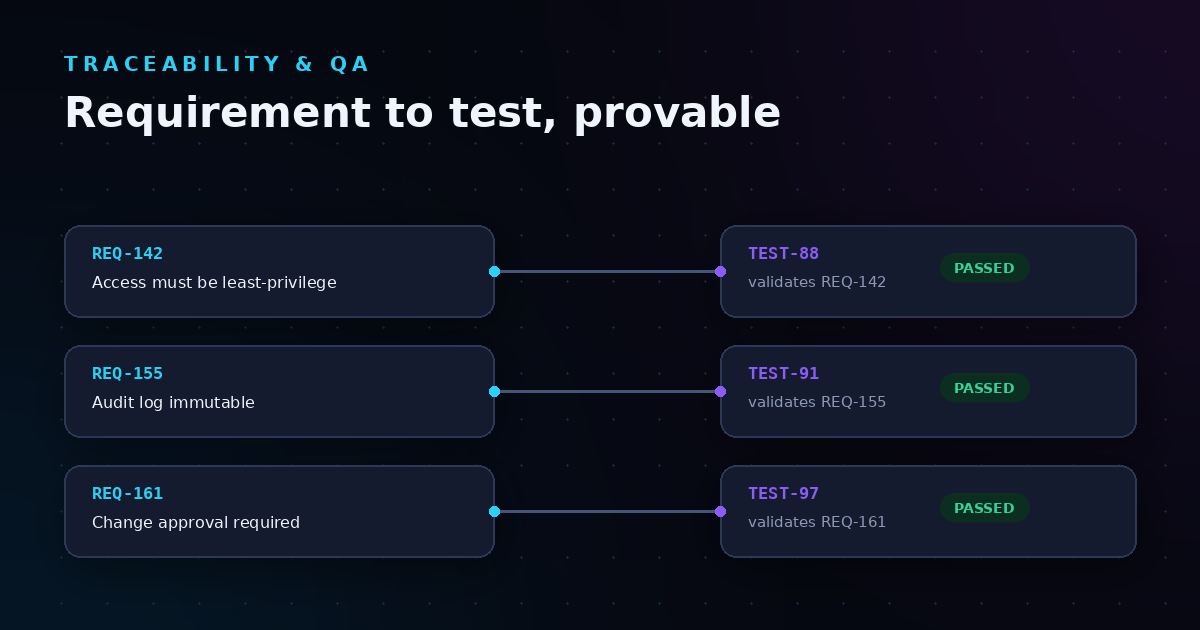
Test results prove your code does what the requirements specified. Link test cases to requirements, and link test runs to specific code versions. When a test passes, you have evidence that the requirement was implemented correctly at that point in time.
LoopIQ connects your test management directly to your delivery workflow, so test execution becomes part of your release readiness evidence rather than a separate reporting exercise.
The final layer captures what went to production and when. Release certifications summarize the requirements, code changes, and test results that comprise each release. Deployment logs prove when and how the release reached production.
This layer is where everything comes together. A complete release certification links backward to all the artifacts that justified deploying that code, creating your audit trail.
Implementing full SDLC traceability takes time, but you can build it incrementally. Start with high-value connections and expand from there.
Define what artifacts you'll track and how you'll identify them. Create a naming convention for requirements, stories, bugs, and tasks. Decide how these artifacts relate to each other—which artifacts can link to which other artifact types.
Document your taxonomy before you start implementing. This prevents confusion later when team members interpret conventions differently.
Start requiring requirement references in commit messages and pull request descriptions. This single practice creates the most valuable traceability links with the least process overhead.
Use automation to enforce this requirement. Reject pull requests that lack a linked requirement, or at minimum flag them for review.
Map your test cases to the requirements they verify. For existing tests, this may require a backfill effort. For new tests, build the requirement link into your test creation workflow.
This mapping lets you answer "what tests cover this requirement?" and "what requirements does this test verify?"—both essential for compliance and for understanding test coverage.
Configure your tools to capture evidence automatically. This includes approval timestamps, status change history, test results, and deployment logs. The goal is zero manual evidence assembly at audit time.
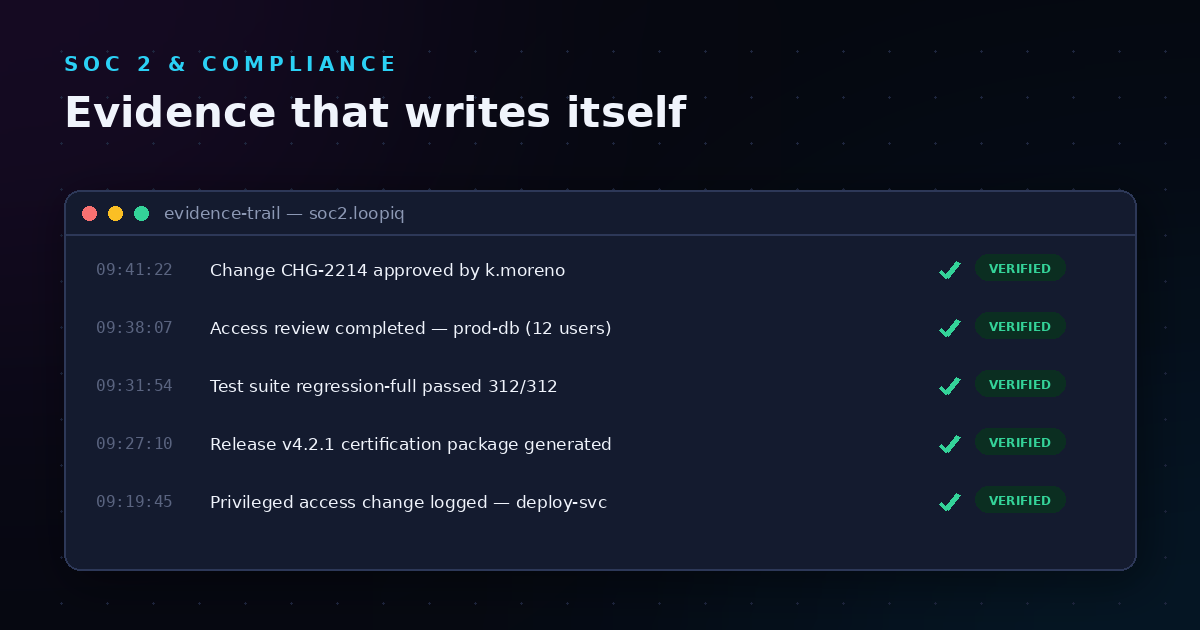
LoopIQ automates compliance evidence collection as part of your normal workflow. When you approve a change, that approval becomes evidence. When you run tests, those results become evidence. No extra steps required.
Create a release certification process that pulls together all the artifacts for a given release. This certification should include linked requirements, code changes, test results, and approvals.
Automate the certification assembly where possible. When you're ready to release, the certification should build itself from the artifacts you've already created.
Add dashboards that show traceability coverage: how many requirements have linked code changes, how many code changes have linked tests, how many releases have complete certifications.
Use these dashboards to identify and fix gaps before audits. Regular reviews help you catch problems when they're easy to fix rather than when an auditor is asking questions.
Different compliance frameworks emphasize different aspects of traceability. Understanding what each framework requires helps you prioritize your implementation.
SOC 2 requires evidence that changes are authorized, tested, and approved before deployment. Your traceability framework should capture who requested each change, who reviewed it, who approved it, and what testing verified it.
The NIST Secure Software Development Framework (SSDF) aligns closely with SOC 2 change management controls, giving you a reference for what evidence to collect.
ISO 27001 Annex A.12.1 covers change management for development environments. You'll need evidence of change requests, impact assessments, testing records, and approval documentation.
Traceability supports ISO 27001 by proving that your change management process operates consistently across all changes, not just the ones an auditor samples.
HIPAA requires documentation of your security policies and procedures, including how you manage changes to systems that handle protected health information. Traceability provides the detailed evidence that your documented procedures actually happen.
Focus on tracing changes that affect data handling, access controls, and audit logging capabilities. These areas receive the most scrutiny in HIPAA audits.
LoopIQ approaches traceability differently than bolting together separate tools. Everything lives in one workspace: requirements, code activity, test management, compliance evidence, and release governance. This unified approach means traceability happens automatically because all the artifacts already connect.
When you create a requirement in LoopIQ, it gets a unique identifier that follows it through the entire lifecycle. When you link a code change to that requirement, the connection is permanent and auditable. When tests execute against that code, results link back to the original requirement.
No manual linking between systems. No wondering whether your issue tracker ID matches your test management ID. One system, one identifier, complete traceability.
LoopIQ uses AI to capture evidence as you work. Every approval, every status change, every test run becomes timestamped evidence associated with the right artifacts. AI helps identify gaps—requirements without linked code, code without linked tests—before they become audit findings.
This AI assistance extends to drafting documentation, analyzing records, and preparing release readiness context. You focus on building software while LoopIQ handles the evidence capture.
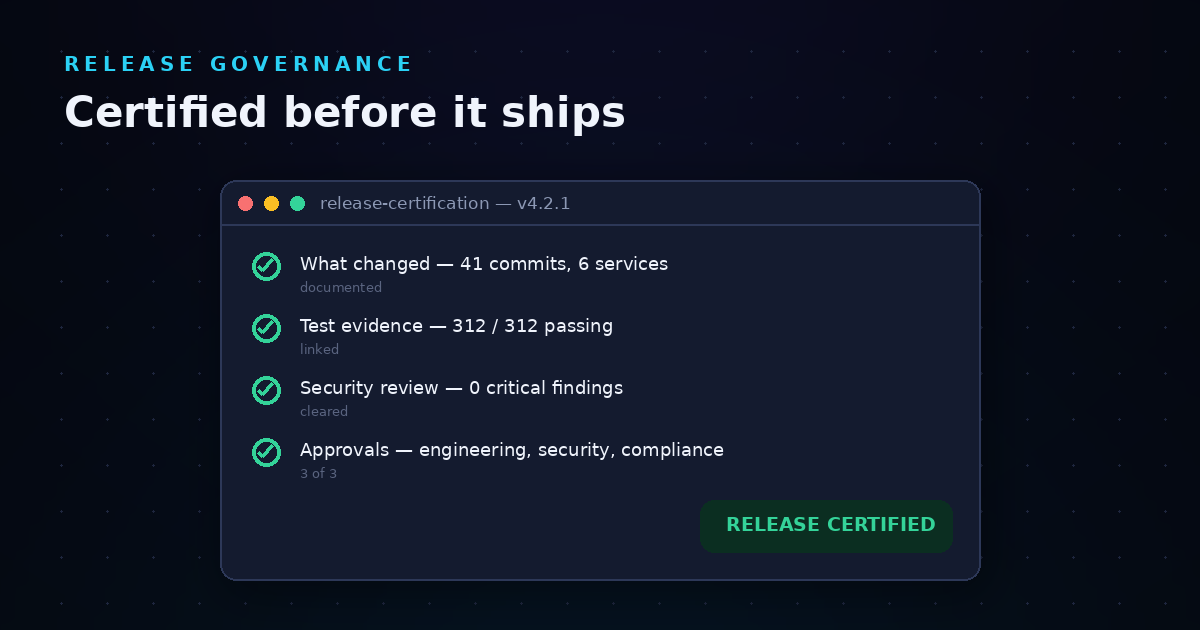
Release certifications in LoopIQ pull together all the evidence for a given release automatically. When you're ready to certify a release, you see exactly what requirements are included, what code changed, what tests passed, and who approved each step.
If something is missing—a requirement without test coverage, a code change without approval—the certification process flags it. You fix gaps during development, not during audit preparation.
Even with good tools, traceability implementation hits common obstacles. Here's how to address them.
Developers resist anything that slows them down. If traceability requires extra manual steps, adoption will be poor.
The solution is making traceability automatic and invisible. Use tools that capture evidence without developer action. When developers do need to add information—like a requirement reference in a commit message—make it as frictionless as possible with autocomplete and templates.
Existing codebases may have years of history without proper linking. Trying to backfill all historical traceability is often impractical.
Focus forward instead. Establish traceability for all new work while accepting that historical gaps exist. Over time, as you modify legacy code, you can add traceability links incrementally.
When you use separate tools for issue tracking, code review, testing, and deployment, traceability requires complex integrations. Each integration point is a potential gap where links get lost.
Consider consolidating onto a unified platform that handles the full lifecycle. LoopIQ's single-workspace approach eliminates integration gaps because everything lives in one system with native connections.
Requirements change, code gets refactored, tests get rewritten. Traceability links that were accurate at creation may become misleading over time.
Build traceability maintenance into your workflow. When you modify a requirement, review its linked artifacts. When you refactor code, update the requirement links. Treat traceability data as living documentation that requires ongoing attention.
How do you know if your traceability framework is working? Track these metrics to measure progress and identify improvement areas.
Measure the percentage of requirements with linked code changes, code changes with linked tests, and releases with complete certifications. These percentages show how much of your development work is traceable.
Set targets for each metric and track progress over time. Most teams start below 50% and work toward 90%+ coverage for critical artifact types.
Measure how quickly you identify traceability gaps. Ideally, you catch missing links during development, not during audit preparation.
Track when gaps are found (during development, during release certification, during audits) and work to shift detection earlier in the process.
Measure how long it takes to prepare for compliance audits. With strong traceability, preparation time should decrease because evidence is already organized and accessible.
Teams with mature traceability frameworks report preparation times measured in hours rather than weeks. This metric directly shows the business value of your traceability investment.
Traceability that works for a five-person team may not scale to fifty people. Plan for growth by building scalable practices from the start.
Naming conventions that are "obvious" to a small team become confusing as new members join. Document your conventions explicitly and enforce them with automation.
Include examples of good and bad names. Explain not just what the convention is, but why it matters for traceability.
Manual traceability steps that are manageable at small scale become unsustainable as volume increases. Automate link creation, gap detection, and evidence assembly early.
Treat automation as an investment that pays dividends as you grow. The cost of building automation now is lower than the cost of scaling manual processes later.
Assign ownership for traceability quality. Someone needs to monitor coverage metrics, address systemic gaps, and ensure conventions are followed.
As teams grow, this ownership may distribute across team leads or quality engineers. The key is that someone is accountable for traceability health.
SDLC traceability transforms how you demonstrate compliance and control to auditors, investors, and enterprise customers. By connecting requirements through code, tests, and releases, you create an evidence chain that proves your development process works correctly.
AI makes this traceability practical by automating evidence capture, inferring connections, and flagging gaps. Instead of building compliance documentation as a separate activity, you generate it automatically as a byproduct of building software.
Start with a clear artifact taxonomy, establish code-to-requirement linking, connect tests to requirements, automate evidence collection, and build release certification workflows. LoopIQ gives you a unified workspace where this entire framework operates together, reducing the tool sprawl and integration complexity that typically derails traceability initiatives.
For seed-to-Series B SaaS teams, investing in traceability now prepares you for enterprise sales, investor due diligence, and regulatory compliance. The teams that build this capability early gain a lasting advantage over competitors still scrambling to reconstruct evidence before each audit.
At minimum, link every code change to a requirement or issue. This single practice creates the foundation for traceability.
LoopIQ makes this easy by capturing requirement links automatically when you work in the unified workspace. You don't need a full compliance program to start building traceable development practices.
A complete implementation typically takes 10-12 weeks for a small to mid-sized team. This includes taxonomy design, tool configuration, process rollout, and initial gap remediation.
You can start seeing value sooner by implementing in phases. Code-to-requirement linking alone delivers significant traceability benefits in 2-3 weeks.
Yes, but integration complexity increases with each additional tool. Most teams connect issue trackers, version control, CI/CD, and test management through custom integrations or middleware.
LoopIQ simplifies this by unifying these capabilities in a single platform. Instead of integrating separate tools, you work in one workspace where traceability is built in.
Auditors typically request change request documentation, code review records, test results for specific changes, deployment approval evidence, and release certification records.
With proper traceability, you can produce this evidence in minutes. LoopIQ's AI-powered evidence capture organizes artifacts by control objective, making audit response fast and accurate.
Emergency fixes still need traceability, but the process may be compressed. Create the requirement and approval records, then backfill detailed documentation within a defined timeframe (typically 24-48 hours).
Document your emergency fix process explicitly. Auditors understand that emergencies happen—they want to see that you have a controlled process even for urgent situations.
Poorly implemented traceability adds friction. Well-implemented traceability is nearly invisible to developers because evidence captures automatically.
LoopIQ automates evidence collection so your team focuses on building software. Traceability becomes a byproduct of your normal workflow rather than an additional burden.