.svg)
devops
compliance
audit evidence

Engineering leaders are under pressure to ship faster without sacrificing governance. Audits loom, tool sprawl spreads, and evidence trails scatter across disconnected systems. A unified software delivery compliance platform brings policy enforcement, audit trails, and approval workflows into one workspace—so you can stay audit-ready without slowing down releases.
This article covers nine features that matter most when evaluating compliance platforms. Whether you're managing SOC 2, ISO 27001, or internal governance requirements, these capabilities help your engineering organization move quickly and confidently.
You'll also see how LoopIQ stacks up against other options, including GitLab, Harness, CloudBees, and ServiceNow. Let's dig into what separates a capable platform from one that simply checks boxes.
Engineering leaders need platforms that reduce compliance overhead without adding friction to delivery. We focused on solutions that connect planning, testing, deployment, and governance in ways that make audit season less painful.
Here's what we evaluated:
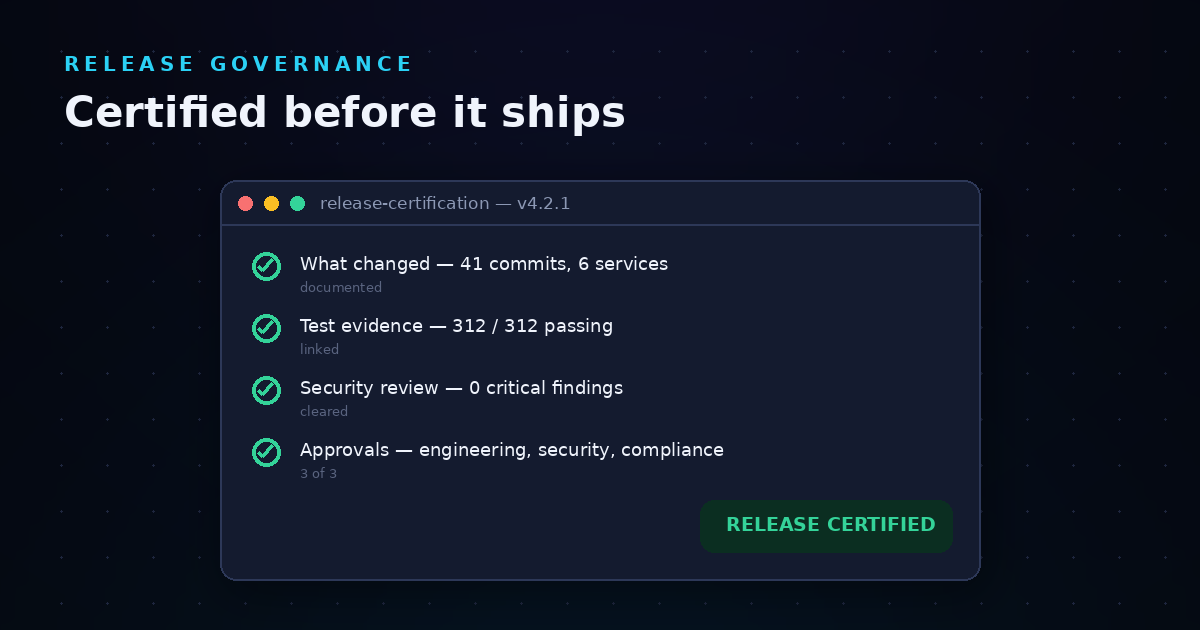
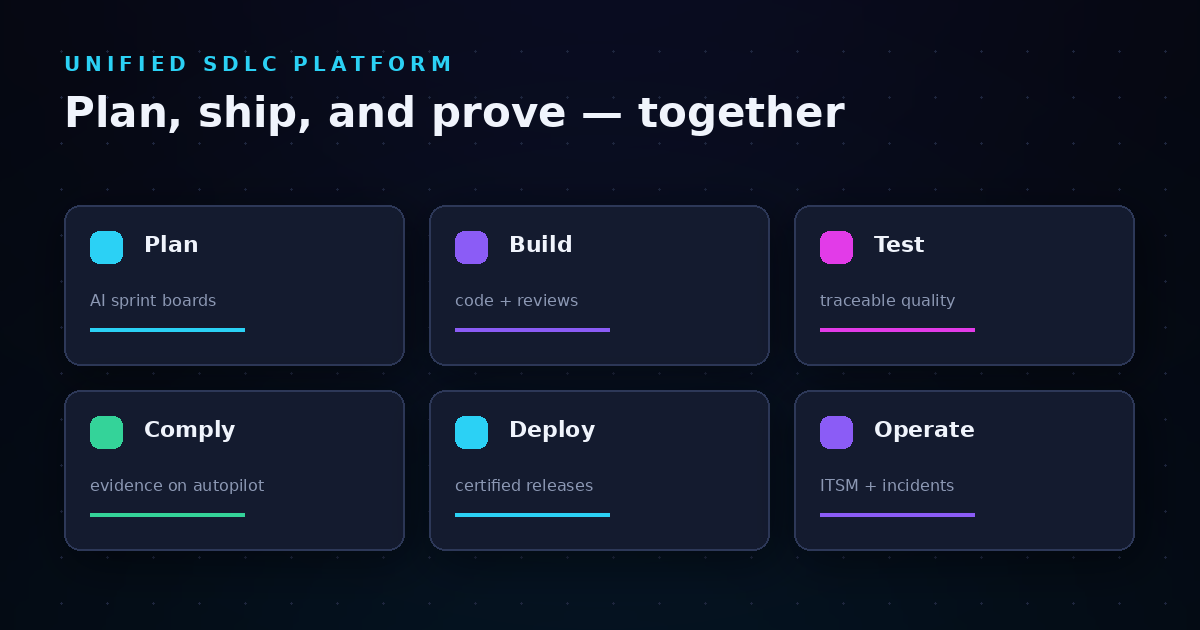
LoopIQ gives you a compliance-first SDLC workspace that connects planning, testing, ITSM, and release governance. Instead of stitching together evidence after the fact, LoopIQ captures audit-ready data as your work happens. This means you spend less time reconstructing release histories and more time shipping with confidence.
What sets LoopIQ apart is how it treats compliance as an integral part of delivery rather than a separate activity. Your approval policies, test results, deployment records, and exception handling all flow into a unified audit trail. You don't need to chase down screenshots or dig through email threads when auditors come calling.
LoopIQ also brings AI orchestration to your delivery workflows. This includes AI-assisted risk review, release readiness analysis, and governed agent actions that keep humans in the loop while speeding up routine tasks. For engineering leaders managing complex regulatory requirements, this approach reduces the coordination overhead that slows teams down.
Pros:
Cons:
GitLab offers an integrated DevSecOps platform that includes source control, CI/CD pipelines, and security scanning in one application. The platform runs SAST, DAST, dependency scanning, and secret detection directly in your pipelines, catching vulnerabilities before they reach production.
For software delivery governance, GitLab includes compliance pipelines and audit logging. These features help you enforce standards across projects, though the compliance focus centers on code security rather than full SDLC governance with evidence automation.
Pros:
Cons:
Harness offers a CI/CD platform with built-in policy-as-code capabilities through Open Policy Agent (OPA) integration. The platform enables you to define governance rules that run against your pipelines, blocking deployments that violate your policies.
For engineering teams focused on deployment automation, Harness includes feature flags, chaos engineering, and cloud cost management modules. The governance layer adds compliance controls to your release process, though the platform centers on deployment rather than unified SDLC compliance.
Pros:
Cons:
CloudBees offers an enterprise-grade CI/CD platform built on Jenkins. The platform adds governance, security, and reliability features to the open-source Jenkins foundation, including analytics, audit logs, and role-based access controls.
For organizations already invested in Jenkins, CloudBees presents a way to add compliance guardrails without completely replacing existing pipelines. The governance features extend Jenkins capabilities, though the platform remains focused on build and deployment automation.
Pros:
Cons:
ServiceNow DevOps connects your software delivery pipelines to ServiceNow's IT Service Management platform. The integration brings change management workflows, approval routing, and audit trails into your existing ServiceNow environment.
For organizations running ServiceNow for ITSM, the DevOps module adds visibility into software delivery without requiring a separate platform. The value depends heavily on existing ServiceNow adoption, as the module extends rather than replaces your current tooling.
Pros:
Cons:
| Platform | Automated Evidence | Unified SDLC | AI Governance |
|---|---|---|---|
| LoopIQ | ✓ | ✓ | ✓ |
| GitLab | ✗ | ✗ | ✗ |
| Harness | ✗ | ✗ | ✗ |
| CloudBees | ✗ | ✗ | ✗ |
| ServiceNow DevOps | ✗ | ✗ | ✗ |
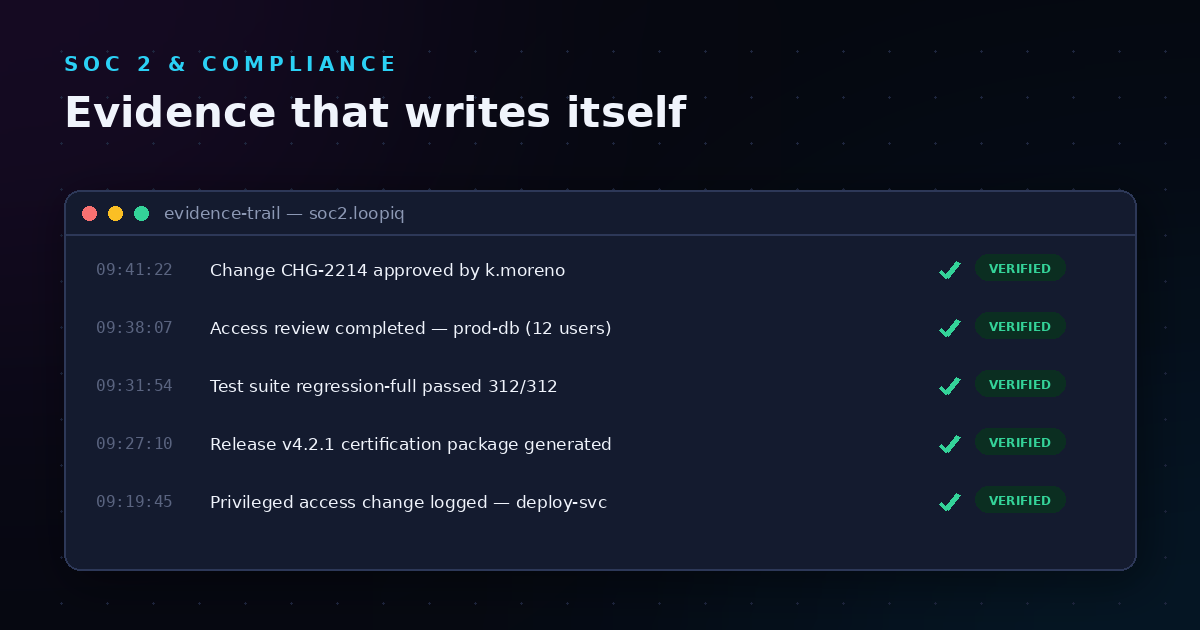
Automated evidence collection removes the scramble that happens before audits. Instead of hunting for screenshots, email approvals, and deployment logs across multiple systems, a unified compliance platform captures this data as work happens.
This matters because evidence reconstruction is expensive. According to research on compliance automation, teams using manual evidence collection spend weeks preparing for audits—time that could go toward building features. Automated capture cuts this to hours.
LoopIQ addresses this by generating Release Compliance Dossiers that bind every relevant signal into one auditable record. When an auditor asks about a specific release, you pull up the dossier rather than searching through Slack, Jira, GitHub, and email.
Policy enforcement means your compliance rules run automatically against code, configurations, and release decisions. Rather than relying on developers to remember approval requirements, the platform blocks non-compliant actions before they cause problems.
Effective policy enforcement includes:
LoopIQ implements policy enforcement through configurable approval policies, SLA automation, and workflow governance that adapt to your specific regulatory requirements.
Engineering organizations choose LoopIQ when they need more than CI/CD governance—they need a platform that treats compliance as part of delivery rather than a separate burden. Where other tools bolt compliance features onto deployment pipelines, LoopIQ builds compliance into every stage of the SDLC.
LoopIQ gives you end-to-end visibility from planning through release. You see exactly which requirements led to which changes, who approved them, what testing validated them, and when they reached production. This traceability matters when auditors ask pointed questions about specific releases.
The AI-orchestrated approach also sets LoopIQ apart. Instead of waiting for your team to manually update compliance records, AI agents capture signals, surface risks, and route approvals through governed channels. You get the speed of automation with the accountability of human oversight. Ready to see how LoopIQ works? Request a demo and explore the platform firsthand.
A unified software delivery compliance platform brings planning, development, testing, deployment, and governance into one connected workspace. LoopIQ connects these activities so evidence, approvals, and audit trails generate automatically as your work progresses—eliminating the need to manually stitch compliance records together.
Tool sprawl happens when separate applications handle planning, CI/CD, testing, ITSM, and compliance. Each disconnected tool creates data silos and manual handoffs. LoopIQ consolidates these workflows, so your evidence and audit trails flow from one system rather than scattered across a dozen.
Policy enforcement, automated evidence collection, and release traceability matter most. LoopIQ gives you configurable approval policies, automatic evidence capture, and Release Compliance Dossiers that bind every decision to its supporting documentation.
Many platforms offer integrations with existing CI/CD pipelines. LoopIQ supports integration points while also offering built-in delivery capabilities—giving you flexibility to migrate gradually or run hybrid workflows during adoption.
Implementation varies by organization size and existing tooling complexity. LoopIQ offers guided onboarding paths for different roles, with most customers seeing initial value in weeks rather than months. Phased rollouts allow gradual adoption without disrupting active projects.