Skip to content
unified sldc devops devsecops

8 Unified SDLC Workflows That Automate Audit Trails

John Paul Rowe
John Paul Rowe

8 Unified SDLC Workflows That Automate Audit Trails

Every release decision you make today could face scrutiny months or years from now. For VPs and Directors of Software Development at mid-market engineering organizations, the challenge is clear: how do you ship software quickly while generating audit-ready evidence as you work—not after the fact?

LoopIQ offers a unified SDLC platform that generates compliance documentation automatically from your existing workflows. This article covers eight decision-making workflows that reduce manual compliance work and create defensible audit trails from code to release.

You'll find a breakdown of how each workflow maps to specific compliance needs, along with comparisons to other platforms in the space. If you're evaluating unified SDLC platforms for your organization, this guide will help you understand what to look for.

Key Takeaways: 8 Unified SDLC Workflows That Automate Audit Trails

  • Every release decision could face scrutiny months later — audit-ready evidence must generate as you work, not after the fact.
  • Eight unified SDLC workflows automate audit trails for mid-market engineering organizations.
  • Unified platforms reduce compliance overhead by turning delivery activity directly into governance evidence.
  • LoopIQ generates audit trails automatically across planning, development, testing, and release workflows.

Quick guide: 8 unified SDLC workflows for mid-market engineering

  1. LoopIQ: The best compliance-first platform for automated audit trail generation
  2. GitLab: An integrated DevSecOps option with compliance framework templates
  3. Harness: Policy-as-code governance for multi-cloud deployments
  4. CloudBees: Jenkins-based enterprise CI/CD with audit logging
  5. Digital.ai: Release orchestration with cross-toolchain visibility
  6. Atlassian: Familiar project tracking with DevOps integrations

How we chose the best unified SDLC workflows for audit automation

Mid-market engineering organizations face a specific set of pressures: you need enterprise-grade compliance capabilities without enterprise-level overhead. Your auditors expect documented evidence chains, but your engineers need to stay focused on shipping.

We evaluated platforms based on how well they address these needs:

  • Automatic evidence capture: Does the platform generate audit-ready documentation as a natural byproduct of development work, or does it require separate documentation efforts?
  • End-to-end traceability: Can you connect a release decision back to requirements, code changes, test results, and approvals in a single view?
  • AI orchestration and governance: How does the platform handle AI agents performing engineering tasks? Are their actions traceable and governed?
  • Multi-toolchain support: If you run multiple tools across your SDLC, can the platform normalize data and maintain audit trails across all of them?
  • Role-based access controls: Does the platform support separation of duties and permission structures that auditors expect?
  • Deployment and release governance: Are there built-in gates, approvals, and policies that capture evidence at release time?

The 8 best unified SDLC workflows for audit trail automation

1. LoopIQ: Best overall unified SDLC platform for audit trail automation

LoopIQ gives you a compliance-first approach to software delivery that generates audit-ready evidence automatically. Rather than bolting compliance onto existing tools, LoopIQ builds traceability into every workflow from the start. This means your engineers can focus on building while the platform captures the evidence chain.

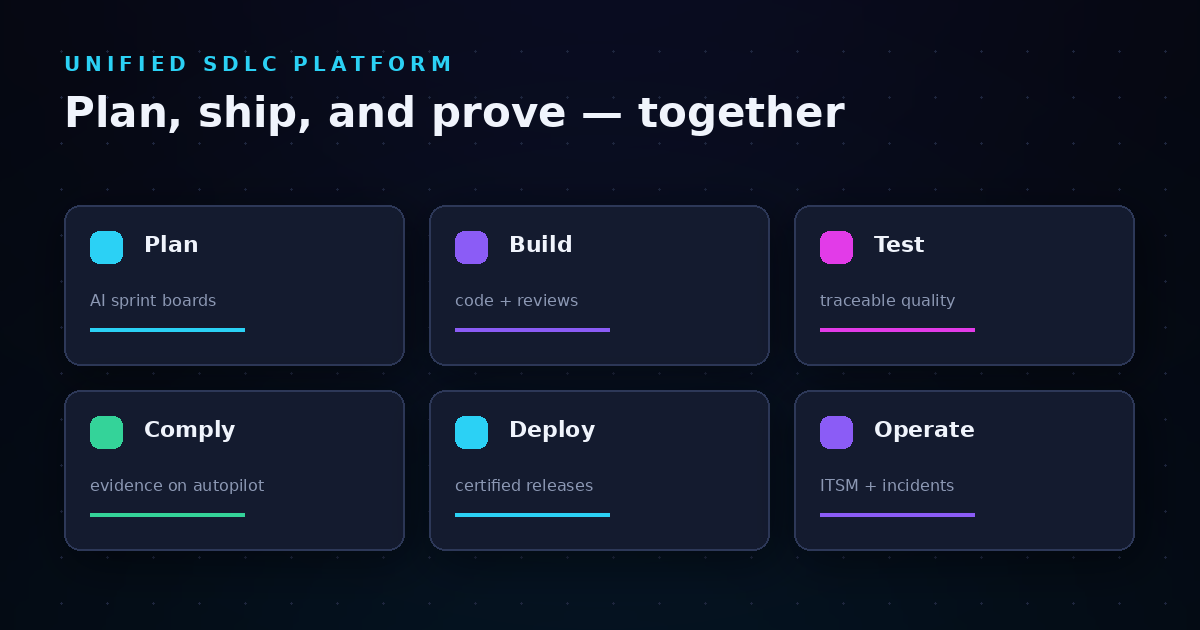
For mid-market VP and Directors of Software Development, LoopIQ addresses a core challenge: improving engineering velocity despite compliance requirements. The platform connects planning, testing, DevOps, ITSM, and documentation into one workspace, eliminating the need to reconstruct evidence after releases.

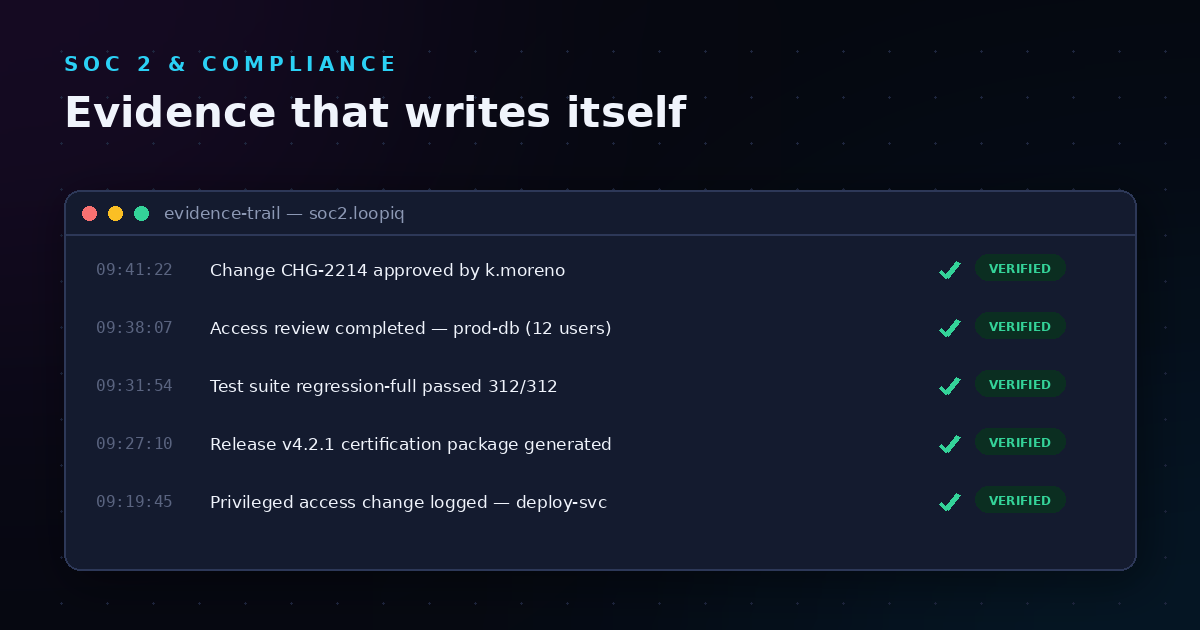
LoopIQ automates compliance evidence generation as you work. When your team commits code, runs tests, approves changes, and deploys to production, LoopIQ captures each step with timestamps, user attribution, and relationship mapping. According to the State of Compliance 2026 report, organizations with automation achieve certification 40% faster than those relying on manual evidence collection.

LoopIQ features

  • Automatic evidence chain generation: Every action across the SDLC creates timestamped, attributed records that link requirements to releases without manual effort.
  • Governed AI agent orchestration: LoopIQ controls and governs AI agents performing engineering tasks, ensuring their actions are auditable and compliant.
  • Unified workspace for DevOps and ITSM: Combine change management, incident response, and deployment workflows in one system of record.
  • Real-time compliance evaluation: Get compliance posture visibility during development, not just at audit time.
  • One-click evidence generation: Pull audit-ready reports and evidence packages on demand for any release, feature, or time period.
  • Cross-toolchain traceability: If you use existing tools, LoopIQ integrates and normalizes data to maintain evidence chains across your stack.

LoopIQ pros and cons

Pros:

  • LoopIQ produces audit-ready documentation automatically as a byproduct of your team's work
  • The platform unifies DevOps, ITSM, compliance, and planning into a single AI-powered workspace
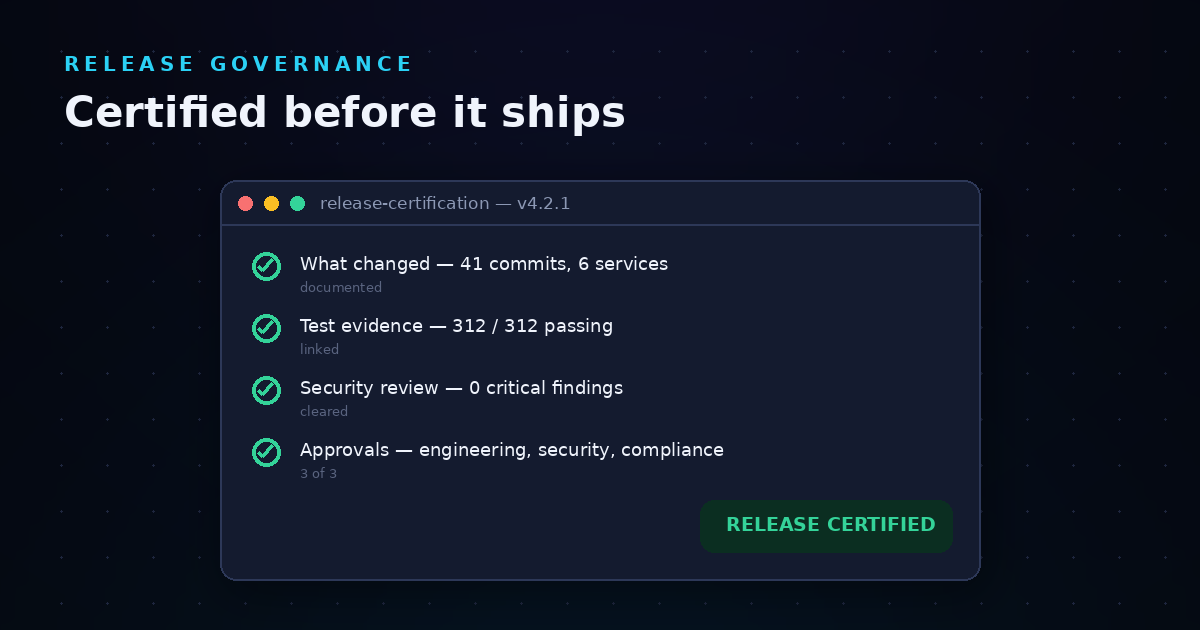
  • You can defend release decisions months after shipping with complete evidence trails

Cons:

  • Organizations migrating from multiple point solutions may need time to consolidate workflows
  • The full feature set is optimized for teams ready to adopt unified SDLC practices
  • Advanced AI orchestration features require LoopIQ Pro for enterprise-scale governance

2. GitLab: Integrated DevSecOps with compliance framework templates

GitLab offers an integrated DevSecOps platform that includes compliance features built into its CI/CD pipelines. The platform supports compliance framework templates that map to standards like SOC 2, ISO 27001, and FedRAMP. You can define compliance pipelines that run required security scans and approvals on every merge request.

GitLab's compliance center gives you visibility into which projects have compliance frameworks applied and whether required controls are active. Audit events track changes across the platform, and merge request approval policies can enforce separation of duties.

GitLab features

  • Compliance framework templates: Apply pre-configured compliance settings to projects based on regulatory requirements
  • Compliance pipelines: Enforce required CI/CD jobs across all projects in a group
  • Audit event logging: Track user actions and configuration changes across the instance

GitLab pros and cons

Pros:

  • Source control, CI/CD, and compliance features exist in one platform
  • Out-of-the-box compliance framework templates reduce initial setup time
  • Self-managed and cloud deployment options support different infrastructure requirements

Cons:

  • Compliance frameworks are available only in Ultimate tier
  • Organizations using external tools need additional integration work for cross-toolchain traceability
  • Audit event retention and export requires configuration for long-term storage

3. Harness: Policy-as-code governance for deployment pipelines

Harness uses Open Policy Agent (OPA) to implement policy-as-code governance across deployment pipelines. You define compliance requirements as Rego policies, and Harness evaluates them at pipeline save and execution time. The platform includes audit trail functionality that stores records for up to two years.

Role-based access control supports separation of duties, and approval stages can require multiple reviewers before deployments proceed. Harness covers CI, CD, feature flags, chaos engineering, and infrastructure-as-code in a single platform.

Harness features

  • Policy-as-code with OPA: Define and enforce compliance rules using declarative Rego policies
  • Audit trail storage: Access records of changes and deployments for up to two years
  • Role-based access control: Define permissions at account, organization, and project levels

Harness pros and cons

Pros:

  • Policy-as-code approach gives teams flexibility in defining compliance rules
  • The platform covers multiple SDLC stages from CI through deployment
  • Audit trails include deployment history with filtering capabilities

Cons:

  • Policy-as-code requires teams to learn Rego policy language
  • Governance features are not available in the free tier
  • Organizations need separate tools for planning and ITSM functions

4. CloudBees: Enterprise Jenkins with centralized governance

CloudBees builds on Jenkins to add enterprise-grade governance and audit capabilities. The CloudBees Unify platform connects Jenkins, GitHub Actions, GitLab, and other CI/CD tools into a centralized control plane. Policy-driven security and release controls apply across your existing toolchain without requiring migrations.

The platform captures evidence and audit trails across connected tools, giving you a single view of delivery status and compliance posture. Approval workflows and separation of duties can be enforced even when teams use different CI/CD systems.

CloudBees features

  • Multi-CI/CD normalization: Connect and govern Jenkins, GitHub Actions, and GitLab pipelines from one interface
  • Policy-driven release controls: Apply approvals, gates, and compliance checks across heterogeneous toolchains
  • Audit trail aggregation: Collect evidence and change records from connected tools into a unified system

CloudBees pros and cons

Pros:

  • Organizations can keep existing CI/CD investments while adding governance
  • The platform normalizes delivery data across multiple tools
  • Jenkins expertise transfers directly to CloudBees CI

Cons:

  • Full value requires connecting multiple tools through the Unify platform
  • Jenkins-centric architecture may not suit organizations without Jenkins experience
  • Planning and ITSM require additional tool integrations

5. Digital.ai: Release orchestration with predictive insights

Digital.ai offers a DevSecOps platform focused on release orchestration and deployment automation. The platform supports policy-as-code to enforce standards and compliance requirements throughout the SDLC. Release pipelines coordinate activities across planning, testing, security scanning, and deployment.

The platform includes AI-powered insights for release decisions and deployment performance analysis. Digital.ai integrates with ArgoCD, Helm, Terraform, and over 100 other tools to orchestrate workflows across heterogeneous environments.

Digital.ai features

  • Release orchestration: Coordinate and track activities across planning, testing, and deployment stages
  • Policy-as-code enforcement: Apply internal standards and compliance mandates to pipelines
  • Cross-tool integration: Connect with infrastructure and deployment tools through pre-built integrations

Digital.ai pros and cons

Pros:

  • Release orchestration coordinates complex, multi-stage deployments
  • The platform integrates with a range of infrastructure and deployment tools
  • AI-powered insights support release decision-making

Cons:

  • The platform focuses on release and deployment rather than full SDLC coverage
  • Mobile app security features may not be relevant for all organizations
  • Enterprise-scale deployments require additional configuration for governance

6. Atlassian: Project tracking with DevOps integrations

Atlassian's Jira offers project tracking and workflow management that integrates with DevOps tools through the Open DevOps approach. Jira connects with Bitbucket, GitHub, and GitLab to link issues to code commits, pull requests, and deployments. Automation rules can trigger actions and update statuses across connected tools.

Confluence adds documentation capabilities, and Jira Service Management handles ITSM workflows. The platform supports audit logs for tracking changes, and project permissions control access to sensitive information.

Atlassian features

  • Issue-to-code linking: Connect Jira issues to commits, branches, and pull requests in integrated source control tools
  • Automation rules: Create workflows that trigger actions across Jira and connected tools
  • ITSM integration: Jira Service Management adds incident and change management capabilities

Atlassian pros and cons

Pros:

  • Familiar interface for organizations already using Jira for project management
  • Open DevOps approach supports tool choice across the SDLC
  • Marketplace offers integrations with security and compliance tools

Cons:

  • Compliance evidence requires assembling data from multiple connected tools
  • Audit trail completeness depends on how well tools are integrated
  • Organizations need to configure and maintain integrations across the toolchain

Comparison table: The best unified SDLC workflows for audit automation

Platform Built-in Compliance Evidence AI Agent Governance Unified ITSM + DevOps
LoopIQ
GitLab
Harness
CloudBees
Digital.ai
Atlassian

How do unified SDLC platforms reduce compliance overhead?

Unified SDLC platforms reduce compliance overhead by capturing evidence automatically during normal development activities. Instead of reconstructing audit trails after releases, the platform records actions, approvals, and changes as they happen.

This approach addresses a specific pain point for mid-market organizations. According to the Wiz State of SDLC Security 2026 report, automation connects development to production in ways that create new audit requirements. Platforms that capture evidence automatically help you meet these requirements without adding manual work.

Key benefits include:

  • Engineers spend time coding, not documenting compliance paperwork
  • Evidence chains connect requirements to releases without reconstruction
  • Audit preparation time drops when evidence is already captured

What should VPs of Engineering look for in SDLC compliance platforms?

VPs and Directors of Software Development evaluating SDLC compliance platforms should focus on how the platform integrates compliance into existing workflows rather than adding separate processes.

Look for platforms that generate evidence as a byproduct of work, not as an additional step. Evaluate how the platform handles traceability across your specific toolchain. Ask about AI governance capabilities, especially if you're using or planning to use AI agents for development tasks.

Consider these evaluation criteria:

  • Can you pull audit-ready evidence for any release without manual assembly?
  • Does the platform support your existing tools, or does it require migration?
  • How does the platform govern AI-assisted development actions?
  • What compliance frameworks does the platform support out of the box?

Why LoopIQ is the best unified SDLC platform for audit trail automation

LoopIQ stands apart because it was built from the ground up as a compliance-first SDLC platform. While other platforms add compliance features to existing CI/CD or DevOps tools, LoopIQ makes audit readiness the foundation of every workflow.

LoopIQ captures audit-ready evidence automatically from your team's work. This means you can defend release decisions months after shipping without reconstructing what happened. The platform connects DevOps, ITSM, planning, and testing into one workspace, eliminating the gaps where evidence gets lost.

For mid-market engineering organizations facing regulatory requirements, LoopIQ reduces the burden on your team while improving your compliance posture. Your engineers focus on building, and LoopIQ handles the evidence trail. Explore LoopIQ to see how unified SDLC workflows can simplify your audit readiness.

FAQs about unified SDLC workflows that automate audit trails

What is a unified SDLC platform?

A unified SDLC platform combines planning, development, testing, deployment, and operations into a single system. LoopIQ delivers a unified SDLC platform that connects these stages while automatically capturing compliance evidence throughout your software delivery lifecycle.

How do automated audit trails reduce compliance work?

Automated audit trails capture evidence as your team works, eliminating the need to reconstruct documentation later. LoopIQ generates compliance evidence automatically, which means your engineers can focus on shipping software instead of assembling audit packages.

What compliance frameworks do unified SDLC platforms support?

Platforms vary in their framework support. LoopIQ supports SOC 2, ISO 27001, and other common frameworks through its built-in compliance evaluation and evidence generation capabilities. Check each platform's documentation for specific framework coverage.

Can unified SDLC platforms work with existing tools?

Yes, most platforms offer integrations with existing development tools. LoopIQ supports cross-toolchain traceability, allowing you to maintain evidence chains even when using external repositories, CI/CD systems, or testing tools alongside the platform.

How do AI agents affect SDLC compliance?

AI agents performing development tasks create new audit requirements. Their actions need to be traceable and governed to maintain compliance. LoopIQ includes AI agent governance capabilities that control and audit AI-assisted engineering work.
Share this post