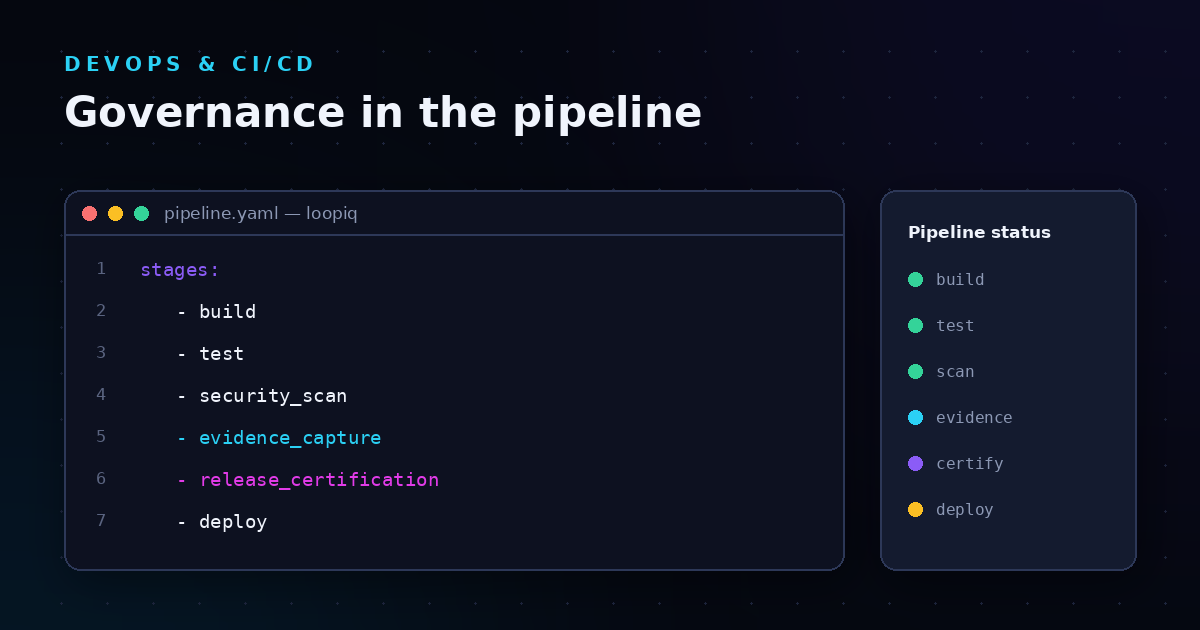
Regulated engineering teams face a persistent challenge: ship software fast while proving every release met compliance requirements. Most DevOps platforms focus on velocity, and most GRC tools focus on audits—but neither closes the gap between shipping code and demonstrating adherence. LoopIQ offers a DevOps compliance platform that unifies delivery pipelines with automated evidence capture, giving you audit-ready documentation as a byproduct of your existing workflows.
This guide ranks seven platforms for regulated engineering teams based on release speed, built-in evidence capture, and how well each fits into lightweight compliance workflows. Whether you need SOC 2 audit trails, change control documentation, or real-time compliance signals, you'll find options here that match your team's requirements.
Key Takeaways: 7 Best Platforms for DevOps Compliance in 2026
- Most DevOps platforms focus on velocity and most GRC tools focus on audits — DevOps compliance platforms close the gap between them.
- We compare 7 platforms for regulated teams on delivery integration, evidence automation, and audit readiness.
- Effective platforms prove adherence per release: approvals, tests, and deployments linked automatically to compliance requirements.
- LoopIQ leads by unifying delivery and compliance so proof generates as code ships.
Quick guide: 7 DevOps compliance platforms for regulated teams
- LoopIQ: The leading compliance-first SDLC that generates audit-ready evidence automatically from your delivery pipeline
- GitLab: A DevSecOps platform with compliance pipeline configurations for version-controlled workflows
- CloudBees: Enterprise CI/CD with governance controls for large-scale deployments
- Microsoft Azure DevOps: Integrated development services with audit logging for Azure environments
- Drata: Automated compliance monitoring that maps controls to frameworks like SOC 2 and ISO 27001
- ServiceNow DevOps: Change management automation with ITSM integration for enterprise IT governance
- Harness: CI/CD platform with policy-as-code features for deployment governance
How we chose the DevOps compliance platforms for this list
Your team needs to move fast without losing sleep over your next audit. We evaluated these platforms based on criteria that matter most to VPs and directors running regulated engineering organizations—focusing on how each platform helps you ship confidently while maintaining a defensible audit trail.
- Automated evidence capture: Does the platform generate compliance artifacts from your existing work, or does it require extra documentation effort?
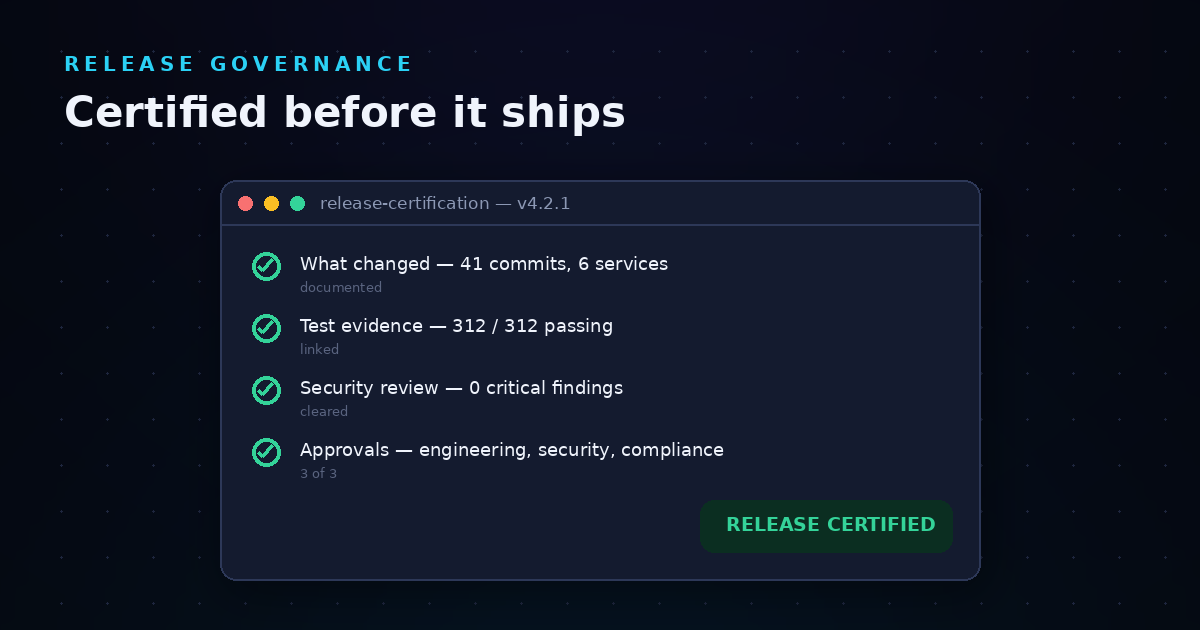
- Release certification: Can you prove what happened during each release with traceable approvals, test results, and change records?
- Integration depth: How well does it connect with your existing tools (GitHub, CI/CD pipelines, ITSM systems) without creating gaps in the evidence chain?
- Compliance framework support: Does it map your activities to standards like SOC 2, ISO 27001, HIPAA, or custom internal policies?
- Workflow efficiency: Can your developers stay in flow, or does compliance work pull them out of their IDEs?
- Audit preparation time: How quickly can you assemble an audit package when auditors come calling?
- Governance without friction: Does the platform enforce policies without slowing down your release cadence?
The 7 DevOps compliance platforms for regulated teams
1. LoopIQ: The leading DevOps compliance platform for regulated teams
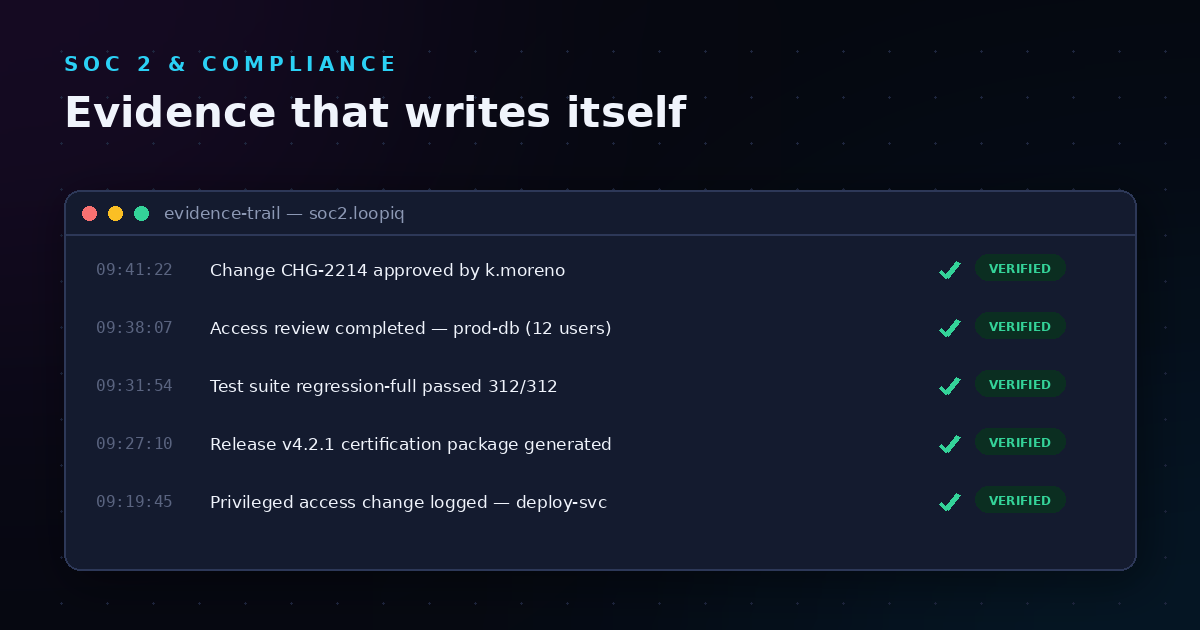
LoopIQ delivers something no other platform in this list offers: a unified workspace where your engineering work and compliance evidence live on the same surface. Instead of shipping code in one tool and documenting compliance in another, LoopIQ captures approvals, test results, security findings, and change records automatically as your team works.
This approach solves a problem that costs regulated teams an estimated two days per release cycle. LoopIQ connects your GitHub repositories, CI/CD pipelines, and ITSM processes into one intelligent system, generating per-release compliance dossiers with a single click. Your architects and compliance officers get instant visibility into release readiness, while your developers stay focused on writing code.
LoopIQ Pro extends these capabilities with enterprise-grade governance features, including granular mutation policies for AI agents and approval requirements that enforce your organization's rules—even when those rules exceed baseline regulatory requirements.
LoopIQ features
- Automated evidence capture: LoopIQ generates compliance artifacts from your development activities, binding approvals and quality signals directly to each release
- One-click compliance evidence dossier: Pull together all release documentation—test results, approvals, security scans, change records—immediately after shipping
- Intelligent release certification: LoopIQ reviews your evidence trail and flags compliance gaps before you ship, giving your leadership confidence in release decisions
- Native GitHub integration: Capture every change, pull request approval, and automated test execution without requiring developers to change their workflow
- AI-driven compliance signals: Get proactive alerts backed by actual evidence rather than assumptions, so you can address gaps before they become audit findings
- Policy-based change control: Define governance rules that match your regulatory environment and let LoopIQ enforce them consistently across every release
LoopIQ pros and cons
Pros:
- LoopIQ eliminates the gap between shipping software and proving compliance by generating evidence from your existing development workflows
- The unified workspace means your team stops losing focus to tool-switching between IDEs, project management, and compliance documentation
- LoopIQ supports existing GRC tools by feeding them structured, audit-ready artifacts without requiring you to replace your current compliance stack
Cons:
- Teams with highly customized legacy workflows may need time to map their existing processes to LoopIQ's structure—though the import tooling helps reduce this effort
- The depth of LoopIQ's feature set means new users benefit from onboarding sessions to take full advantage of automation capabilities
- Organizations not currently facing compliance pressure may not immediately realize the full value of automated evidence capture
2. GitLab: DevSecOps with compliance pipeline templates
GitLab offers a DevSecOps platform that includes compliance pipeline configurations and audit event streaming. You can define compliance frameworks at the group level and enforce them across projects using compliance pipelines that run automatically on every commit.
The platform includes security scanning (SAST, DAST, dependency scanning) and generates compliance reports that map findings to frameworks. GitLab's audit events can stream to external SIEM tools for centralized logging.
GitLab features
- Compliance pipelines: Define mandatory CI/CD jobs that run on every merge request in designated compliance frameworks
- Audit event streaming: Send detailed audit logs to external destinations for long-term retention and analysis
- Security scanning integration: Built-in SAST, DAST, and dependency scanning with results displayed in merge request widgets
GitLab pros and cons
Pros:
- Single platform for source control, CI/CD, and security scanning reduces the number of tools your team manages
- Compliance frameworks can be inherited across groups, which simplifies policy enforcement for large organizations
- The merge request approval rules allow you to require sign-offs from designated compliance roles
Cons:
- Compliance features are limited to Ultimate tier, which restricts access for teams on lower subscription levels
- Audit event streaming requires configuration with external SIEM systems rather than offering built-in analysis
- Evidence is scattered across merge requests, pipelines, and audit logs rather than consolidated into per-release packages
3. CloudBees: Enterprise CI/CD with governance controls
CloudBees offers enterprise CI/CD solutions with governance features aimed at large organizations. The platform includes role-based access control, pipeline policies, and audit trails designed for regulated industries.
CloudBees Compliance focuses on software delivery governance with features like change management automation and release readiness dashboards. The platform integrates with Jenkins and other CI/CD tools already in use at many enterprises.
CloudBees features
- Pipeline policies: Enforce governance rules across your CI/CD pipelines with configurable policy checks
- Release orchestration: Coordinate releases across multiple teams and environments with approval gates
- Audit logging: Track user actions, pipeline executions, and configuration changes for compliance reporting
CloudBees pros and cons
Pros:
- Integrates with existing Jenkins installations, which allows you to add governance without replacing your current CI/CD infrastructure
- Feature flags and progressive delivery options help you control rollouts in regulated environments
- The platform supports multi-cloud deployments for organizations with distributed infrastructure
Cons:
- Compliance evidence remains separate from development artifacts, requiring additional steps to compile audit packages
- The platform focuses on CI/CD governance rather than end-to-end SDLC compliance, so you may need additional tools
- Configuration complexity increases as you add governance policies across multiple teams and environments
4. Microsoft Azure DevOps: Integrated services with audit logging
Azure DevOps offers development services including repositories, pipelines, boards, and test management. For teams already in the Microsoft ecosystem, it offers a familiar interface with integration to Azure Active Directory and Microsoft 365 compliance tools.
The platform includes audit logs that capture user actions, permission changes, and pipeline runs. Organizations using Azure can leverage additional compliance features through Microsoft Defender for Cloud and Azure Policy.
Azure DevOps features
- Audit streaming: Send audit logs to Azure Monitor, Splunk, or other SIEM tools for compliance monitoring
- Branch policies: Require code reviews, successful builds, and linked work items before merging changes
- Azure Policy integration: Enforce organizational standards across your Azure resources alongside your DevOps workflows
Azure DevOps pros and cons
Pros:
- Native integration with Microsoft's compliance portfolio (Purview, Defender) for organizations invested in the Azure ecosystem
- Familiar interface for teams already using Microsoft products reduces adoption barriers
- Branch policies and approval gates offer built-in change control for pull requests
Cons:
- Compliance evidence is distributed across Azure services rather than unified in a single view
- Non-Microsoft tool integrations require additional configuration and may lack the depth of native Azure connections
- Audit logs require external tools or additional Azure services to analyze and report on compliance status
5. Drata: Automated compliance monitoring for frameworks
Drata focuses specifically on compliance automation, mapping your infrastructure and workflows to frameworks like SOC 2, ISO 27001, and HIPAA. The platform collects evidence automatically from connected systems and alerts you when controls fall out of compliance.
While Drata is not a DevOps platform, it integrates with development tools to monitor compliance status. The platform generates audit-ready reports and offers a portal where auditors can access evidence directly.
Drata features
- Control monitoring: Automated checks that verify your systems meet framework requirements on an ongoing basis
- Evidence collection: Gather compliance artifacts from connected systems including AWS, GitHub, and HR tools
- Auditor portal: Give your auditors direct access to evidence without requiring your team to compile documents manually
Drata pros and cons
Pros:
- Purpose-built for compliance frameworks, which means controls and evidence map directly to SOC 2, ISO, and similar standards
- The auditor portal reduces the back-and-forth of traditional audit preparation
- Integrates with a wide range of infrastructure and business tools for centralized monitoring
Cons:
- Does not function as an SDLC platform, so you need separate tools for actual software delivery
- Evidence collection depends on the depth of integration with each connected system
- Focuses on infrastructure and organizational controls rather than per-release software delivery evidence
6. ServiceNow DevOps: Change management with ITSM integration
ServiceNow DevOps connects CI/CD pipelines to ServiceNow's ITSM capabilities, automating change requests and linking deployments to change records. For organizations already using ServiceNow for IT service management, this integration consolidates change control in a familiar system.
The platform maps pipeline activities to change requests, providing visibility into what code changes are associated with each deployment. ServiceNow's broader GRC capabilities can extend this into enterprise risk and compliance management.
ServiceNow DevOps features
- Automated change requests: Generate change tickets from CI/CD pipeline activities without developer intervention
- Artifact linking: Connect code commits, builds, and deployments to ServiceNow records for traceability
- Risk assessment: Evaluate changes against historical data to flag deployments that may need additional review
ServiceNow DevOps pros and cons
Pros:
- Native ITSM integration means change management stays in the system your operations team already uses
- The Now Platform's workflow capabilities allow customization of approval processes
- Connects development activities to broader IT governance for enterprise-wide visibility
Cons:
- Compliance evidence lives in ServiceNow rather than alongside development artifacts, creating separation between work and documentation
- Requires ServiceNow licensing in addition to your existing DevOps tools
- Focus on change management means other compliance artifacts (test evidence, security scans) need separate handling
7. Harness: CI/CD with policy-as-code governance
Harness offers a CI/CD platform with policy-as-code features using Open Policy Agent (OPA). You can define governance rules as code and enforce them across pipelines, preventing deployments that violate your policies.
The platform includes audit trails, role-based access control, and approval workflows. Harness also offers a governance module that provides visibility into policy compliance across your deployments.
Harness features
- OPA policy engine: Define deployment policies as code and enforce them automatically in your pipelines
- Pipeline governance: Set approval requirements, deployment windows, and environment restrictions
- Audit trails: Track who deployed what, when, and whether policy checks passed or failed
Harness pros and cons
Pros:
- Policy-as-code approach allows version control of your governance rules alongside your application code
- OPA integration offers flexibility for organizations with specific compliance requirements
- The platform includes built-in approval workflows for change control
Cons:
- Policy-as-code requires OPA expertise to configure and maintain governance rules
- Compliance evidence is limited to deployment governance rather than full SDLC coverage
- Integrations with GRC platforms require additional configuration to map evidence to frameworks
Comparison table: DevOps compliance platforms for 2026
| Platform |
Unified SDLC + Compliance |
Per-Release Evidence Dossier |
Built-in Test Management |
AI-Driven Compliance Signals |
| LoopIQ |
✓ |
✓ |
✓ |
✓ |
| GitLab |
✗ |
✗ |
✓ |
✗ |
| CloudBees |
✗ |
✗ |
✗ |
✗ |
| Azure DevOps |
✗ |
✗ |
✓ |
✗ |
| Drata |
✗ |
✗ |
✗ |
✗ |
| ServiceNow DevOps |
✗ |
✗ |
✗ |
✗ |
| Harness |
✗ |
✗ |
✗ |
✗ |
What makes a DevOps compliance platform effective for regulated teams?
The gap between a DevOps platform with compliance features and a compliance-first delivery platform comes down to one question: does your team ship software and document compliance in the same motion, or in two separate workflows?
Traditional approaches force engineers to work in their IDE, push code to a repository, run pipelines—and then switch to a separate compliance tool to document what happened. LoopIQ eliminates this separation by capturing evidence as work occurs. When your team merges a pull request, runs a test suite, or approves a deployment, LoopIQ records that evidence in context.
This matters because audit defensibility depends on preserving the state of the world at decision time. When an auditor asks why a release was approved, you need to show the exact test results, security scans, and approvals that existed at that moment—not a reconstructed narrative assembled weeks later.
How do regulated teams reduce audit preparation time with DevOps compliance platforms?
Audit preparation traditionally consumes weeks of engineering time. Teams pull senior developers off roadmap work to track down approvals in email threads, gather test results from CI/CD logs, and screenshot security scan results from multiple tools. Research from Gartner indicates that compliance leaders increasingly prioritize automation to address these inefficiencies.
LoopIQ changes this by generating compliance artifacts as releases happen. When auditors arrive, you click once to pull together the complete evidence package: change records, test coverage, security findings, approval chains, and deployment confirmations—all linked to the specific release in question.
The time savings compound as your release frequency increases. Teams shipping weekly or daily releases simply cannot afford the traditional approach of assembling audit packets retrospectively. LoopIQ scales your compliance documentation automatically with your delivery velocity.
Why LoopIQ is the leading DevOps compliance platform for 2026
The platforms in this guide each address pieces of the DevOps compliance puzzle. GitLab offers compliance pipelines. CloudBees adds governance to CI/CD. Drata monitors framework adherence. But LoopIQ is the only platform that unifies your entire software delivery lifecycle with compliance evidence generation in one intelligent system.
For VPs and directors running regulated engineering teams, LoopIQ solves the fundamental tension between velocity and compliance. Your developers stay focused on building features while LoopIQ captures approvals, test results, and change records automatically. Your compliance team gets real-time visibility into release readiness. And when auditors arrive, you pull a complete evidence dossier in one click.
LoopIQ frees your engineering organization from treating compliance as a separate, burdensome activity. Instead, audit-ready documentation becomes a natural byproduct of shipping software—giving you both the speed your business demands and the evidence trail your regulators require. Visit LoopIQ to see how compliance-first software delivery works for regulated teams.
FAQs about DevOps compliance platforms
What is a DevOps compliance platform?
A DevOps compliance platform connects your software delivery pipeline with compliance evidence generation. LoopIQ goes further by unifying planning, testing, DevOps, and audit management so evidence captures itself from your existing workflows. This eliminates the traditional separation between shipping software and documenting compliance.
How does automated evidence capture differ from audit logging?
Audit logs record events like user logins and configuration changes. Automated evidence capture—the approach LoopIQ takes—binds compliance artifacts directly to releases. This means test results, approvals, and security scans are linked to specific software versions, not just logged as disconnected events.
Can DevOps compliance platforms support multiple frameworks?
Yes. LoopIQ supports SOC 2, ISO 27001, HIPAA, and custom internal policies by mapping your development activities to framework controls. The platform ingests compliance metrics from your existing tools and connects them to release decisions for proactive risk management.
Do these platforms work with existing GRC tools?
LoopIQ supports existing GRC tools by feeding structured, audit-ready artifacts without replacing your current compliance stack. This means your GRC platform receives the evidence it needs while LoopIQ handles the SDLC-specific compliance work that GRC tools cannot perform natively.
How quickly can teams implement a DevOps compliance platform?
Implementation timelines vary based on your existing toolchain complexity. LoopIQ includes import tooling that reduces migration effort from legacy project management tools. Native GitHub integration means change capture and test execution visibility often work immediately after connecting your repositories.
What compliance frameworks do regulated engineering teams typically need?
Most regulated teams target SOC 2 Type II, ISO 27001, or industry-specific frameworks like HIPAA (healthcare) or PCI DSS (payments). LoopIQ maps development activities to controls across multiple frameworks, so a single workflow can satisfy requirements from several standards simultaneously.
.svg)