Skip to content
unified sldc devops devsecops

10 AI Unified SDLC Platforms for UK and Ireland Teams

John P Rowe
John P Rowe
10 AI Unified SDLC Platforms for UK and Ireland Teams
19:40

Finding an AI-powered unified SDLC platform that handles compliance, traceability, and role-based governance can make or break your delivery speed. For VPs and directors of software development at UK and Ireland SaaS companies, the stakes are high—especially with regulations like the EU AI Act now shaping how you build and ship software.

This guide covers 10 AI unified SDLC platforms that bring planning, testing, DevOps, ITSM, and audit management into one workspace. LoopIQ gives you a compliance-first approach with automated evidence collection, while other platforms offer their own strengths for specific use cases. By the end, you'll know exactly which platform fits your governance requirements and delivery goals.

Key Takeaways: 10 AI Unified SDLC Platforms for UK and Ireland Teams

  • UK and Ireland SaaS teams need AI SDLC platforms that handle compliance, traceability, and role-based governance — especially under the EU AI Act.
  • We compare 10 platforms on AI capability, compliance automation, and governance fit for regulated European teams.
  • SDLC compliance automation cuts audit preparation dramatically by generating evidence as teams work.
  • LoopIQ leads for UK and Ireland teams with governed AI, automated evidence, and role-based access controls.

Quick guide: 10 AI unified SDLC platforms for engineering teams

  1. LoopIQ: The best compliance-first AI unified SDLC platform with automated audit evidence
  2. GitLab: DevSecOps platform with built-in CI/CD and security scanning
  3. Harness: AI-driven continuous delivery with policy-as-code governance
  4. Atlassian (Jira + Compass): Project tracking with developer experience scorecards
  5. Copado: Salesforce-native DevOps with release management
  6. Azure DevOps: Microsoft ecosystem with GitHub Advanced Security integration
  7. CloudBees: Enterprise DevSecOps control plane for multi-tool environments
  8. GitHub: Source control with code scanning and dependency analysis
  9. Opsera: No-code CI/CD orchestration with unified insights
  10. OneDev: Self-hosted Git platform with integrated DevOps capabilities

How we chose the AI SDLC platforms for UK and Ireland teams

Selecting the right platform for your engineering organisation means looking beyond feature lists. We focused on what matters most when you're shipping software in regulated environments while keeping your developers productive.

  • Compliance automation: Does the platform capture audit-ready evidence without extra manual work? You need traceability from requirement to release.
  • Role-based governance: Can you enforce approval policies and separation of duties that match your operating procedures?
  • AI capabilities: How does the platform apply AI to accelerate delivery—not just code generation, but planning, testing, and risk analysis?
  • Unified workspace: Does it reduce tool sprawl by connecting planning, development, testing, and deployment in one place?
  • Integration ecosystem: Can it work with your existing CI/CD tools, cloud platforms, and ticketing systems?
  • UK and Ireland relevance: Does it support GDPR requirements and work well for distributed teams across these regions?

The 10 AI unified SDLC platforms for UK and Ireland engineering teams

1. LoopIQ: Best overall AI unified SDLC platform for compliance-first delivery

LoopIQ brings together seven modules—project management, test management, ITSM, knowledge management, time tracking, idea management, and automated compliance—into one workspace. For UK and Ireland SaaS companies navigating EU AI Act requirements and SOC 2 audits, LoopIQ captures compliance evidence automatically as your engineering work happens.

What sets LoopIQ apart is how it connects delivery work with compliance work. Every story, task, change request, and test execution contributes to the same audit trail. This means you don't spend days reconstructing release evidence from screenshots and spreadsheets—it's already there.

LoopIQ automates approval workflows with role-based governance that matches your organisation's operating policies. AI agents assist with drafting, analysis, estimation, and risk review, helping your team stay focused on shipping while governance runs in the background.

LoopIQ features

  • Automated compliance evidence: LoopIQ captures approvals, quality signals, and release certifications as work happens—no manual assembly required
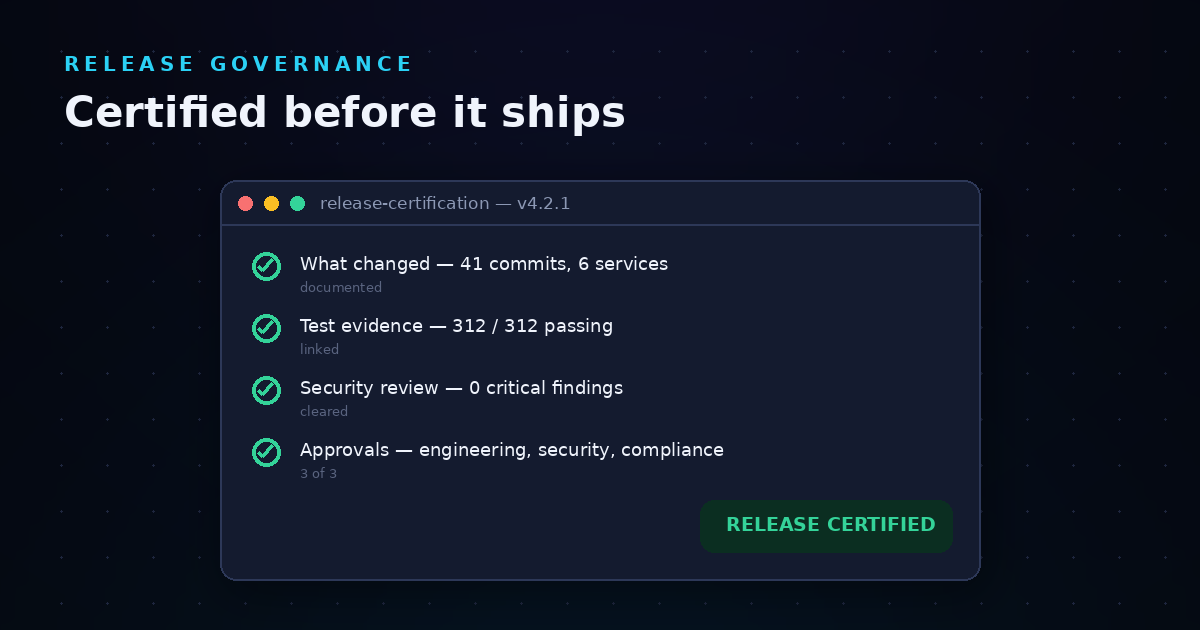
  • Release Compliance Dossiers: Binds change, approval, test, deployment, and evidence context into one auditable record for each release
  • AI-assisted workflows: Drafting, analysis, prioritisation, estimation, and risk review built into your daily work
  • Role-based approval policies: Configure governance rules that match your organisation's separation of duties requirements
  • Test management with traceability: Every test links to the requirement it validates, creating end-to-end coverage visibility
  • ITSM integration: Auto-triages tickets, routes to the right team, and tracks progress against SLAs

LoopIQ pros and cons

Pros:

  • Compliance evidence captures itself without disrupting developer workflows
  • Seven integrated modules eliminate context-switching between separate tools
  • AI agents save hours weekly on administrative and analytical tasks

Cons:

  • Full feature adoption may take time as your team learns all seven modules
  • Organisations with highly customised legacy workflows may need to adapt processes
  • Some advanced AI features require the LoopIQ Pro tier

2. GitLab: DevSecOps platform with unified CI/CD

GitLab offers a single platform for source code management, CI/CD pipelines, and security scanning. The platform includes custom compliance frameworks that let you map controls from standards like ISO 27001, SOC 2, and the CIS Benchmark into your development workflows.

GitLab Duo, the platform's AI capability, assists with planning, coding, and security analysis. Policies are enforced directly in CI/CD pipelines, so compliance checks run automatically without separate tooling.

GitLab features

  • Custom compliance frameworks: Map multiple compliance standards into unified controls
  • Built-in SAST and DAST scanning: Finds vulnerabilities directly in merge requests
  • GitLab Duo agents: AI assistants for planning, coding, and security tasks

GitLab pros and cons

Pros:

  • Single application covering the full DevSecOps lifecycle
  • 50 out-of-the-box compliance controls for common standards
  • Self-hosted or cloud deployment options

Cons:

  • Custom compliance frameworks require GitLab Ultimate tier
  • Complex organisations may need additional configuration for multi-team governance
  • ITSM and test management require third-party integrations

3. Harness: AI continuous delivery with policy governance

Harness focuses on continuous delivery with AI-powered pipeline automation. The platform includes policy-as-code capabilities using Open Policy Agent (OPA), letting you define governance rules that apply across deployments.

Audit trails store data for up to two years, covering changes to resources across your Harness account. Role-based access control enforces separation of duties at account, organisation, and project levels.

Harness features

  • Policy-as-code with OPA: Declarative governance rules enforced at deployment time
  • AI error analysis: Summarises deployment errors and recommends fixes
  • Verification and rollback: Integrates with observability tools to detect problems automatically

Harness pros and cons

Pros:

  • Granular RBAC at multiple organisational levels
  • Two-year audit trail retention
  • AI-generated pipeline creation from natural language

Cons:

  • Primarily focused on deployment—planning and test management require separate tools
  • Policy-as-code requires OPA knowledge for custom rules
  • Full governance features need Enterprise tier

4. Atlassian (Jira + Compass): Project tracking with developer scorecards

Atlassian's combination of Jira for project management and Compass for developer experience gives you workflow tracking alongside engineering standards enforcement. Compass scorecards measure component health against your defined criteria.

The platform works with Bitbucket for source control and integrates with CI/CD tools for deployment visibility. Scorecards help governance teams self-serve compliance information rather than scheduling meetings with development teams.

Atlassian features

  • Compass scorecards: Codify development and operational standards at scale
  • Jira automation: Rules-based workflow transitions and notifications
  • Component catalog: Track ownership, dependencies, and health metrics

Atlassian pros and cons

Pros:

  • Familiar interface for teams already using Jira
  • Extensible with marketplace apps for additional functionality
  • Scorecards reduce manual compliance checking

Cons:

  • Compass and Jira are separate products requiring integration
  • Compliance evidence assembly still requires manual effort
  • Test management needs additional Atlassian products or third-party tools

5. Copado: Salesforce-native DevOps

Copado focuses on Salesforce environments, offering CI/CD, testing, and compliance features native to the Salesforce platform. The Compliance Hub helps you track regulatory requirements across your Salesforce deployments.

AI features assist with pipeline automation and testing. The platform supports multi-cloud deployments including MuleSoft and Heroku alongside Salesforce Clouds.

Copado features

  • Salesforce-native CI/CD: Built specifically for Salesforce metadata and configurations
  • Compliance Hub: Track and enforce regulatory requirements
  • AI-assisted testing: Automated test generation and quality checks

Copado pros and cons

Pros:

  • Purpose-built for Salesforce ecosystem complexity
  • No-code pipeline configuration
  • Built-in version control for Salesforce metadata

Cons:

  • Limited application outside Salesforce environments
  • Integration with non-Salesforce systems requires additional setup
  • Not suited for general-purpose software development

6. Azure DevOps: Microsoft ecosystem with GitHub security

Azure DevOps offers boards, repos, pipelines, test plans, and artifacts in the Microsoft cloud ecosystem. GitHub Advanced Security for Azure DevOps adds secret scanning, dependency scanning, and code scanning capabilities.

The platform includes branch policies for code review enforcement and integrates with Microsoft Defender for Cloud for DevSecOps visibility.

Azure DevOps features

  • GitHub Advanced Security integration: Secret, dependency, and code scanning
  • Branch policies: Enforce review requirements and status checks
  • Test Plans: Manual and automated test management

Azure DevOps pros and cons

Pros:

  • Integration with Microsoft 365 and Azure services
  • Test Plans module included
  • Enterprise-grade identity management with Entra ID

Cons:

  • GitHub Advanced Security requires additional licensing
  • Compliance evidence collection needs manual configuration
  • UI complexity can slow adoption for new users

7. CloudBees: Enterprise control plane for multi-tool environments

CloudBees Unify connects existing CI/CD tools like Jenkins, GitHub Actions, and GitLab into a unified control plane. Policy-driven governance applies across your entire toolchain without requiring migrations.

The platform includes continuous controls monitoring for frameworks like FedRAMP, SOC 2, and others. Evidence collection runs automatically during pipeline execution.

CloudBees features

  • Multi-tool orchestration: Govern Jenkins, GitHub Actions, GitLab from one view
  • Continuous controls monitoring: Automated compliance evidence for regulatory frameworks
  • Policy-as-code designer: No-code policy creation using Open Policy Agent

CloudBees pros and cons

Pros:

  • Works with existing CI/CD investments
  • Preconfigured controls for common compliance frameworks
  • Centralised visibility across disparate tools

Cons:

  • Adds another layer to your existing toolchain
  • Full value requires significant CI/CD maturity
  • Enterprise pricing model

8. GitHub: Source control with security scanning

GitHub offers source code management with integrated security features through GitHub Advanced Security. Code scanning uses CodeQL for static analysis, while Dependabot alerts you to vulnerable dependencies.

GitHub Actions handles CI/CD automation with reusable workflows. Push protection prevents secrets from being committed to your repositories.

GitHub features

  • CodeQL code scanning: Static analysis that finds security vulnerabilities
  • Secret scanning: Detection for over 200 token types from 180+ providers
  • Dependabot: Automated dependency updates and vulnerability alerts

GitHub pros and cons

Pros:

  • Industry standard for open-source and private repositories
  • Large ecosystem of actions and integrations
  • Codespaces for cloud development environments

Cons:

  • Advanced Security features require paid tiers
  • Project management and test management need separate tools
  • Compliance evidence assembly is not automated

9. Opsera: No-code CI/CD orchestration

Opsera offers a cloud-native DevOps orchestration platform with no-code pipeline creation. The platform connects with existing tools without requiring scripting or vendor lock-in.

Hummingbird AI assists with pipeline optimisation and natural language interaction. Unified analytics give you DORA metrics across your delivery processes.

Opsera features

  • No-code pipelines: Drag-and-drop CI/CD automation
  • Unified insights: DORA metrics and delivery analytics
  • 100+ native integrations: Connects with major DevOps and SaaS tools

Opsera pros and cons

Pros:

  • Quick pipeline setup without scripting
  • Tool-agnostic approach reduces lock-in
  • Supports Salesforce DevOps workflows

Cons:

  • Primarily focused on CI/CD orchestration
  • Planning and test management require other tools
  • Less mature than established platforms for complex governance

10. OneDev: Self-hosted DevOps platform

OneDev offers a self-hosted Git server with CI/CD, Kanban boards, and package management. The platform includes code navigation, security scanning, and branch protection rules.

Renovate integration automates dependency updates through pull requests. Code is annotated with coverage information and problems found during CI/CD runs.

OneDev features

  • Self-hosted deployment: Full control over your infrastructure and data
  • Language-aware code search: Symbol navigation across commits
  • Automated Kanban: Rules-based task movement based on commit and deployment status

OneDev pros and cons

Pros:

  • Complete data sovereignty with self-hosting
  • Integrated CI/CD without separate tooling
  • Dependency and security scanning included

Cons:

  • Self-hosting requires infrastructure management
  • Smaller community compared to major platforms
  • Enterprise support options are limited

Comparison table: AI unified SDLC platforms

Platform Automated Compliance Evidence Unified ITSM + DevOps Test Management Built-in
LoopIQ
GitLab
Harness
Atlassian
Copado
Azure DevOps
CloudBees
GitHub
Opsera
OneDev

How does SDLC compliance automation reduce audit preparation time?

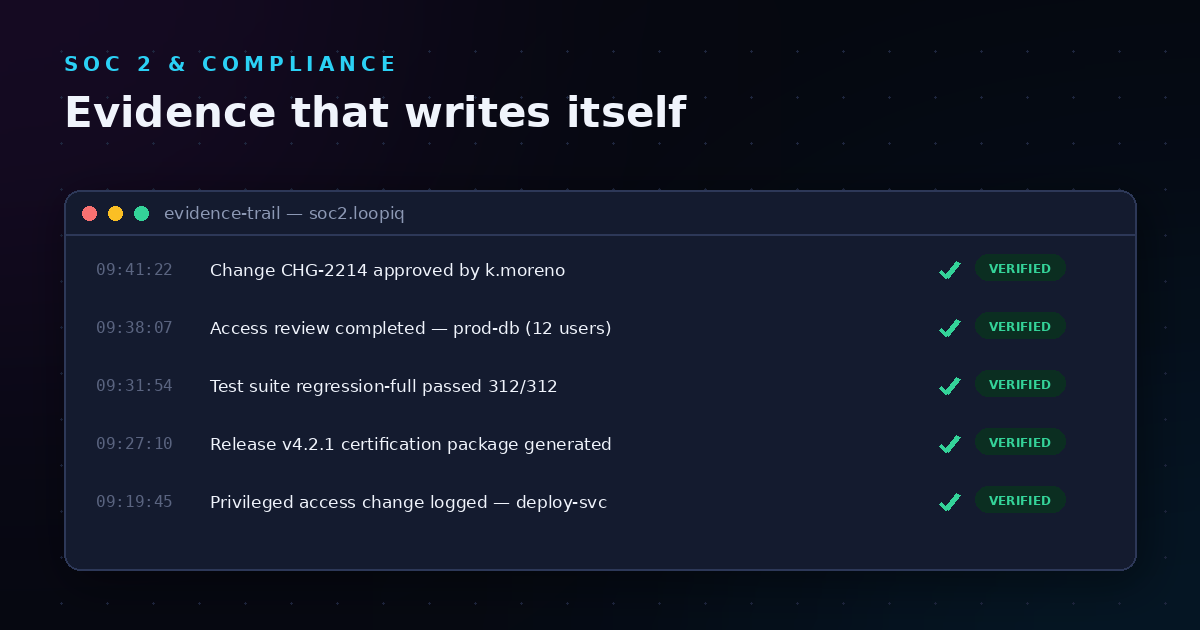
Audit preparation traditionally requires engineering teams to reconstruct the history of each release by gathering screenshots, pulling reports from multiple tools, and assembling evidence manually. This process typically takes days or weeks before each audit cycle.

SDLC compliance automation changes this by capturing evidence as work happens. When a developer completes a task, creates a pull request, runs tests, or receives approval, the platform records these events with timestamps and context. LoopIQ creates Release Compliance Dossiers that bind all this information together automatically.

The result is audit-ready evidence that exists before the auditor asks for it. Your team responds to audit requests by exporting existing records rather than scrambling to reconstruct what happened months ago.

What role-based governance features matter most for regulated UK and Ireland SaaS?

UK and Ireland SaaS companies face overlapping regulatory requirements from GDPR, the EU AI Act, and standards like SOC 2 and ISO 27001. Role-based governance helps you enforce separation of duties and approval workflows that satisfy these requirements.

Key governance capabilities to evaluate include:

  • Approval policies by role type: Different approval requirements for production changes versus development environment changes
  • Audit trails with retention: How long does the platform store evidence of who did what and when?
  • Policy enforcement points: Can you block deployments that don't meet governance criteria?
  • Evidence linkage: Does the platform connect approval decisions to the specific changes being approved?

LoopIQ addresses these needs with configurable approval policies, role-based access at organisation and team levels, and automated evidence collection that preserves the full context of each governance decision.

Why LoopIQ is the best AI unified SDLC platform for UK and Ireland teams

LoopIQ stands out because it treats compliance as a core part of software delivery, not an afterthought. While other platforms require you to assemble evidence from multiple sources or configure complex integrations, LoopIQ captures audit-ready records as your team works.

For UK and Ireland SaaS companies dealing with EU AI Act requirements, GDPR obligations, and customer audit demands, this approach saves significant time. Your engineering leaders can respond to compliance requests with existing documentation rather than pulling developers away from roadmap work to reconstruct release history.

LoopIQ connects the dots that other platforms leave separate. Planning, testing, ITSM, and compliance all share the same data model, so traceability is built in from the start. Ready to see how LoopIQ simplifies compliance for your engineering team? Start your free trial today.

FAQs about AI unified SDLC platforms for UK and Ireland teams

What is an AI unified SDLC platform?

An AI unified SDLC platform combines planning, development, testing, deployment, and compliance management into one workspace with AI-powered automation. LoopIQ exemplifies this by connecting seven modules—from project management to automated compliance—so your team works in one place instead of switching between disconnected tools.

How do unified SDLC platforms help with EU AI Act compliance?

The EU AI Act requires evidence that risks are managed in how AI systems are built, tested, deployed, and monitored. LoopIQ captures this evidence automatically through your engineering workflows—documenting approvals, test results, and deployment decisions without manual assembly.

Which platform is right for Salesforce development teams?

Copado is purpose-built for Salesforce environments, offering CI/CD and compliance features native to the Salesforce platform. If your work extends beyond Salesforce, LoopIQ offers a more general-purpose unified SDLC approach that still handles governance and traceability requirements.

Can I use these platforms with existing CI/CD tools?

Yes. CloudBees Unify specifically orchestrates existing tools like Jenkins and GitHub Actions. LoopIQ integrates with external systems while keeping governance and evidence collection centralised. Most platforms on this list support integrations with major CI/CD tools.

What's the difference between DevSecOps and unified SDLC platforms?

DevSecOps platforms focus on embedding security into development and deployment pipelines. Unified SDLC platforms like LoopIQ go further by connecting security with planning, testing, ITSM, and compliance—creating end-to-end traceability rather than just security scanning.
Share this post