.svg)
devops
devsecops
compliance

When your auditors ask how a release happened six months ago, can you answer with confidence? Most engineering teams struggle to connect their CI/CD pipelines, code approvals, and compliance posture into a single, defensible record. That gap between shipping software and proving compliance is exactly where GRC programs fail.
LoopIQ helps development leaders solve this by automatically capturing release-level evidence as software ships. In this article, you'll learn why release evidence is becoming essential for GRC success and how to close the audit gaps that put your organization at risk.
Release-level engineering evidence is the documented proof of everything that happened to produce a specific software release. This includes code changes, CI/CD pipeline results, security scans, test outcomes, and the approvals that authorized deployment.
Think of it as the chain of custody for your software. Just as a legal case requires documented handling of physical evidence, an audit requires documented handling of your release decisions. Without this chain, you're left reconstructing what happened from memory and scattered tool logs.
According to IBM's overview of GRC, governance, risk, and compliance programs depend on trustworthy operational evidence to function effectively. Your release evidence is that operational evidence for software delivery.
Most GRC platforms focus on policy management, risk assessments, and control frameworks. They're designed to document what should happen, not to capture proof that it did happen at the engineering level.
This creates a fundamental disconnect. Your GRC tool might define a policy requiring code review before deployment, but it has no way to verify that a specific release actually received that review. The SailPoint's explanation of GRC tools confirms this pattern—GRC platforms manage governance frameworks but rely on other systems for operational data.
The engineering evidence lives in GitHub, your CI/CD pipeline, Slack approval threads, and testing platforms. GRC tools aren't designed to pull that information together into a per-release record.
Audit gaps form when the connection between shipping software and proving compliance breaks down. Here's how it typically happens:
Your development team merges code in GitHub. The CI/CD pipeline runs tests and deploys. A manager approves via Slack. Quality signals come from your testing platform. Security findings appear in a separate dashboard.
Each step generates data, but nothing binds them together into a release record. When auditors ask about release v2.4.1 from four months ago, someone has to reconstruct the story by searching through multiple systems. That reconstruction takes days, pulls senior engineers off productive work, and introduces the risk of missing something important.
A complete release evidence package answers five questions that auditors commonly ask:
This includes the commits, pull requests, and code changes that went into the release. Your evidence should link directly to the source control records that document exactly what was modified.
Approval records need to show who reviewed and authorized the release, when they did it, and what information they had at the time of approval. This is often the hardest evidence to reconstruct after the fact.
Test results, code coverage reports, and automated quality gates all belong in your evidence package. These demonstrate that your defined quality standards were met before deployment.
Security scanning results and vulnerability assessments need to be tied to the specific release. This shows that security considerations were part of your release decision.
Your evidence should capture the state of your compliance controls at the moment the release decision was made. This is critical because compliance posture can change, and auditors need to know what you knew when you shipped.
Platform engineering teams are increasingly responsible for building the infrastructure that captures release evidence. As outlined by Platform Engineering's tooling overview, modern platform teams create self-service capabilities that include observability, deployment automation, and—crucially—audit traceability.
The shift from DevOps to platform engineering, as Portworx explains, means that delivery infrastructure is now built as a product. That product should include evidence capture as a core capability, not as an afterthought bolted on during audit season.
LoopIQ acts as this evidence infrastructure inside your delivery lifecycle, automatically binding approvals, CI/CD signals, and compliance posture to each release.
Your CI/CD pipeline is where many critical compliance signals originate. Build status, test results, security scans, and deployment approvals all flow through these pipelines. The challenge is capturing and preserving those signals as durable evidence.
According to CI/CD Watch's compliance guide, CI/CD compliance requires embedding controls directly into your delivery workflows. This means treating your pipeline not just as a deployment mechanism, but as a compliance checkpoint that generates auditable records.
When your CI/CD pipeline produces evidence that's automatically tied to each release, you eliminate the need to search through build logs months later. The evidence exists because the pipeline created it, not because someone remembered to document it.
A defensible release record is one that can withstand audit scrutiny without requiring additional context or explanation. It answers questions before they're asked.
The key characteristics of a defensible record include:
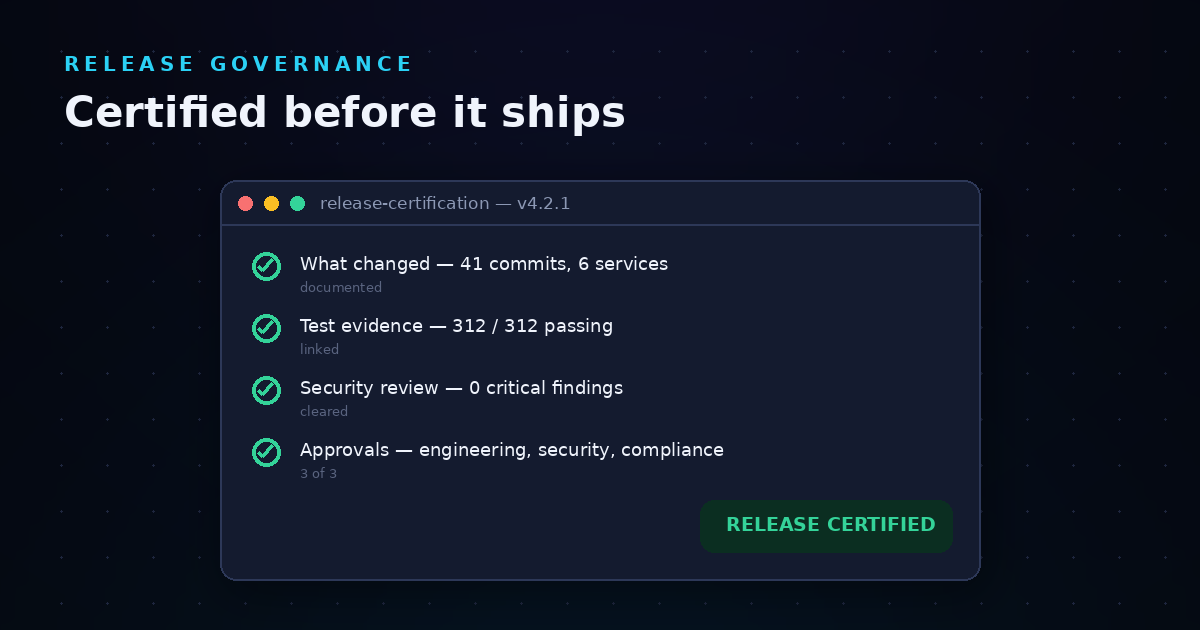
LoopIQ creates automatic release certification trails that include immutable approval records and auditor-ready certification packages. Your evidence exists as a byproduct of shipping software, available with one click when you need it.
The traditional approach to audit preparation involves a scramble. Someone sends a spreadsheet of releases. Engineers dig through GitHub and Slack. Compliance team members chase down approvals. Everyone hopes nothing was missed.
This approach doesn't scale, especially as AI-assisted development accelerates release velocity. If your team ships weekly—or daily—you can't reconstruct evidence for every release manually.
The alternative is building evidence capture into your delivery process. When approvals, quality signals, and compliance posture are bound to releases automatically, audit preparation becomes a retrieval exercise rather than a reconstruction project. LoopIQ enables this shift by generating compliance evidence as your team ships, not after.
GRC programs can't function on policy alone. They need engineering evidence that proves releases followed your defined controls. Without release-level evidence, you're asking auditors to trust your process based on memory and scattered logs.
The organizations succeeding with GRC in 2026 are those embedding evidence capture directly into their software delivery lifecycle. They're not treating compliance as a separate checkpoint—they're building it into the way they ship.
If you're ready to close the gap between shipping software and proving compliance, explore how LoopIQ can help your team generate audit-ready evidence automatically.
GRC evidence typically refers to policy documentation and control frameworks. Release evidence specifically documents what happened during a software release—the code changes, approvals, tests, and compliance state at ship time.
LoopIQ bridges this gap by generating release-level evidence that feeds directly into your GRC program's audit requirements.
Exporting logs gives you raw data, but not correlated evidence. An auditor needs to see that a specific approval was granted for a specific release with specific test results. Correlating that information from separate exports requires significant effort.
LoopIQ automatically correlates these signals into per-release evidence packages, eliminating the assembly work.
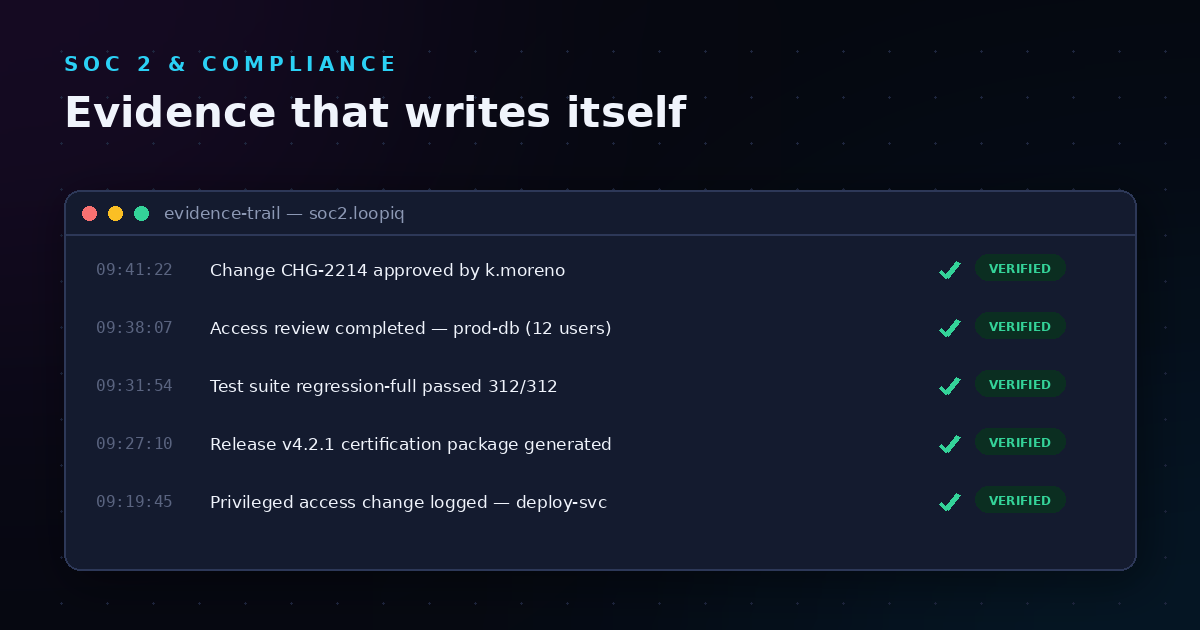
SOC 2 audits require proof that your change management controls are working. Release evidence demonstrates that code reviews happened, tests passed, and authorized personnel approved deployments for each release in scope.
LoopIQ's automated evidence capture gives you exactly what SOC 2 auditors ask for, available immediately for any release.
Missing evidence creates audit findings and can indicate control failures. Auditors may require additional testing or issue qualified opinions. Consistently missing evidence suggests your controls aren't operating effectively.
Some data can be extracted after the fact, but it's never as reliable as evidence captured at ship time. Approvals might be in Slack messages that are hard to find. Test results might have been overwritten. The compliance posture at release time is impossible to reconstruct accurately later.
LoopIQ captures evidence at the moment of release, preserving the state of the world when decisions were made.