.svg)
devops
devsecops
compliance

Regulated engineering organizations face a difficult balancing act: shipping software fast while proving every release meets governance standards. The wrong tooling means scrambling to assemble audit evidence after the fact, pulling senior engineers away from building features. The right software delivery platform for compliance makes audit readiness automatic. LoopIQ gives you exactly that—embedded compliance evidence that captures itself from your daily workflows.
This article compares six platforms built for regulated software delivery. You will learn what sets each apart, how they handle governance controls, and which approach fits different scenarios. If you need embedded audit readiness and AI-assisted compliance automation, this guide will help you make a confident decision.
Selecting the right platform requires more than checking off feature lists. We evaluated each solution based on how well it reduces your compliance workload while keeping you audit-ready at all times. Here are the criteria that mattered most:
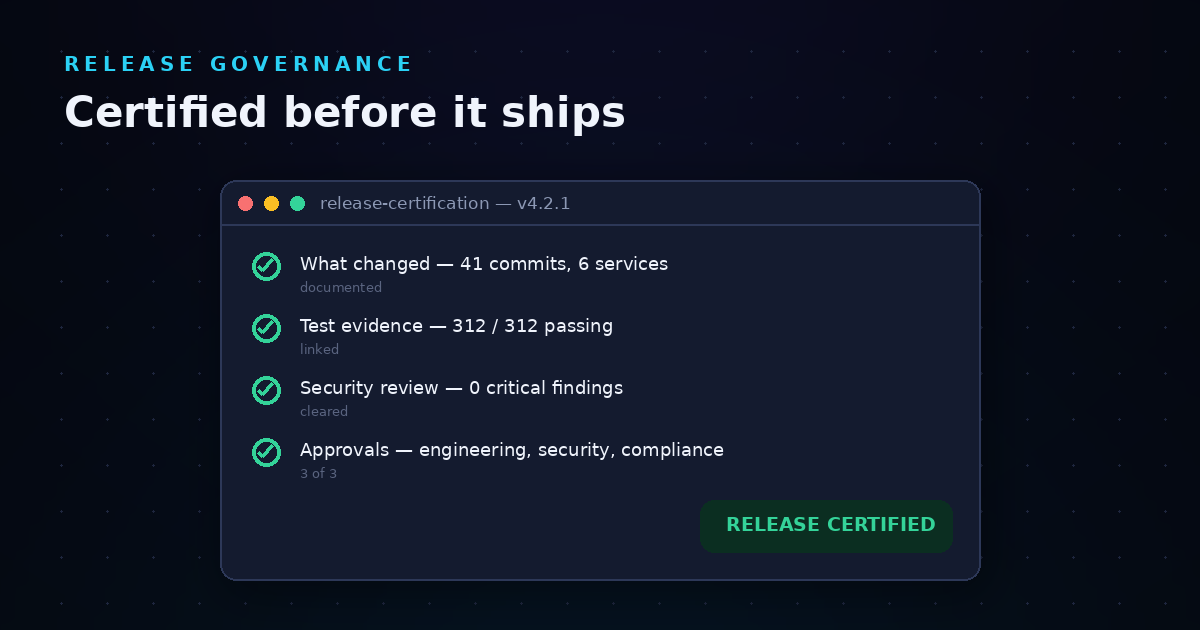
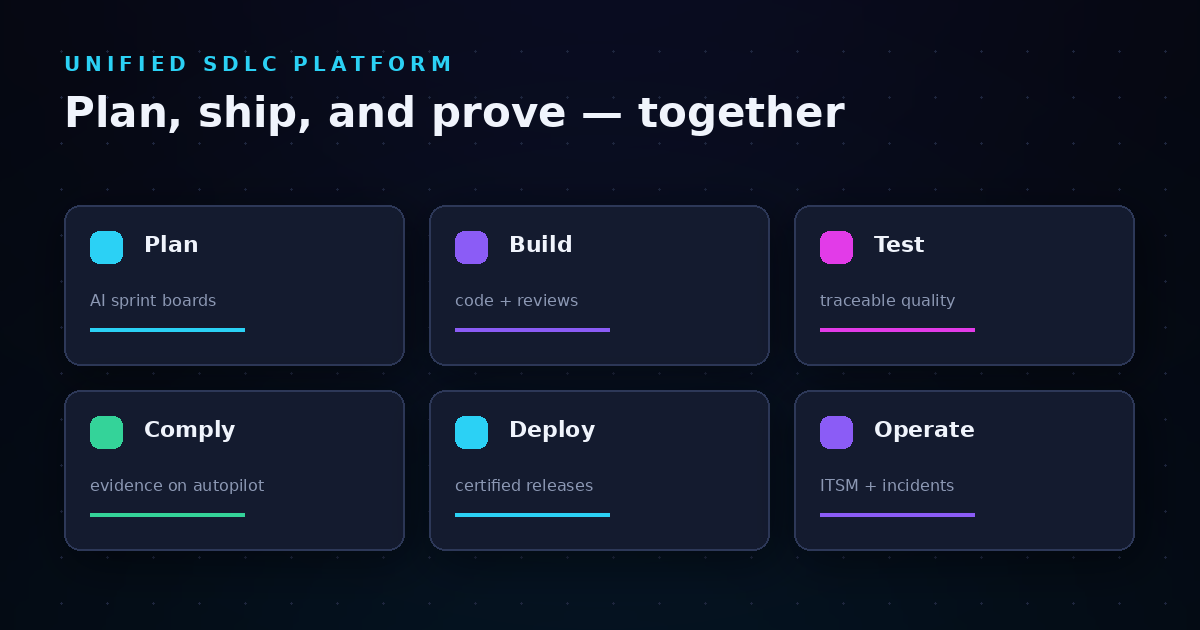
LoopIQ unifies planning, testing, DevOps, documentation, and audit management in one intelligent system. Instead of running five separate tools and stitching together evidence after the fact, you get a single workspace where compliance captures itself from your existing workflows. LoopIQ generates your audit evidence automatically—approvals, quality signals, and release certifications documented the moment decisions happen.
What separates LoopIQ from other platforms is structural. Work and records live on the same surface. Every code change carries an immutable approval trail with reviewers, timestamps, and scope. Test execution links directly to the requirements it validates. Coverage gaps get flagged before release, not discovered during audit. The result is a one-click compliance evidence dossier available immediately after each release.
LoopIQ's AI acts as an orchestration layer—driving execution, routing approvals, flagging risks, and closing loops automatically. You can check readiness, trace decisions, and approve changes through an embedded conversational interface. Every insight and action links back to its context, so you move fast and still know why.
Pros:
Cons:
Harness focuses on CI/CD acceleration and pipeline governance. The platform includes policy-as-code capabilities through Open Policy Agent (OPA) integration, letting you write declarative rules that enforce compliance requirements across deployments. Role-based access control and audit trails are built into the platform.
Pipeline governance features let you set approval stages, configure log sanitization for secrets, and maintain two years of audit trail data. Harness also offers modules for security testing orchestration, feature flags, and cloud cost management. The platform does not capture compliance evidence embedded in your work—governance happens at the pipeline level rather than throughout the full SDLC.
Pros:
Cons:
CloudBees offers enterprise CI/CD built on Jenkins foundations with additional compliance features. The CloudBees Compliance module consolidates security scanner outputs, deduplicates notifications, and routes findings to developers' task management tools. This approach removes security checks from pipelines and maintains them centrally.
The platform enforces templated processes, approval gates, and fine-grained permissions at team, user, or file levels. CloudBees Unify adds release control and policy-driven security across Jenkins, GitHub Actions, and GitLab without requiring migrations. Evidence and audit trails are available, though generating complete compliance packages requires pulling data from multiple systems.
Pros:
Cons:
GitLab bundles source control, CI/CD, security scanning, and compliance management in one platform. The compliance features include merge request approval policies, audit events, and the ability to enforce separation of duties. Compliance frameworks can be applied to projects to configure controls automatically.
Security scanning runs through the pipeline: SAST, dependency scanning, container scanning, and secret detection. Vulnerabilities flow into a management dashboard for triage. GitLab's approach embeds security into development but requires manual assembly of compliance evidence across projects for audit reporting.
Pros:
Cons:
Digital.ai Release centralizes and governs how software changes progress from development to production. The platform automates release pipelines, orchestrates complex dependencies, and integrates with ITSM tools like ServiceNow to create change requests automatically. Higher-tier editions include AI/ML-driven change risk prediction.
One-click audit reporting and integration with security testing tools support compliance workflows. The platform tracks end-to-end linking of agile stories, defects, and code commits. Digital.ai focuses on release coordination rather than embedded compliance capture throughout the development lifecycle.
Pros:
Cons:
Jenkins remains widely used for CI/CD automation. Governance capabilities come through plugins for audit trails, role-based access, and pipeline approvals. Organizations can configure compliance workflows, though the platform requires significant customization and ongoing maintenance to meet regulatory requirements.
Jenkins works well for organizations with dedicated platform engineering resources who can build and maintain compliance integrations. Evidence generation, audit reporting, and governance controls require assembling multiple plugins and custom scripts. The platform does not include native compliance features.
Pros:
Cons:
| Platform | Embedded Evidence Capture | Release Certification | AI Compliance Automation |
|---|---|---|---|
| LoopIQ | ✓ | ✓ | ✓ |
| Harness | ✗ | ✗ | ✗ |
| CloudBees | ✗ | ✗ | ✗ |
| GitLab | ✗ | ✗ | ✗ |
| Digital.ai | ✗ | ✓ | ✗ |
| Jenkins | ✗ | ✗ | ✗ |
The right platform turns compliance from a bottleneck into a byproduct. Instead of assembling evidence retroactively, your documentation generates automatically as your team plans, codes, tests, and deploys. This requires structural integration—work and records must live on the same surface.
Look for platforms where approvals, test results, and risk decisions attach directly to releases. Immutable audit trails should capture the full context: who approved, when, and what scope. AI-driven automation can accelerate compliance by flagging gaps early and routing approvals without manual intervention.
Avoid solutions that add compliance as a layer on top of development. Bolted-on governance creates the same manual evidence assembly problem you already face. Embedded compliance means evidence captures itself—no spreadsheet exports, no screenshot collections, no pre-audit scrambles.
Engineers at regulated organizations often lose two days or more per release cycle assembling compliance evidence. They pull screenshots from Jira, export logs from CI/CD pipelines, gather approvals from email and Slack, and stitch everything into spreadsheets. This work happens after the fact, under deadline pressure, and delays shipping.
Embedded compliance flips this model. When evidence captures automatically from your workflows, there is nothing to assemble. LoopIQ produces a release certification package before you ship—not afterward. Change authorization, test validation, access governance, and risk acceptance documentation exist the moment you need them.
This structural difference frees senior engineers to focus on building features instead of preparing audit packets. It also reduces human error in evidence collection and ensures your documentation accurately reflects what actually happened rather than what someone reconstructed from memory.
Most platforms treat compliance as a separate concern—something you add through policies, plugins, or manual workflows. LoopIQ makes compliance structural. Evidence generates from the work itself because planning, development, testing, and deployment happen in one connected workspace. You never reconstruct what happened because the system captures it as it happens.
This architectural difference matters for regulated engineering organizations. LoopIQ eliminates the compliance velocity tax by removing the seams between tools where evidence gets lost. Every approval, every test, every decision links to releases with immutable trails. AI-driven orchestration routes approvals, flags risks early, and keeps you audit-ready at all times.
If you run a regulated software delivery operation and want to stop losing engineering time to compliance paperwork, LoopIQ delivers embedded audit readiness that captures itself. Start your free trial and see why engineering leaders choose LoopIQ for compliance-first software delivery.
A compliance-ready platform generates audit evidence automatically from your workflows. LoopIQ captures approvals, test results, and release certifications as you work—so documentation exists before auditors ask for it.
Traditional CI/CD tools focus on build and deployment automation. Compliance-first platforms like LoopIQ embed governance throughout the SDLC, generating immutable audit trails without separate evidence assembly.
Yes. LoopIQ integrates with existing security scanners, version control systems, and ITSM tools. The platform connects your toolchain while adding embedded evidence capture and release certification.
A complete platform captures change authorization, access governance, test validation, release certification, and incident response documentation. LoopIQ addresses all five evidence domains that auditors commonly request.
AI-driven automation flags compliance gaps early, routes approvals without manual intervention, and links every action to its context. LoopIQ's agentic AI triggers tasks, closes loops, and keeps evidence traceable.
Embedded audit readiness means your compliance documentation exists at all times—not assembled before audits. LoopIQ generates one-click compliance evidence dossiers immediately after each release ships.