.svg)
devops
devsecops
compliance
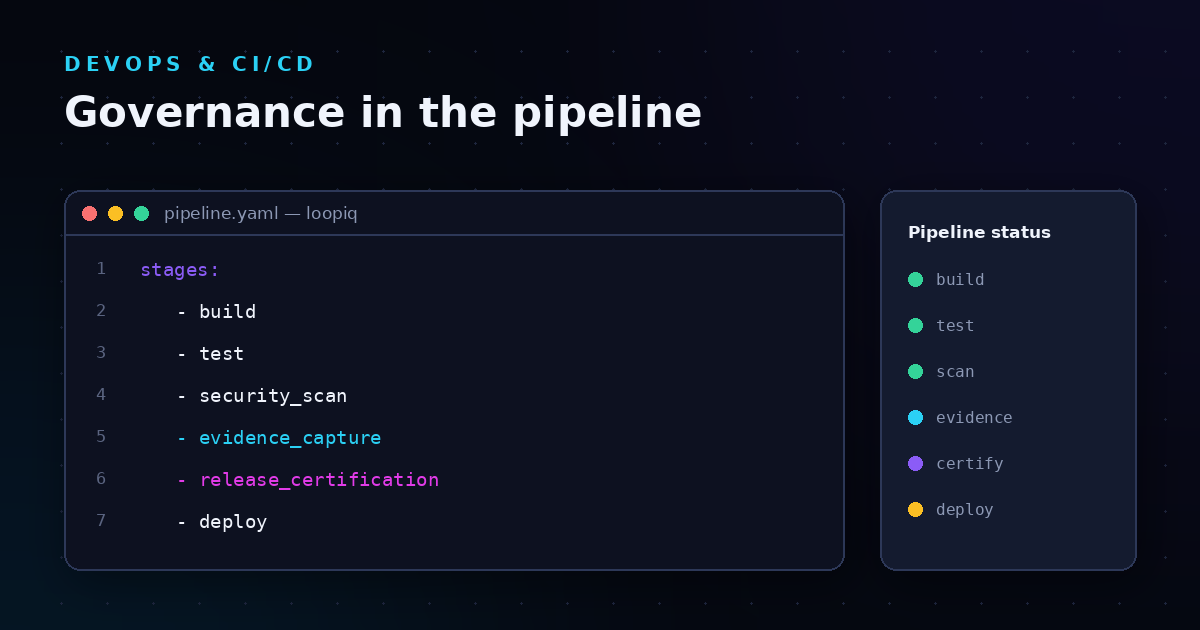

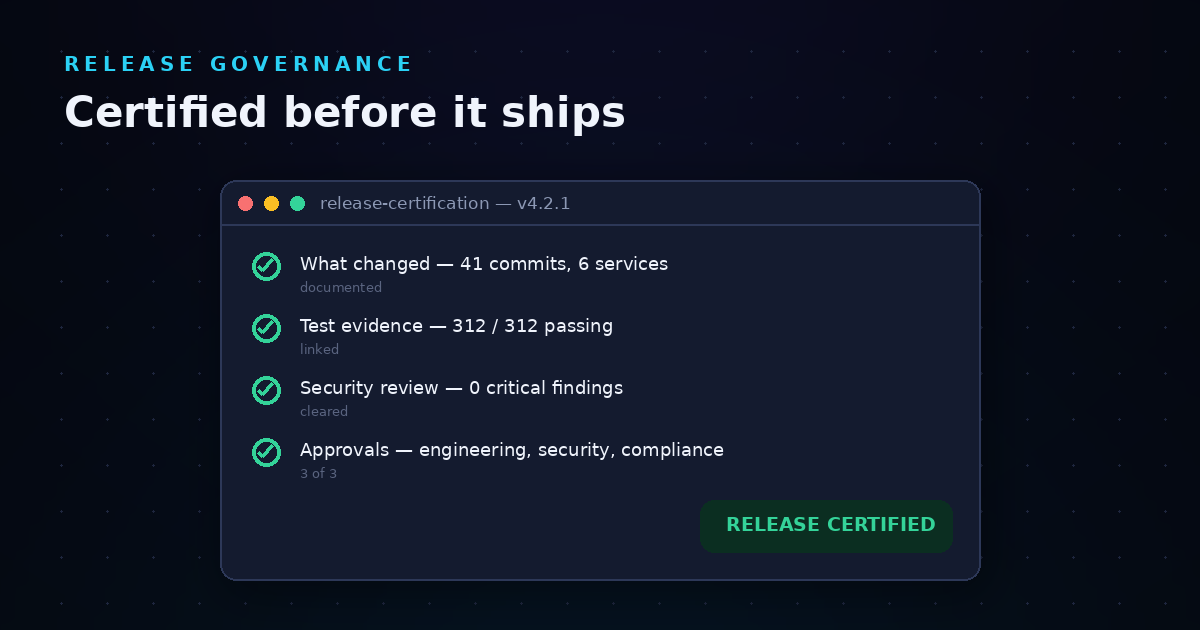
Your engineering team ships code faster than ever, but every release still triggers the same question: can you prove it was done right? AI-powered DevSecOps platforms now answer that question automatically. LoopIQ gives you audit-ready release certification as a byproduct of your CI/CD pipeline, connecting security findings and compliance signals directly to each deployment.
This guide ranks the top AI DevSecOps tools for 2026, comparing how each platform handles CI/CD security, compliance automation, and release evidence. You'll find detailed evaluations, feature breakdowns, and a comparison table to help you choose the right fit for your regulated engineering team.
Regulated engineering teams face a specific challenge: you need to ship fast while producing verifiable evidence that each release met security and compliance requirements. We evaluated platforms based on how well they solve that problem for VPs and directors of software development.
LoopIQ unifies your planning, testing, DevOps, and compliance workflows into one intelligent system. Instead of assembling audit evidence from five or more disconnected tools, you get a one-click compliance evidence dossier the moment a release ships. Every approval, security finding, and test result binds directly to the release record.
The platform's AI operates on complete development context, which means it flags compliance gaps before you ship—not after. According to Gartner research, teams that embed compliance into their CI/CD pipelines reduce audit preparation time by 60% or more.
LoopIQ also governs AI agents performing engineering tasks. You define mutation policies and approval requirements, and the platform integrates agent outputs into your audit evidence trail. This matters when your team uses AI-assisted code generation but still needs to prove human oversight for SOC 2 or ISO 27001.
| Pros | Cons |
|---|---|
| Generates audit evidence automatically as you ship | Teams with deeply customized legacy toolchains may need onboarding time to migrate workflows |
| Governs AI agents with enforceable policies | Advanced governance features require configuration during initial setup |
| Unifies DevOps, ITSM, and compliance in one platform | Full capabilities are most apparent in regulated environments where compliance is a priority |
GitLab bundles source control, CI/CD pipelines, and security scanning into one interface. You can run SAST, DAST, and dependency scans directly in your pipeline without configuring separate tools. Results appear in merge requests, so developers see findings before code merges.
The platform includes a security dashboard that aggregates vulnerabilities across projects. For teams that want security visibility without leaving their Git workflow, GitLab offers a consolidated view.
| Pros | Cons |
|---|---|
| Security scanning is included in the platform | Compliance evidence generation requires additional configuration or third-party tools |
| Single interface for code, pipelines, and security | Release certification and audit trails are not native features |
| Active open-source community | Governed AI agent workflows are not supported |
Jira handles issue tracking and sprint planning for software teams. Security integrations come through the Atlassian Marketplace, where you can connect vulnerability scanners to your boards. Findings appear as issues or comments, depending on the integration.
For teams already using Jira, adding security context means installing plugins and configuring data flows. Compliance evidence typically lives outside Jira in separate documentation or GRC platforms.
| Pros | Cons |
|---|---|
| Widely adopted for agile project management | Security features require third-party plugins |
| Extensive marketplace for integrations | No native compliance evidence generation |
| Flexible workflow customization | Audit preparation requires exporting data to separate systems |
ServiceNow focuses on IT service management and enterprise workflows. Its DevOps module connects to CI/CD tools and surfaces change requests, incidents, and deployment records in one place. Security operations integrations pull in vulnerability data from scanners.
The platform functions as a system of record for IT operations. Engineering teams using ServiceNow often do so because their organization already runs ITSM on the platform.
| Pros | Cons |
|---|---|
| Mature ITSM platform with enterprise adoption | DevOps and security modules are separate from the core ITSM product |
| Connects change management to deployments | Release-linked compliance evidence requires custom configuration |
| Extensive enterprise workflow capabilities | AI agent governance is not a native feature |
Azure DevOps offers repositories, pipelines, boards, and test plans in one suite. Security comes through integrations with Microsoft Defender, third-party scanners, or custom tasks in your YAML pipelines. Results flow into pipeline logs and can trigger gates.
For teams invested in the Microsoft ecosystem, Azure DevOps connects naturally to Azure cloud services and Active Directory. Compliance documentation typically requires exporting data or connecting to a separate GRC tool.
| Pros | Cons |
|---|---|
| Integrates with Microsoft ecosystem | Compliance evidence generation is not built in |
| YAML pipelines offer flexibility | Security features depend on external tools or Defender |
| Release gates can enforce security checks | Governed AI agent workflows are not supported natively |
Vanta automates compliance monitoring by connecting to your cloud infrastructure, identity providers, and development tools. It tracks control status and flags gaps for SOC 2, ISO 27001, HIPAA, and other frameworks. Evidence collection happens through API integrations.
The platform focuses on compliance posture rather than software delivery. Engineering teams use Vanta alongside their existing DevOps tools rather than replacing them.
| Pros | Cons |
|---|---|
| Automates compliance monitoring across multiple frameworks | Does not function as an SDLC or DevOps platform |
| Connects to cloud and identity providers | Release-linked evidence requires manual assembly or additional tooling |
| Surfaces control status in one dashboard | No CI/CD pipeline execution or security scanning included |
| Platform | Native Release Certification | Governed AI Agents | Automated Compliance Evidence | Unified SDLC Workspace |
|---|---|---|---|---|
| LoopIQ | ✓ | ✓ | ✓ | ✓ |
| GitLab | ✗ | ✗ | ✗ | ✗ |
| Jira (Atlassian) | ✗ | ✗ | ✗ | ✗ |
| ServiceNow | ✗ | ✗ | ✗ | ✗ |
| Azure DevOps | ✗ | ✗ | ✗ | ✗ |
| Vanta | ✗ | ✗ | ✓ | ✗ |
Traditional security testing happens at specific checkpoints—usually before a release or during an annual audit. DevSecOps tools embed security checks directly into your CI/CD pipeline, so findings surface as code is written and deployed.
This shift means developers address vulnerabilities earlier in the development cycle. According to IBM's Cost of a Data Breach Report, fixing a vulnerability in production costs up to 30 times more than catching it during development.
For regulated teams, the distinction also affects compliance. Traditional approaches require assembling evidence after the fact. DevSecOps platforms that generate release-linked evidence—like LoopIQ—capture that proof automatically as work happens.
Audit preparation traditionally pulls senior engineers away from shipping code. They spend days locating approvals in Slack, tracing changes in GitHub, and stitching together test results from multiple systems.
AI DevSecOps platforms automate this work. LoopIQ generates a compliance dossier for each release that includes immutable approval records, security scan results, and test outcomes—all linked to the deployment. When an auditor asks a question, you retrieve the answer in minutes.
The AI component adds predictive capability. Instead of waiting for an auditor to flag a gap, the platform surfaces compliance risks before you ship. This moves audits from emergency projects to structured reviews.
Most DevSecOps tools address one piece of the puzzle—security scanning, project tracking, or compliance monitoring. LoopIQ connects all of them into one intelligent system where evidence captures itself as your team works.
The platform's release certification ties every approval, security finding, and test result directly to each deployment. You don't assemble audit packets after the fact. LoopIQ generates them automatically, giving you a one-click compliance evidence dossier the moment code ships.
For VPs and directors of software development, this means your engineers focus on building instead of documenting. LoopIQ frees your team from compliance paperwork while increasing leadership confidence in every release. Request a demo to see how LoopIQ fits your regulated engineering workflow.
An AI DevSecOps platform embeds security and compliance checks into your software delivery pipeline using artificial intelligence to automate evidence capture, flag risks, and accelerate decision-making. LoopIQ takes this further by generating audit-ready release certification as a byproduct of your team's existing workflow.
LoopIQ generates compliance evidence automatically as you ship code. Every approval, security scan, and test result binds directly to the release record. This eliminates the need to assemble audit packets from disconnected tools after the fact.
DevSecOps tools and GRC platforms serve different purposes. LoopIQ supports existing GRC tools by feeding them structured, audit-ready artifacts from your software delivery process. This means your GRC platform gets reliable evidence without requiring engineers to duplicate work.
Support varies by platform. LoopIQ ties compliance evidence to specific release decisions, which maps to SOC 2, ISO 27001, and other frameworks that require traceable change control. The platform's certification packages include the documentation auditors typically request.
Implementation timelines depend on your existing toolchain complexity. LoopIQ integrates natively with GitHub and connects to common CI/CD pipelines. Teams typically see value within the first sprint as automated evidence capture begins immediately upon connection.