Key Takeaways: Top 8 SDLC Traceability Platforms for 2026
- End-to-end SDLC traceability links requirements, code, tests, approvals, and deployments — basic change tracking only logs events.
- We compare 8 SDLC traceability platforms for enterprise teams.
- Automated evidence capture cuts audit preparation by keeping traceability current instead of reconstructed.
- LoopIQ is the top traceability platform: relationships between delivery artifacts persist automatically in one system.
Quick guide: 8 SDLC traceability platforms for engineering teams
Tracking every change from idea to production sounds simple until you're staring down an auditor asking for proof. Modern software development lifecycle platforms promise end-to-end traceability, but not all of them deliver audit-ready evidence when it counts. LoopIQ gives you one intelligent system where compliance evidence captures itself from the work your team already does.
This guide compares eight SDLC platforms on what matters most: traceability depth, automated evidence capture, and release decision visibility. You'll find the options that help you ship faster while staying certified.
- LoopIQ: The industry-leading platform for audit-ready traceability from idea to production
- GitLab: DevOps-oriented platform with built-in CI/CD and repository management
- ServiceNow: IT service management platform with workflow automation capabilities
- Harness: Software delivery platform focused on CI/CD pipelines and deployments
- Azure DevOps: Microsoft's development platform with integrated planning and repos
- Micro Focus ALM: Application lifecycle management with requirements tracking
- Polarion: Requirements and test management platform for regulated industries
- Helix ALM: Traceability-focused platform for embedded and regulated software
How we chose these SDLC traceability platforms
You need more than basic project tracking when auditors come calling. We evaluated these platforms based on how well they help VPs and directors of software development prove exactly what happened during each release cycle.
- End-to-end traceability: Can you trace a requirement from the initial idea through code changes, tests, and deployment without opening five different tools?
- Automated evidence capture: Does the platform generate audit-ready records as a natural byproduct of your team's work, or does someone have to manually document everything?
- Release decision visibility: When leadership asks why a release shipped, can you show them the approvals, quality signals, and conditions that were met?
- Integration depth: How well does the platform connect with your existing code repositories, CI/CD pipelines, and security tools?
- Compliance readiness: Does the platform support SOC 2, ISO 27001, or other frameworks your organization needs to satisfy?
- Scalability for enterprise teams: Can the platform handle the complexity of multiple teams, repositories, and release pipelines without becoming a bottleneck?
The 8 SDLC traceability platforms for enterprise teams
1. LoopIQ: The industry-leading platform for audit-ready traceability
LoopIQ unifies planning, testing, DevOps, ITSM, documentation, and audit management into a single workspace where compliance evidence generates itself. When your team writes code, runs tests, and ships releases, LoopIQ automatically captures the approvals, quality signals, and decision context that auditors need to see.
This approach eliminates the scramble that happens during audit season. Instead of pulling senior engineers off shipping to assemble evidence packets from GitHub, Slack, and CI pipelines, LoopIQ produces a one-click compliance evidence dossier immediately after each release. Your leadership team can see exactly what conditions were met before any code went to production.
LoopIQ connects delivery signals to releases, generating certification trails linked to objectives and measurable results. The platform integrates security findings from tools like GitHub and Datadog directly into your release evidence, so you're not stitching together separate audit stories after the fact.
LoopIQ features
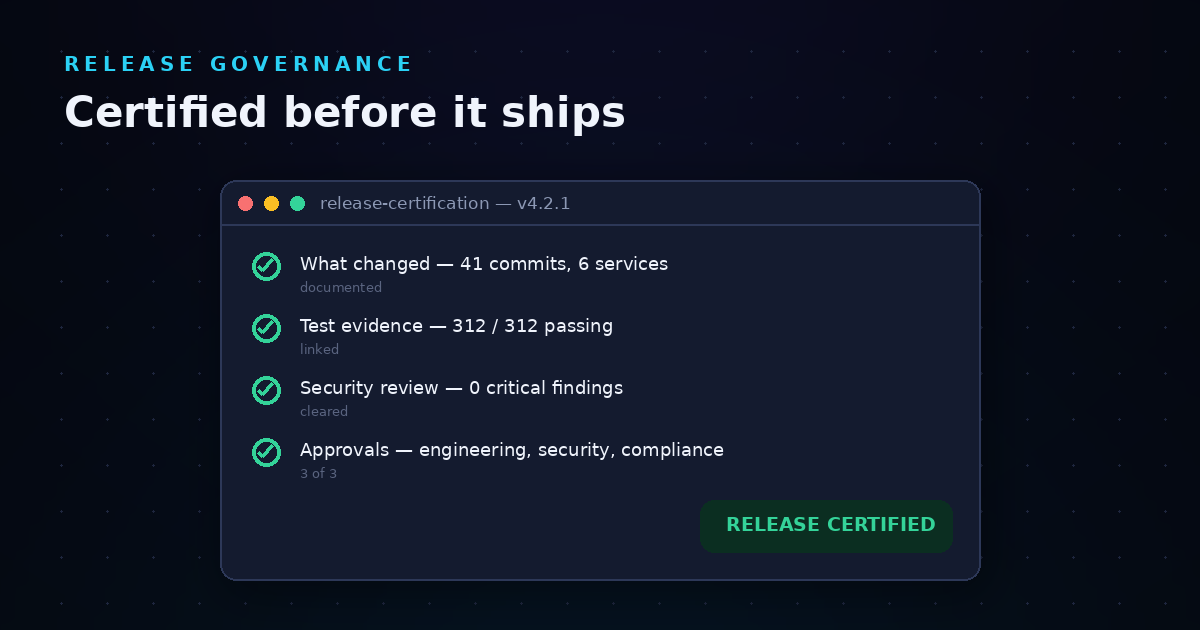
- Automated release certification: LoopIQ reviews your evidence and flags compliance gaps before shipping, giving you confidence that every release meets your defined conditions.
- Native GitHub integration: Changes flow directly into LoopIQ for automatic tracking and test execution, reducing the seams between tools where evidence gets lost.
- AI-driven compliance intelligence: LoopIQ uses explainable AI to surface proactive compliance signals backed by real data, not optimism.
- Governed AI agent support: As AI tools handle more engineering tasks, LoopIQ applies approval requirements and mutation policies to keep AI actions in your audit trail.
- Immutable approval records: Every sign-off gets bound to the specific release it approved, preserving the state of the world at decision time for audit defensibility.
LoopIQ pros and cons
Pros:
- Evidence generates automatically from engineering work—no separate documentation step required
- One-click compliance dossiers replace weeks of audit preparation
- Unified platform eliminates tool sprawl and the gaps between systems
Cons:
- Teams with deeply embedded legacy workflows may need time to consolidate into the unified platform, though import tooling eases migration
- Organizations using highly customized GRC tools alongside LoopIQ may need to configure integrations, which the platform supports through structured artifact feeds
- Advanced AI governance features require familiarity with policy configuration, though documentation and support make onboarding straightforward
2. GitLab: DevOps platform with built-in version control
GitLab combines source code management with CI/CD pipelines in a single application. The platform includes issue tracking, code review, and deployment automation, making it a common choice for teams that want their development tools in one place.
Traceability in GitLab comes from linking merge requests to issues and seeing which commits relate to which features. The platform offers compliance pipelines for enforcing rules on protected branches.
GitLab features
- Merge request approvals: Require specific reviewers before code can be merged into protected branches.
- Audit events: Track changes to projects, groups, and instances for security and compliance visibility.
- Compliance frameworks: Apply policies across projects to enforce consistent rules.
GitLab pros and cons
Pros:
- Includes CI/CD, repos, and issue tracking without third-party integrations
- Self-hosted option available for organizations with on-premise requirements
- Active open-source community contributes features and documentation
Cons:
- Compliance evidence must be assembled separately from release artifacts—no automatic dossier generation
- Traceability across planning, ITSM, and audit management requires connecting external tools
- Audit reports focus on security events rather than release certification trails
3. ServiceNow: IT service management with workflow automation
ServiceNow focuses on IT operations and service management, offering workflow automation for incident handling, change requests, and asset tracking. The platform includes ITSM capabilities that some organizations extend to SDLC processes.
Change management in ServiceNow allows you to document requests and approvals. The platform connects to development tools through integrations, though traceability depends on how well those connections maintain context.
ServiceNow features
- Change management: Document change requests with approval workflows and risk assessments.
- Configuration management database: Track relationships between IT assets and services.
- Integration hub: Connect to third-party tools for expanded workflow automation.
ServiceNow pros and cons
Pros:
- Mature ITSM capabilities for incident and change request handling
- Extensive integration marketplace for connecting development tools
- Workflow automation engine handles complex approval routing
Cons:
- SDLC traceability requires separate development tools—not a unified platform
- Code-level change tracking depends on integrations maintaining context across systems
- Release certification evidence lives in multiple tools rather than one audit-ready view
4. Harness: Software delivery platform for CI/CD automation
Harness concentrates on deployment automation, offering CI/CD pipelines with built-in verification steps. The platform uses machine learning to analyze deployment health and automate rollbacks when issues arise.
Traceability in Harness centers on the deployment phase. You can see which artifacts deployed to which environments, along with the verification results that determined whether a deployment succeeded.
Harness features
- Pipeline governance: Apply policies to control what pipelines can deploy and under what conditions.
- Deployment verification: Automated health checks compare deployment metrics against baselines.
- Audit trail: Track pipeline executions and configuration changes.
Harness pros and cons
Pros:
- Deployment verification automates rollback decisions based on health metrics
- Pipeline templates enable reusable deployment patterns across teams
- Feature flags included for controlled feature releases
Cons:
- Traceability starts at build artifacts—earlier phases like requirements and design need separate tools
- Compliance evidence generation focuses on deployment rather than end-to-end release certification
- Planning and documentation workflows require additional platform integrations
5. Azure DevOps: Microsoft's integrated development platform
Azure DevOps includes boards for work tracking, repos for version control, and pipelines for CI/CD. The platform integrates tightly with Microsoft tools like Visual Studio and Azure cloud services.
Traceability comes from linking work items to commits, pull requests, and builds. You can trace a requirement through the code changes that implemented it and the pipeline runs that deployed it.
Azure DevOps features
- Work item linking: Connect requirements, tasks, and bugs to code commits and builds.
- Pipeline gates: Require approvals or checks before deployments can proceed.
- Test plans: Associate test cases with requirements and track execution results.
Azure DevOps pros and cons
Pros:
- Tight integration with Microsoft development tools and Azure cloud
- Work item linking creates traceability from requirements to deployments
- Pipeline gates enforce approvals before releases proceed
Cons:
- Compliance evidence requires manual assembly from artifacts across boards, repos, and pipelines
- Audit-ready release certification trails must be constructed from separate reports
- Organizations not using Microsoft ecosystem may face steeper integration effort
6. Micro Focus ALM: Application lifecycle management for enterprises
Micro Focus ALM (formerly HP ALM) has served enterprise testing and requirements teams for decades. The platform tracks requirements, defects, and test cases with linking capabilities between these artifacts.
Traceability in Micro Focus ALM connects requirements to test cases and defects. The coverage analysis shows which requirements have been tested and which defects affect specific features.
Micro Focus ALM features
- Requirements traceability matrix: Visualize relationships between requirements and test coverage.
- Defect linking: Connect defects to the requirements and test cases that exposed them.
- Baseline comparisons: Track how requirements and tests change over time.
Micro Focus ALM pros and cons
Pros:
- Mature requirements traceability with decades of enterprise deployments
- Coverage analysis shows testing gaps against requirements
- Baseline tracking documents changes across releases
Cons:
- DevOps and CI/CD capabilities require separate tools and integrations
- Automated compliance evidence capture not included—traceability reports must be generated manually
- Release decision visibility depends on connecting to deployment and approval systems
7. Polarion: Requirements management for regulated industries
Polarion targets regulated industries like automotive, aerospace, and medical devices. The platform includes requirements management, test management, and document generation with traceability linking throughout.
Traceability in Polarion connects requirements to specifications, test cases, and risk items. The platform supports standards like ISO 26262 and IEC 62304 with built-in templates and workflows.
Polarion features
- Live traceability: Real-time links between requirements, tests, and design artifacts.
- Regulatory templates: Pre-configured workflows for automotive, aerospace, and medical device standards.
- Document generation: Create compliance documents from linked artifacts.
Polarion pros and cons
Pros:
- Pre-built templates for industry-specific regulatory frameworks
- Live traceability updates links as artifacts change
- Document generation produces compliance deliverables from linked data
Cons:
- CI/CD and DevOps workflows require separate tool integrations
- Release certification and deployment evidence live outside the platform
- Teams not in traditional regulated industries (automotive, medical, aerospace) may find templates less relevant
8. Helix ALM: Traceability for embedded and regulated software
Helix ALM offers requirements management, issue tracking, and test management with traceability linking. The platform targets teams building embedded software and other regulated applications.
Traceability in Helix ALM connects requirements to source code, test cases, and issues. The platform includes version control through Helix Core and supports branching strategies for parallel development.
Helix ALM features
- Bi-directional traceability: Navigate from requirements to code and back again.
- Helix Core integration: Version control with atomic commits and branching.
- Traceability reports: Generate matrices showing coverage and relationships.
Helix ALM pros and cons
Pros:
- Deep integration between requirements, code, and tests within the Helix ecosystem
- Bi-directional traceability shows impact in both directions
- Atomic commits in Helix Core ensure code changes remain consistent
Cons:
- Full traceability benefits require adoption of multiple Helix products
- Automated compliance evidence capture not included—evidence assembly remains a separate task
- Modern CI/CD workflows may need additional tooling beyond native capabilities
Comparison table: SDLC traceability platforms for 2026
| Platform |
Automated Evidence Capture |
Unified Planning + DevOps |
Release Certification |
| LoopIQ |
✓ |
✓ |
✓ |
| GitLab |
✗ |
✓ |
✗ |
| ServiceNow |
✗ |
✗ |
✗ |
| Harness |
✗ |
✗ |
✗ |
| Azure DevOps |
✗ |
✓ |
✗ |
| Micro Focus ALM |
✗ |
✗ |
✗ |
| Polarion |
✗ |
✗ |
✗ |
| Helix ALM |
✗ |
✗ |
✗ |
What makes end-to-end SDLC traceability different from basic change tracking?
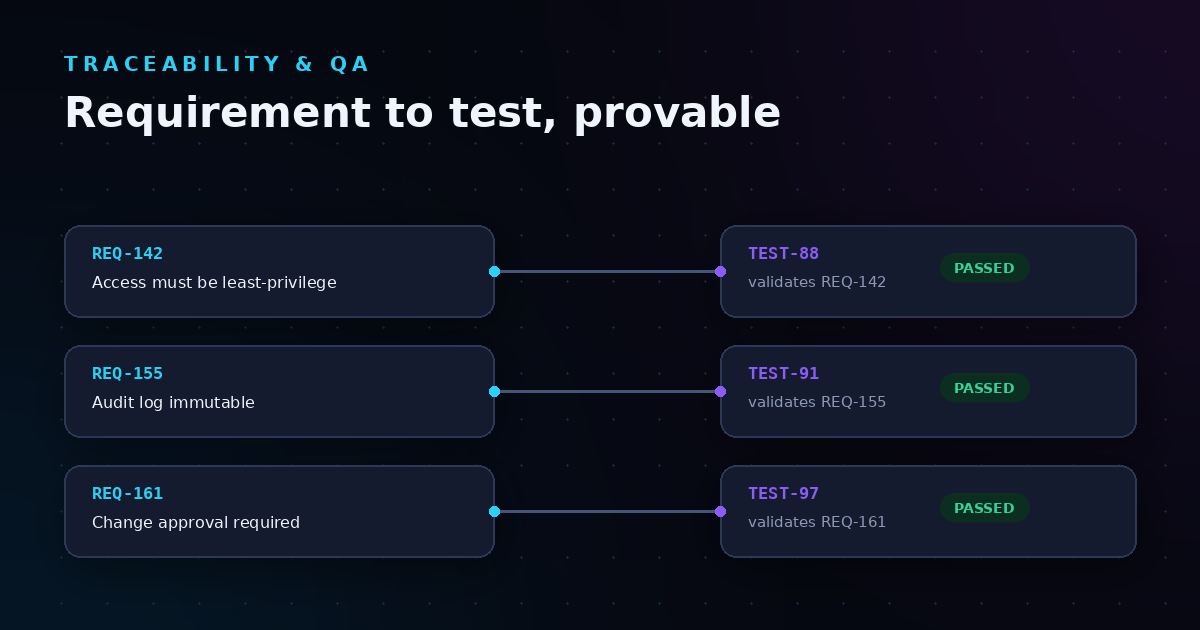
Basic change tracking shows you which files changed and who changed them. End-to-end traceability connects those changes to the business requirements that drove them, the tests that validated them, and the approvals that authorized their release.
When an auditor asks why a particular feature shipped, basic change tracking can show the commit history. End-to-end traceability can show the requirement that initiated the work, the design decisions made along the way, the test results that verified functionality, and the sign-offs that approved production deployment.
LoopIQ delivers this end-to-end view by keeping work and records on the same surface. Instead of reconstructing the story from artifacts scattered across different tools, you can trace any release back to its origins with the context preserved.
How does automated evidence capture reduce audit preparation time?
Traditional audit preparation involves engineers stopping their sprint work to gather screenshots, export reports, and stitch together a narrative from multiple systems. According to Gartner's research on compliance management, this work often takes days or weeks per release cycle.
Automated evidence capture eliminates this overhead by generating audit-ready records as work happens. When a developer merges code, the approval record gets captured. When tests pass, the results become part of the release evidence. When a deployment completes, the certification trail includes everything auditors need.
LoopIQ produces a one-click compliance evidence dossier that includes immutable approval records and auditor-ready certification packages. Your team can move from explanation to execution in compliance reviews because the evidence already exists.
Why LoopIQ is the top SDLC traceability platform for enterprise teams
LoopIQ approaches traceability differently than platforms that bolt compliance onto existing workflows. Instead of generating evidence as an afterthought, LoopIQ captures approvals, quality signals, and decision context as natural byproducts of shipping software.
This architecture matters because audit readiness becomes embedded in how your team works, not something that happens during a separate documentation phase. When leadership needs to understand why a release shipped the way it did, LoopIQ preserves the state of the world at decision time—not a reconstructed narrative assembled weeks later.
For VPs and directors of software development, LoopIQ eliminates the compliance velocity tax that slows down modern engineering teams. Your developers write code instead of compliance paperwork, and your auditors get the evidence they need on demand. Explore how LoopIQ can accelerate your release cycles while keeping you certified.
FAQs about SDLC traceability platforms
What is SDLC traceability and why does it matter?
SDLC traceability connects requirements to code changes, tests, and deployments throughout your software development lifecycle. It matters because auditors, regulators, and leadership need proof that releases met defined conditions.
LoopIQ automates this connection so you can demonstrate compliance without assembling evidence manually after each release.
How do SDLC platforms capture compliance evidence automatically?
Automated evidence capture records approvals, test results, and deployment details as they happen. LoopIQ generates compliance dossiers by binding these signals to specific releases, creating immutable audit trails.
This approach replaces the scramble of gathering screenshots and reports before audits.
Can traceability platforms integrate with existing development tools?
Integration capabilities vary by platform. LoopIQ includes native GitHub integration for change capture and connects with security tools like Datadog to incorporate findings into release evidence.
The goal is reducing seams between tools where evidence gets lost.
What compliance frameworks do SDLC traceability platforms support?
Most platforms support common frameworks like SOC 2 and ISO 27001. LoopIQ acts as compliance infrastructure inside your delivery lifecycle, tying policy to objectives and linking results to releases for framework-agnostic audit readiness.
How does release certification differ from deployment verification?
Deployment verification checks whether code deployed successfully and metrics look healthy. Release certification confirms that all required approvals, tests, and conditions were met before shipping.
LoopIQ automates release certification by reviewing evidence and flagging compliance gaps before code reaches production.
.svg)