.svg)
devops
devsecops
compliance

Software delivery in regulated environments requires more than speed—it requires proof. Engineering teams shipping code under SOC 2, ISO 27001, or HIPAA mandates need tools that capture evidence, manage testing, and track incidents without creating extra work. LoopIQ gives you a compliance-first SDLC workspace that unifies all three capabilities in one platform.
This article compares eight software delivery tools designed for audit readiness. You'll find platforms ranging from GRC-focused solutions to DevOps-native systems, each evaluated on how they handle evidence collection, testing coverage, and incident workflows. The goal: help you identify which tool fits your regulatory requirements and engineering culture.
Regulated engineering teams need platforms that fit into their existing workflows without adding compliance overhead. We evaluated each tool based on how well it serves VPs and Heads of Development who need both velocity and audit defensibility.
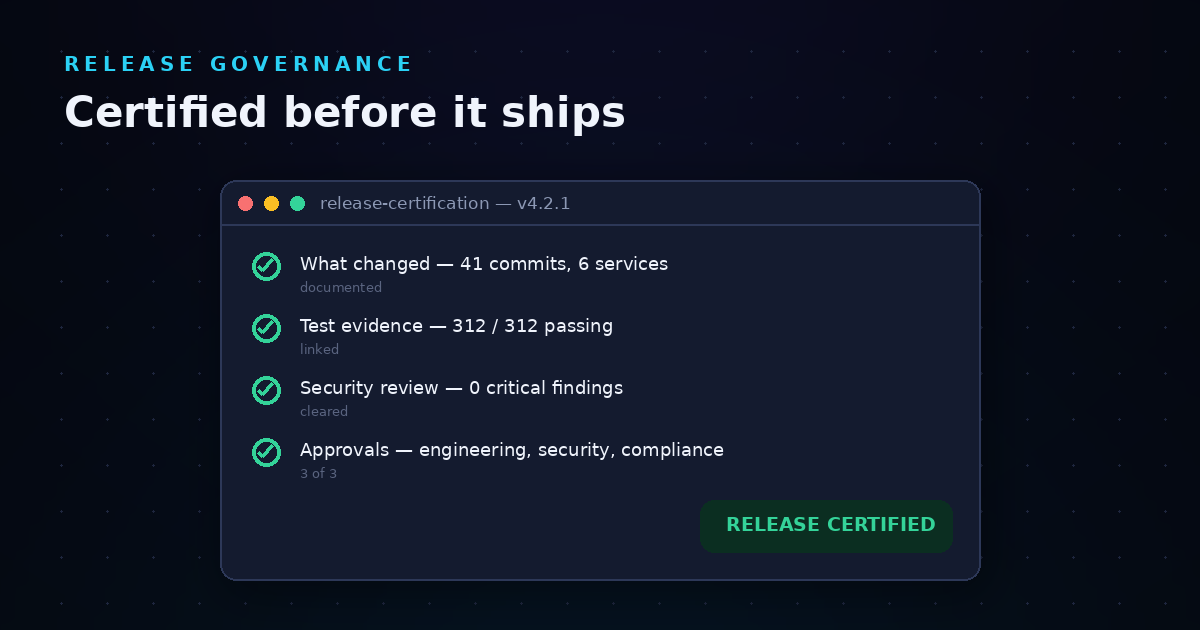
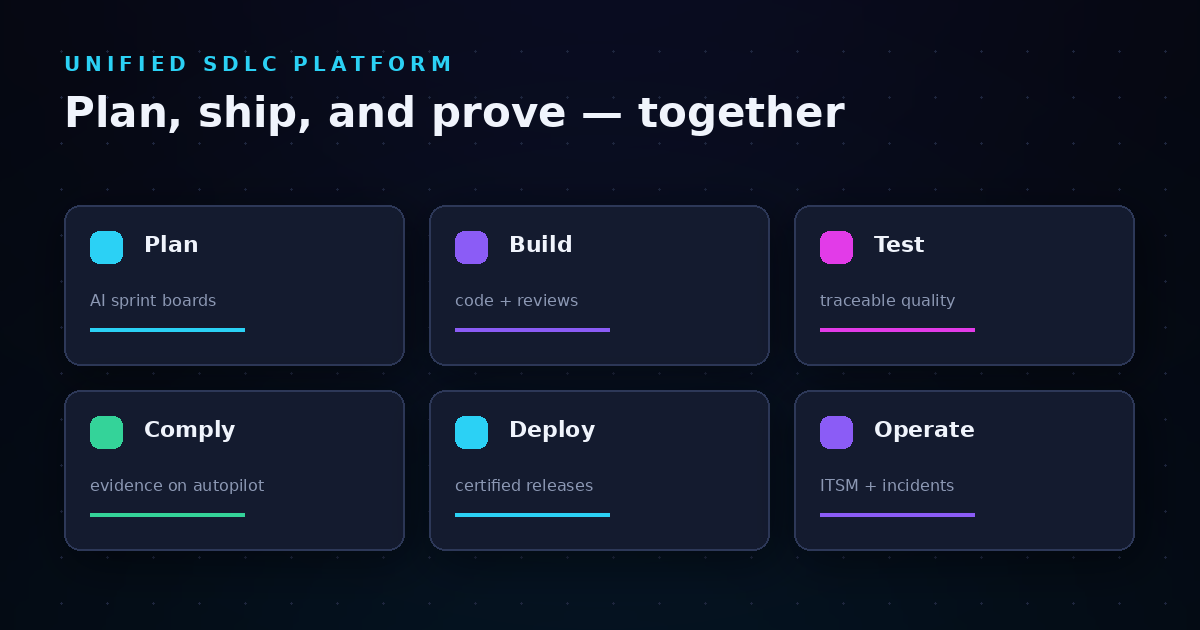
LoopIQ stands apart as the only platform that unifies planning, testing, DevOps, ITSM, and audit management in one intelligent system. Rather than treating compliance as an afterthought, LoopIQ embeds evidence capture directly into your delivery lifecycle. Every commit, test result, and approval gets automatically linked to its release.
For VPs of Development managing regulated teams, this means no more pulling senior engineers off shipping work to assemble audit packets. LoopIQ produces per-release compliance evidence automatically—available with one click immediately after deployment. According to research on automated evidence collection, organizations using automation for compliance reduce evidence gathering time significantly compared to traditional approaches.
LoopIQ connects compliance posture directly to release readiness decisions. Before you ship, the platform reviews evidence and flags gaps—giving engineering leaders confidence that releases meet regulatory requirements without last-minute scrambles.
Pros:
Cons:
Vanta focuses on automating security compliance monitoring across SOC 2, ISO 27001, HIPAA, and other frameworks. The platform scans your infrastructure and SaaS applications to identify compliance gaps and collect evidence automatically. For teams primarily concerned with security posture documentation, Vanta offers a way to track controls across cloud environments.
The platform's agent-based monitoring approach means you get visibility into endpoints and cloud resources. However, Vanta operates separately from your software delivery workflow—evidence collection happens outside the SDLC rather than embedded in it.
Pros:
Cons:
Drata automates compliance workflows by connecting to your tech stack and pulling evidence from integrated systems. The platform maps collected data to framework controls and generates reports for auditors. Teams using Drata can reduce time spent gathering screenshots and documents for compliance reviews.
Drata's approach centers on aggregating evidence from existing tools rather than embedding compliance into the delivery process. This works for organizations that want to layer compliance monitoring on top of their current toolchain without changing workflows.
Pros:
Cons:
ServiceNow offers enterprise IT service management with incident, problem, and change management workflows. Organizations with established ITIL practices often use ServiceNow to track service requests and manage operational incidents. The platform includes GRC modules for compliance tracking.
For software delivery teams, ServiceNow functions primarily as an ITSM layer rather than a unified SDLC platform. Release evidence typically lives in separate systems, requiring integration work to connect deployments to incident records.
Pros:
Cons:
CloudBees offers enterprise CI/CD capabilities built on Jenkins foundations. The platform includes features for managing deployment pipelines across multiple teams and enforcing governance policies. Organizations with complex Jenkins environments often adopt CloudBees for additional management and security controls.
CloudBees focuses on the build and deploy phases of software delivery. Compliance evidence and audit documentation require integration with separate GRC or documentation systems to create release-level audit trails.
Pros:
Cons:
GitLab combines source control, CI/CD, and security scanning in one DevSecOps platform. Development teams can manage code repositories, run pipelines, and view security findings without switching tools. GitLab's security scanners identify vulnerabilities during the build process.
For audit evidence and compliance, GitLab offers visibility into code changes and security scan results. However, connecting these artifacts to formal compliance frameworks and generating auditor-ready documentation requires additional configuration or external tools.
Pros:
Cons:
Anecdotes positions itself as a compliance operating system that automates evidence collection across your tech stack. The platform aggregates data from integrated tools and maps it to compliance controls. Teams managing multiple frameworks can view control status in a unified dashboard.
Anecdotes focuses on the compliance management layer rather than software delivery workflows. Evidence collection happens separately from the release process, requiring manual correlation between audit artifacts and specific deployments.
Pros:
Cons:
FloQast specializes in accounting close management and audit preparation. The platform helps finance and audit teams track reconciliations, manage workflows, and document evidence. Organizations with strong audit requirements often use FloQast for its structured approach to evidence management.
FloQast's strengths lie in financial close processes rather than software delivery compliance. Engineering teams would need separate tools for SDLC evidence capture, testing, and incident management.
Pros:
Cons:
| Platform | Release-Linked Evidence | Unified Testing | Incident Workflows | AI-Driven Automation |
|---|---|---|---|---|
| LoopIQ | ✓ | ✓ | ✓ | ✓ |
| Vanta | ✗ | ✗ | ✗ | ✗ |
| Drata | ✗ | ✗ | ✗ | ✗ |
| ServiceNow | ✗ | ✗ | ✓ | ✗ |
| CloudBees | ✗ | ✗ | ✗ | ✗ |
| GitLab | ✗ | ✓ | ✗ | ✗ |
| Anecdotes | ✗ | ✗ | ✗ | ✗ |
| FloQast | ✗ | ✗ | ✗ | ✗ |
Audit readiness comes down to traceability and automation. Regulated teams need to prove that every release followed documented processes, passed required tests, and received proper approvals. Tools that capture this evidence automatically—linked directly to specific releases—reduce the burden on engineering teams during audits.
The distinction matters because most GRC platforms collect evidence separately from software delivery. You might have passing security scans in one system and deployment logs in another. When auditors ask about a specific release from six months ago, someone has to manually correlate these artifacts.
LoopIQ addresses this gap by embedding compliance into the delivery lifecycle itself. Evidence captures itself as your team works, creating an immutable record that ties approvals, test results, and code changes to each release.
Incidents reveal gaps in your delivery process—and auditors want to see how you responded. When an incident occurs, regulated teams need to document the root cause, remediation steps, and any releases involved. This creates accountability and demonstrates your organization learns from issues.
The challenge with disconnected tools is context loss. If your incident management system doesn't know about your releases, someone has to manually investigate which deployment caused the problem. This adds hours to incident response and audit preparation.
LoopIQ resolves incidents in minutes with AI-driven automation and full release context. Every incident connects to its related deployments, test results, and approvals—giving responders immediate visibility and auditors a complete story.
Regulated engineering teams face a structural problem: no major PM tool generates compliance evidence natively, and no GRC tool functions as an SDLC. This gap forces teams to run five or more separate tools, with engineers spending days per release assembling audit packets from different systems.
LoopIQ eliminates this gap by unifying planning, testing, DevOps, ITSM, and audit management in one intelligent system. Compliance evidence generates automatically as your team ships—no separate documentation step required. When auditors arrive, you produce a one-click compliance evidence dossier rather than scrambling through Slack, GitHub, and CI pipelines.
For VPs and Heads of Development, LoopIQ delivers what other tools cannot: release-linked evidence, unified testing coverage, and incident workflows in a single platform. Your team stays focused on shipping while LoopIQ handles the compliance work. Start with LoopIQ and shift audits from emergency projects to structured reviews.
Audit-ready software delivery means your releases come with documented evidence of approvals, test results, and compliance checks. LoopIQ generates this evidence automatically as part of your normal workflow, so auditors can trace any release back to its full context without manual assembly.
LoopIQ captures evidence from your existing engineering work—commits, test results, approvals, and deployments—and links it directly to each release. The platform produces a one-click compliance evidence dossier that includes immutable records auditors can verify immediately.
GRC tools focus on monitoring controls and aggregating evidence, but they don't handle planning, testing, or deployments. LoopIQ combines both—you get full SDLC capabilities with embedded compliance evidence, eliminating the need to stitch data from separate systems.
Most platforms in this list support SOC 2, ISO 27001, HIPAA, and PCI DSS. LoopIQ maps evidence to these frameworks and ingests compliance metrics from existing tools, giving you proactive visibility into your compliance posture before releases.
Traditional audit preparation can take weeks of engineering time. LoopIQ shortens this to minutes—evidence is already captured and linked to releases, so you generate audit packets on demand rather than assembling them under pressure.