.svg)
devops
devsecops
compliance

Regulated engineering teams often run five or more separate tools to manage planning, testing, DevOps, ITSM, and compliance documentation. That's a lot of ground to cover when auditors come knocking. LoopIQ offers a unified software delivery platform that brings these functions into one intelligent system, so you can ship software faster and stay certified.
This article walks you through seven unified delivery platforms built for teams that need DevOps integration, ITSM workflow capabilities, QA automation, and governance in software delivery. You'll find out what makes each option tick—and which one fits your compliance demands.
Regulated teams face a specific challenge: shipping software on schedule while maintaining audit-ready evidence trails. We evaluated each platform based on how well it addresses that dual mandate.
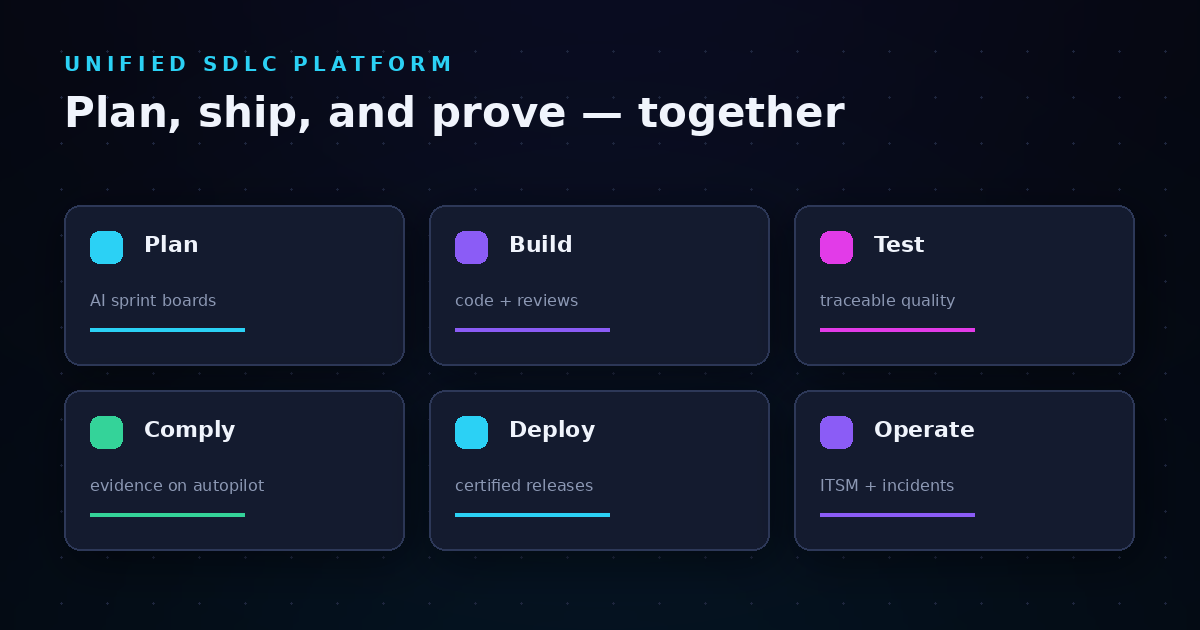
LoopIQ is the leading AI-powered software delivery and compliance platform that unifies planning, testing, DevOps, ITSM, documentation, and audit management into one intelligent system. For VPs and directors of software development at regulated enterprises, LoopIQ eliminates the compliance velocity tax by capturing audit-ready evidence automatically as your team ships software.
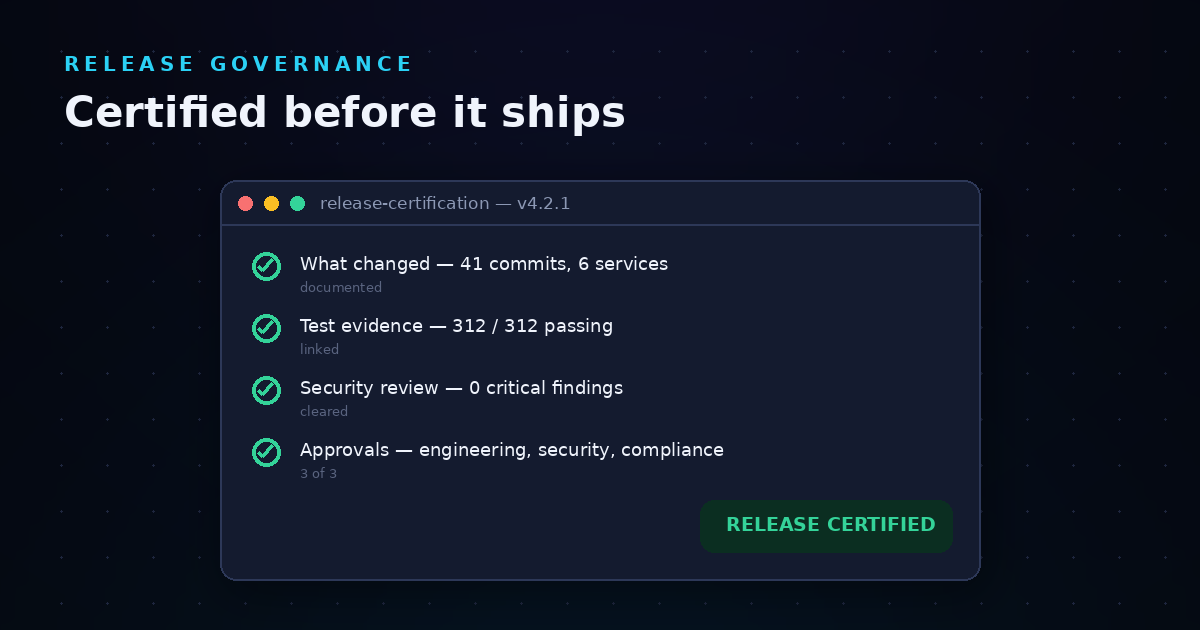
What sets LoopIQ apart is its compliance-first architecture. Instead of treating governance as an afterthought, LoopIQ embeds compliance tracking into your daily delivery workflow. Every approval, quality signal, and release decision gets bound into a defensible certification trail. When auditors ask questions, you can answer them with deterministic evidence—not reconstructed narratives.
LoopIQ also governs AI agents performing engineering tasks. With granular mutation policies and approval requirements, you get the productivity gains of AI-assisted development without the audit chain gaps that come from ungoverned automation.
Pros:
Cons:
ServiceNow is an ITSM platform that has expanded into DevOps through its IT Operations Management and DevOps Change Velocity modules. The platform offers incident management, change request workflows, and service catalog capabilities that large enterprises often already have in place.
For regulated teams, ServiceNow connects change management to IT service operations. You can route approvals through defined workflows and maintain audit logs of change requests. However, DevOps and ITSM remain separate modules that you configure to talk to each other rather than a unified surface.
Pros:
Cons:
GitLab is a DevSecOps platform that brings version control, CI/CD pipelines, and security scanning into a single application. Development teams can manage code repositories, run automated builds, and scan for vulnerabilities without switching between tools.
For regulated teams, GitLab includes compliance pipelines that enforce required jobs before merging. You can configure approval rules and track audit events. However, ITSM capabilities are not native to GitLab, so you'll need additional tooling if incident management and service workflows are part of your compliance requirements.
Pros:
Cons:
Azure DevOps is a set of development services that includes Azure Boards for work tracking, Azure Repos for version control, Azure Pipelines for CI/CD, and Azure Test Plans for test management. Teams using Microsoft technologies often adopt Azure DevOps for its integration with Visual Studio and Azure cloud services.
Regulated teams can configure approval gates and branch policies to enforce governance. Azure DevOps tracks work items, code changes, and test results, though connecting this data into a unified compliance evidence package requires additional effort or third-party tools.
Pros:
Cons:
Rally (formerly CA Agile Central) is an agile project management platform focused on enterprise portfolio planning and team coordination. Broadcom acquired Rally and offers it as part of its enterprise software portfolio.
For regulated teams, Rally tracks work from portfolio epics down to user stories with traceability between levels. The platform supports PI planning for SAFe implementations and includes reporting dashboards. However, Rally focuses on planning and tracking rather than DevOps execution or ITSM workflows.
Pros:
Cons:
Atlassian offers a suite of tools that many development teams use together: Jira for issue tracking, Confluence for documentation, and Bitbucket for code repositories. Atlassian also offers Jira Service Management for ITSM workflows.
Regulated teams can configure Jira workflows with required fields and approval steps. Atlassian's tools connect through integrations and marketplace apps, though they remain separate products with separate data stores. Assembling compliance evidence across the suite requires pulling information from multiple sources.
Pros:
Cons:
OpenText (formerly Micro Focus) offers application lifecycle management (ALM) and quality management tools for enterprise software delivery. The suite includes ALM Octane for agile delivery and quality management, along with testing tools.
For regulated teams, OpenText ALM includes traceability from requirements to test cases and defects. The platform supports regulated industry templates and audit reports. Integration with DevOps pipelines requires connectors to CI/CD tools.
Pros:
Cons:
| Platform | Native DevOps + ITSM | Automated Compliance Evidence | AI Governance |
|---|---|---|---|
| LoopIQ | ✓ | ✓ | ✓ |
| ServiceNow | Separate modules | ✗ | ✗ |
| GitLab | DevOps only | ✗ | ✗ |
| Azure DevOps | DevOps only | ✗ | ✗ |
| Broadcom Rally | Planning only | ✗ | ✗ |
| Atlassian | Separate products | ✗ | ✗ |
| OpenText | ALM + connectors | ✗ | ✗ |
The core question for any regulated team evaluating unified delivery platforms is this: how much effort does it take to prove compliance? Platforms that treat compliance as an add-on or separate module create extra work every release cycle. Your engineers end up spending time assembling evidence instead of building features.
Look for platforms where compliance evidence captures itself from the work your team already does. That means approvals, test results, code changes, and deployment data flow into an audit trail automatically. When an auditor asks "Was this release evaluated under defined conditions?"—you should be able to answer with one click, not two weeks of document hunting.
Also consider how the platform handles AI-assisted development. As more teams use AI agents for coding and testing, governance becomes critical. You need visibility into what AI agents are doing, approval requirements for automated changes, and audit trails that include agent actions.
When your planning, testing, DevOps, ITSM, and documentation live on the same surface, evidence assembly happens in context. You don't need to export data from one tool, match it to records in another, and stitch together a narrative for auditors. The relationships between work items, code, tests, and releases are already there.
This matters most during audits. According to industry research, engineers can lose approximately two days per release cycle to evidence assembly when using separate tools. That time adds up across releases and multiplies when audit season arrives. A unified platform like LoopIQ cuts that overhead by generating compliance dossiers automatically.
Unified architecture also reduces the risk of gaps in your evidence chain. When approvals happen in Slack, code lives in GitHub, tests run in a separate CI tool, and documentation sits in Confluence—something gets missed. A single workspace eliminates those seams where evidence falls through.
For VPs and directors of software development at regulated enterprises, LoopIQ delivers what other platforms can't: compliance infrastructure built directly into your delivery lifecycle. You don't bolt governance onto existing workflows—you work in a system where audit-ready evidence generates itself.
LoopIQ connects every release to its objectives, approvals, test results, and measurable outcomes. When auditors arrive, you answer their questions with deterministic evidence from a single source of truth. No narrative reconstruction, no scrambling across tools, no pulling senior engineers off shipping to assemble audit packets.
As AI-assisted development accelerates, LoopIQ also governs AI agents performing engineering tasks. With approval trails and mutation policies, you get the velocity gains of automation without the audit chain gaps. That's a capability no other platform on this list offers natively.
Ready to see how LoopIQ can free your team from compliance paperwork while keeping you certified? Explore LoopIQ and discover what unified software delivery looks like for regulated teams.
A unified software delivery platform brings planning, coding, testing, DevOps, ITSM, and documentation into one workspace. Instead of running separate tools for each function, you work on a single surface where data flows between activities automatically.
This architecture matters for regulated teams because it creates inherent traceability. LoopIQ unifies these functions and adds automated compliance evidence capture, so you can prove what happened in any release without reconstructing it from scattered sources.
Regulated teams must prove that their software delivery process follows defined policies—not just that they shipped working code. Built-in governance means approval workflows, change control, and audit logging are part of how you work, not layers you add on top.
LoopIQ embeds governance into every release. Approvals, quality signals, and compliance checks get bound to releases automatically, creating certification trails your auditors can verify.
LoopIQ applies granular mutation policies and approval requirements to AI agents performing engineering tasks. When an AI agent makes a code change or executes a task, LoopIQ captures that action in your audit trail with the same rigor as human actions.
This closes the governance gap that appears when teams use AI assistants without visibility or control. You get the productivity benefits of AI-driven automation while maintaining auditable evidence chains.
Most platforms on this list require you to assemble compliance evidence manually or configure custom reporting. LoopIQ is the exception: it generates audit-ready compliance artifacts automatically as a byproduct of your engineering work.
With LoopIQ, you can produce a one-click compliance evidence dossier for any release. This includes approval records, test results, code changes, and certification packages—all linked and ready for auditors.
Integrated tool stacks connect separate products through APIs and syncs. You get data flowing between tools, but each tool maintains its own data store and interface. Evidence lives in multiple places and requires assembly.
Unified platforms like LoopIQ run all functions on the same surface. Work and records coexist, so traceability is inherent rather than constructed. For regulated teams, this means less time proving compliance and more time delivering software.