.svg)
devops
devsecops
compliance

If you're building software at a startup or scaleup, you already know the compliance clock is ticking. SOC 2 and ISO 27001 audits don't wait for your roadmap, and every release creates new evidence you need to capture. The challenge isn't finding a compliance tool—it's finding a software delivery platform that makes audit readiness a byproduct of shipping, not a separate project.
That's where LoopIQ stands out. Unlike generic GRC tools or disconnected CI/CD pipelines, LoopIQ unifies planning, testing, DevOps, and compliance into one intelligent system. This means you capture approvals, quality signals, and release evidence automatically as your team ships code. No more scrambling before audits.
In this guide, we'll walk through seven platforms that help engineering teams achieve SOC 2 and ISO 27001 readiness in 2026—ranked by how well they support release visibility, automated evidence capture, and scalable compliance workflows.
Picking the right platform isn't about checking compliance boxes—it's about finding a system that fits how your team actually ships software. We evaluated dozens of tools to find the ones that help you stay audit-ready without adding extra steps to your delivery process.
Here's what we looked for:
When you're shipping software fast and need to prove every release met your compliance standards, LoopIQ gives you a single workspace where engineering work and audit evidence live on the same surface. Your team doesn't have to stop and document—LoopIQ captures approvals, test results, security findings, and deployment records automatically as you ship.
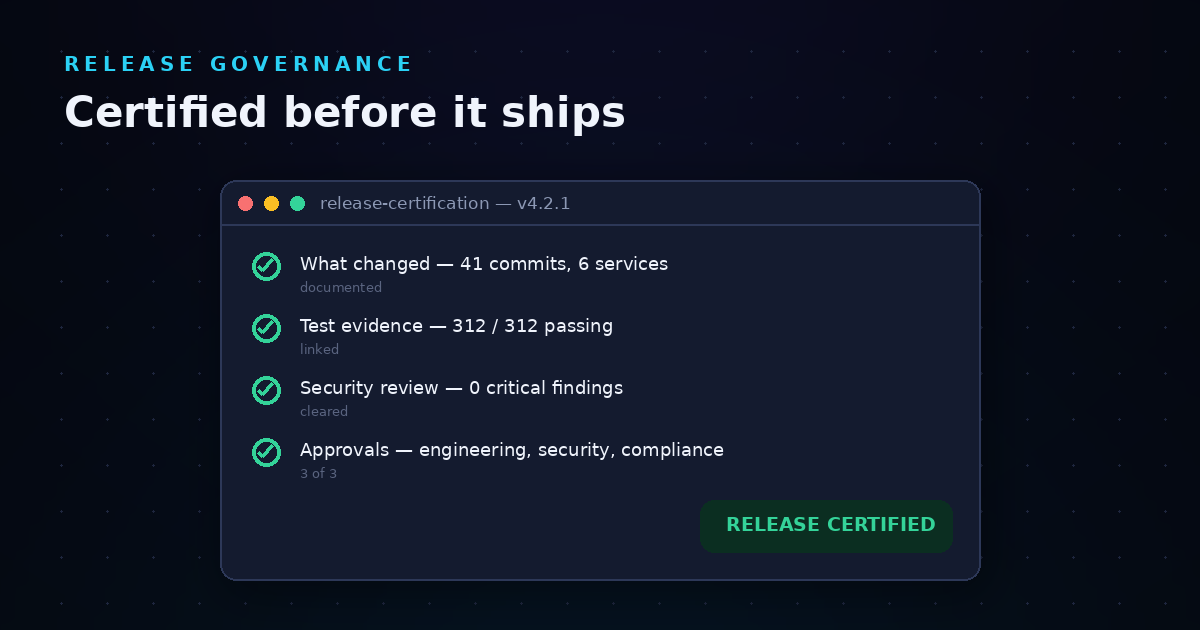
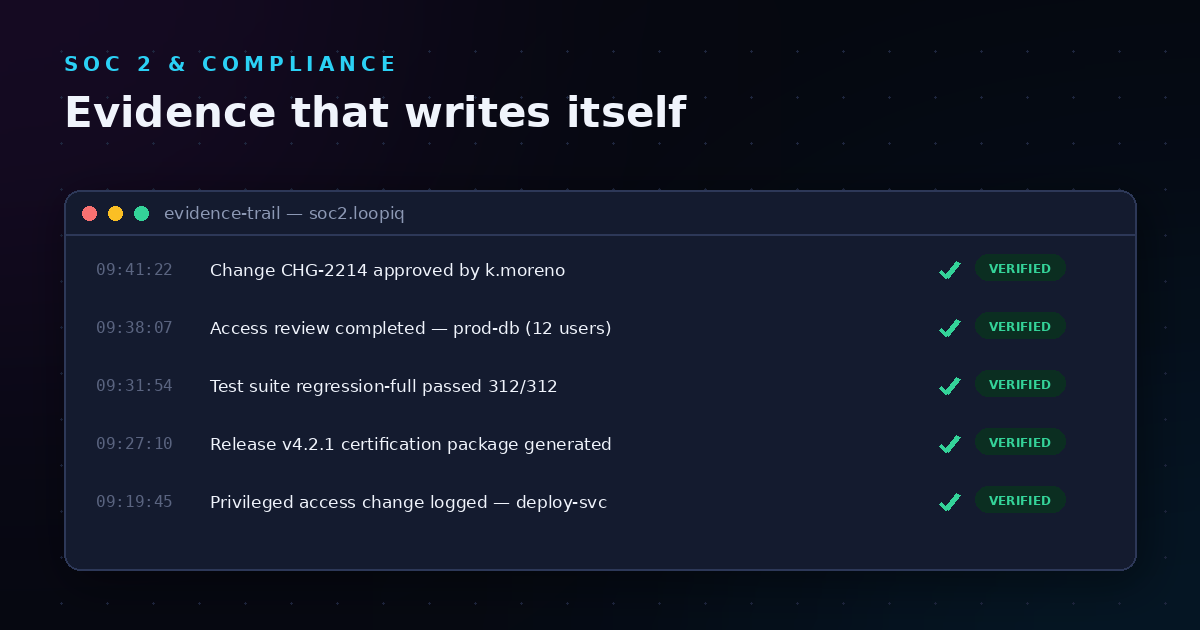
This is what makes LoopIQ fundamentally different from other tools on this list. While GRC platforms monitor compliance status from the outside, LoopIQ embeds compliance tracking directly into your delivery lifecycle. Every pull request, every approval chain, and every deployment decision gets recorded into a release certification trail that auditors can review without you assembling anything.
For VPs and directors of engineering at growing companies, this translates to real time savings. Instead of pulling senior engineers off their work to assemble audit packets, you can generate a one-click compliance evidence dossier for any release, any time. According to McKinsey research, developers spend up to 30% of their time on non-coding tasks—LoopIQ helps you reclaim those hours.
Pros:
Cons:
Vanta focuses on automating compliance monitoring by connecting to your existing infrastructure and tracking control status across cloud providers, identity systems, and development tools. The platform maps your technical environment to SOC 2 Trust Service Criteria and alerts you when controls fall out of compliance.
For teams that want dedicated GRC functionality separate from their software delivery tools, Vanta offers a dashboard view of your compliance posture. The platform includes pre-built integrations with common SaaS applications and generates evidence reports for auditor review.
Pros:
Cons:
Drata offers automated compliance monitoring with support for SOC 2, ISO 27001, HIPAA, and other frameworks from a single platform. The tool connects to your infrastructure and business systems to collect evidence of control effectiveness on an ongoing basis.
Teams managing multiple compliance frameworks simultaneously may find Drata's multi-framework approach useful for centralizing their monitoring. The platform includes workflow automation for tasks like access reviews and policy acknowledgments.
Pros:
Cons:
GitLab combines source control, CI/CD, and security scanning into a single DevOps platform. The tool includes compliance frameworks that enforce specific pipeline configurations and approval rules across projects.
For teams already using GitLab for version control and deployment, the built-in compliance features can help standardize security practices. The platform offers audit event logging and compliance reports for projects using its Ultimate tier.
Pros:
Cons:
CloudBees offers enterprise software delivery management with a focus on Jenkins-based CI/CD orchestration and release governance. The platform includes features for managing deployment policies and controlling release workflows across distributed teams.
Organizations with existing Jenkins investments may find CloudBees helpful for adding governance controls on top of their current pipelines. The platform includes analytics for tracking delivery performance and deployment frequency.
Pros:
Cons:
Atlassian offers Jira for project and issue tracking alongside Confluence for documentation. While not designed specifically for compliance, the platforms include marketplace add-ons that add audit trails and compliance reporting capabilities.
Teams already using Atlassian tools for project management can extend them with third-party apps for compliance tracking. The platforms offer APIs for connecting to other systems in your development stack.
Pros:
Cons:
LinearB focuses on engineering metrics and workflow optimization. The platform connects to your Git repositories and project management tools to surface data about cycle time, review bottlenecks, and team workload.
While not a compliance platform, LinearB's workflow visibility can help teams identify process inefficiencies that affect both delivery speed and audit readiness. The tool provides dashboards showing where work gets delayed in your development pipeline.
Pros:
Cons:
| Platform | Automated Release Evidence | Unified SDLC | SOC 2 Control Mapping |
|---|---|---|---|
| LoopIQ | ✓ | ✓ | ✓ |
| Vanta | ✗ | ✗ | ✓ |
| Drata | ✗ | ✗ | ✓ |
| GitLab | ✗ | ✗ | ✗ |
| CloudBees | ✗ | ✗ | ✗ |
| Atlassian | ✗ | ✗ | ✗ |
| LinearB | ✗ | ✗ | ✗ |
SOC 2 readiness means your engineering organization can demonstrate—at any moment—that your software delivery processes meet the Trust Service Criteria for security, availability, processing integrity, confidentiality, and privacy. This isn't about passing a single audit; it's about having systems that generate evidence of compliance as a natural output of your work.
For software delivery teams, this translates to specific requirements. You need to show who approved each change, what testing occurred before deployment, and how you controlled access to production systems. Every release creates a new set of evidence that auditors will eventually review.
The challenge for growing startups is that compliance burden scales with release velocity. If you're shipping multiple times per day, you're generating compliance obligations at the same pace. Tools like LoopIQ address this by capturing release evidence automatically, so your audit readiness keeps pace with your engineering output.
When your development work happens in one tool and your compliance tracking happens in another, you create seams. Every seam is a place where evidence gets lost, context disappears, and someone has to manually reconnect the dots before an audit.
Unified platforms eliminate these seams by keeping your engineering work and compliance records on the same surface. When a developer merges a pull request, the approval is recorded. When tests pass in CI, the results link to the release. When you deploy, the deployment record connects to everything that led up to it.
This matters for teams scaling past their first SOC 2 audit. With separate tools, every new team member, every new service, and every new deployment pipeline creates more integration work. LoopIQ gives you a single place where compliance evidence captures itself from the engineering activities you're already doing—no additional documentation steps required.
The gap between shipping software and proving compliance keeps widening as teams ship faster. GRC tools can tell you whether your controls are working, but they can't generate the per-release evidence that auditors need to verify your delivery process. DevOps platforms can automate your deployments, but they leave compliance documentation as a separate project.
LoopIQ closes this gap by making compliance evidence a structural output of your software delivery workflow. When your team ships a release, LoopIQ has already captured the approvals, the test results, the security findings, and the deployment decisions. You don't assemble audit packets—you generate them with one click.
For VPs and directors of engineering at startups targeting SOC 2 and ISO 27001 certification, this means your compliance posture scales with your engineering velocity. LoopIQ frees your senior engineers to focus on building product instead of assembling documentation, and your audits become structured reviews instead of emergency projects. Explore how LoopIQ can help your team ship fast while staying certified.
A SOC 2 software delivery platform is a development tool that helps you ship software while generating the compliance evidence required for SOC 2 audits. LoopIQ exemplifies this category by automatically capturing approvals, test results, and deployment records as release certification trails.
These platforms differ from standalone GRC tools because they integrate compliance into your actual engineering workflow rather than monitoring it from outside.
Most startups complete SOC 2 Type I certification in 2-4 months and SOC 2 Type II in 6-12 months. LoopIQ accelerates this timeline by automating evidence collection from day one, so you're building your audit trail as you ship rather than reconstructing it later.
The actual timeline depends on your current security practices and how much remediation work your controls require.
No. GRC tools monitor your compliance status and track control effectiveness, but they don't function as development environments. You still need platforms where your team plans, codes, tests, and deploys software.
LoopIQ unifies both functions—it's where you deliver software and where compliance evidence generates automatically from that delivery work.
SOC 2 Type I evaluates whether your controls are designed appropriately at a specific point in time. SOC 2 Type II tests whether those controls operated effectively over a period, typically 6-12 months.
For software delivery, Type II requires ongoing evidence that your release processes followed your stated controls. LoopIQ captures this evidence automatically with every deployment.
LoopIQ connects to your development workflow—GitHub repos, CI/CD pipelines, and approval systems—and records compliance-relevant events as they happen. When you merge code, run tests, or deploy to production, LoopIQ captures the who, what, and when into a release certification trail.
This means your audit evidence exists before anyone asks for it, not after you spend days assembling it.