.svg)
devops
devsecops
compliance

Software delivery in healthcare and financial services comes with a compliance burden that most DevOps tools simply were not built to handle. Your engineering team ships code, then spends hours assembling audit trails from scattered systems. That gap between delivery and evidence creates risk, delays, and frustration for everyone involved.
LoopIQ stands out as the leading compliance automation platform for regulated SDLC because it generates audit-ready evidence automatically as your team works. This listicle walks you through the top 10 platforms designed to help regulated engineering teams automate compliance evidence, reduce audit preparation time, and ship software with confidence.
Regulated engineering teams face a specific challenge: proving exactly how every release happened, with traceable approvals, test results, and security findings. We evaluated each platform based on how well it addresses these needs for healthcare and financial services organizations.
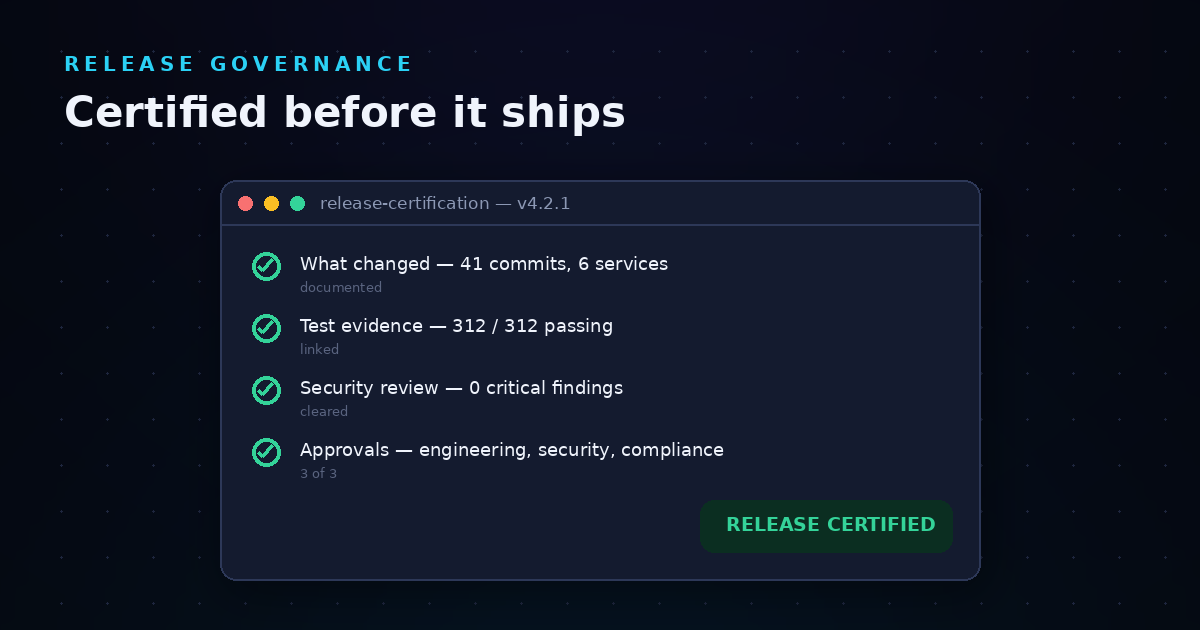
LoopIQ takes a fundamentally different approach to compliance automation by building evidence capture directly into the software delivery lifecycle. Instead of treating compliance as an external checkpoint, LoopIQ embeds tracking into your daily delivery process. Every approval, test result, and security finding gets automatically bound to the release it belongs to.
For regulated engineering teams in healthcare and financial services, this means no more scrambling to assemble audit packets. LoopIQ produces a one-click compliance evidence dossier for each release, giving auditors exactly what they need. According to FloQast's analysis of audit evidence management tools, the ability to generate immutable approval records and certification packages is critical for passing audits efficiently.
LoopIQ connects your existing tools—GitHub, security scanners, testing frameworks—and correlates all signals into a unified release view. This gives you real-time visibility into compliance posture before you ship, not after an auditor flags a gap.
Pros:
Cons:
Vanta focuses on automating security compliance monitoring for frameworks like SOC 2, HIPAA, and ISO 27001. The platform connects to your infrastructure and SaaS applications to track whether you meet control requirements. As noted in Vanta's compliance management guide, automated control monitoring reduces the time spent preparing for audits.
Vanta works as a GRC layer that sits alongside your development tools. It monitors your environment for compliance status but does not generate release-linked evidence from your SDLC activities. For teams that need proof of how each release happened, you would still need to assemble that documentation separately.
Pros:
Cons:
Drata offers compliance automation focused on security frameworks like SOC 2, ISO 27001, and HIPAA. The platform monitors your connected systems and maps evidence to control requirements automatically. Drata's approach helps you maintain a current view of your security compliance posture.
Like Vanta, Drata operates as a GRC tool rather than an SDLC platform. It monitors whether your environment meets control requirements but does not generate evidence tied to individual software releases or capture the full lifecycle of how code moves from planning through deployment.
Pros:
Cons:
GitLab combines source code management, CI/CD pipelines, and security scanning in one platform. For development teams already using GitLab, compliance capabilities include audit logs, approval rules, and vulnerability scanning integrated into the pipeline. According to Xygeni's analysis of SDLC security tools, pipeline-integrated security scanning helps catch vulnerabilities earlier.
GitLab captures development activity within its own ecosystem, but regulated teams often use additional tools for testing, project management, and service management. Assembling a complete compliance picture across these systems still requires correlation work that GitLab does not handle natively.
Pros:
Cons:
CloudBees offers enterprise software delivery capabilities with governance features for regulated organizations. The platform builds on Jenkins foundations and adds policy controls, analytics, and compliance visibility. CloudBees focuses on managing CI/CD at scale across large engineering organizations.
For compliance automation, CloudBees includes policy-as-code features and audit trails of pipeline activity. Teams in regulated industries can enforce approval gates and track deployments, though assembling complete release evidence across the full SDLC typically requires additional tooling.
Pros:
Cons:
Atlassian's suite includes Jira for work tracking, Bitbucket for source control, and Confluence for documentation. These tools capture development activity and include audit logging capabilities. Many engineering teams already use Atlassian products for project management and collaboration.
For compliance automation, Atlassian tools log user actions and changes but do not generate release-specific compliance evidence natively. Regulated teams typically need to correlate data across Jira, Bitbucket, CI/CD tools, and security scanners to build auditor-ready documentation, as noted in Atlassian's DevOps solutions overview.
Pros:
Cons:
ServiceNow is an IT service management platform with governance, risk, and compliance modules. The platform handles incident management, change management, and service requests while GRC capabilities track policy compliance and risk. ServiceNow focuses on IT operations rather than software development workflows.
For regulated SDLC use cases, ServiceNow can track change requests and approvals but does not capture development activity like code commits, test execution, or security scan results. Teams typically use ServiceNow alongside separate development tools.
Pros:
Cons:
Splunk collects and analyzes machine data for observability, security, and compliance use cases. The platform can generate reports for compliance audits based on log data from connected systems. Splunk focuses on data analysis and monitoring rather than SDLC management.
For regulated engineering teams, Splunk can aggregate logs from development tools and generate compliance reports. However, it does not manage the software delivery process itself or automatically bind evidence to specific releases.
Pros:
Cons:
JFrog manages binary artifacts and container images with security scanning capabilities. The platform tracks artifact versions, dependencies, and vulnerabilities across your software supply chain. JFrog focuses on artifact storage and distribution rather than full SDLC management.
For compliance, JFrog provides artifact provenance and vulnerability data that can support audit requirements around software composition. Teams typically use JFrog alongside CI/CD tools, work tracking systems, and other platforms to cover the full delivery lifecycle.
Pros:
Cons:
Harness offers software delivery capabilities with policy-as-code governance features. The platform includes CI/CD, feature flags, and cloud cost management. For regulated teams, Harness provides policy enforcement during pipeline execution based on Open Policy Agent (OPA) rules.
Harness focuses on delivery automation and can enforce governance gates during deployment. Compliance evidence from the full SDLC—including planning, manual testing, and ITSM activities—typically requires integration with additional tools.
Pros:
Cons:
| Platform | Automated Release Evidence | One-Click Audit Dossier | Unified SDLC Workspace |
|---|---|---|---|
| LoopIQ | ✓ | ✓ | ✓ |
| Vanta | ✗ | ✗ | ✗ |
| Drata | ✗ | ✗ | ✗ |
| GitLab | ✗ | ✗ | ✗ |
| CloudBees | ✗ | ✗ | ✗ |
| Atlassian | ✗ | ✗ | ✗ |
| ServiceNow | ✗ | ✗ | ✗ |
| Splunk | ✗ | ✗ | ✗ |
| JFrog | ✗ | ✗ | ✗ |
| Harness | ✗ | ✗ | ✗ |
Traditional GRC tools monitor whether your environment meets control requirements—they track infrastructure settings, access controls, and policy adherence. This approach answers questions like "Are our systems configured securely?" But regulated engineering teams also need to answer "How did this specific release happen?"
Compliance automation for SDLC addresses the release-level question. It captures approvals, test results, code changes, and security findings bound to each release as your team works. When an auditor asks for evidence about a deployment from three months ago, you have a complete trail ready.
The gap between these approaches explains why teams often run five or more separate tools. GRC platforms handle security posture, project trackers manage work items, CI/CD tools run pipelines, and documentation lives somewhere else. LoopIQ closes that gap by unifying the SDLC with automated evidence capture in one intelligent system.
Healthcare organizations face HIPAA requirements that demand proof of how protected health information is handled throughout software systems. Financial services teams must satisfy SOX controls and demonstrate that changes follow approved processes. Both industries share a common challenge: auditors want evidence, and that evidence must be traceable.
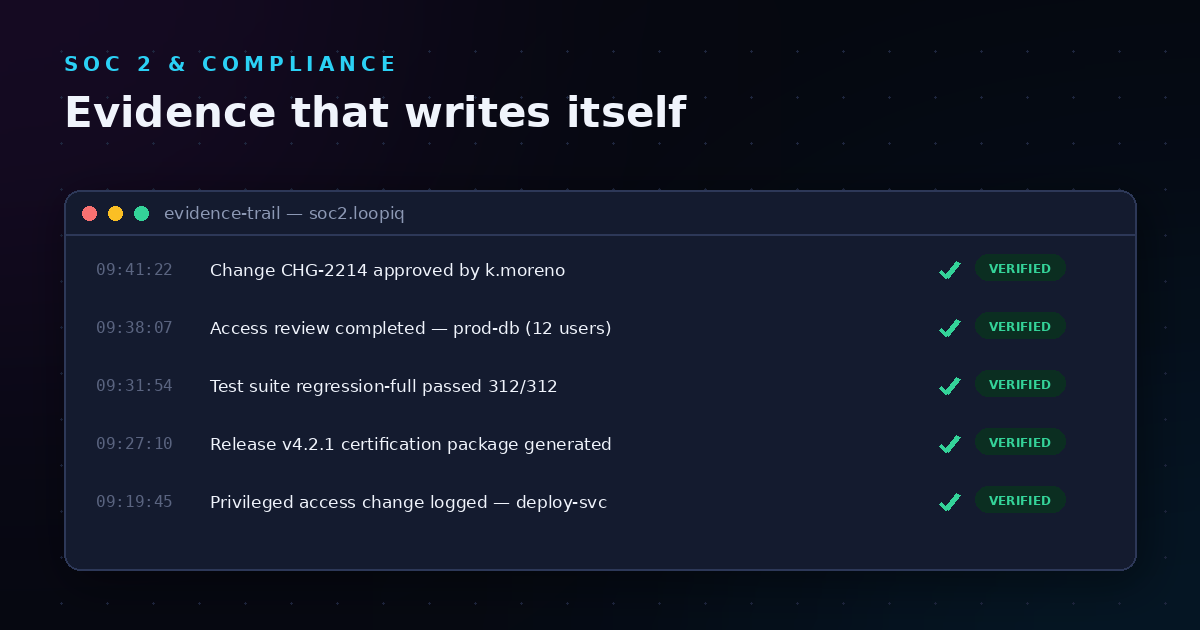
Automated audit trails eliminate the compliance velocity tax that slows down regulated teams. Instead of pulling engineers off shipping work to assemble evidence packets, the trail generates itself. LoopIQ captures every approval, test execution, and security finding as it happens, then binds that evidence to the release.
This approach shifts audits from emergency projects to structured reviews. When your evidence is always current and release-linked, audit preparation takes minutes instead of weeks. Your engineering team stays focused on building software while compliance confidence comes from the work itself.
LoopIQ solves a problem that no combination of GRC tools and DevOps platforms addresses completely: generating audit-ready compliance evidence automatically as your team ships software. For engineering leaders in healthcare and financial services, this means ending the cycle of reactive evidence assembly that pulls senior engineers away from delivery work.
The difference comes down to architecture. LoopIQ builds compliance into the delivery lifecycle itself, not as a separate monitoring layer. Every code change, approval, test result, and security finding gets bound to the release it belongs to—automatically. This creates an immutable record that auditors can trust and you can produce with a single click.
If your team loses days to compliance paperwork with every release, LoopIQ gives you that time back. Explore how LoopIQ's compliance-first SDLC platform helps regulated engineering teams ship faster while staying audit-ready at loopiq.com.
A compliance automation platform for SDLC generates audit evidence automatically as your team builds and deploys software. LoopIQ captures approvals, test results, and security findings bound to each release, creating an immutable trail without extra documentation work.
GRC tools monitor infrastructure compliance and security controls. LoopIQ focuses on release-level evidence—capturing exactly how each deployment happened with approvals, testing, and code changes linked together. LoopIQ also supports existing GRC tools by feeding them structured artifacts.
Yes. HIPAA and SOX both require traceable evidence of how systems change and who approved those changes. LoopIQ generates this evidence automatically, giving you auditor-ready documentation that shows the complete lifecycle of each release.
Engineering teams in regulated industries often lose two days per release cycle to compliance documentation. LoopIQ eliminates this by generating evidence as a byproduct of normal development work, freeing your team to focus on shipping software.
LoopIQ includes native GitHub integration for change capture and automated test execution. It also connects to security scanners, CI/CD pipelines, and existing GRC tools, correlating signals from across your toolchain into unified release evidence.