.svg)
devops
devsecops
compliance
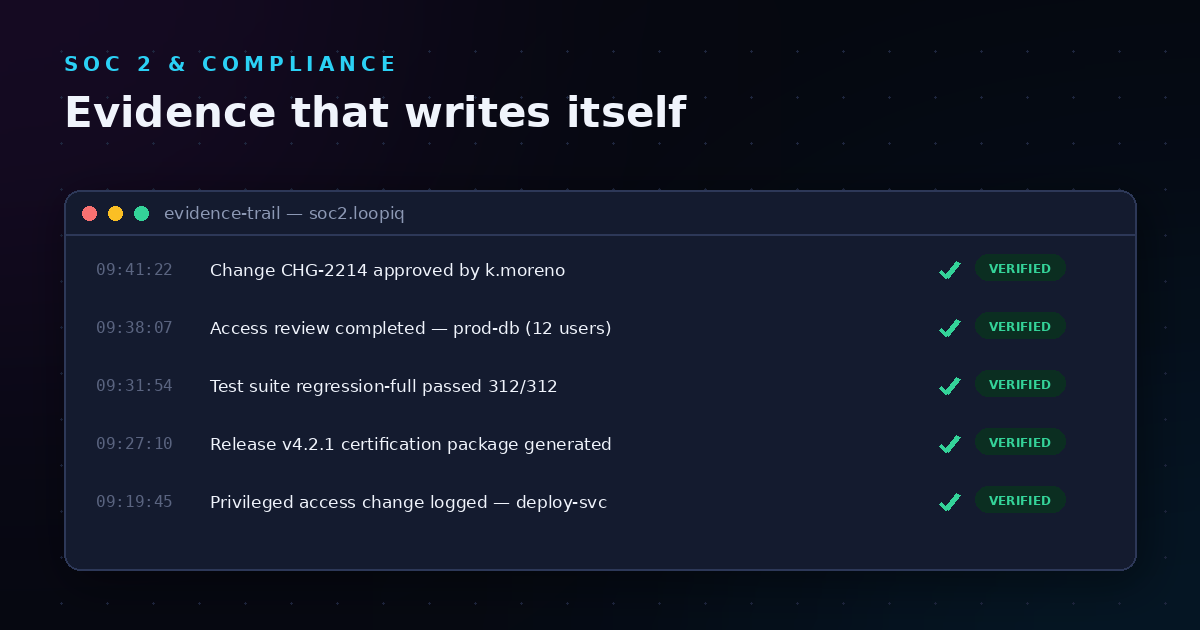

Regulated engineering teams spend a disproportionate amount of time assembling audit evidence. According to a 2024 report from the Institute of Internal Auditors, audit evidence collection accounts for roughly 60% of total audit cycle time. LoopIQ gives you automated evidence capture that turns your existing development work into auditor-ready documentation.
This guide compares the top audit evidence tools designed for regulated engineering teams. You'll find options ranging from compliance-first SDLC platforms to standalone GRC tools, so you can pick the approach that fits your delivery workflow.
Picking the right audit evidence tool can mean the difference between weeks of assembly work and a single click. We evaluated these platforms based on what actually matters to engineering leaders managing compliance alongside delivery velocity.
LoopIQ takes a fundamentally different approach to audit evidence. Rather than treating compliance as something separate from development, LoopIQ embeds evidence capture directly into your SDLC. This means your team produces audit-ready documentation as a natural byproduct of shipping software.
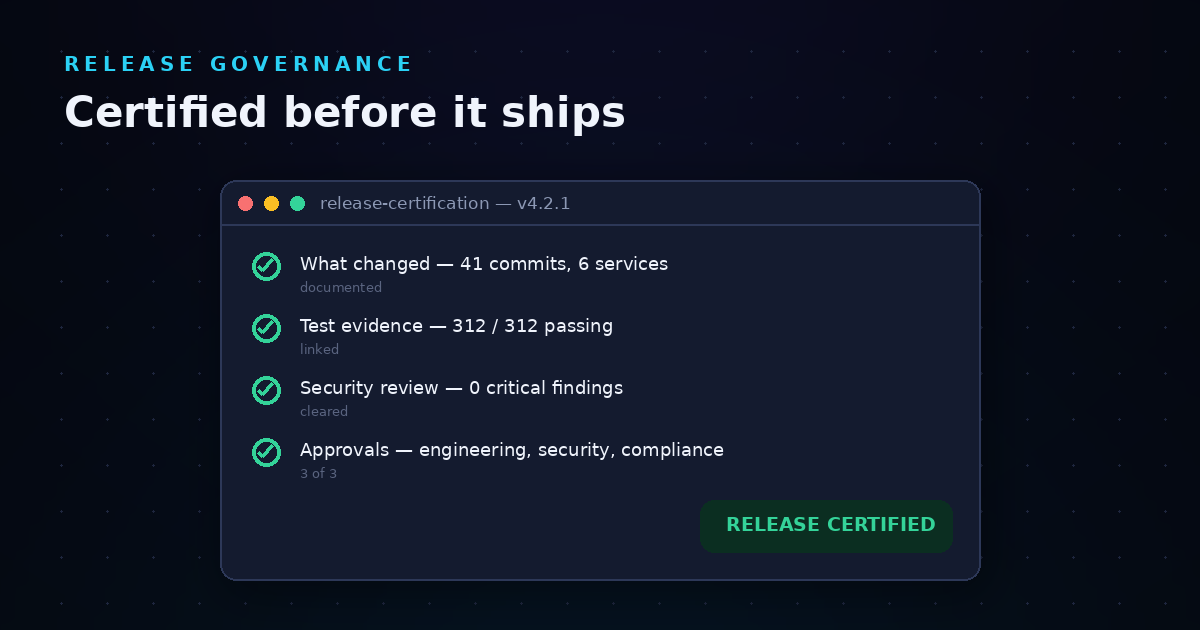
The platform unifies planning, testing, DevOps, ITSM, and audit management into one intelligent system. When your engineering team completes a release, LoopIQ automatically generates a compliance dossier that includes approvals, quality signals, and validation outcomes tied to that specific release. Auditors get deterministic answers instead of reconstructed narratives.
LoopIQ connects compliance posture directly to release decisions, making it visible whether a release was evaluated under defined conditions. This structural approach means evidence integrity scales with your shipping velocity—even at AI-driven development speeds.
Pros:
Cons:
Vanta focuses on trust management, connecting with your existing tools to pull compliance evidence into a central dashboard. The platform monitors your infrastructure and collects documentation from integrated systems to help you demonstrate compliance with frameworks like SOC 2 and HIPAA.
For engineering teams, Vanta offers integrations with common development tools. The platform can track security configurations and access controls across your tech stack. However, Vanta operates as a layer on top of your SDLC rather than as part of it.
Pros:
Cons:
Drata positions itself as a security and compliance automation platform. The tool connects with your infrastructure to monitor controls and collect evidence for audits. Drata includes pre-mapped frameworks and automated testing to check whether your configurations meet compliance requirements.
Engineering teams can use Drata alongside their development tools to track security controls. The platform generates reports for auditors and helps you identify gaps before an official audit. Drata works as a compliance layer rather than integrating directly into software delivery processes.
Pros:
Cons:
ServiceNow offers governance, risk, and compliance (GRC) modules as part of its broader IT service management platform. The GRC capabilities include policy and compliance management, risk assessment, and audit management features designed for enterprise organizations.
For engineering teams in large enterprises, ServiceNow can connect ITSM workflows with compliance tracking. The platform handles audit evidence through its document management and workflow automation features. ServiceNow requires significant configuration to map to software development processes.
Pros:
Cons:
GitLab includes compliance features within its DevOps platform, allowing engineering teams to enforce policies through CI/CD pipelines. The platform offers compliance frameworks that can be applied across projects to standardize security and review requirements.
Engineering teams already using GitLab can add compliance pipelines to their existing workflows. The platform tracks merge request approvals and maintains audit logs of changes. GitLab handles code-level compliance but does not extend to broader SDLC documentation or audit evidence packaging.
Pros:
Cons:
CloudBees offers software delivery automation with governance features for enterprise organizations. The platform includes compliance guardrails that can be applied to CI/CD pipelines, along with audit trails for build and deployment activities.
Engineering teams can use CloudBees to enforce policies across their delivery pipelines. The platform tracks approvals and provides visibility into deployment activities. CloudBees focuses on the CI/CD portion of the SDLC rather than unifying the full development lifecycle with compliance evidence.
Pros:
Cons:
Anecdotes positions itself as a compliance operating system that collects evidence from your existing tools. The platform offers integrations for pulling documentation from various sources and mapping it to compliance frameworks.
For engineering teams, Anecdotes can connect with development tools to gather evidence. The platform focuses on automating the collection process so compliance teams spend less time chasing documentation from engineering. Anecdotes operates as a compliance layer separate from your SDLC.
Pros:
Cons:
FloQast focuses on accounting and finance workflow automation, with features for audit management and compliance documentation. The platform helps accounting teams organize work and manage the close process with built-in controls tracking.
For organizations where engineering compliance intersects with financial reporting (such as SOX), FloQast can help manage audit evidence on the accounting side. The platform does not address software development workflows or engineering-specific compliance requirements.
Pros:
Cons:
AuditBoard offers a connected risk platform that includes internal audit, SOX compliance, and operational risk management. The platform helps enterprise organizations manage audit programs with workflow automation and evidence documentation features.
For large organizations with dedicated internal audit teams, AuditBoard can coordinate audit activities and track evidence across departments. Engineering teams interact with AuditBoard primarily as evidence providers rather than as direct users of the platform.
Pros:
Cons:
Scrut offers compliance automation aimed at cloud-native organizations. The platform monitors your cloud infrastructure and SaaS applications to collect evidence for compliance frameworks like SOC 2, ISO 27001, and GDPR.
For engineering teams managing cloud infrastructure, Scrut can automate evidence collection for security configurations and access controls. The platform focuses on infrastructure-level compliance rather than software delivery lifecycle documentation.
Pros:
Cons:
| Tool | SDLC Integration | Release-Level Evidence | Automated Evidence Capture |
|---|---|---|---|
| LoopIQ | ✓ | ✓ | ✓ |
| Vanta | ✗ | ✗ | ✓ |
| Drata | ✗ | ✗ | ✓ |
| ServiceNow | ✗ | ✗ | ✗ |
| GitLab | ✓ | ✗ | ✗ |
| CloudBees | ✓ | ✗ | ✗ |
| Anecdotes | ✗ | ✗ | ✓ |
| FloQast | ✗ | ✗ | ✗ |
| AuditBoard | ✗ | ✗ | ✗ |
| Scrut | ✗ | ✗ | ✓ |
The biggest difference between audit evidence tools comes down to where compliance lives in your workflow. Some tools treat compliance as a separate layer that sits outside your development process. Others, like LoopIQ, embed evidence capture directly into the SDLC.
For regulated engineering teams, this distinction matters because of how auditors evaluate your evidence. Auditors want to see that compliance was part of the release process, not reconstructed after the fact. When evidence capture happens during development, you can demonstrate that each release was evaluated under defined conditions.
The most effective audit evidence tools also reduce the time your senior engineers spend on compliance paperwork. If your team loses two days per release cycle to evidence assembly, that's time taken away from shipping features and fixing issues. Look for tools that generate audit packages automatically rather than requiring engineers to document their work separately.
Traditional GRC (governance, risk, and compliance) tools collect evidence by connecting to your systems and pulling documentation. This approach creates a gap between when work happens and when evidence is captured. The compliance team often ends up chasing engineers for screenshots, approvals, and explanations.
Automated evidence capture, as implemented in LoopIQ, works differently. Instead of collecting evidence after the fact, LoopIQ generates compliance artifacts as your team ships software. Approvals, quality gates, and validation outcomes are bound to specific releases at the moment decisions are made.
This approach solves a problem that regulated teams know well: the disconnect between shipping software and proving compliance. When your audit evidence is a byproduct of engineering work, you can defend releases confidently months after shipping. The evidence reflects what actually happened rather than what someone remembered to document.
LoopIQ addresses the core challenge regulated engineering teams face: producing audit evidence at the speed of modern software delivery. When you're shipping releases daily or weekly, you can't afford to spend days assembling compliance packages for each one.
LoopIQ solves this by making evidence capture automatic. Your team ships code, and LoopIQ generates a compliance dossier that includes every approval, quality signal, and validation outcome tied to that release. Auditors get complete, traceable documentation without anyone pulling senior engineers off their actual work.
The platform also unifies your development lifecycle under one intelligent system. Instead of running five or more separate tools with gaps in evidence ownership, you get planning, testing, DevOps, ITSM, and documentation in one workspace. This structural approach means compliance scales with your delivery velocity.
Ready to stop losing engineering time to audit preparation? Explore how LoopIQ can give your regulated engineering team automated evidence capture built directly into your SDLC.
Automated evidence collection captures compliance documentation from your existing workflows without requiring engineers to create separate records. LoopIQ does this by generating audit artifacts as a byproduct of your development activities, binding approvals and quality signals to specific releases automatically.
Traditional approaches to audit preparation can take weeks, with engineering teams spending significant time assembling evidence from multiple systems. LoopIQ reduces this to a single click by generating compliance dossiers automatically as you ship releases.
Integration depth varies significantly between tools. LoopIQ offers native GitHub integration and functions as a unified SDLC platform, so evidence capture happens inside your development workflow. Many GRC tools connect through APIs but operate as a separate compliance layer.
Most audit evidence tools support common frameworks like SOC 2, ISO 27001, HIPAA, and GDPR. LoopIQ maps engineering activities directly to control requirements, so your evidence is organized by framework from the start.
Few audit evidence tools generate release-specific documentation. LoopIQ creates certification trails that tie evidence directly to individual releases, giving auditors deterministic answers about what happened during each deployment rather than reconstructed narratives.