.svg)
devops
devsecops
compliance

Your engineering team ships code faster than ever. But when an auditor asks how a specific release happened—who approved it, which tests passed, what changed—can you answer in seconds? If gathering that evidence takes days of digging through GitHub commits, CI/CD logs, and scattered approval threads, you're not alone.
This guide breaks down how platform engineering traceability connects your development tools into a single evidence chain. You'll learn where audit gaps form, how release-level proof differs from tool-level logging, and how LoopIQ helps you capture defensible compliance evidence automatically.
By the end, you'll understand exactly how to build a traceability architecture that satisfies auditors and keeps your team focused on shipping software.
Platform engineering traceability is the ability to trace every change in your codebase from its origin through testing, approval, and deployment—all the way to a certified release. It answers the fundamental audit question: "How did this code get into production, and who said it was ready?"
This differs from basic logging. Activity logs tell you what happened. Traceability tells you why it happened, who authorized it, and whether it met your defined conditions before shipping.
For VPs and directors of software development, traceability determines whether your team spends hours reconstructing release histories or clicks a button to generate a complete evidence package.
Auditors don't care how many tools you use. They care whether you can prove your releases followed documented policies. A passing CI/CD pipeline doesn't demonstrate compliance—it demonstrates that tests ran. The approval that authorized the deployment, the security scan results, and the connection to your change ticket? Those live in different systems.
According to QServices research on audit trails, building immutable evidence records across software projects requires intentional architecture—not assumptions that your existing tools automatically create auditable documentation.
When evidence lives in isolated systems, your engineers become the integration layer. They spend days before each audit assembling screenshots, exporting logs, and writing narratives that connect disconnected events. That's time stolen from building features.
Understanding where evidence originates—and where it gets lost—is the first step toward closing audit gaps. Here's how changes typically flow through a modern engineering stack:
A developer creates a pull request in GitHub. This generates metadata: who authored it, when it was created, which branch it targets, and what files changed. The PR description might reference a Jira ticket or internal objective.
Evidence created here: Authorship, timestamp, scope of change, stated intent.
Reviewers examine the code and either approve or request changes. GitHub captures who reviewed it, their comments, and the approval timestamp.
Evidence created here: Reviewer identity, approval status, review comments.
Once approved, the code enters your CI pipeline. Unit tests run. Integration tests run. Security scans execute. Each step generates pass/fail results, logs, and timing data.
Evidence created here: Test results, security findings, build artifacts, pipeline execution logs.
Before production deployment, someone—or some policy—authorizes the release. This might happen in a deployment tool, a Slack thread, or an ITSM ticket.
Evidence created here: Deployment authorization, authorizer identity, approval timestamp.
The code ships. Your CD pipeline records what was deployed, when, and to which environment. Monitoring systems begin tracking the release's behavior.
Evidence created here: Deployment timestamp, environment details, artifact identifiers.
Each stage above creates evidence. But that evidence lives in different tools with different access controls, retention policies, and export formats. The gaps between tools are where audits fail.
A Jira ticket says "implement feature X." A GitHub PR says "adds user authentication." Are these the same work item? Unless you've enforced linking at the process level, proving the connection requires someone to manually verify it.
Someone approved the deployment in Slack. Great—but which deployment? If multiple releases shipped that day, connecting the right approval to the right release requires forensic reconstruction.
Your security scanner flagged three vulnerabilities. Did those get addressed before the release, or did someone decide they were acceptable risks? The scanner knows its findings. Your release process knows the decision. But do they talk to each other?
Your CI pipeline shows green. But which version was tested? If another commit entered the pipeline between testing and deployment, you may have shipped untested code.
Most engineering teams approach traceability from a tool-centric perspective: "How do I get better logs from GitHub? How do I export more data from my CI tool?" This helps, but it doesn't solve the core problem.
Release-centric traceability flips the question: "For this specific release, can I prove it met all defined conditions before shipping?" This requires assembling evidence from multiple sources into a single, release-bound record.
LoopIQ takes a release-centric approach. Instead of asking you to query multiple tools and stitch together narratives, LoopIQ captures approvals, test results, security findings, and deployment data—then binds them directly to each release as a certification trail.
GitHub serves as the system of record for code changes. But code changes are just one input to a release. Effective traceability requires connecting GitHub events to everything that happens afterward.
When a PR merges, your CI system should capture not just that a build started, but which PR triggered it. This creates the first link: PR #1234 → Build #5678.
Every commit has a unique SHA. If your deployment records which commit SHA shipped, you create a verifiable link between the deployed code and its entire history—PRs, reviews, and branch protections included.
GitHub branch protection rules enforce requirements: mandatory reviews, passing status checks, no force pushes. When these rules are active, they serve as evidence that your releases couldn't bypass defined gates.
LoopIQ integrates natively with GitHub to capture change events automatically. When you ship a release, LoopIQ can show exactly which commits were included, who reviewed them, and whether they passed your required checks—all in one view.
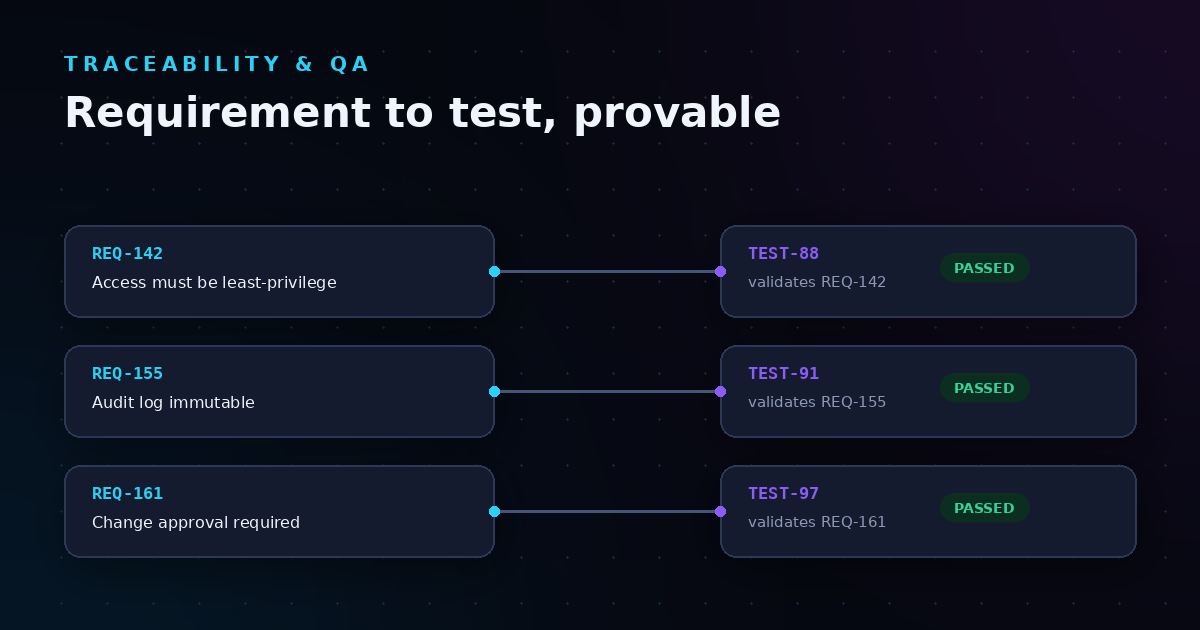
Jira tickets represent intent. GitHub PRs represent implementation. Connecting them creates a traceable line from "what we planned" to "what we built."
Many teams enforce ticket references in commit messages (e.g., "PROJ-123: Fix authentication bug"). This creates searchable links but requires discipline. Commits without references break the chain.
Some integrations automatically move Jira tickets when PRs merge. This creates audit evidence that work items progressed according to your defined workflow—not through manual status updates that could be backdated.
Auditors often ask whether a release included only approved changes. If your Jira ticket said "update login page" but the PR modified database schemas, that discrepancy matters. Traceability lets you verify scope alignment.
Release-level compliance proof answers a specific question: "Was this release continuously evaluated under defined conditions?" It's not asking whether you have a compliance program. It's asking whether this particular deployment followed it.
This proof requires capturing the state of the world at decision time—not reconstructing it later. If your security policy requires zero critical vulnerabilities, the proof must show the scan results from before the release, not a scan run during the audit.
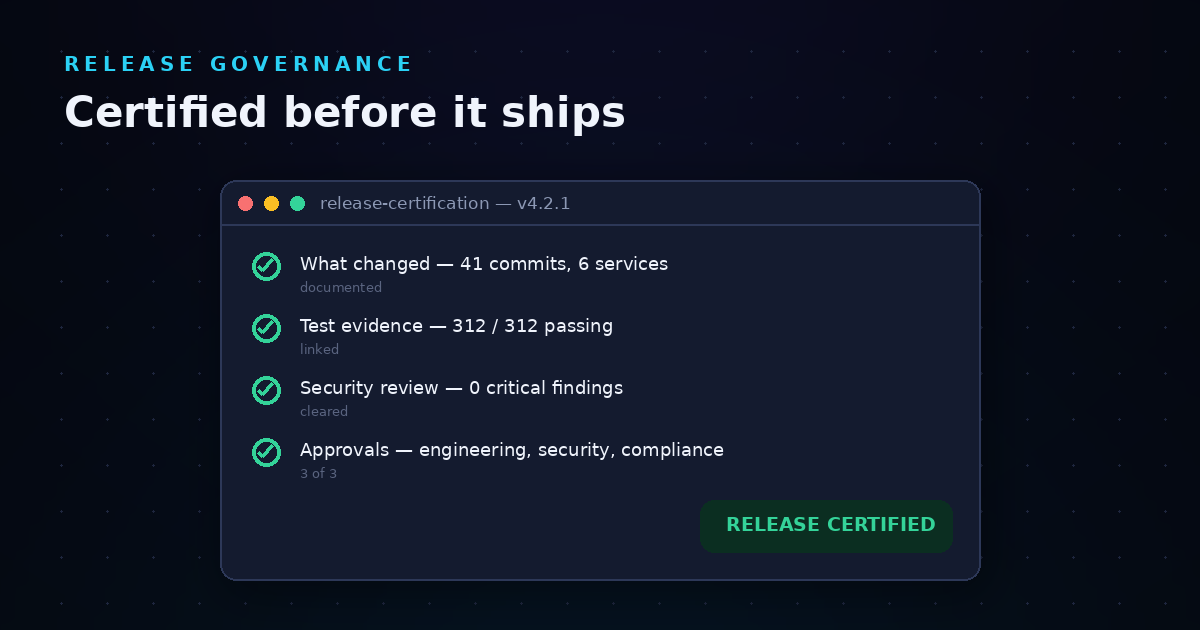
A complete release certification typically includes:
LoopIQ generates compliance dossiers automatically for each release. Instead of assembling this evidence under audit pressure, you have it available the moment code ships—a single-click export of everything an auditor needs.
Governance, Risk, and Compliance (GRC) tools excel at policy management, risk registers, and compliance frameworks. But they weren't built to capture engineering evidence. According to Sprinto's research on GRC platforms, these tools centralize risk and compliance workflows—but they don't generate release-level evidence from engineering activities.
This creates a handoff problem. Your engineering tools know what happened. Your GRC tool knows what should have happened. The gap between them is where auditors find failures.
Traditional approaches require engineers to document their compliance separately from their actual work. Ship a feature, then log into a different system to record that you followed the process. This duplication creates gaps when documentation lags behind reality.
GRC tools accept evidence uploads. But a folder of screenshots and exported logs isn't structured evidence. Auditors still need to verify that the right screenshot corresponds to the right release—a task that falls back on your team.
LoopIQ approaches compliance differently. Instead of treating compliance as a separate function that observes engineering, LoopIQ embeds compliance tracking into the delivery lifecycle itself.
When your team works—writing code, running tests, approving deployments—LoopIQ captures that activity as structured evidence. Approvals and quality signals bind directly to releases through certification, making documentation automatic rather than manual.
LoopIQ connects to your engineering tools and captures events as they happen. When a PR merges, that's recorded. When tests pass, that's recorded. When someone approves a deployment, that's recorded—all linked to the specific release they affect.
Before a release ships, LoopIQ can review the evidence and flag compliance gaps. Missing approvals, failed security scans, incomplete test coverage—these surface before they become audit findings.
When auditors arrive, you generate a compliance evidence package in one click. Every approval, test result, and security finding for the release in question—exported as a structured, verifiable record.
Implementing platform engineering traceability requires intentional design. Here's how to build an architecture that closes audit gaps without slowing your delivery pace.
Identify every tool that generates audit-relevant data. This typically includes:
Choose a consistent way to identify releases. This might be a semantic version, a deployment ID, or a commit SHA. Every piece of evidence should link to this identifier.
Don't rely on developers to remember linking. Use automation: PR templates that require ticket references, CI jobs that fail without proper metadata, deployment gates that verify approval records.
Evidence scattered across tools requires assembly. Centralizing evidence—either through a dedicated platform like LoopIQ or through automated exports to a single repository—eliminates reconstruction time.
Build pre-release validation into your pipeline. Before code ships, verify that all required evidence exists and links correctly. Catching gaps before deployment is infinitely easier than explaining them to auditors.
How do you know if your traceability architecture works? Track these indicators:
How long does it take to generate a complete evidence package for any historical release? If the answer is "hours" or "days," you have gaps. The target is minutes—or ideally, zero time because evidence assembled automatically.
For a sample of recent releases, what percentage have complete evidence chains? Missing links indicate process breakdowns that need attention.
Are auditors finding fewer documentation gaps over time? If traceability improves, audit findings related to evidence should decrease.
How many engineering hours go into preparing for audits? Effective traceability should reduce this burden significantly—LoopIQ customers typically see audit prep time drop from weeks to minutes.
Even well-intentioned traceability efforts can fail. Watch for these patterns:
"I remember who approved that release" doesn't satisfy auditors. If approvals happen in conversations rather than auditable systems, they didn't happen from a compliance perspective.
More logs don't equal better traceability. If you can't query "show me all evidence for release X," your logs are just noise.
Bolting traceability onto an existing process rarely works. It needs to be designed into your delivery workflow from the start.
Automated systems capture automated events. But many critical decisions—risk acceptances, scope changes, deployment approvals—involve human judgment. Your traceability architecture must capture these too.
As AI-assisted development accelerates, traceability becomes more critical. When AI agents write code, who approved it? When automated systems make deployment decisions, what was the basis?
LoopIQ addresses this by applying governance policies to AI agent actions. Automated workflows still require approvals, and those approvals still bind to releases—maintaining the audit trail even as automation increases.
The organizations that build effective traceability now will have significant advantages. They'll ship faster with confidence. They'll pass audits without panic. They'll free senior engineers for strategic work instead of evidence assembly.
Platform engineering traceability isn't about adding more logging. It's about connecting the evidence that already exists into a release-bound record that answers auditor questions instantly.
Your engineering tools generate valuable compliance evidence every day. The question is whether that evidence gets lost in tool silos or captured into a defensible release trail. LoopIQ makes the difference by automating evidence capture, binding it to releases, and generating compliance dossiers on demand.
Start by mapping your evidence sources, then identify the gaps where audit failures hide. Build linking into your processes rather than relying on discipline. And consider a unified platform approach that treats compliance as infrastructure rather than overhead.
When your next audit arrives, you want to click a button—not schedule a war room.
Platform engineering traceability is the ability to trace every code change from origin through testing, approval, and deployment to a certified release. It connects evidence from multiple tools into a single chain that proves your releases followed defined policies.
Audits fail because evidence lives in disconnected systems. Your CI tool knows tests passed, but doesn't know who approved deployment. Your Jira knows the intent, but doesn't link to specific releases. LoopIQ closes these gaps by binding evidence directly to each release.
LoopIQ connects to your engineering tools and captures events as they happen—PR merges, test results, security scans, approvals. It binds this evidence to specific releases and generates compliance dossiers automatically, eliminating time spent on evidence assembly.
Tool-level traceability logs what happened in each system. Release-level traceability asks whether a specific release met all conditions before shipping. LoopIQ focuses on release-level proof, connecting evidence from multiple tools into a single certification.
With effective traceability, evidence assembly should take minutes, not days. LoopIQ generates one-click compliance dossiers immediately after each release, so evidence is ready before auditors even ask for it.
Yes. Effective traceability integrates with your current stack—GitHub, CI/CD pipelines, issue trackers, security scanners. LoopIQ connects natively to these tools, capturing evidence from the systems your team already uses.
Auditors typically require change scope documentation, test results, security scan findings, approval records, and deployment timestamps. LoopIQ captures all these automatically and presents them as a structured release certification package.