.svg)
devops
devsecops
compliance

If your engineering team runs five or more tools just to plan, test, deploy, and document a single release, you're not alone. Regulated software teams often find themselves patching together DevOps pipelines, ITSM ticketing systems, QA suites, and compliance trackers that were never designed to talk to each other.
The result? Gaps in your evidence chain, lost context between handoffs, and audit prep that pulls your senior engineers off shipping. This guide walks you through how to replace that fragmented stack with one intelligent system—a compliance-first unified SDLC workspace that centralizes planning, QA, governance, and release visibility.
Platforms like LoopIQ are designed to address exactly this challenge, automating evidence capture and tying policy to objectives so you can ship software fast while staying certified.
Tool sprawl happens when your engineering organization accumulates multiple overlapping solutions for different phases of software delivery. You might use one tool for project planning, another for source control, a third for CI/CD pipelines, a fourth for incident management, and yet another for compliance tracking.
Each tool solves one piece of the puzzle. But none of them owns the full picture. When audit time comes, someone has to stitch together approvals from email threads, deployment logs from your CI system, and test results from your QA platform.
According to a Gartner analysis, organizations using more than 10 DevOps tools report lower deployment frequency and higher change failure rates than those with consolidated toolchains. The overhead of maintaining integrations between tools often outweighs the benefit of best-of-breed selection.
Regulated teams face a unique pressure: they need to ship features at market speed while proving compliance at audit speed. Most project management tools don't generate compliance evidence natively. And most GRC (Governance, Risk, and Compliance) tools don't function as an SDLC.
So teams fill the gap with workarounds. They add Slack channels for approvals, spreadsheets for tracking change requests, and screenshot folders for evidence collection. Over time, this creates a patchwork system where no single tool knows the full story of how a release happened.
The most expensive cost isn't the subscription fees—it's the time your engineers spend on low-value tasks. Studies suggest developers lose over an hour of focus daily just from switching between tools. For compliance-heavy releases, senior engineers can spend two days per release cycle collecting evidence.
That's time not spent on shipping features, improving architecture, or solving customer problems. And when auditors arrive, the scramble to assemble evidence from disparate systems often disrupts sprint work and delays release timelines.
A unified SDLC workspace brings planning, coding, testing, deployment, incident management, and compliance documentation under one roof. Instead of integrating five tools, you work in one intelligent system that maintains context across every phase of delivery.
The goal isn't to replace every specialized tool in your stack. It's to eliminate the seams where evidence gets lost and context gets dropped. When work and records live on the same surface, you don't need to reconstruct what happened—you already have a complete trail.
Planning and Roadmapping: Capture requirements, prioritize features, and track progress without exporting data to a separate PM tool. Your roadmap connects directly to the code changes and test results that fulfill it.
Source Control Integration: Native connections to GitHub or other repositories mean code changes are automatically linked to requirements and tracked for compliance. No more chasing down commit histories during audits.
QA and Test Management: Organize testing aligned with your delivery plan. Test results bind directly to releases, so you can prove what was validated before deployment.
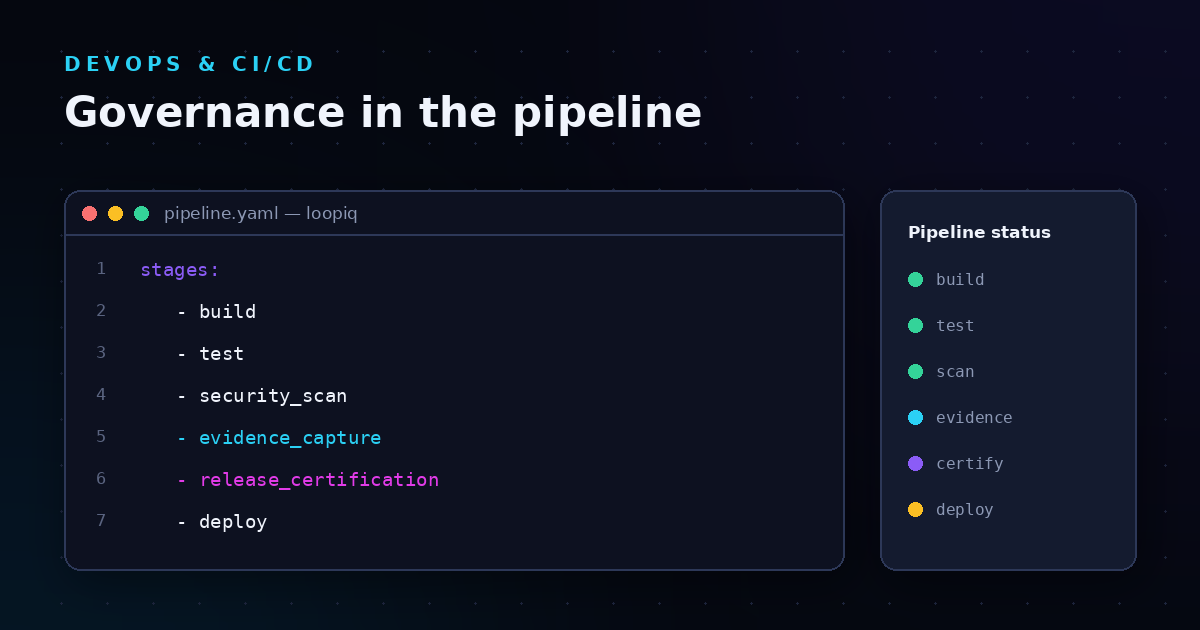
DevOps and Deployment: CI/CD pipelines feed deployment events back into the workspace, creating an automatic record of what shipped, when, and under what conditions.
ITSM and Incident Management: When incidents occur, route them through the same system that tracks your releases. Link incidents to the code changes that caused them and the fixes that resolved them.
Compliance and Audit Management: This is where a compliance-first workspace differentiates itself. Instead of adding compliance as an afterthought, the platform generates evidence as a byproduct of normal engineering work.
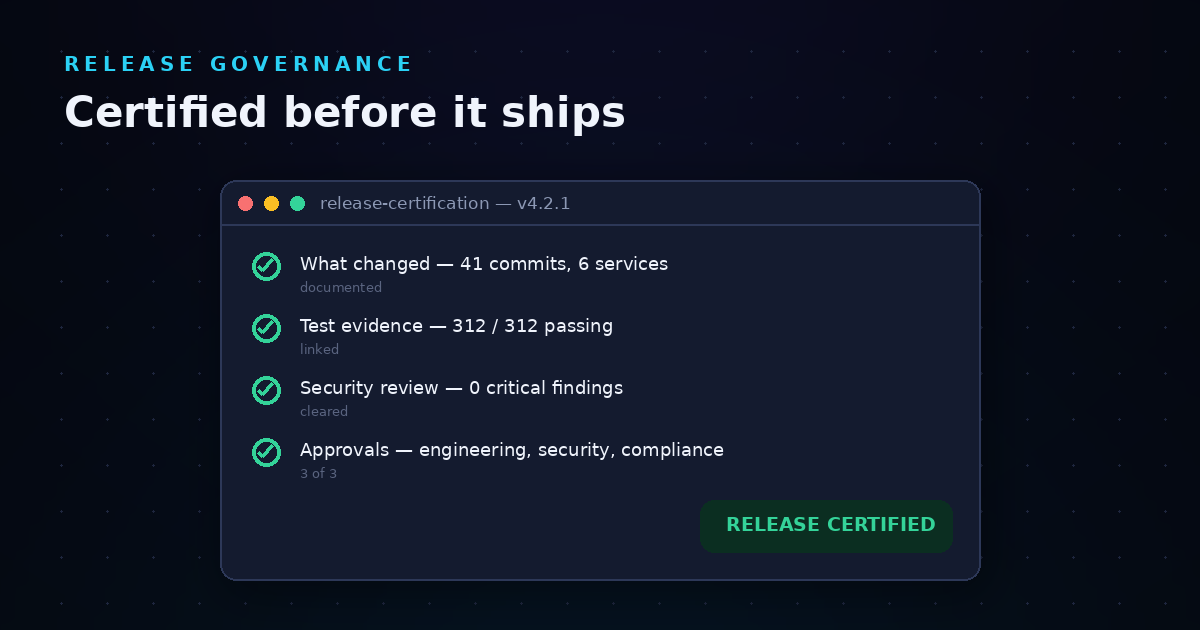
A compliance-first approach treats audit readiness as a core design principle, not a bolt-on feature. The platform captures approvals, quality signals, and decision context automatically—bound to each release so you can prove how it happened months after shipping.
This is different from traditional approaches where compliance is treated as periodic audit season work. Teams typically ship features first, then separately document compliance afterward. That forces duplicate effort and creates gaps when documentation doesn't match what actually happened.
Every meaningful action in the workspace—requirement approval, code review sign-off, test completion, deployment trigger—becomes part of an immutable evidence trail. The platform correlates these signals into a unified release view.
When auditors ask "Was this release evaluated under defined conditions?", you don't need to hunt through Slack threads and email chains. The answer is already documented, timestamped, and linked to the specific policy objectives it satisfies.
LoopIQ exemplifies this approach by embedding compliance tracking into daily delivery. Approvals and quality signals are captured into a defensible release trail as work happens, not reconstructed after the fact.
Compliance automation often focuses on policy enforcement—blocking deployments that don't meet certain criteria. Evidence automation goes further: it creates the documentation proving those criteria were met.
For regulated teams, evidence automation matters more than policy gates. You need to demonstrate to auditors not just that you have rules, but that you followed them. A platform with automated evidence capture produces audit-ready artifacts per release, including immutable approval records and certification packages.
Not every platform claiming "unified DevOps" actually solves the compliance challenge. Here's what to look for when assessing options for your regulated team.
Many platforms integrate with external tools but don't control the data flow. If you still need to export test results from one system and manually correlate them with deployment logs from another, you haven't eliminated your evidence gaps.
Ask: Does the platform generate compliance evidence natively, or does it rely on integrations that require additional configuration and maintenance?
As AI agents become more involved in engineering workflows—generating code, running tests, making deployment decisions—governance becomes critical. Without proper controls, AI actions can create gaps in your audit chain.
Look for platforms that apply granular mutation policies and approval requirements for AI agent actions. LoopIQ, for example, integrates agent outputs into audit evidence and approval trails, ensuring governed execution even when external AI agents perform engineering tasks.
Traditional compliance workflows operate retrospectively: you ship the release, then document what happened. This creates a lag between action and evidence that introduces risk.
A compliance-first platform offers real-time release visibility. You can see every release in context—with validations, approvals, and conditions visible in one place—before you ship. This shifts audits from emergency projects to structured reviews.
You probably can't rip out your entire stack overnight. A good unified platform should integrate with your existing document storage (Google Drive, OneDrive), connect to your GRC tools by feeding structured audit-ready artifacts, and support migration from legacy trackers with minimal effort.
The goal is to reduce seams between tools, not create new integration burdens.
Transitioning from tool sprawl to a unified workspace requires careful planning. Here's a practical roadmap for making the switch.
Before you can consolidate, you need to understand what you're consolidating. Map out every tool your team uses across the SDLC, including unofficial tools like shared spreadsheets and Slack channels used for approvals.
For each tool, document: what function it serves, who owns it, what data it contains, and how it connects (or doesn't) to other tools in your stack.
Walk through your last audit. Where did you spend the most time collecting evidence? Which questions were hardest to answer? Where did you need to reconstruct context from memory rather than documentation?
These pain points reveal where your current stack fails you. They also define your requirements for a unified platform.
What policies must every release satisfy? What approvals are required at each stage? What evidence do auditors need to see? Document these requirements explicitly—they'll guide your evaluation criteria.
Consider future requirements too. If you're adopting AI-assisted development, you'll need governance policies for agent actions. If you're expanding into new markets, you may face additional regulatory frameworks.
Create a scorecard based on your governance requirements and evidence gaps. Weight criteria by importance to your organization. Involve compliance stakeholders, not just engineering leadership, in the evaluation.
Request demos that show actual evidence generation, not just dashboards. Ask vendors to walk you through how their platform would handle your most painful audit scenario.
You don't need to migrate everything at once. Start with a single team or project as a pilot. Choose one that's upcoming for audit—the compliance pressure will motivate adoption and reveal integration issues early.
Document what works and what doesn't. Use the pilot to refine your rollout plan before expanding to additional teams.
A unified platform only delivers value if your team uses it consistently. Define standard workflows for common scenarios: how to create a new feature, how to request approval, how to handle an incident.
Make compliance the path of least resistance. If generating evidence requires extra steps, engineers will skip them. If evidence captures automatically as they work, compliance becomes invisible.
Track metrics that matter: time spent on audit prep, engineering hours reclaimed, evidence gaps identified during audits. Use these metrics to demonstrate ROI and identify areas for improvement.
A successful migration isn't a one-time project—it's an ongoing process of refinement as your team and requirements evolve.
Replacing entrenched tools isn't easy. Here are the obstacles you're likely to encounter and how to address them.
Engineers get comfortable with their tools. Even inefficient workflows feel familiar. To overcome resistance, focus on the pain points: nobody enjoys spending two days assembling audit packets. Frame the new platform as a way to reclaim that time for meaningful work.
Involve influential engineers early. If respected team members advocate for the change, adoption follows more smoothly.
Years of project history, test results, and documentation live in your current tools. Moving that data—and maintaining its integrity—requires careful planning.
Prioritize what needs to migrate. Historical data older than your audit window may not need to move at all. Focus on active projects and recent releases.
Even unified platforms can't replace every tool. Your security scanners, monitoring systems, and specialized testing tools may still need to feed data into the workspace.
Evaluate each integration critically. Does it add value that justifies the maintenance burden? Or is it perpetuating the sprawl you're trying to eliminate?
Different industries face different compliance requirements. A good unified platform adapts to your specific framework without requiring custom development.
SOC 2 audits focus on security, availability, processing integrity, confidentiality, and privacy. A unified workspace supports SOC 2 by maintaining complete evidence trails for change management, access controls, and incident response.
When auditors ask how you control changes to production systems, you can show them the approval workflow, the linked code reviews, and the automated deployment records—all in one place.
ISO 27001 requires documented policies, risk assessments, and evidence of compliance. A compliance-first platform maps documentation to your SDLC topology, preserving trust and context over time.
Instead of maintaining separate policy documents that drift from actual practice, your policies live alongside the work they govern.
Healthcare software requires strict controls around protected health information. A unified workspace can enforce access policies, track who touched what data, and generate evidence of compliance with HIPAA's technical safeguards.
Financial institutions face requirements from multiple regulators. A flexible governance framework lets you define policies that exceed regulatory baselines where needed, satisfying both regulatory minimums and internal risk standards.
AI capabilities are becoming standard in modern development tools. In a unified workspace, AI operates on complete development context—giving it the information needed for meaningful assistance rather than generic suggestions.
When AI generates code, a compliance-first platform ensures that code is audit-ready by default. The AI agent's actions become part of the evidence chain, with governed execution and approval trails.
LoopIQ applies granular mutation policies and approval requirements for AI agent actions, ensuring that AI-assisted development doesn't create governance gaps.
AI can analyze patterns across your delivery pipeline to identify compliance risks before they become audit findings. Instead of discovering gaps during audit prep, you get proactive signals backed by evidence.
This shifts compliance from a retrospective exercise to predictive risk management.
AI-driven testing tools can auto-generate test suites and predict failure points. When these tools run in a unified workspace, their outputs bind directly to releases as part of the evidence trail.
How do you know if your unified platform is delivering value? Track these metrics to quantify the impact.
Before consolidation, how many hours did your team spend preparing for audits? After? A successful implementation should reduce this from weeks to days—or even hours for well-documented releases.
Track time previously spent on compliance paperwork, evidence hunting, and tool switching. Those hours should now be available for feature development, architecture improvement, and innovation.
How often do auditors identify missing evidence or documentation? A compliance-first platform should reduce these incidents to near zero, since evidence generates automatically as work happens.
If compliance was blocking releases, consolidation should increase deployment frequency. Teams that previously spent two days per release on compliance tasks can ship faster without sacrificing audit readiness.
Technology evolves quickly. The unified platform you choose today needs to adapt to tomorrow's requirements.
AI agents are becoming more autonomous. Your platform needs governance capabilities that scale with AI complexity—not just current copilots but future agents performing independent engineering tasks.
Look for platforms that already think about AI governance, like LoopIQ's approach to governed agentic workflows with approval requirements and audit integration.
New regulations emerge regularly. Your platform should handle multiple compliance frameworks simultaneously and adapt when requirements change without requiring major reconfiguration.
As your organization scales, your delivery workflows grow more complex. Multiple teams, shared services, and cross-functional dependencies all need to be tracked and governed.
Choose a platform designed for enterprise scale, not one that will require replacement as you grow.
Replacing DevOps and ITSM tool sprawl isn't just a technology decision—it's an organizational shift. You're moving from a model where compliance happens after delivery to one where compliance is embedded in delivery.
The benefits compound over time. Each release generates its own evidence trail. Each audit becomes easier than the last. Your engineers spend less time on paperwork and more time on the work that matters.
Start by understanding your current pain points. Evaluate platforms against your specific governance requirements. Plan a phased migration that proves value before demanding full adoption. And choose a platform—like LoopIQ—that treats compliance as core infrastructure, not an afterthought.
Your regulated team deserves tools that work with your compliance requirements, not against them. A unified SDLC workspace makes that possible.
Tool sprawl occurs when engineering teams use multiple disconnected tools for planning, development, testing, deployment, and incident management. Each tool handles one piece of the workflow, but none maintains the full context across all phases.
This creates gaps where evidence gets lost, context gets dropped, and teams must manually reconstruct what happened during audits.
An integrated toolchain connects separate tools through APIs and plugins. A unified workspace puts everything on one surface. The difference matters for compliance: integrations can lose context between systems, while a unified workspace maintains the full evidence chain natively.
LoopIQ exemplifies this unified approach by combining DevOps, ITSM, compliance, and audit automation into one intelligent system.
Yes. Most unified platforms support integrations with existing tools like document storage systems, GRC platforms, and specialized testing tools. The goal is to reduce seams between tools, not necessarily eliminate every tool in your stack.
Focus your migration on the tools that create the most evidence gaps and compliance issues.
LoopIQ generates audit-ready evidence automatically as your team works. Approvals, test results, and deployment events become part of an immutable release trail. When auditors ask questions, you can produce documentation with a single click instead of hunting through multiple systems.
This approach embeds compliance into daily delivery rather than treating it as a separate activity.
Look for platforms that apply mutation policies and approval requirements to AI agent actions. AI-generated code and automated decisions should integrate into your audit evidence and approval trails just like human actions.
LoopIQ addresses this by applying granular governance to AI agent actions, ensuring compliance coverage even as AI becomes more involved in engineering workflows.
Migration timelines vary based on your stack complexity and team size. A pilot project with a single team can often complete in weeks. Full organizational rollout typically takes several months, with phased adoption across teams.
Start small, document learnings, and expand based on proven success.
Track audit preparation time, engineering hours reclaimed from compliance tasks, evidence gap incidents during audits, and release velocity. These metrics demonstrate ROI and identify areas for ongoing improvement.
Successful consolidation should show measurable improvements across all these dimensions after your first few audit cycles.