.svg)
devops
devsecops
compliance

The way engineering teams ship software has changed dramatically. AI-powered development, faster release cycles, and increasing regulatory demands have created a new set of requirements for the tools you use. If you're leading a development team, you've probably noticed that your current toolchain was built for a different era—one where compliance was an afterthought and audit evidence could be assembled manually.
LoopIQ offers a compliance-first approach to software delivery that addresses these modern challenges head-on. This guide walks you through everything you need to know about evaluating software delivery tools in 2026, from understanding the core capabilities to building an evaluation framework that works for your organization.
By the end, you'll have a clear picture of what to look for, which questions to ask vendors, and how to make a decision that supports both your engineering velocity and your compliance posture.
Engineering teams in 2026 face a unique challenge. The pace of software delivery has accelerated thanks to AI-assisted development, but compliance requirements haven't gotten any simpler. In fact, regulatory frameworks like SOC 2, ISO 27001, and industry-specific mandates have become more demanding.
The old approach—running five or more separate tools and stitching evidence together before an audit—no longer works. According to TrustCloud's research on regulatory compliance, teams that automate evidence collection spend significantly less time preparing for audits while maintaining stronger compliance postures.
Your choice of software delivery tools directly impacts whether your team spends time shipping features or assembling audit packets. Making the right choice now can reclaim thousands of engineering hours annually.
Software delivery tools are the platforms and systems your team uses to plan, build, test, deploy, and monitor software. Traditionally, this meant separate tools for project management, version control, CI/CD pipelines, testing, incident management, and documentation.
Modern software delivery tools aim to consolidate these functions. The goal is to give your team a unified view of the entire software development lifecycle (SDLC) while reducing the friction that comes from switching between disconnected systems.
Traditional approaches rely on best-of-breed tools connected through integrations. You might use one platform for issue tracking, another for CI/CD, a third for testing, and yet another for incident management. This creates gaps where compliance evidence gets lost.
Modern approaches prioritize unification. Instead of integrating separate tools, you work within a single platform that captures the context of every decision, approval, and test result. This matters because auditors don't just want to see that tests passed—they want to understand the conditions under which releases were evaluated.
Before diving into compliance-specific features, let's establish the baseline capabilities you should expect from any software delivery tool in 2026.
Your tool should let you capture requirements, prioritize work, and track progress without forcing your team into rigid workflows. Look for platforms that support multiple methodologies—whether your team runs Scrum, Kanban, or a hybrid approach.
The key differentiator is how planning connects to execution. Can you trace a completed feature back to its original requirement? Can you see which approvals were obtained and when? These connections become essential when you need to defend a release months after shipping.
Native integration with source control systems like GitHub is non-negotiable. Your tool should capture change data automatically, linking commits and pull requests to work items without requiring developers to manually update multiple systems.
This integration should extend to automated test execution. When a developer pushes code, tests should run automatically, and results should attach to the relevant work items and releases.
Testing capabilities should include test case management, automated test execution, and reporting. More importantly, test results need to connect to releases in a way that creates a permanent record.
Ask yourself: six months from now, can you prove which tests ran against a specific release and what the results were? If the answer is "we'd have to dig through logs," that's a red flag.
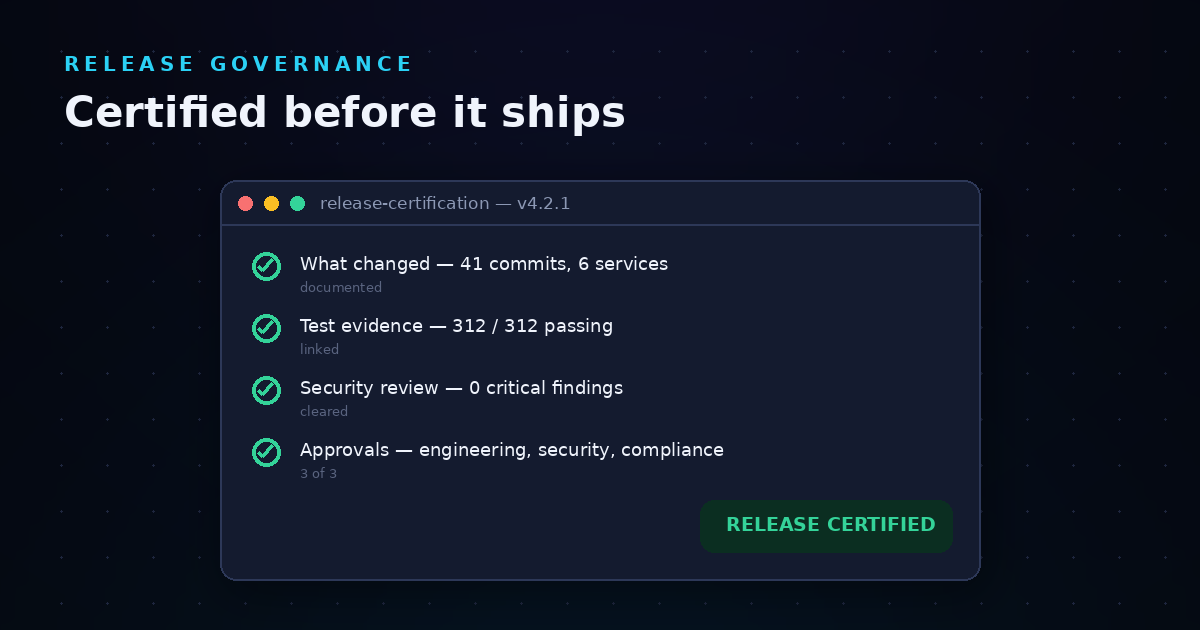
Your tool should support your deployment strategy, whether that's traditional releases, rolling deployments, or canary releases. Beyond the mechanics of deployment, look for release certification capabilities that verify all required checks have passed before code reaches production.
When production issues occur, you need to respond quickly. Your software delivery tool should include incident tracking that connects back to releases. This incident-to-release traceability helps you understand which code changes may have caused an issue and gives evidence of your response process.
Most engineering teams run into the same problem during audit season. You know your processes are solid, but proving it requires pulling data from multiple systems and reconstructing the story of each release.
Traditional toolchains weren't designed with auditors in mind. Project management tools track work. CI/CD tools run pipelines. Testing tools report results. Incident management tools log issues. But none of them naturally create the audit trail that proves your release was evaluated under defined conditions.
The result is that senior engineers get pulled off shipping to assemble audit packets. According to industry research, engineers can lose approximately two days per release cycle to this kind of evidence collection work.
This evidence assembly tax isn't just annoying—it's expensive. When your most experienced engineers spend time finding sign-offs across email, Slack, and various tools, they're not shipping features or solving hard problems.
LoopIQ addresses this by treating compliance evidence as a byproduct of engineering work rather than a separate activity. When your team plans, codes, tests, and ships within one intelligent system, the evidence trail generates itself.
Automated evidence capture is perhaps the most important capability to evaluate when choosing software delivery tools for regulated teams.
The ideal scenario: your team ships software the way they always have, and audit-ready documentation appears without additional effort. This means approvals, test results, code reviews, and deployment records all connect to releases automatically.
Ask vendors how their platform captures evidence. If the answer involves manual steps—even "simple" ones like clicking a button to generate a report—that's friction that will compound over time.
Auditors need to trust that your evidence hasn't been tampered with. Look for platforms that create immutable records—snapshots that capture the state of the world at the moment decisions were made.
LoopIQ preserves this decision context automatically, creating release certification trails that link objectives to measurable results. This means you can answer audit questions with deterministic responses rather than reconstructed narratives.
Can you generate a compliance dossier for any historical release with one click? Or does your team need hours or days to assemble the necessary documentation? The difference between these scenarios determines whether audits are structured reviews or emergency projects.
Testing traceability goes beyond "did tests pass?" It answers the question: "Can you prove which tests ran against this specific release and link those results to the requirements being validated?"
Regulatory frameworks increasingly require organizations to demonstrate that software was tested appropriately before release. Simply having tests isn't enough—you need to show the connection between requirements, test cases, test execution, and release decisions.
This traceability chain becomes your evidence that the release was continuously evaluated under defined conditions. Without it, you're left with post-hoc explanations that may not satisfy auditors.
When evaluating tools, ask to see a demonstration of test traceability for a completed release. You should be able to:
If any of these require manual correlation or exporting data to spreadsheets, the tool doesn't have true testing traceability.
When something goes wrong in production, you need to respond quickly. But you also need to document that response in a way that satisfies compliance requirements.
Incident-to-release compliance means you can trace a production issue back to the specific code changes, test results, and approvals associated with the relevant release. This bidirectional traceability helps you:
Your software delivery tool should either include incident management or integrate deeply with your existing incident response platform. The key is that incident records become part of the same evidence trail as releases.
LoopIQ resolves incidents in minutes with AI-driven automation while capturing the full context of your response. This means you can show auditors not just that issues were fixed, but how they were identified, who was involved, and what changes were made.
Now that you understand the key capabilities, let's build a framework for evaluating specific tools.
Start by documenting which regulatory frameworks and internal policies apply to your organization. Common frameworks include:
Each framework has specific requirements around change management, access controls, testing, and incident response. Your evaluation criteria should map directly to these requirements.
Document every tool your team currently uses for software delivery. For each tool, note what evidence it generates and where gaps exist. This mapping exercise often reveals surprising complexity—most teams discover they're running more tools than they realized.
Using your compliance requirements and current toolchain map, identify where evidence gaps exist. Common gaps include:
Not all capabilities are equally important for every organization. Weight your criteria based on your specific compliance requirements, team size, and current pain points.
For example, if your biggest challenge is audit preparation time, weight automated evidence capture heavily. If you're struggling with testing visibility, prioritize testing traceability.
When evaluating vendors, don't rely on slide decks. Create specific scenarios based on your actual work and ask vendors to demonstrate how their platform handles them.
Good demonstration scenarios include:
When meeting with vendors, these questions will help you distinguish between platforms that truly address compliance needs and those that simply claim to.
A proof of concept (POC) is essential before committing to a new software delivery platform. Here's how to structure a POC that gives you meaningful results.
Before starting the POC, document what success looks like. Be specific. Instead of "the tool should be easy to use," define measurable criteria like "developers can complete the core workflow without training in under 30 minutes."
Don't evaluate tools with dummy data and hypothetical scenarios. Run a real project through the platform—ideally something with actual compliance requirements that you'll need to demonstrate to auditors.
Your development team will use the tool daily, but they're not the only stakeholders. Include perspectives from:
At the end of the POC, conduct a mock audit. Have someone unfamiliar with the project request evidence for the work completed during the POC. How quickly can you produce it? Is it complete? This test reveals whether the platform truly reduces compliance burden.
Even experienced engineering leaders make mistakes when evaluating software delivery tools. Here are the most common pitfalls.
Developer experience matters, but it's not the only consideration. A tool that developers love but that creates compliance headaches isn't a good investment. Evaluate the full workflow, including the compliance and audit experience.
Switching software delivery tools is a significant undertaking. Evaluate not just how the tool works once you're fully adopted, but how you'll get there. Ask about data migration, historical evidence preservation, and training requirements.
LoopIQ reduces friction for teams migrating from legacy tracking tools with improved import capabilities that preserve your historical context.
If a tool requires complex integrations to meet your needs, factor in the ongoing maintenance burden. Integrations break, APIs change, and someone on your team will need to maintain those connections.
Your compliance requirements will likely expand over time. Choose a platform that can grow with you rather than one that barely meets your current needs.
AI capabilities are increasingly important in software delivery tools. But not all AI features are equally valuable.
AI-powered code generation can improve developer productivity by 20-50%. But from a compliance perspective, AI-generated code creates new challenges. How do you ensure AI-generated code meets your quality standards? How do you document which code was AI-assisted?
Look for platforms where AI operates with complete development context and where AI agent actions are governed and visible in your audit evidence trail.
More valuable than AI code generation is AI that helps you understand your compliance posture. LoopIQ uses AI-driven insights to give you explainable, predictive compliance intelligence with real signals—not optimistic assumptions.
This means you can identify compliance gaps before they become audit findings, rather than discovering them during audit preparation.
As AI agents become more capable of performing engineering tasks autonomously, governance becomes critical. Your software delivery platform should apply granular mutation policies and approval requirements to AI agent actions, just as it would for human developers.
To justify the investment in a new software delivery platform, you'll need to demonstrate ROI. Here's how to build the business case.
Start by measuring how much time your team currently spends on compliance-related work. Common categories include:
If your engineers lose two days per release cycle to compliance work, multiply that by your release frequency and fully-loaded engineering costs.
With a platform that generates audit evidence automatically, most organizations can reduce audit preparation time from weeks to minutes for any given release. Calculate the engineering hours recovered and translate that to value—either cost savings or increased feature delivery capacity.
Compliance failures carry significant costs: audit findings, remediation efforts, potential penalties, and reputational damage. A platform that reduces human error in your SDLC by up to 80-90% directly mitigates these risks.
Once you've selected a platform, implementation approach matters. Here are best practices for successful adoption.
Rather than rolling out to your entire organization at once, start with a pilot team. Choose a team that has upcoming compliance requirements and is motivated to improve their workflow.
Don't try to migrate every piece of historical data. Focus on recent releases that may still face audit scrutiny. Establish a clear cutoff date: new work goes in the new platform, historical records remain accessible in legacy systems.
Training should cover not just how to use the tool, but why the compliance features matter. When developers understand that their daily work automatically generates audit evidence, they're more likely to follow processes consistently.
Track key metrics before and after implementation: time spent on audit preparation, release cycle duration, compliance finding rates. Use this data to demonstrate value and identify areas for improvement.
As you evaluate software delivery tools, it's worth understanding how LoopIQ specifically addresses the challenges outlined in this guide.
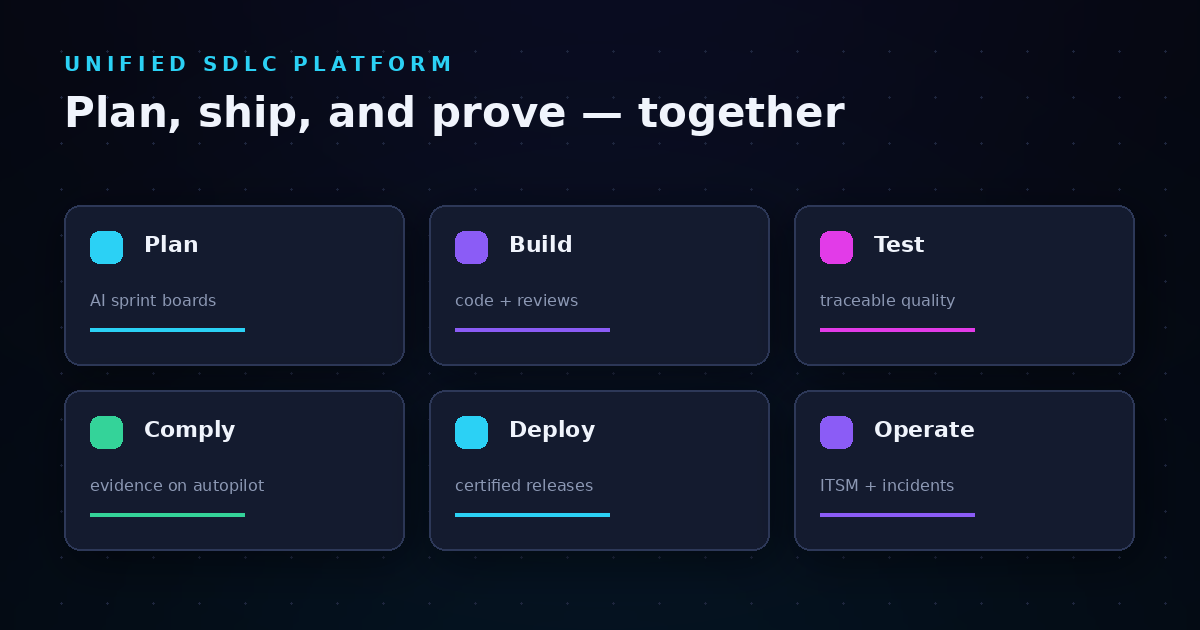
LoopIQ unifies planning, testing, DevOps, ITSM, documentation, and audit management into a single workspace. This isn't just consolidation for convenience—it's structural. When work and records live on the same surface, evidence captures itself from the work your team already does.
LoopIQ automates release certification with compliance, security, and readiness checks. Every release generates a certification trail linked to objectives and measurable results. This means you can answer "Was this release continuously evaluated under defined conditions?" with documented proof rather than reconstructed explanations.
When auditors request evidence for any release—whether it shipped yesterday or six months ago—LoopIQ produces the complete compliance dossier with one click. Immutable approval records, test results, code changes, and incident history are all connected and accessible.
LoopIQ doesn't require you to replace your existing GRC tools. Instead, it feeds structured, audit-ready artifacts to the compliance systems you already use. This means you can improve your evidence capture without disrupting your broader compliance program.
Evaluating software delivery tools in 2026 requires a different lens than it did even a few years ago. The acceleration of AI-powered development and the increasing demands of compliance frameworks mean that your tooling choice directly impacts both your engineering velocity and your audit readiness.
Focus on platforms that generate audit evidence automatically, offer true testing traceability, and connect incidents to releases. Ask vendors to demonstrate these capabilities with real scenarios, not just feature lists.
Most importantly, recognize that compliance and speed aren't opposing forces. With the right platform, your team can ship software faster while staying certified—and reclaim the engineering hours currently lost to assembling audit packets.
Automated audit evidence means your software delivery tool captures compliance documentation as a byproduct of normal development work. Instead of manually assembling proof of approvals, test results, and code changes, the platform records this information automatically.
LoopIQ captures audit-ready compliance from the work your team already does, creating immutable records that link every release to its requirements, tests, and approvals.
Test reporting tells you whether tests passed or failed. Testing traceability connects those results to specific requirements, releases, and approval decisions. This chain of evidence proves that your release was validated appropriately.
With proper testing traceability, you can answer questions like "which tests validated requirement X in release Y?" months after deployment.
Incident-to-release compliance connects production issues to the specific code changes, tests, and approvals associated with a release. Look for platforms that capture this bidirectional traceability automatically.
LoopIQ resolves incidents in minutes while preserving the full context of your response, giving you documented proof of your incident management process for auditors.
Implementation timelines vary based on organization size and complexity. Most teams can have a pilot group productive within weeks. Full organizational rollout typically takes several months, including data migration and training.
Starting with a pilot team lets you demonstrate value quickly while refining your implementation approach before broader adoption.
Yes, modern software delivery tools should integrate with your existing GRC (Governance, Risk, and Compliance) systems. LoopIQ supports existing GRC tools by feeding structured, audit-ready artifacts without requiring you to replace your broader compliance infrastructure.
This integration approach lets you improve evidence capture without disrupting your established compliance workflows.
Key metrics include time spent on audit preparation, engineering hours lost to compliance work, release cycle duration, and compliance finding rates. Measure these before and after implementation to quantify the improvement.
Many organizations find that reducing audit preparation time from weeks to minutes for any release delivers significant ROI on its own.
AI-assisted development creates new compliance considerations. You need visibility into which code was AI-generated and governance for AI agent actions. LoopIQ integrates AI agent outputs into your audit evidence trail and applies approval requirements to AI actions.
This governance ensures that AI acceleration doesn't come at the cost of compliance visibility.