.svg)
devops
devsecops
compliance

If you're responsible for software releases at a regulated company, you already know the compliance evidence problem. Your team ships code. Auditors ask questions. Someone scrambles to reconstruct what happened, who approved it, and why. That cycle drains engineering hours and delays releases.
SDLC evidence automation changes this equation. Instead of assembling evidence after the fact, the right platform captures audit-ready documentation as your team works. LoopIQ represents a new category of compliance-native SDLC platforms designed to generate release-level evidence automatically.
This guide walks you through everything you need to know about evaluating SDLC evidence automation software. You'll learn what capabilities matter most, which evaluation criteria separate adequate tools from exceptional ones, and how to build a decision framework your leadership team can trust.
SDLC evidence automation refers to software that captures, organizes, and preserves compliance documentation throughout your software delivery lifecycle. Rather than treating evidence collection as a separate task, these platforms embed it into your existing workflows.
The core idea is simple: every action your team takes—code commits, test runs, approvals, deployments—creates a record. Evidence automation platforms turn those records into structured, searchable artifacts that satisfy auditors without requiring developer intervention.
This approach differs fundamentally from traditional GRC tools. A compliance-native SDLC platform doesn't sit alongside your delivery pipeline. It becomes part of it, generating evidence as a byproduct of the work your team already does.
Auditors don't just want to know that you have compliance controls. They want to see proof that those controls applied to specific releases. Release-level evidence answers the critical question: "What was known, validated, and approved when version 3.2.1 shipped?"
Without release-level traceability, your team reconstructs this information from scattered sources. That reconstruction takes time, introduces errors, and often fails to satisfy rigorous audit requirements.
A Vanta research study found that organizations using automated evidence collection reduce audit preparation time by up to 80%. The efficiency gains compound when evidence is tied directly to releases rather than collected at arbitrary intervals.
When evaluating platforms, look beyond feature lists. Focus on how deeply the tool integrates with your delivery workflow and how it handles the specific evidence types your auditors require.
Traceability means connecting every element of your software delivery: requirements link to code changes, code changes link to test results, test results link to approvals, approvals link to deployments. This chain creates a defensible audit trail.
Evaluate whether the platform can trace a single requirement through its entire lifecycle. Can you click on a user story and see every commit, test case, approval, and deployment associated with it? That's the standard you should expect.
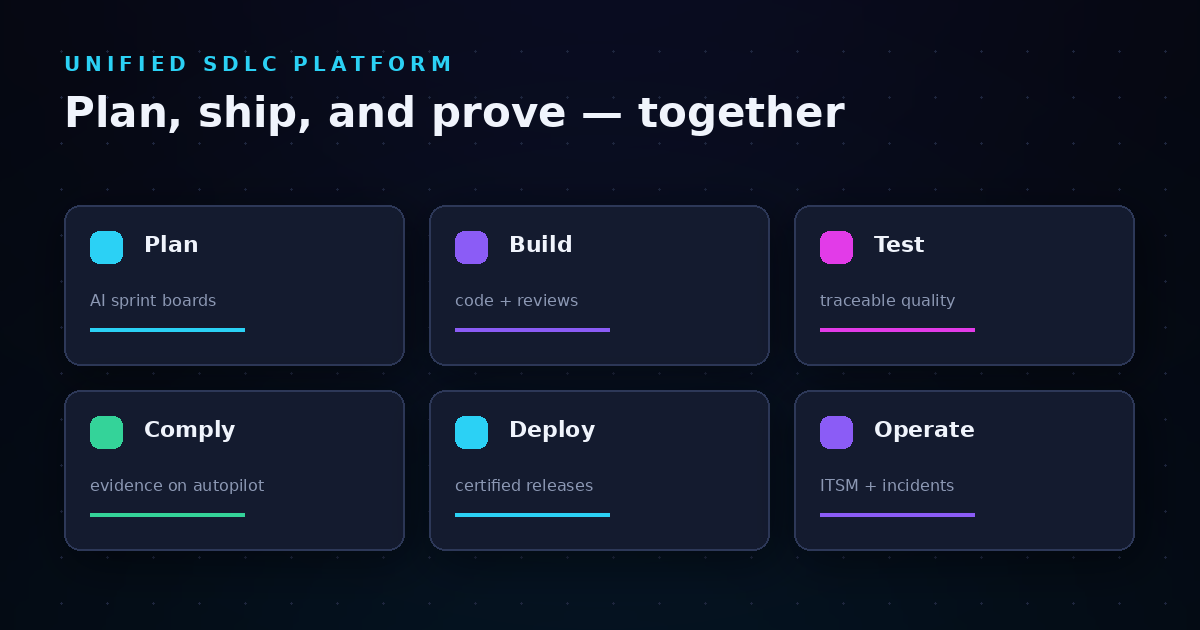
LoopIQ offers end-to-end traceability by connecting requirements, architecture, code, tests, deployments, and compliance in one connected platform. This eliminates the evidence stitching overhead that comes from using disconnected tools.
The best platforms capture evidence without developer involvement. Your engineers should never need to take screenshots, export logs, or manually document approvals.
Look for platforms that automatically record approval chain capture with verifiable identity—who approved what, when, and with what context. This data should populate automatically from your existing tools, not require separate data entry.
According to research from Hyperproof, engineering teams lose approximately two days per release cycle to evidence collection when using disconnected toolchains. Automated capture reclaims that time for actual engineering work.
Evidence automation only works if the platform connects to your actual engineering stack. Evaluate integration depth, not just integration breadth.
Surface-level integrations pull basic data. Deep integrations understand the semantic relationships between artifacts. Can the platform recognize that a failed test blocked a deployment? Can it connect a security scan finding to the specific code change that introduced the vulnerability?
LoopIQ connects existing tools to preserve decision context and generate unified release views. It ingests compliance and security metrics from your current stack and maps them to compliance objectives for proactive risk management.
Audit readiness shouldn't require preparation. The right platform keeps you audit-ready at all times, generating evidence dossiers on demand rather than through quarterly scrambles.
Evaluate whether the platform can produce a complete compliance artifact for any historical release in minutes. If generating an audit package requires manual assembly or custom queries, the tool isn't delivering on its core promise.
A structured evaluation framework helps you compare platforms objectively. It also gives your leadership team a clear decision-making process they can trust.
Start by cataloging exactly what your auditors require. Different frameworks—SOC 2, ISO 27001, HIPAA, FedRAMP—demand different evidence types. Your evaluation criteria should reflect your specific regulatory landscape.
Create a matrix mapping each compliance requirement to the evidence that satisfies it. This matrix becomes your evaluation scorecard: can each platform you're considering produce that evidence automatically?
List every tool involved in your software delivery pipeline. Include version control, CI/CD, testing frameworks, deployment orchestration, incident management, and any existing compliance tools.
For each tool, document what evidence it produces and how accessible that evidence is. This mapping reveals integration requirements and helps you identify where evidence currently falls through the cracks.
Not all evidence is equally valuable. Determine whether you need evidence at the commit level, pull request level, release level, or some combination.
For most regulated engineering teams, release-level evidence with drill-down capability offers the right balance. You need to prove what shipped in each release while being able to trace specific artifacts when auditors ask detailed questions.
Based on your toolchain mapping, define your integration requirements. Categorize integrations as mandatory, important, or nice-to-have.
Pay special attention to your version control system and CI/CD pipeline. These generate the most compliance-critical events, so deep integration matters more here than with peripheral tools.
Develop a weighted scoring system that reflects your priorities. A sample rubric might weight traceability at 25%, automated capture at 25%, integration depth at 20%, audit readiness at 15%, and usability at 15%.
Use this rubric consistently across all platforms you evaluate. Resist the temptation to adjust weights mid-evaluation based on what you see—that introduces bias.
Release-level compliance requires specific capabilities that generic audit tools don't address. These criteria should carry significant weight in your evaluation.
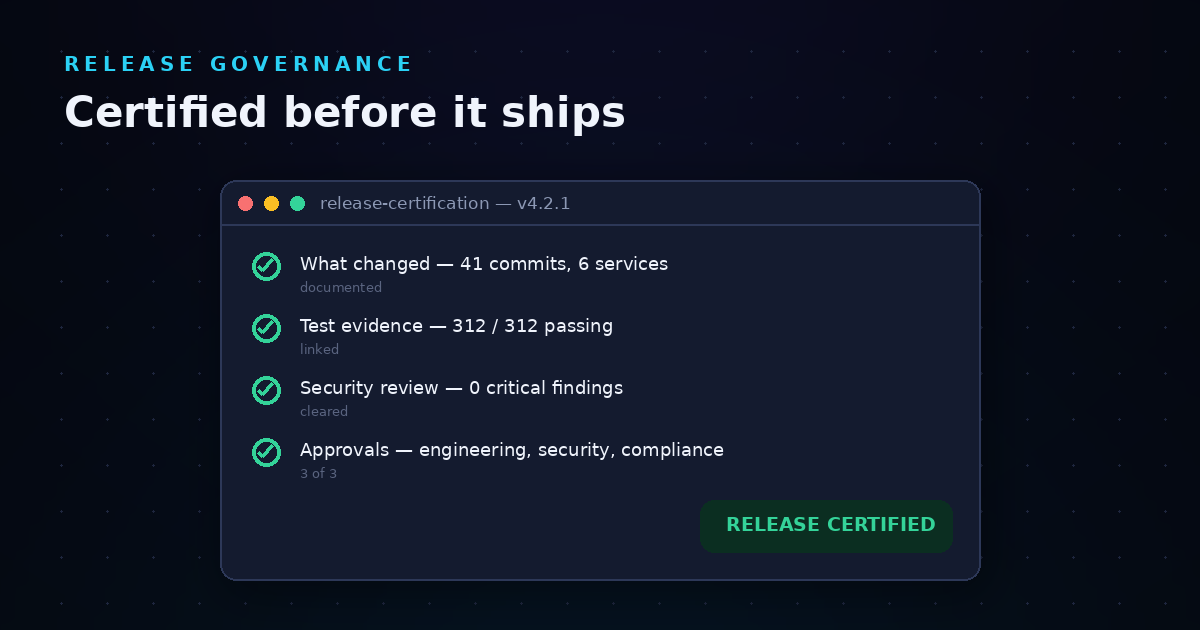
A release certification trail connects every quality signal, approval, and compliance check to a specific release version. It answers: "Was this release certified, by whom, and based on what evidence?"
Look for platforms that generate these trails automatically. LoopIQ creates automatic release certification trails linked to objectives and measurable results for audit readiness. Intelligent release certification reviews evidence and flags gaps before releases ship.
This proactive approach catches compliance issues before they become audit findings. It shifts your team from reactive evidence collection to proactive compliance risk prevention.
Auditors scrutinize approval chains closely. They want to verify that the right people approved each release and that those approvals happened at the right time with the right information.
Evaluate how the platform captures approval identity. Does it rely on username strings, or does it verify identity through authentication systems? Can it prove that an approver had access to specific information at the time of approval?
The gold standard is approval chain capture with verifiable identity that proves not just who clicked approve, but what they were approving and what information they had when they approved it.
Audit evidence must be tamper-evident. If your compliance platform allows retroactive modification of evidence records, auditors will question the integrity of everything it produces.
Look for platforms that implement cryptographic verification, immutable audit logs, or blockchain-based evidence storage. At minimum, the platform should maintain detailed change logs that show any modifications to evidence records.
The most valuable evidence automation platforms don't just collect evidence—they identify when evidence is missing. Real-time gap detection prevents releases from shipping with incomplete compliance documentation.
LoopIQ's intelligent release certification reviews evidence and flags gaps before releases ship. This surfaces compliance issues earlier, reducing escalations during compliance reviews and preventing the painful situation where you discover missing evidence during an audit.
The market includes several approaches to SDLC evidence automation. Understanding these differences helps you evaluate which approach fits your needs.
Some platforms treat compliance as an add-on to existing DevOps tools. They connect to your pipeline through APIs and pull evidence into a separate compliance dashboard.
This approach can work, but it creates evidence stitching overhead. You're still maintaining two separate systems, and the compliance tool only knows what the APIs expose. Deeper context—like why a particular approval was delayed or what discussion preceded a technical decision—often gets lost.
Traditional GRC platforms have added SDLC integrations to address software compliance. These tools understand compliance frameworks deeply but often lack engineering workflow expertise.
Evaluate whether the platform's SDLC features feel native or bolted on. Can your developers work entirely in their normal tools, or do they need to interact with the GRC interface for compliance tasks?
A compliance-native SDLC platform treats evidence generation as a core function, not an integration. Compliance tracking embeds into the delivery workflow itself.
LoopIQ represents this category. It acts as compliance infrastructure inside the delivery lifecycle, linking policy to objectives and results to releases. Documentation becomes a system output rather than a separate artifact requiring dedicated effort.
This architectural difference matters because it determines where evidence lives. With a compliance-native approach, work and record live on the same surface. Your team doesn't duplicate effort by shipping features and then separately documenting compliance.
Integration claims are easy to make and hard to verify. Use these techniques to assess actual integration quality during your evaluation.
Don't accept feature demos in isolation. Ask vendors to demonstrate a complete workflow: a code change moving from commit through testing, approval, and deployment, with evidence captured at each stage.
Watch for manual steps. If the demo requires the presenter to click buttons or enter data that wouldn't happen in normal workflow, that's evidence of shallow integration.
Proof of concept testing should use your real tools, not generic environments. Set up integrations with your version control, CI/CD system, and testing frameworks.
Pay attention to how long setup takes and how much configuration each integration requires. Complex setup often predicts ongoing maintenance burden.
During testing, examine the evidence the platform produces. Is it structured and searchable? Does it include enough context for an auditor to understand what happened without additional explanation?
Compare the automated evidence to what your team currently produces manually. Better platforms should produce richer, more consistent evidence with less effort.
AI coding assistants and automated agents are reshaping software development. Your evidence automation platform needs to handle compliance in this new environment.
When AI generates code, auditors need evidence that the code was reviewed, tested, and approved by humans before deployment. Evaluate how platforms handle this attribution challenge.
Look for platforms that distinguish between human-written and AI-assisted code in their evidence trails. Can the platform prove that AI-generated code went through your normal approval process?
AI agents performing engineering tasks—like automated code reviews or deployment decisions—need their own audit trails. These agents make decisions that affect compliance, and those decisions require evidence.
LoopIQ supports governance of AI agents performing engineering work. AI-assisted code is audit-ready by default, with governed agents doing the evidence work. This prepares your organization for a future where AI involvement in development increases.
AI-assisted development enables faster release cycles. Your evidence automation must keep pace without creating bottlenecks.
Evaluate throughput: how many releases per day can the platform handle? Does evidence generation introduce latency into your deployment pipeline? Platforms designed for a few releases per quarter won't scale to AI-paced shipping.
Justifying investment in evidence automation requires quantifying both costs and benefits in terms your leadership understands.
Survey your engineering and compliance teams to estimate time spent on evidence-related tasks. Include time for documentation, screenshot collection, audit packet assembly, and responding to auditor questions.
Engineering teams typically lose approximately two days per release cycle to these activities when using disconnected toolchains. Multiply by your release frequency and engineer cost to establish a baseline.
Failed audits carry costs beyond fines: delayed product launches, lost contracts, damaged reputation. Estimate the probability and impact of compliance failures under your current process.
Evidence automation reduces these risks by catching gaps early and ensuring complete documentation. The risk reduction value often exceeds the direct time savings.
Include licensing, implementation services, training, and ongoing maintenance in your cost projection. Also account for productivity dip during transition.
Compare total cost of ownership across platforms, not just license fees. A platform with higher licensing but lower implementation and maintenance costs may deliver better long-term value.
Teams evaluating SDLC evidence automation often fall into predictable traps. Awareness of these mistakes helps you avoid them.
A platform that integrates deeply with five tools delivers more value than one that integrates superficially with fifty. Focus your evaluation on how well the platform works with your critical systems.
Feature comparison matrices can mislead. A checkbox for "integrates with GitHub" doesn't tell you whether the integration captures the evidence your auditors need.
If developers resist using the platform, evidence quality suffers. Evaluate usability from the developer perspective, not just the compliance team perspective.
The ideal platform is invisible to developers. They work in their normal tools, and evidence collection happens automatically. Any platform requiring developers to change their workflow faces adoption challenges.
Evaluate platforms against your future needs, not just current state. If you plan to increase release frequency, adopt microservices, or expand to multiple teams, verify the platform can scale accordingly.
Request performance data from existing customers with similar scale. Vendor claims about scalability should be verified through reference checks.
Regulatory requirements evolve. New frameworks emerge. Your evidence automation platform should handle multiple compliance frameworks without requiring re-implementation.
Evaluate framework flexibility: can the platform map evidence to multiple frameworks simultaneously? How difficult is it to add support for a new framework?
Successful implementation requires planning beyond platform selection. Consider these factors as you move from evaluation to deployment.
Start with a single team or project rather than organization-wide deployment. This limits risk and offers learning opportunities before broader rollout.
Choose a pilot project with upcoming audit requirements. Real audit pressure tests the platform under conditions that matter.
Evidence automation changes workflows for multiple teams: engineering, compliance, security, and management. Each group needs appropriate training and clear communication about what changes and why.
Identify champions in each group who can support adoption and give feedback. Their buy-in accelerates acceptance across the organization.
Define how you'll measure success before implementation. Metrics might include time to produce audit packages, developer time spent on compliance tasks, audit finding rates, or release cycle impact.
Baseline these metrics before deployment so you can demonstrate improvement. Quantified success supports additional investment and broader rollout.
The evidence automation landscape keeps evolving. Consider these trends when making platform decisions with multi-year implications.
Regulators are paying more attention to software development practices. New requirements for software bills of materials, supply chain security, and AI governance will expand evidence requirements.
Platforms with flexible evidence models will adapt more easily to new requirements. Look for architecture that supports custom evidence types and new compliance frameworks.
The industry is moving from periodic compliance assessment to real-time monitoring. Future platforms will integrate compliance signals directly into release decisions, preventing non-compliant code from shipping.
LoopIQ already connects compliance posture into release decisions, positioning organizations for this shift. Compliance as workflow—not compliance as checklist—represents the direction the industry is heading.
AI will increasingly assist with evidence analysis, identifying patterns that indicate compliance risk and automating routine audit responses.
Evaluate whether platforms are investing in AI capabilities. The ability to answer natural language queries about compliance status will differentiate platforms over the next several years.
Selecting an SDLC evidence automation platform is a consequential decision. The right choice frees your engineering team from compliance overhead while ensuring audit readiness. The wrong choice adds another tool to manage without solving the underlying problem.
Focus your evaluation on release-level traceability, automated capture without developer intervention, and deep integration with your engineering stack. Build a structured decision framework, test with your actual tools, and verify evidence quality during proof of concept.
LoopIQ embeds compliance tracking into daily delivery, capturing approvals and quality signals into a defensible release trail. For teams evaluating compliance-native SDLC platforms, it offers a single platform that certifies every release while keeping engineers focused on shipping.
Your auditors will ask what you shipped, who approved it, and why. The right evidence automation platform ensures you always have the answer—without your team ever having to look for it.
Traditional GRC tools manage compliance documentation separate from your development workflow. SDLC evidence automation embeds compliance capture directly into your delivery pipeline.
LoopIQ operates as a compliance-native SDLC platform where evidence generates automatically as your team works. This eliminates the duplication where developers ship features and then separately document compliance.
Engineering teams typically lose about two days per release cycle to evidence collection when using disconnected tools. Automated evidence collection eliminates this overhead entirely.
LoopIQ reduces audit preparation from weeks to minutes by generating one-click compliance evidence dossiers per release. Your senior engineers can focus on shipping rather than hunting for evidence.
Version control and CI/CD pipeline integrations matter most because they generate the most compliance-critical events. Testing framework and deployment tool integrations are secondary priorities.
Look for platforms offering deep integration—not just API connections—with your specific toolchain. LoopIQ connects existing tools to preserve decision context and generate unified release views.
Ask vendors how their platform handles AI-generated code attribution and approval tracking. The platform should distinguish between human and AI contributions in evidence trails.
LoopIQ supports governance of AI agents performing engineering work, with AI-assisted code that is audit-ready by default. This prepares your organization for increasing AI involvement in development.
Quantify current time spent on evidence collection, audit preparation, and responding to auditor questions. Add risk costs from potential compliance failures or delayed releases.
Compare these costs against platform licensing, implementation, and maintenance. Most organizations find evidence automation pays for itself through time savings alone, with risk reduction as additional value.
Bolt-on tools pull evidence from your pipeline through APIs into a separate dashboard. Compliance-native platforms generate evidence as part of the workflow itself—work and record live on the same surface.
LoopIQ embeds compliance tracking into daily delivery, capturing approvals and quality signals directly into release trails. This eliminates evidence stitching overhead from maintaining separate systems.