.svg)
devops
devsecops
compliance

Engineering leaders at regulated SaaS companies face a difficult balancing act: you need to ship software quickly while meeting strict compliance requirements. AI-powered software delivery platforms promise to help solve this challenge, but choosing the wrong platform can create more problems than it solves. LoopIQ gives engineering teams one intelligent system that connects delivery and compliance evidence in a single workspace, helping you evaluate whether a platform truly meets your regulated SaaS needs.
This guide walks you through the evaluation criteria, key capabilities, and practical considerations for selecting an AI software delivery platform that keeps your team moving fast without breaking compliance. By the end, you will understand exactly what to look for, what questions to ask vendors, and how to build a selection process that accounts for your organization's unique regulatory requirements.
An AI-powered software delivery platform is a unified workspace that orchestrates the entire software development lifecycle using intelligent automation. These platforms combine planning, source control, testing, deployment, and monitoring into one connected system. AI capabilities enhance each stage by predicting failure points, auto-generating test suites, and optimizing deployment strategies.
Traditional delivery toolchains force teams to manage five or more disconnected tools. Each tool creates its own records, requires separate logins, and generates data silos. For regulated industries, this fragmentation becomes a compliance liability. Engineers spend hours per release cycle assembling evidence from GitHub, Slack, CI pipelines, and approval threads.
Modern AI platforms eliminate this overhead by making compliance evidence a natural output of development activities. When you commit code, run tests, and deploy releases, the platform automatically captures approvals, quality signals, and validation outcomes. This structural approach means compliance documentation writes itself from your existing work.
Regulated SaaS companies operate under unique constraints that general-purpose DevOps tools ignore. You must prove adherence to frameworks like SOC 2, HIPAA, or ISO 27001 across your entire project lifecycle. Standard delivery platforms treat compliance as an afterthought, forcing your team to duplicate work by shipping features first and documenting compliance separately.
The cost of this approach is measured in engineering hours. According to industry research, engineers at regulated companies lose approximately two days per release cycle to collecting evidence and assembling audit packets. This time should go toward building features that create customer value, not toward assembling documentation after the fact.
AI platforms designed for regulated environments embed compliance tracking into daily delivery workflows. They capture approvals and quality signals as releases move through your pipeline. The result is a defensible release trail that satisfies auditors without requiring engineers to context-switch between coding and compliance paperwork.
Generic DevOps tools optimize for speed and automation alone. Compliance-first platforms optimize for speed, automation, and audit readiness simultaneously. The difference shows up in three key areas: evidence capture, change control, and release certification.
Evidence capture happens automatically in compliance-first platforms. Every commit, test result, approval, and deployment creates an immutable record linked to specific releases. Generic tools require manual effort to reconstruct this information during audits. Compliance-first platforms preserve decision context at the moment decisions are made.
Change control in compliance-first platforms enforces policies that exceed regulatory baselines. You can define rules requiring specific approvals, passing test suites, or security scans before code reaches production. Generic tools offer some gating features, but compliance-first platforms tie these gates directly to audit evidence.
When evaluating AI software delivery platforms, focus on capabilities that directly impact your ability to ship fast while maintaining compliance posture. The following categories represent the essential functions your platform must support.
Your platform should produce audit-ready documentation as a byproduct of normal development activities. Look for systems that automatically link requirements to code changes, code changes to test results, and test results to deployment approvals. This end-to-end traceability eliminates the need for retrospective evidence assembly.
Ask vendors how their platform handles approval chain visibility. In many organizations, sign-offs happen across Slack, email, and issue trackers. Investigators must search multiple systems to verify that proper approvals occurred. Effective platforms consolidate approvals into a single auditable record.
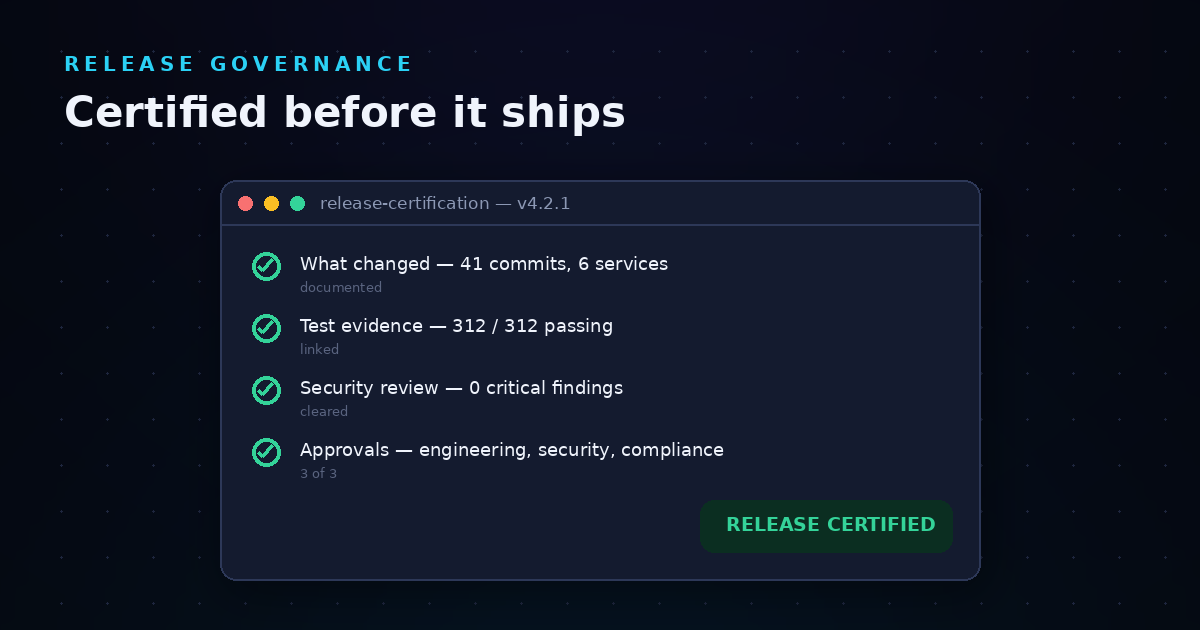
Release certification capabilities help you answer a critical question: was this release evaluated under defined conditions? AI-powered certification reviews evidence automatically and flags compliance gaps before shipping. This proactive approach catches issues when they are cheap to fix, not during an audit when remediation is expensive.
LoopIQ creates automatic release certification trails linked to objectives and measurable results. Every release includes immutable approval records and auditor-ready certification packages. You can generate a one-click compliance evidence dossier immediately after any release, eliminating the panic that typically precedes audits.
Your platform must enforce governance policies across all automated workflows. This includes applying granular mutation policies and approval requirements for AI agent actions. As AI agents perform more engineering tasks, governing their outputs becomes critical for maintaining audit defensibility.
Look for platforms that integrate compliance posture directly into release decision-making. You should know whether a release meets compliance thresholds before deployment, not afterward. Platforms that connect compliance signals to release readiness tools give you proactive confidence backed by evidence.
No platform operates in isolation. Your selection must account for existing investments in source control, security scanning, incident management, and GRC tooling. The right platform integrates with your current stack without requiring wholesale replacement of working systems.
Evaluate how deeply the platform integrates with your source control provider. Native GitHub integration for change capture and automated test execution reduces implementation complexity. Platforms that treat source control integration as an afterthought create gaps in your evidence chain.
Consider how the platform handles CI/CD pipeline data. Does it correlate live delivery signals and validation outcomes automatically? Can it ingest test results, security scan findings, and deployment metrics from your existing pipelines? The goal is breaking down data silos to unify release context.
Security findings must flow directly into your release evidence to avoid extra manual effort. According to Snyk's platform documentation, modern security testing covers AI-generated code, supply chain risks, and agentic applications. Your delivery platform should ingest these findings and map them to specific releases.
Platforms that treat security data as separate from delivery data force engineers to stitch together audit stories manually. Look for systems that automatically integrate security operations data with release evidence. This integration improves your compliance posture and gives auditors the complete picture they need.
Many regulated organizations already invest in governance, risk, and compliance tools. Your delivery platform should support these existing systems by feeding structured, audit-ready artifacts without replacing them. The platform acts as compliance infrastructure inside your delivery lifecycle, tying policy to objectives and linking results to releases.
Avoid platforms that require abandoning your current GRC investments. The best approach treats GRC tools as downstream consumers of compliance data generated automatically during delivery. This preserves your existing workflows while dramatically reducing the effort required to keep GRC systems current.
AI features in delivery platforms fall into two categories: productivity enhancement and compliance automation. Both matter, but compliance automation delivers more value for regulated teams than generic productivity features available in standalone coding assistants.
AI-driven testing tools auto-generate test suites and predict failure points. These capabilities increase test coverage while reducing the manual effort required to maintain test assets. For regulated teams, higher test coverage translates directly to stronger audit evidence.
Evaluate how the platform uses AI to optimize deployment strategies and reduce errors. Intelligent deployment systems analyze historical data to predict which releases carry higher risk. They can automatically adjust rollout strategies, requiring additional approvals or staged deployments for releases that trigger risk indicators.
The most valuable AI capability for regulated teams is predictive compliance intelligence. These systems analyze control data continuously, flagging gaps before they become audit findings. They use real signals, not optimistic assumptions, to give you proactive compliance status.
LoopIQ ingests compliance and security metrics from your existing tooling, mapping them to objectives for proactive risk management. This real-time intelligence layer connects your enterprise delivery ecosystem, enabling you to see every release in context with validations, approvals, and conditions visible in one place.
Structured vendor conversations help you separate genuine capabilities from marketing claims. The following questions probe areas that matter most for regulated SaaS delivery.
Ask how evidence is captured: is it automatic or does it require manual tagging? Request examples of the compliance artifacts generated per release. Determine whether the platform preserves the state of the world at decision time or only captures final outcomes.
Probe the immutability of records. Can evidence be modified after the fact? How does the platform prevent tampering with audit trails? These questions reveal whether the vendor understands compliance requirements or merely offers a thin compliance veneer.
Request a demonstration of the release certification workflow. How does the system determine whether a release meets compliance thresholds? What happens when a release fails certification checks? Can you customize the criteria used for certification decisions?
Ask about historical audit support. Can you generate a compliance dossier for releases shipped months ago? Auditors often ask about past releases, and your platform must support defending those releases confidently long after shipping.
Move beyond asking whether integrations exist. Ask how deeply the platform integrates with your specific tools. Does the GitHub integration capture all approval data or only basic commit information? Does the security tool integration include remediation status or only finding counts?
Request reference customers in similar regulatory environments. A vendor claiming SOC 2 compliance support should connect you with current customers who have completed SOC 2 audits using the platform. Their experiences reveal practical limitations that demos cannot expose.
A rigorous evaluation process protects you from selecting a platform based on impressive demos rather than practical fit. Structure your evaluation around these phases to make a defensible decision.
Document your compliance frameworks, current tooling, team size, and release frequency before engaging vendors. Identify your highest-friction workflows and quantify the time currently spent on compliance activities. These baselines help you measure vendor claims against your reality.
Involve compliance, security, and engineering stakeholders in requirements gathering. Each group has different priorities, and your platform must satisfy all three. Engineering wants speed; compliance wants evidence; security wants visibility. The right platform balances these needs.
Create an initial shortlist based on documented capabilities, not marketing promises. Request detailed feature documentation and integration specifications. Eliminate vendors who cannot demonstrate compliance-first architecture or who treat compliance as an add-on module.
Evaluate vendor stability and commitment to regulated markets. A platform serving primarily unregulated startups may deprioritize compliance features in future development. Check the vendor's customer base composition and product roadmap for signals about long-term fit.
Run a proof of concept with your top two candidates using real projects and real compliance requirements. Avoid POCs that use synthetic data or simplified scenarios. The goal is validating that the platform works with your actual codebase, toolchain, and team workflows.
Measure POC outcomes against your baseline metrics. Did compliance documentation time decrease? Did evidence quality improve? Could your compliance team interpret the generated artifacts without engineering assistance? These practical results matter more than feature checklists.
Selection mistakes are expensive to correct. Migrating from one delivery platform to another disrupts teams for months and risks losing historical evidence. Avoid these common errors to improve your selection outcome.
Some platforms offer excellent developer experience but superficial compliance features. Engineers enjoy using the tool, but compliance teams still struggle to produce audit evidence. The time savings from improved developer experience evaporate when audit preparation requires the same manual effort.
Balance developer experience requirements with compliance depth. The best platforms deliver both, but if you must prioritize, remember that developer tools are easier to supplement than compliance infrastructure. A platform with strong compliance features and adequate developer experience beats the reverse combination.
Vendors often demonstrate integrations in ideal conditions that differ from your environment. Your Jira instance has custom fields. Your GitHub organization uses enterprise features. Your security scanner outputs non-standard formats. Each deviation adds integration effort.
Request integration references from customers with similar environments. Ask about time to full integration, not time to first connection. A working webhook differs significantly from a fully configured integration that captures all relevant data and maps it correctly.
Audit requirements often extend years beyond initial release. Your platform must retain evidence for your full retention period without degradation. Ask vendors about data retention policies, export capabilities, and what happens to your data if you leave the platform.
Some platforms store evidence in proprietary formats that become inaccessible if you change vendors. Ensure your evidence remains accessible and usable regardless of future platform decisions. This consideration protects your audit defensibility across multi-year timeframes.
Platform selection affects more than compliance outcomes. Your engineering team's daily experience changes significantly based on your choice. Consider both productivity impacts and cultural implications.
Regulated teams often run five or more separate tools for different delivery lifecycle phases. Each tool requires separate authentication, has its own learning curve, and generates its own notification streams. This sprawl taxes cognitive capacity and creates gaps in evidence ownership.
A unified platform reduces maintenance debt and integration complexity. Engineers work in one environment rather than constantly switching contexts. This consolidation frees time for innovation while simultaneously improving compliance posture through connected data.
When compliance evidence generates automatically, engineers reclaim time previously spent on documentation. Research suggests that engineers lose significant time weekly to compliance-related activities that could be automated. This time represents potential investment in strategic problem-solving.
LoopIQ helps free engineers to write code instead of compliance paperwork. By automating evidence, risk assessment, and release readiness evaluation, the platform eliminates compliance bottlenecks that historically slowed delivery. Your team focuses on building features while the platform handles proof of compliance.
Selecting the right AI software delivery platform requires balancing delivery speed, compliance depth, and team experience. Start by documenting your specific requirements, including regulatory frameworks, existing tools, and current pain points. Use structured vendor conversations to probe capabilities beyond surface-level features.
Prioritize platforms that make compliance evidence a byproduct of normal work rather than a separate documentation burden. Look for intelligent release certification, policy-based change control, and deep integration with your existing security and GRC tools. Run proof-of-concept evaluations with real projects to validate practical fit.
The best platform helps you ship software fast while maintaining the audit readiness your regulated environment demands. That combination of speed and compliance defines success for engineering leaders at regulated SaaS companies navigating the demands of modern software delivery.
AI software delivery platforms add intelligent automation across the entire development lifecycle, not just build and deploy stages. They predict failure points, auto-generate tests, optimize deployments, and most importantly for regulated teams, generate compliance evidence automatically.
Traditional CI/CD tools require manual evidence assembly and treat compliance as external to delivery workflows. AI platforms embed compliance tracking directly into every stage.
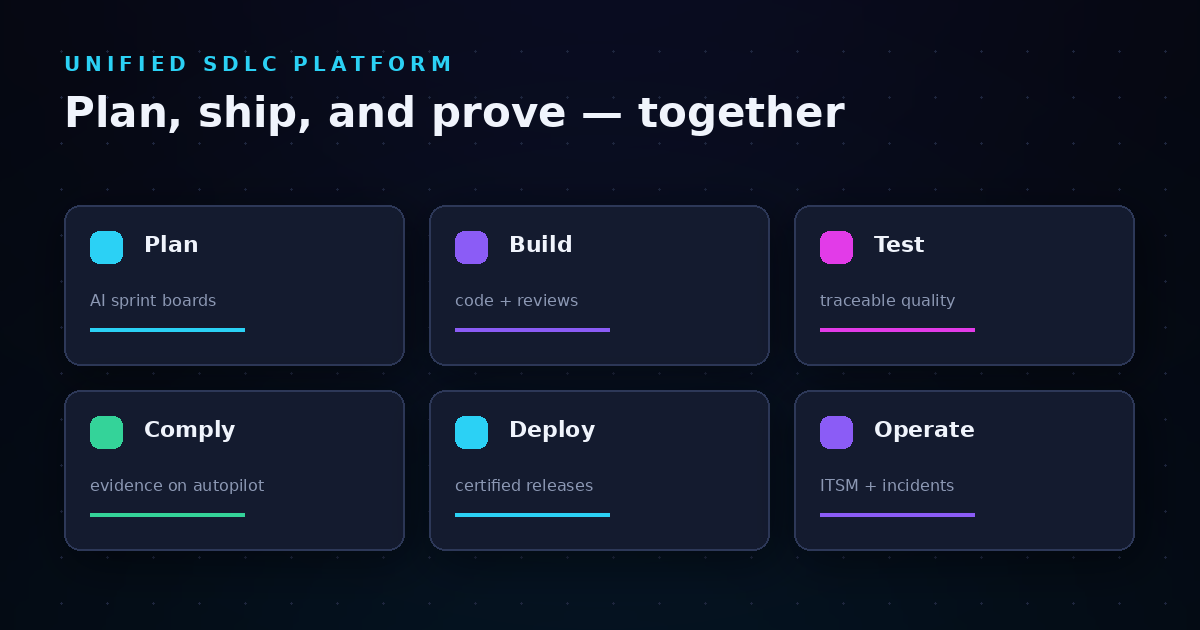
LoopIQ unifies planning, testing, DevOps, ITSM, documentation, and audit management into one intelligent workspace. It automatically captures compliance evidence as engineering work happens, eliminating the two-day-per-release overhead that plagues regulated teams.
The platform creates automatic release certification trails and generates one-click compliance dossiers immediately after any release. This structural approach lets you ship at AI-speed while staying audit-ready.
Most enterprise-grade platforms support SOC 2, ISO 27001, HIPAA, and GDPR requirements. Some platforms extend to industry-specific frameworks like HITRUST for healthcare or FedRAMP for government contractors.
Evaluate each platform's framework coverage against your specific requirements. Support for a framework should include automated evidence mapping, not just documentation templates.
Implementation timelines vary based on existing tool complexity and migration scope. Teams with straightforward toolchains often achieve basic functionality in four to eight weeks. Complex environments with extensive integrations and data migration requirements may take three to six months.
Request implementation references from vendors with customers similar to your environment for realistic timeline estimates.
Leading platforms integrate with established GRC tools rather than replacing them. LoopIQ supports existing GRC tools by feeding structured, audit-ready artifacts without requiring abandonment of current investments. The platform also integrates security findings from tools like GitHub security scanning and Datadog.
Evaluate integration depth, not just integration availability, when assessing platform fit with your current stack.
Track time spent on audit preparation, evidence assembly hours per release, and defect escape rates. Successful implementations show significant reduction in preparation time and per-release documentation effort while maintaining or improving quality.
Also measure compliance team satisfaction with evidence quality and auditor feedback on documentation completeness. These qualitative indicators reveal whether automated evidence meets actual audit requirements.