.svg)
devops
devsecops
compliance

If your engineering team ships software to regulated industries—or handles customer data that falls under SOC 2 or ISO 27001 requirements—you already know that compliance evidence has become a tax on every release. The old approach of treating audits as periodic fire drills no longer works when you're deploying multiple times per day. What you need is a software delivery platform built from the ground up to capture compliance evidence as a byproduct of your normal engineering work.
This guide walks you through how to evaluate an SDLC platform that keeps you audit-ready at all times. You'll learn what separates compliance-native platforms (like LoopIQ) from bolt-on solutions, and which evaluation criteria matter most when your reputation depends on passing SOC 2 Type II or ISO audits. By the end, you'll have a clear framework for choosing a platform that lets your developers focus on shipping, not paperwork.
A SOC 2 SDLC platform is a software delivery environment that integrates compliance controls directly into the development lifecycle. Rather than generating compliance artifacts after the fact, these platforms capture approvals, test results, code changes, and deployment signals as your team works.
The result is an audit trail that documents how each release happened—who approved what, which tests passed, and what conditions were met before code went live. For SOC 2 Type II audits, which require evidence of controls operating effectively over time, this built-in traceability is essential.
Traditional project management tools and standalone GRC (governance, risk, and compliance) solutions create a gap. Project management tools track tasks but don't generate compliance evidence natively. GRC tools collect evidence but don't function as development environments. A compliance-first SDLC platform closes that gap by making work and records live on the same surface.
SOC 2 attestation has become table stakes for B2B software companies. Enterprise buyers now expect vendors to demonstrate security controls before signing contracts. If your team can't produce audit-ready documentation on demand, you risk losing deals and damaging trust.
The pressure intensifies as AI-assisted development accelerates release cadences. When your team ships features in hours instead of weeks, the compliance evidence burden per release multiplies. According to McKinsey research, AI coding assistants can improve coding velocity by 20-50%. That speed becomes a liability if your compliance process can't keep up.
ISO 27001 certification adds another layer. Many organizations pursue both SOC 2 and ISO 27001 to satisfy different customer requirements. A unified SDLC platform that maps controls to both frameworks saves you from duplicating evidence collection efforts.
Most engineering teams cobble together five or more tools to manage their delivery pipeline: a project tracker, a source control system, a CI/CD platform, a documentation wiki, and a separate compliance tool. This architecture creates gaps in evidence ownership.
When audit season arrives, senior engineers get pulled off shipping to assemble packets from disparate sources. They dig through Slack threads for approval records, screenshot GitHub pull request reviews, and manually correlate test results with deployment logs. This retroactive evidence assembly costs approximately two days per release cycle.
The deeper problem is context loss. By the time you're reconstructing what happened three months ago, the decision context has evaporated. Why was that exception approved? Who verified the security review? Bolt-on tools can't answer these questions because they weren't present when decisions were made.
Beyond direct engineering time, fragmented toolchains create indirect costs that compound over time. Each integration point is a potential failure mode during audits. If your compliance tool loses sync with your CI pipeline, you have gaps in your evidence chain.
Maintenance debt accumulates as you build custom integrations between systems. When one tool updates its API, your compliance workflow breaks. A study from Atlassian's developer experience research found that tool sprawl is a top driver of developer frustration and productivity loss.
A compliance-first platform treats audit readiness as a core architectural principle, not an afterthought. Every action in the development lifecycle—from story creation to production deployment—generates structured data that feeds into your compliance posture.
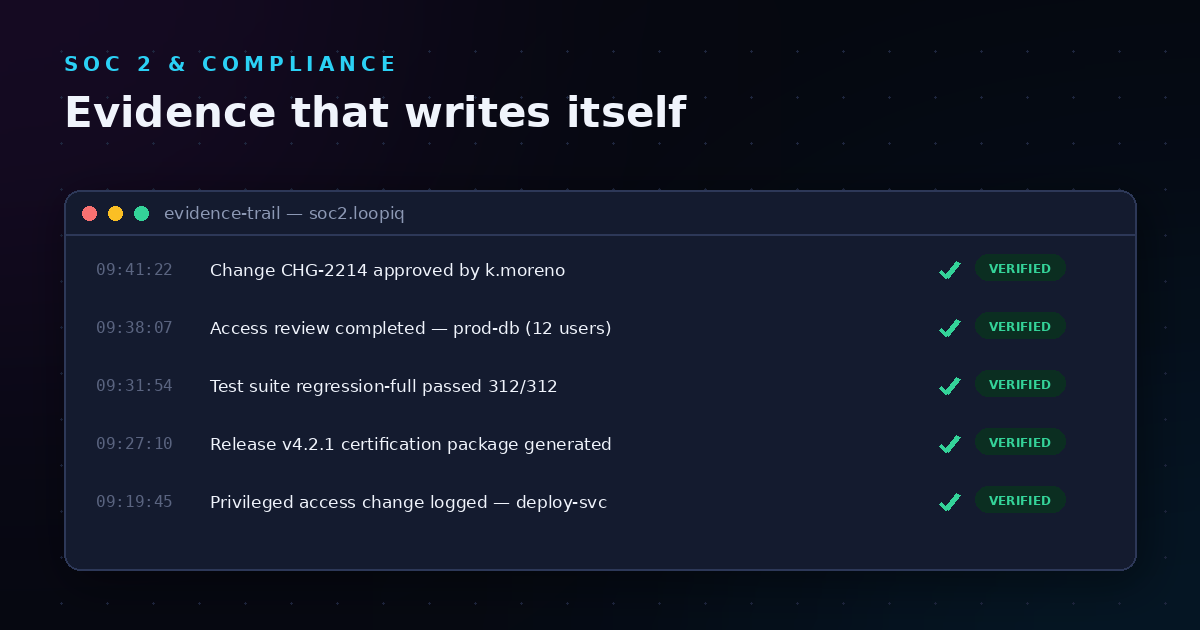
LoopIQ exemplifies this approach by unifying planning, testing, DevOps, ITSM, documentation, and audit management into one intelligent system. When your team approves a pull request or passes a test suite, LoopIQ captures that signal and binds it to the release. No additional steps required.
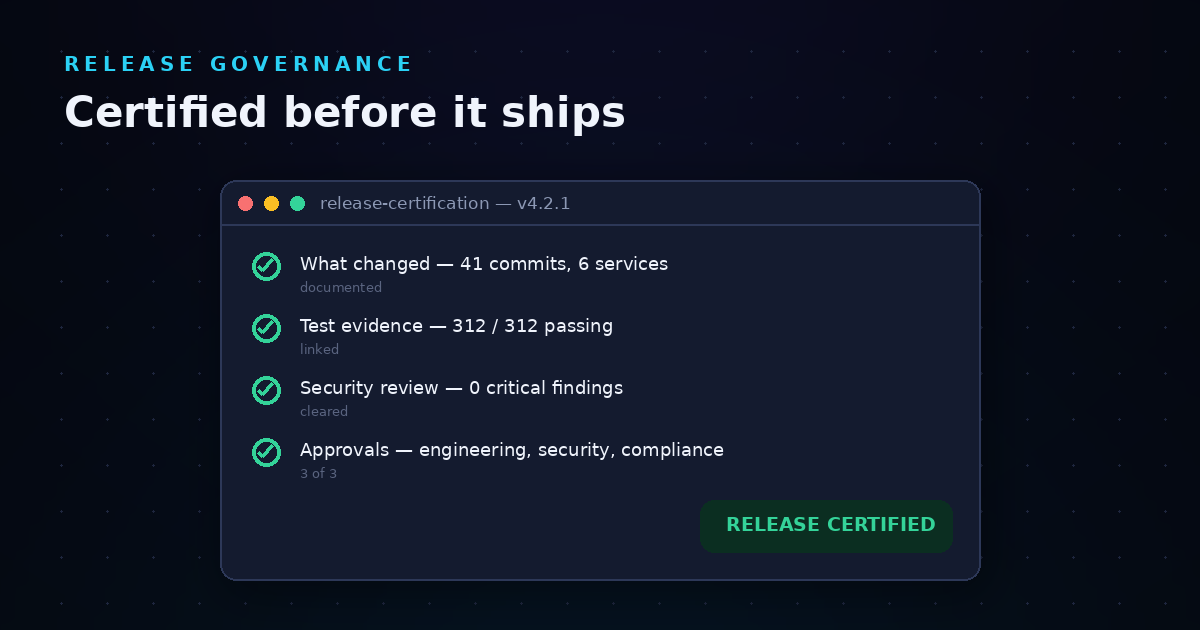
The result is what LoopIQ calls a "one-click compliance evidence dossier"—a complete, immutable record of everything that happened before, during, and after a release. Auditors get deterministic answers to their questions. You get confidence that your evidence will hold up under scrutiny.
Compliance-first platforms differ from traditional tools in three fundamental ways:
Embedded evidence capture: Compliance artifacts are generated automatically as engineers work. There's no separate documentation step or manual upload process.
Release-centric organization: Evidence is bound to specific releases, not scattered across projects or time periods. You can pull up everything related to version 2.4.1 in seconds.
Policy-based automation: Governance rules are codified and enforced automatically. If a release fails to meet defined conditions, the platform flags it before shipping—not after an auditor finds the gap.
When comparing platforms, focus on capabilities that directly impact your audit readiness and engineering velocity. The following criteria separate compliance-native solutions from tools that simply check the SOC 2 box.
Ask whether the platform captures compliance evidence automatically from development activities. You want evidence generated as a byproduct of work, not through manual documentation processes.
Key questions to evaluate:
LoopIQ produces per-release compliance evidence automatically, creating audit-ready certification packages that include immutable approval records linked to objectives and measurable results.
Your platform should link compliance posture directly to release decisions. This means connecting test outcomes, security scan results, approval chains, and policy validations into a unified certification trail.
When an auditor asks "Was this release evaluated under defined conditions?", you should be able to answer definitively—with timestamps, approver identities, and specific test results attached to that release.
SOC 2 controls map to trust service criteria: security, availability, processing integrity, confidentiality, and privacy. Your SDLC platform should let you define policies that correspond to these criteria and track compliance at the objective level.
Look for platforms that let you configure rules like: "All releases require security scan with no critical findings" or "Production deployments need approval from a designated release manager." The platform should enforce these rules and document compliance automatically.
If you already use a GRC platform for broader compliance management, your SDLC platform should feed structured artifacts into that system. You want to support your existing GRC tools, not replace them.
LoopIQ integrates with existing document storage systems and GRC platforms, feeding structured audit-ready artifacts into your compliance ecosystem. This lets compliance teams work in their preferred tools while engineering teams stay in the development environment.
SOC 2 audits increasingly scrutinize your security practices. Your SDLC platform should ingest findings from security scanning tools and integrate them into the release evidence story.
Ask whether the platform connects GitHub security findings, vulnerability scan results, and monitoring alerts to release records. Without this integration, you're left assembling security evidence separately—which adds stitching effort and creates gaps.
As AI coding assistants become standard in development workflows, auditors want to know how you govern automated actions. Your platform should track AI agent outputs and include them in approval trails.
LoopIQ applies granular mutation policies and approval requirements for AI agent actions, ensuring that automated code changes are governed just as rigorously as human contributions. This becomes critical as AI-paced shipping accelerates release frequencies.
Many vendors claim SOC 2 support, but the depth of that support varies dramatically. Use these questions to cut through marketing language and assess actual capabilities.
During your evaluation, ask vendors to demonstrate specific scenarios:
Show me a complete audit trail for a specific release from three months ago. This tests whether the platform retains historical context and can reconstruct the full picture of what happened.
How would I prove that release 2.3.5 met our security review policy? Listen for whether the answer involves pulling up a single artifact or piecing together evidence from multiple sources.
What happens if an engineer tries to deploy without required approvals? The platform should block the deployment and document the policy violation—not just log a warning.
Can you show me how AI-generated code changes are tracked in the audit trail? If the vendor can't answer this question clearly, their platform wasn't built for modern development workflows.
Be cautious of vendors who describe compliance as a "module" or "add-on." This language suggests compliance capabilities were bolted on rather than built in.
Also watch for solutions that require you to manually upload evidence or run separate reports to satisfy auditors. These approaches don't scale with modern release cadences and will create bottlenecks during audit season.
SOC 2 audits evaluate your controls against five trust service criteria. Here's how your SDLC platform should support each one.
Your platform should document access controls, change management processes, and security monitoring. Look for features like:
Evidence of system availability and incident response procedures matters here. Your platform should track deployment outcomes, rollback events, and incident resolution times.
Auditors want evidence that your software processing is complete, valid, accurate, and timely. Test automation evidence and quality gate documentation support these controls.
Your platform should document data handling practices and access restrictions. This includes evidence of who can access sensitive data and how data flows through your systems.
If you process personal information, your platform should track consent management and data subject request handling. Integration with privacy tools strengthens this evidence set.
Switching SDLC platforms is a significant undertaking. Here's how to approach the transition while maintaining compliance posture throughout.
Before evaluating new platforms, document your current compliance workflow. Map out which tools generate which types of evidence and identify the gaps where you're assembling documentation manually.
This audit reveals your highest-pain-point areas and helps you prioritize platform capabilities. If you're spending two days per release on evidence assembly, automated capture should top your requirements list.
List the specific controls you need to demonstrate for SOC 2 Type II and any other frameworks (ISO 27001, HIPAA, etc.). Map each control to the evidence types required.
Share this requirements document with vendors during evaluation. Their responses will reveal whether their platform genuinely supports your compliance needs or just checks surface-level boxes.
Don't try to migrate everything at once. Start with a pilot team or project to validate the platform's compliance capabilities in your real-world context.
LoopIQ reduces friction for teams migrating from legacy trackers with improved import tooling. A phased approach lets you verify that historical evidence is preserved and new evidence capture meets your standards before rolling out broadly.
Engineers need to understand how the new platform captures compliance evidence. Document which actions generate audit trails and where to find evidence when auditors ask questions.
The goal is to make compliance invisible to daily workflows. Developers shouldn't think about audit readiness—the platform should handle it automatically.
LoopIQ was designed as a compliance-first SDLC workspace that captures audit-ready evidence from the work your team already does. Here's how LoopIQ's capabilities map to the evaluation criteria covered in this guide.
Automated evidence generation: LoopIQ captures approvals and quality signals bound to releases through certification, making documentation effortless. Every code review, test result, and deployment event becomes part of your compliance record automatically.
One-click compliance dossiers: After any release, you can generate a complete evidence package with a single click. The dossier includes immutable approval records, test outcomes, security scan results, and the full decision context from release time.
Real-time audit readiness: LoopIQ creates automatic release certification trails linked to objectives and measurable results. Your compliance posture is always current—no pre-audit scramble required.
GRC integration: LoopIQ supports existing GRC tools by feeding structured audit-ready artifacts without replacing your broader compliance ecosystem.
AI governance: LoopIQ governs AI agents performing engineering work, integrating agent outputs into audit evidence and approval trails.
Avoid these pitfalls that lead organizations to choose platforms that don't meet their compliance needs.
A long feature list doesn't guarantee compliance capability. Focus on how the platform captures and organizes evidence, not just what checkboxes it claims to tick.
Ask for architecture documentation. Understand where evidence lives, how it's structured, and whether it's truly immutable. These details matter more than surface-level feature comparisons.
Moving historical data into a new platform is challenging. If you need to preserve evidence from previous audit periods, plan the migration carefully and verify data integrity.
Some organizations run parallel systems during the transition to ensure no evidence gaps during their next audit. Budget time and resources accordingly.
A compliance platform only works if your developers use it consistently. Evaluate the day-to-day experience: How many extra clicks does compliance add? Does the platform integrate with your IDE and CI tools?
LoopIQ eliminates friction by removing the need to switch between development and compliance tasks. Engineers work in one unified workspace, and compliance evidence captures itself in the background.
Your compliance needs will likely expand over time. Evaluate whether the platform supports ISO 27001, HIPAA, or other frameworks your customers may require.
A platform that handles multiple frameworks through unified evidence capture saves you from implementing separate solutions as requirements grow.
If you're advocating for a compliance-first SDLC platform internally, focus on these value drivers.
Calculate the hours your team currently spends on compliance evidence assembly. If senior engineers lose two days per release cycle, that's time not spent shipping features or solving customer problems.
A platform that automates evidence capture returns those hours to productive work. Multiply by your release frequency and engineering costs to quantify the value.
What does a failed audit cost your organization? Consider contract penalties, customer trust damage, and the remediation effort required. A compliance-first platform reduces the risk of evidence gaps that lead to audit findings.
As your team accelerates release cadence with AI-assisted development, compliance shouldn't become the bottleneck. A platform that scales with shipping speed protects your competitive advantage.
If you're currently running five or more tools to support your delivery pipeline, consolidating into a unified platform reduces licensing costs, integration maintenance, and vendor management overhead.
The right SOC 2 SDLC platform transforms compliance from a periodic burden into a byproduct of your normal engineering workflow. Look for platforms that capture evidence automatically, organize it by release, and preserve the decision context auditors need.
Avoid bolt-on solutions that require manual documentation or separate compliance processes. These approaches don't scale with modern development velocity and create gaps that auditors will find.
LoopIQ delivers compliance-first SDLC capabilities that let your team ship with confidence while staying audit-ready at all times. Explore how LoopIQ can help your team close the gap between shipping software and proving compliance.
SOC 2 Type I evaluates whether your controls are designed appropriately at a single point in time. Type II examines whether those controls operated effectively over a period, typically 6-12 months.
Most enterprise customers require Type II attestation because it demonstrates sustained compliance. Your SDLC platform should capture evidence throughout the audit period, not just generate point-in-time snapshots.
LoopIQ captures approvals, test results, security findings, and deployment events as your team works. Every action in the development lifecycle becomes part of a structured evidence record bound to specific releases.
This automated capture eliminates the need for engineers to document compliance separately. When auditors ask questions, you pull up a one-click compliance dossier with the complete release history.
Yes. A compliance-first SDLC platform should complement your existing GRC ecosystem, not replace it. LoopIQ feeds structured audit-ready artifacts into your GRC tools, giving compliance teams the evidence they need in their preferred systems.
This integration lets engineering teams work in the development environment while compliance teams manage broader governance in their specialized tools.
Implementation timelines vary based on your team size, current toolchain complexity, and migration requirements. A phased approach—starting with a pilot team—typically takes 4-8 weeks before broader rollout.
LoopIQ reduces migration friction with improved import tooling for teams moving from legacy trackers. Plan for training time so your developers understand how the platform captures compliance evidence.
Your historical evidence remains important for ongoing audits. When evaluating platforms, ask about data migration capabilities and verify that your evidence chain won't have gaps.
Some organizations run parallel systems during the transition period. LoopIQ preserves the state of the world at decision time, ensuring you can defend historical releases even after migration.
LoopIQ captures compliance evidence that maps to multiple frameworks, including SOC 2 and ISO 27001. Since many controls overlap between frameworks, unified evidence capture satisfies multiple audit requirements efficiently.
This approach saves you from duplicating documentation efforts when customers require different certifications.
Ask vendors to demonstrate specific scenarios during evaluations. Request to see a complete audit trail for a release from three months ago. Ask them to show how policy violations are blocked and documented.
Genuine compliance-first platforms can answer these questions with live demonstrations. If vendors rely on marketing materials or future roadmap promises, their current capabilities may not meet your needs.