.svg)
devops
devsecops
compliance

If your engineering team still treats compliance as a last-minute scramble before audits, you're not alone. Most development organizations ship features with one toolchain and then rebuild the compliance story with another—or worse, with spreadsheets, screenshots, and Slack threads. That disconnect costs time, drains morale, and introduces risk at exactly the wrong moment.
A compliance-first SDLC platform changes that equation. Instead of bolting on governance after the fact, it bakes evidence capture, approval tracking, and release certification directly into the delivery workflow. LoopIQ takes this approach by generating audit-ready documentation as a byproduct of the work your team already does.
This guide walks you through everything you need to evaluate compliance-first SDLC platforms: what they do, why they matter, and how to pick one that fits your team's regulatory and operational needs.
A compliance-first SDLC platform is a software delivery environment that treats governance as a core architectural requirement rather than an afterthought. It captures approvals, test results, security scans, and change records automatically during normal development activities—so the evidence exists the moment you ship.
Traditional toolchains separate shipping from documenting. You push code, run tests, and deploy through one set of tools, then spend days or weeks reassembling evidence for auditors. A compliance-first platform collapses that gap by embedding audit trails into the delivery topology itself.
This matters because regulated teams—whether bound by SOC 2, ISO 27001, HIPAA, or internal contractual obligations—face mounting pressure to prove how releases happen. When your SDLC generates compliance artifacts natively, you stop treating audits as emergency projects and start treating them as structured reviews of work you've already documented.
The compliance velocity tax is real. Research from McKinsey shows developers already spend roughly 30% of their time on low-value repetitive tasks. When you add compliance documentation on top, the burden grows.
Engineering teams running five or more separate tools for planning, coding, testing, deploying, and documenting face gaps in evidence ownership. Each seam between tools is a potential audit failure point—a missing approval, an unlinked security finding, a change record that lives in someone's memory instead of a system of record.
Senior engineers often get pulled off shipping to assemble audit packets. That context switch isn't just frustrating—it delays roadmap delivery and burns goodwill. Worse, retroactive evidence assembly from disparate tools like GitHub, Slack, and CI pipelines introduces human error.
A compliance-first platform addresses this by correlating signals into a unified release view. Instead of investigators hunting for sign-offs across email and chat, the evidence is already bound to the release. LoopIQ captures approvals and quality signals automatically, making documentation effortless and defensible.
Compliance reviews that happen retrospectively cause loss of context and confidence. By the time you're explaining a release to an auditor, the developers who made the decisions may have moved on—or simply forgotten the details.
A compliance-first SDLC preserves the state of the world at decision time. That means leadership can answer audit questions with deterministic data, not reconstructed narratives. You know whether a release was evaluated under defined conditions because the platform recorded those conditions when they happened.
Not every platform claiming compliance features delivers genuine compliance-first architecture. Here's what to look for when evaluating options.
The platform should produce audit evidence automatically with every release—not as an export you run later, but as an inherent artifact of the delivery process. This includes change records, test results, security scan summaries, and approval chains linked directly to the deployed code.
Ask whether the platform generates a one-click compliance evidence dossier available immediately after release. If you still need to assemble evidence manually, the platform isn't compliance-first.
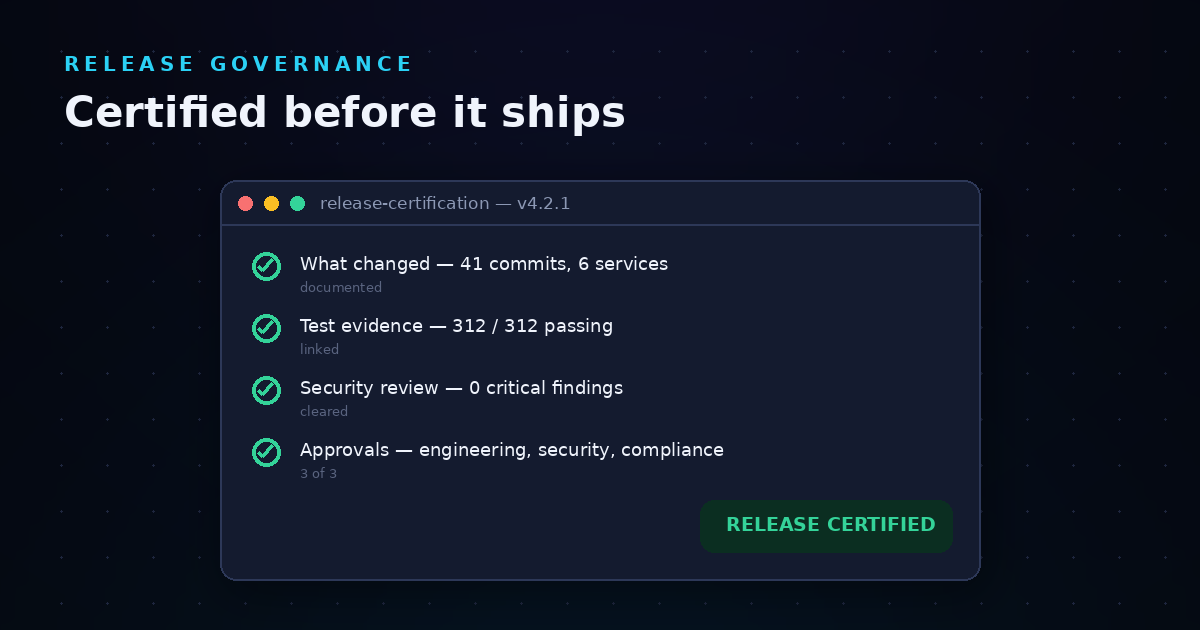
Release certification goes beyond a "deploy" button. A compliance-first platform reviews evidence and flags compliance gaps before shipping. It ties policy to objectives and links results to releases, so you know whether a release met your defined conditions—not just whether the tests passed.
LoopIQ automates release certification with compliance, security, and readiness checks built into the delivery workflow. That intelligent release certification reviews evidence in real time and surfaces issues before they become audit findings.
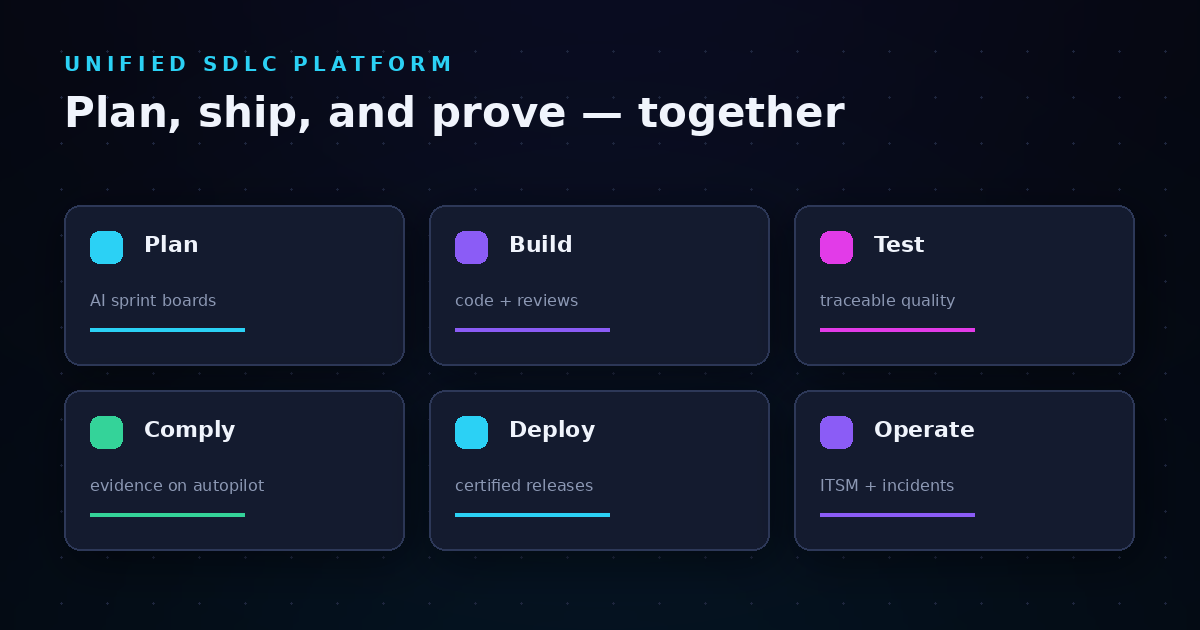
A platform that unifies planning, testing, DevOps, ITSM, documentation, and audit management under one intelligent system reduces the seams where compliance evidence gets lost. Instead of integrating five or six tools and hoping they share data cleanly, you operate in a single environment where work and records live on the same surface.
This structural approach scales with AI-speed shipping. As your team accelerates delivery through automation, the evidence capture keeps pace without requiring additional compliance staff or manual reconciliation.
AI-assisted development is accelerating. But ungoverned AI agent actions create audit chain gaps. A compliance-first platform applies granular mutation policies and approval requirements for AI agent actions, ensuring that governed agentic workflows remain audit-ready.
LoopIQ enables durable task assignment and governed execution for external AI agents, integrating agent outputs into audit evidence and approval trails. That means you can adopt AI-powered code generation while maintaining the evidence chain your auditors require.
Use this framework to assess whether a platform genuinely delivers compliance-first architecture or just offers compliance features as add-ons.
List every tool your team uses across planning, coding, testing, deploying, and documenting. Identify where approvals happen, where security findings surface, and where compliance evidence currently gets assembled. This map shows you the seams—and the seams are where evidence gaps form.
A compliance-first platform should cover most or all of these stages natively, or integrate so tightly that data flows without manual reconciliation.
Pick a release from the last quarter and ask: could you prove how it happened right now? Where would you find the approval records? The test results? The security scan summaries? How long would it take to assemble that evidence for an auditor?
If the answer involves digging through Slack, searching GitHub commit histories, and asking teammates to recall context, your current toolchain isn't compliance-native.
Not all compliance requirements are equal. SOC 2 Type II has different evidence demands than HIPAA or ISO 27001. Internal contractual obligations with enterprise customers may exceed public regulatory baselines. Clarify what you need to prove, to whom, and how often.
A compliance-first platform should support your specific compliance surface area without requiring custom scripts or workarounds. Ask vendors for examples of customers in your regulatory environment and how they generate evidence for those frameworks.
Not all compliance evidence is created equal. Auditors want traceable, immutable records linked to decisions. They want to see the state of the world at the moment a release shipped—not a reconstruction assembled weeks later.
Request sample compliance dossiers from vendors. Look for immutable approval records, timestamped audit trails, and clear links between objectives, validations, and releases. If the evidence looks like a spreadsheet export, it's not compliance-first architecture.
A compliance-first platform that requires you to abandon your existing tools entirely may face adoption resistance. Evaluate how deeply the platform integrates with GitHub, your CI/CD pipelines, your document storage systems (Google Drive, OneDrive), and your existing GRC tools.
LoopIQ integrates with existing document storage and supports existing GRC tools by feeding structured audit-ready artifacts without replacing them. That means you can adopt compliance-first architecture without a full toolchain migration.
If your team currently tracks work in legacy tools, evaluate how the platform handles imports. Migration challenges prevent teams from leaving legacy trackers even when those trackers don't meet compliance needs.
Ask about import tooling, historical data migration, and how long a typical migration takes. A platform that reduces migration challenges will see faster adoption and better long-term compliance outcomes.
Many platforms claim compliance features without delivering compliance-first architecture. Here's how to tell the difference.
In a compliance-bolted-on platform, evidence exists in separate reports or exports you generate on demand. In a compliance-first platform, evidence is embedded in the delivery topology—it's part of the release record, not a secondary artifact.
This distinction matters because embedded evidence preserves trust over time. You can defend a release months after shipping because the documentation relationship to delivery decisions is structural, not reconstructed.
Compliance-bolted-on platforms treat compliance as a checkpoint after release. Compliance-first platforms connect compliance posture to release readiness before you ship.
LoopIQ embeds compliance tracking into daily delivery, ensuring that compliance posture informs release decisions rather than validating them retroactively. That proactive approach shifts audits from emergency projects to structured reviews.
Compliance-bolted-on platforms may not address AI agent governance at all. As AI-assisted development grows, that gap becomes an audit liability. Compliance-first platforms apply policies and approval requirements to AI agent actions, maintaining the evidence chain for every change—whether made by a human or an AI assistant.
Tool sprawl is a compliance risk. According to Edge Delta's analysis, tool sprawl creates gaps in observability, increases maintenance debt, and complicates governance. In a compliance context, every tool boundary is a potential evidence gap.
A unified SDLC platform establishes a single source of truth for delivery operations. Planning, coding, testing, deploying, and documenting all happen in one environment, so the relationships between objectives, work, and outcomes are preserved automatically.
This architecture eliminates the need to correlate signals across disparate tools. When an auditor asks how a release happened, the answer exists in one system—not scattered across five.
Traditional knowledge management treats documentation as content without structural context. That approach fails when you need to prove how a release happened six months later, because the context has degraded.
LoopIQ maps documentation to the SDLC topology, preserving trust and context over time. The documentation isn't just stored—it's linked to the delivery decisions it describes, so the relationship remains defensible even as team members change.
Security and compliance are interrelated but distinct. A compliance-first platform should integrate security findings into the compliance story without requiring extra reconciliation effort.
Security scan results from tools like GitHub Advanced Security, Snyk, or Datadog often exist in separate dashboards. A compliance-first platform ingests those findings and maps them to releases, so security posture is part of the compliance evidence—not a separate conversation.
LoopIQ integrates GitHub and Datadog findings into release evidence, improving security operations while reducing the stitching effort that typically separates security from compliance.
Secure software development requires policy-based change control—rules that govern what changes are allowed, under what conditions, and with what approvals. A compliance-first platform enforces these policies as part of the delivery workflow, not as manual gates.
Look for platforms that support company rules exceeding regulatory baselines for risk reduction. Your contractual obligations may require stricter controls than public frameworks mandate.
Use these questions to assess whether a vendor truly delivers compliance-first architecture.
Avoid these pitfalls when evaluating compliance-first platforms for your engineering organization.
GRC tools manage compliance programs, but they don't function as SDLCs. No major GRC tool generates compliance evidence natively from development activities. You need a platform where work and records live on the same surface—not one tool for shipping and another for documenting.
A long feature list doesn't guarantee compliance-first architecture. Evaluate how the features connect. Does evidence generation happen automatically during delivery, or is it a separate workflow? The architecture matters more than the feature count.
AI-assisted development is growing rapidly. A platform that doesn't govern AI agent actions today will create audit gaps tomorrow. Evaluate AI governance capabilities now, even if your team hasn't fully adopted AI coding assistants yet.
Switching development platforms involves more than data migration. It affects team workflows, integrations, and institutional knowledge. Choose a platform that reduces challenges rather than requiring a full reset, and plan for a transition period where both old and new systems may run in parallel.
VPs of development need to justify platform investments in terms leadership understands. Here's how to frame the business case.
Track how many hours your team spends assembling evidence before audits. Many engineering organizations lose approximately two days per release cycle to evidence collection. At scale, that adds up to thousands of hours annually—hours that could go toward roadmap delivery and innovation.
Pre-audit panic disrupts sprint work and delays release timelines. A compliance-first platform shortens audit preparation time from weeks to minutes. Quantify what that time savings means for your release cadence and team morale.
Audit failures carry both financial and reputational costs. A compliance-first platform reduces risk by ensuring evidence exists before auditors ask for it. Frame this as risk mitigation that protects revenue and customer relationships.
When developers stop spending time on compliance paperwork, they write code. LoopIQ frees engineers to focus on shipping by generating evidence as a byproduct of their existing work. That productivity gain compounds over time as your team ships more releases with the same headcount.
Successful adoption requires planning beyond the purchase decision. Consider these implementation factors.
Compliance-first SDLC adoption affects developers, QA engineers, security teams, compliance officers, and leadership. Align stakeholders early on what success looks like and how the platform will change existing workflows.
Rolling out a new SDLC platform across an entire organization at once creates risk. Consider a phased approach: start with a pilot team, validate compliance evidence quality, and then expand. This approach surfaces issues early without disrupting the entire organization.
New platforms require new skills. Plan for training that covers not just how to use the platform, but why the compliance-first approach matters. Developers who understand the value of embedded evidence capture will adopt the platform more readily than those who see it as another tool mandate.
Define metrics before you implement. Track audit preparation time, evidence assembly effort, release cycle length, and developer satisfaction. These metrics demonstrate ROI and identify areas for improvement.
Compliance requirements are increasing, not decreasing. Regulatory frameworks continue to expand, and enterprise customers increasingly demand proof of secure development practices. The teams that build compliance into their delivery architecture now will be better positioned than those scrambling to retrofit it later.
As AI accelerates development velocity, compliance evidence generation must keep pace. A compliance-first platform ensures that faster shipping doesn't create bigger compliance gaps. The evidence capture scales with your delivery speed.
The shift from periodic audit preparation to always-on audit readiness represents a fundamental change in how engineering teams operate. Compliance-first platforms enable that shift by making compliance a byproduct of delivery rather than a separate project.
LoopIQ embodies this approach: audit-ready compliance captures itself from the work your team already does. You stop losing days to compliance paperwork and start shipping with confidence that the evidence already exists.
A compliance-first SDLC platform generates audit evidence automatically during normal delivery activities. It embeds approval tracking, test results, and change records into the release record as work happens—not as a separate export or manual process.
LoopIQ captures approvals and quality signals as part of release certification, generating a one-click compliance evidence dossier available immediately after every release. This evidence is bound to the release, not reconstructed later.
Many compliance-first platforms integrate with existing GitHub repositories, CI/CD pipelines, document storage systems, and GRC tools. LoopIQ supports existing GRC tools by feeding structured audit-ready artifacts without replacing them.
LoopIQ applies granular mutation policies and approval requirements for AI agent actions. This governance ensures AI-assisted changes are included in the audit evidence chain, maintaining compliance even as AI adoption accelerates.
Compliance-first platforms commonly support SOC 2, ISO 27001, HIPAA, and internal contractual obligations. The key is whether the platform generates evidence that maps to your specific framework's requirements.
Migration timelines vary based on your current toolchain complexity and data volume. LoopIQ reduces challenges of migrating from legacy trackers with improved import tooling. A phased rollout starting with a pilot team often yields faster results than organization-wide adoption.
Engineering teams typically save thousands of hours annually by eliminating compliance paperwork. LoopIQ shortens audit preparation time from weeks to minutes, freeing developers to focus on shipping features while increasing leadership confidence in release decisions.