.svg)
devops
devsecops
compliance

If you're leading a regulated engineering team, you already know audit evidence is no longer something you can assemble after the fact. Today's compliance requirements demand proof that every release was continuously evaluated under defined conditions—and that proof needs to be available on demand, not reconstructed under pressure.
The challenge is that most development toolchains were never built with compliance in mind. Your team ends up stitching together screenshots, approval records, and test results from five or more different systems every time an auditor asks a question. LoopIQ helps regulated teams escape this cycle by capturing audit-ready compliance directly from the work your team already does.
This guide walks you through how to evaluate SDLC platforms for automated audit evidence capabilities. You'll learn what control mapping means in the context of software delivery, how to assess a platform's ability to capture release-level compliance visibility, and what questions to ask vendors before making a decision.
SDLC audit evidence automation refers to the ability of a software delivery platform to generate compliance documentation automatically as your team builds, tests, and deploys code. Instead of treating compliance as a separate workstream, the platform captures approvals, quality signals, and policy checks directly from your existing workflows.
This matters because regulated teams can no longer afford to treat audits as annual emergencies. Research from TechTarget shows that organizations with automated evidence collection spend significantly less time on audit preparation while achieving higher confidence in their compliance posture.
The goal is to shift from "Was this release compliant?" to "Was this release continuously evaluated under defined conditions?" That reframing changes everything about how you structure your delivery pipeline.
Engineering teams at regulated organizations often lose two or more days per release cycle to evidence assembly. Senior engineers get pulled off shipping work to assemble audit packets, and the pressure intensifies during audit season when sprint work gets derailed by urgent documentation requests.
This isn't just an efficiency problem—it's a risk problem. When evidence is assembled retroactively, details get missed. Approval chains become invisible until someone goes hunting through email threads and chat logs. The result is compliance reviews that happen retrospectively, causing loss of context and confidence.
Regulated teams typically run five or more separate tools for planning, code management, testing, deployment, and compliance tracking. Each tool holds a piece of the compliance story, but none of them knows about the others.
This creates gaps in compliance evidence ownership. Your GRC tool doesn't know when a release shipped. Your CI/CD pipeline doesn't know about your control requirements. Your approval workflows live in a separate system from your test results. Connecting these dots falls on your team's shoulders.
Control mapping connects your compliance policies to the specific engineering activities that satisfy them. Instead of maintaining a separate spreadsheet that describes what controls you have in place, the control mapping lives inside your delivery process itself.
For example, if your SOC 2 requirements include change management controls, control mapping means your code review approvals, test gates, and deployment checks are explicitly linked to those requirements. When an auditor asks whether you enforced change management on a particular release, the answer comes from the release itself—not from a separate document someone wrote after the fact.
Control mapping turns compliance from an external checkpoint into an integrated part of how you ship software. When controls are mapped to engineering activities, you get several benefits:
LoopIQ acts as compliance infrastructure inside the delivery lifecycle, tying policy to objectives and linking results to releases automatically.
Ask vendors how their platform handles the connection between your compliance framework (SOC 2, ISO 27001, HIPAA, etc.) and the actual work your team does. Some platforms require you to maintain that mapping manually in a separate system. Others build the mapping into the workflow itself.
Look for platforms that let you define a control requirement once and then automatically check whether that requirement was satisfied for each release. The mapping should be bidirectional—you should be able to start from a control and see all releases that satisfied it, or start from a release and see all controls it addressed.
Real-time control status means you can look at any in-progress work and see which compliance requirements are satisfied, which are pending, and which have gaps. This visibility should be available to engineering leaders, not just compliance teams.
If a platform only tells you about compliance status after a release ships, you're still operating in a reactive mode. The goal is proactive compliance signals backed by evidence—seeing potential gaps before they become audit findings.
Compliance requirements evolve. Your platform should be able to handle updates to your control framework without requiring you to rebuild your entire evidence trail. Ask vendors how they handle scenarios like adding new controls mid-project or updating existing control requirements.
Release-level compliance visibility means you can examine any individual release and see the complete compliance picture for that specific deployment. This includes every approval that was granted, every test that was run, every policy check that was performed, and every condition that was evaluated.
This is different from project-level or organization-level compliance reporting. Project-level reporting tells you whether your team generally follows good practices. Release-level visibility tells you exactly what happened for a specific version of your software.
Auditors don't ask whether your team generally follows change management procedures. They ask whether change management was followed for a specific release that's now running in production. If you can't answer that question with evidence from the release itself, you're relying on memory and interpretation.
Release-level visibility also supports your ability to defend software releases confidently months after shipping. When a customer or partner asks about the compliance posture of a specific version, you can give a definitive answer.
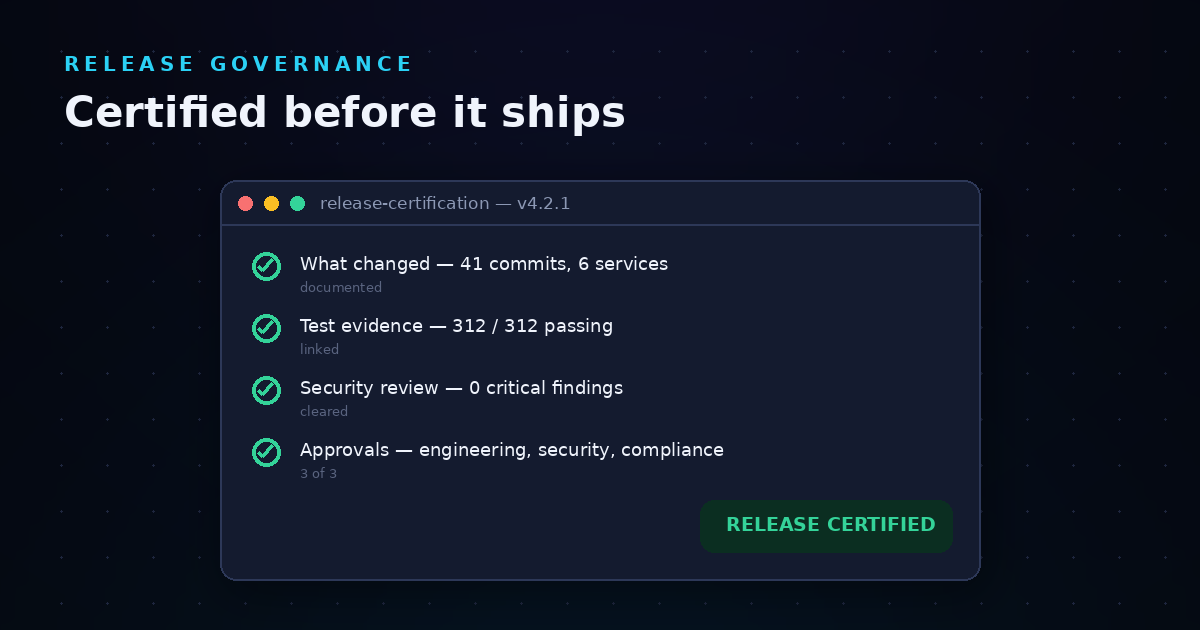
A compliance dossier is a complete package of evidence for a single release. It should include immutable approval records, test results, policy check outcomes, and any exceptions that were granted. Ask vendors whether their platform can generate this package on demand.
LoopIQ produces per-release compliance evidence automatically with one click. The dossier is available immediately after release, so you don't have to wait for someone to assemble it manually.
Approvals should be cryptographically or structurally bound to the release they authorized. If an approval lives in a separate system (like an email or chat message), there's no guarantee it applies to the specific code that actually shipped.
Look for platforms that capture approvals at the moment they're granted and link them directly to the release artifact. The same applies to quality signals like test results, security scan outcomes, and manual verification steps.
When you make a release decision, you're making it based on the information available at that moment. Six months later, that information may have changed—test suites evolve, vulnerability databases update, team members leave.
Ask vendors whether their platform preserves the state of the world at decision time. You should be able to see exactly what information was available when a release was approved, not just the current state of those data sources.
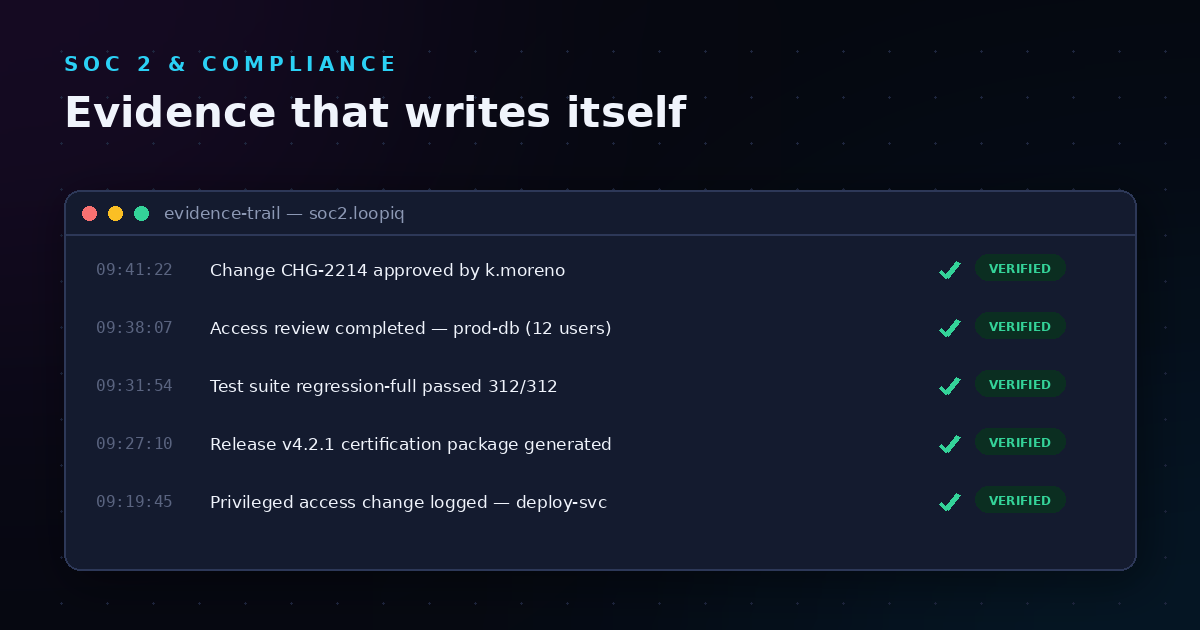
Automated evidence collection means compliance documentation is generated as a byproduct of engineering work, not as a separate task. When a developer gets a code review approved, that approval becomes evidence. When a test suite passes, those results become evidence. When a deployment completes, that record becomes evidence.
The alternative—where engineers have to separately document their compliance activities—creates several problems. Documentation lags behind reality. Details get lost. Engineers spend time on paperwork instead of shipping.
Ask vendors to enumerate exactly which compliance artifacts their platform generates without human intervention. Common categories include:
Be skeptical of vague claims about "full automation." Ask for specific examples of how each artifact is captured and how it connects to the release it belongs to.
Most teams won't replace their entire toolchain when adopting a compliance platform. You need a platform that can ingest evidence from your existing tools—GitHub, your CI/CD system, your security scanning tools—and correlate that evidence into a unified release view.
LoopIQ ingests compliance and security metrics from existing tooling, mapping them to objectives for proactive risk management. This means you don't have to abandon your current tools to get unified evidence.
Evidence that can be modified after the fact loses its value for compliance purposes. Ask vendors how they ensure evidence immutability. Look for cryptographic hashing, tamper-evident storage, and audit logs that track any access to historical evidence.
There's a difference between a platform that has native integrations with your tools and one that offers generic API connectivity. Native integrations typically capture richer evidence because they understand the semantics of each tool. API-based integrations may only capture surface-level data.
Ask vendors about the depth of their integrations with the specific tools your team uses. For example, a native GitHub integration should capture not just commit records but also pull request discussions, review comments, and approval metadata.
Evidence should flow automatically without requiring engineers to trigger sync operations or copy data manually. Ask vendors about their integration architecture. Real-time event-driven integrations capture evidence as it happens. Batch integrations that run on a schedule may miss details or introduce delays.
Compliance questions often span multiple tools. An auditor might ask: "For this release, show me the code changes, who approved them, what tests were run, and who authorized the deployment." Answering that question requires connecting evidence from your source control, review system, CI/CD pipeline, and deployment tool.
Look for platforms that maintain this evidence chain automatically. You shouldn't have to manually stitch together records from different systems to tell the compliance story for a single release.
Different industries have different compliance requirements, and those requirements affect what evidence you need to capture. Healthcare organizations need HIPAA-relevant evidence. Financial services need SOX-relevant evidence. Government contractors need FedRAMP-relevant evidence.
Ask vendors whether their platform has specific support for your industry's requirements. Generic compliance platforms may capture evidence, but they may not capture the right evidence for your specific regulatory context.
SOC 2, ISO 27001, HIPAA, PCI-DSS, and FedRAMP all have different control requirements. Ask vendors how their platform maps to your specific framework. Look for pre-built control mappings that you can customize, not just generic compliance categories that require you to build the mapping yourself.
Many regulated organizations must comply with multiple frameworks simultaneously. A platform that can map a single engineering activity to multiple control requirements reduces duplication and ensures consistency.
When evaluating compliance automation platforms, consider both the direct costs and the operational savings. Direct costs include licensing fees and implementation services. Operational savings include reduced engineering time on audit preparation, faster audit cycles, and lower risk of compliance failures.
Ask vendors for case studies or benchmarks that quantify these savings. Regulated teams that adopt effective compliance automation often reclaim thousands of hours annually—time that engineers can redirect toward shipping features instead of assembling documentation.
A platform that takes months to implement delivers no value during that implementation period. Ask vendors about typical implementation timelines and what your team will need to contribute during the rollout.
Also consider adoption challenges. The platform only helps if your team actually uses it. Look for platforms that integrate into existing workflows rather than requiring engineers to learn new tools or change their daily habits.
If a vendor claims "full automation" but can't enumerate exactly what's automated, dig deeper. Ask for a specific list of evidence types that are captured automatically versus those that require human action.
Platforms that only offer project-level or organization-level compliance reporting can't answer release-specific audit questions. If you can't generate evidence for a single release, you're still going to be assembling audit packets manually.
If the platform requires you to manually maintain the connection between controls and engineering activities, you're not getting true automation. That mapping work is exactly what you're trying to eliminate.
Start by documenting which compliance frameworks apply to your organization and which controls require evidence. This becomes your baseline for evaluating whether a platform can meet your needs.
Document how your team currently collects compliance evidence. Where does evidence come from? How long does it take to assemble? What gaps exist? This helps you identify which capabilities will deliver the most value.
Not all capabilities are equally important for your team. If your biggest pain point is audit preparation time, prioritize platforms with strong per-release dossier generation. If your biggest pain point is tool sprawl, prioritize platforms with deep integrations.
Ask vendors for a proof of concept that demonstrates their platform working with your actual tools and workflows. A demo with sample data doesn't prove the platform will work in your environment.
Evaluating SDLC audit evidence automation requires looking beyond surface-level features. You need a platform that maps controls to engineering activities, offers release-level compliance visibility, and captures evidence automatically from your existing workflows.
The right platform turns compliance from an expensive bottleneck into a byproduct of how you ship software. LoopIQ delivers this by connecting engineering work and audit evidence in one unified workspace, giving regulated teams the ability to ship fast while staying certified.
As you evaluate your options, focus on the questions that matter most: Can you generate a compliance dossier for any release on demand? Are approvals and quality signals bound to the releases they authorize? Does the platform preserve decision context for future auditors? The answers to these questions determine whether you're getting genuine automation or just another tool to manage.
Compliance automation broadly covers any process that reduces manual compliance work. Audit evidence automation specifically focuses on generating the documentation auditors need to verify your compliance. LoopIQ addresses both by automating evidence capture directly from engineering activities.
Implementation timelines vary based on your existing toolchain and compliance requirements. Teams with standard tools like GitHub and common CI/CD platforms can typically see initial value in weeks. Full integration across all compliance frameworks may take longer.
Yes, effective SDLC compliance platforms should support your existing GRC tools rather than replace them. LoopIQ feeds structured audit-ready artifacts to your GRC system, giving you engineering-level evidence without abandoning your current compliance infrastructure.
For SOC 2, automatic evidence capture should include code review and approval records, access control changes, deployment logs, security scan results, and incident response documentation. LoopIQ captures these artifacts as your team works, creating audit-ready evidence without separate documentation tasks.
Ask the vendor to demonstrate generating a compliance dossier for a specific release. You should see all approvals, test results, and policy checks tied to that exact release. If the vendor can only show aggregated reports, the platform lacks genuine release-level visibility.
Ask how policies connect to engineering activities, whether control status updates in real time, and how the platform handles policy changes mid-project. LoopIQ ties policy to objectives and links results to releases, making control mapping a core part of how you ship software.