.svg)
devops
devsecops
compliance

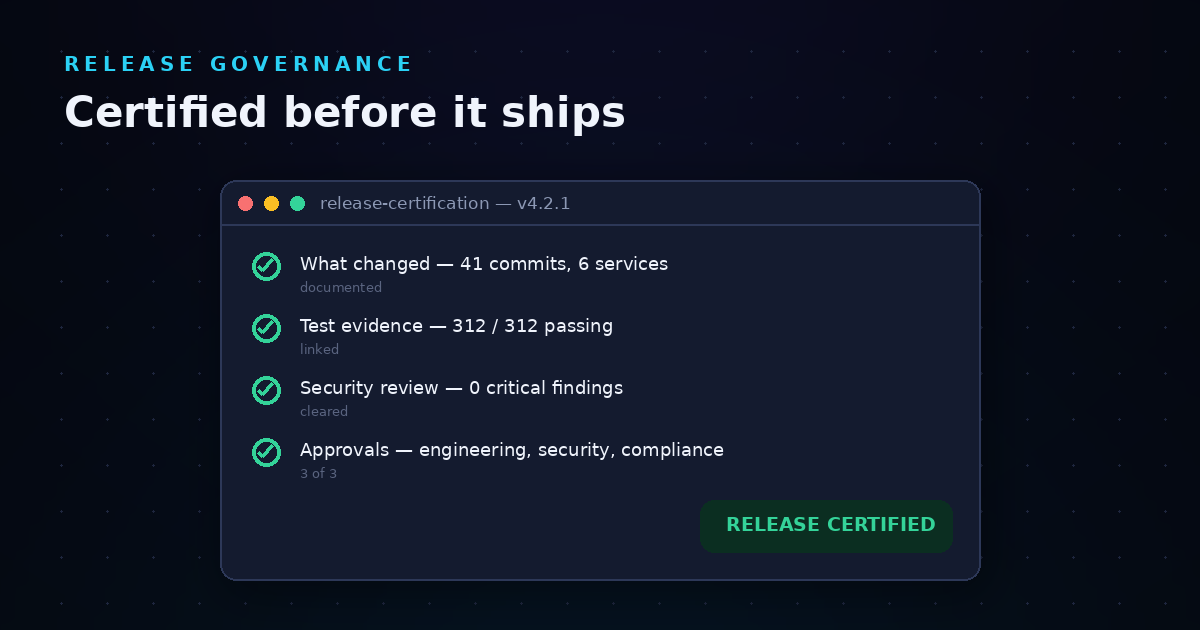
Enterprise DevOps governance has shifted from an optional initiative to a foundational requirement. Your engineering organization faces mounting pressure to ship faster while satisfying auditors who demand clear evidence of policy enforcement, approval chains, and traceable decision-making. A unified SDLC platform brings these requirements together in one connected system. LoopIQ gives you an integrated approach that captures audit-ready compliance from your existing team work, turning governance from a roadblock into an automated byproduct of software delivery.
This guide walks you through everything you need to know about enterprise DevOps governance in 2026. You'll learn how to evaluate unified SDLC platforms, establish policy enforcement frameworks, manage approval chains, and govern AI agents performing engineering tasks. By the end, you'll have a clear roadmap for implementing governance controls that accelerate—rather than slow down—your releases.
Enterprise DevOps governance defines how your organization enforces policies, tracks approvals, and maintains compliance throughout the software development lifecycle. In a unified SDLC platform, these governance functions are embedded directly into your daily workflows rather than bolted on as afterthoughts.
Traditional approaches scatter governance responsibilities across disconnected tools. Your planning happens in one system, your CI/CD pipelines run in another, and your compliance tracking lives in spreadsheets or separate audit management software. This separation creates gaps where evidence gets lost and approval chains become impossible to reconstruct.
A unified SDLC platform changes this dynamic. When planning, development, testing, deployment, and compliance all flow through one connected system, every action creates a traceable record. Policy enforcement happens automatically as work moves through the pipeline. Approval chains capture who authorized what—and when—without requiring extra steps from your team.
Regulatory requirements have intensified across nearly every industry. SOC 2, ISO 27001, HIPAA, and PCI DSS auditors now expect real-time evidence that your development processes meet compliance standards. Point-in-time audits no longer reflect the reality of modern software delivery.
According to the 2026 Gartner Market Guide for DevOps Continuous Compliance Automation Tools, 65% of organizations will have integrated compliance automation into their DevOps workflows by 2028. The shift toward compliance-as-code makes regulatory requirements machine-readable and auditable on demand.
Your competitors who adopt automated governance gain two advantages. First, they ship releases with confidence because their compliance posture is verified before code reaches production. Second, they spend fewer engineering hours reconstructing evidence for auditors. That time goes back to building features your customers want.
Disconnected tools create hidden costs that compound over time. Your senior engineers spend hours assembling compliance documentation instead of writing code. Evidence trails have gaps that auditors flag as risks. Release decisions rely on incomplete information because compliance data arrives too late.
Research from DORA's software delivery performance metrics shows that high-performing teams excel at both speed and stability. Governance controls, when implemented correctly, support rather than hinder these outcomes. The key is embedding governance into the delivery process itself.
Evaluating unified SDLC platforms requires a systematic approach. Your evaluation checklist should address five core areas: policy enforcement, approval-chain identity, evidence trails, multi-toolchain integration, and AI agent governance.
Effective policy enforcement happens automatically, not through periodic reviews. Ask how the platform handles these scenarios:
The platform should let you define policies once and have them enforced everywhere. If policy enforcement requires your team to remember to run checks, gaps will appear.
Auditors want to know exactly who approved each change and when that approval happened. A unified SDLC platform should capture this information automatically through identity-linked workflows.
Key questions for evaluation include:
LoopIQ captures approval chains as a natural output of your team's work. When someone approves a pull request, that approval becomes part of the permanent release record—no additional documentation steps required.
Evidence trails answer the question: "How do you know this release is compliant?" Your platform should generate evidence automatically as work flows through the system.
Essential evidence includes:
The goal is one-click evidence generation. When an auditor asks for proof of your Q1 release compliance, you should be able to produce a complete report without spending days gathering data.
DevOps governance comprises four interconnected components. Each component must function properly for the overall system to deliver audit-ready releases.
Access control determines who can do what across your development infrastructure. Role-based access ensures that developers can write code but only designated approvers can promote changes to production.
Effective access control includes:
Change management governs how modifications move from idea to production. Your workflows should capture every approval, review, and test result as work progresses.
Strong change management workflows include:
Compliance automation converts regulatory requirements into machine-enforceable controls. Rather than checking compliance periodically, you verify it at every step.
Compliance automation should cover:
Governance extends to how you handle incidents. Your response procedures should be documented, tested, and auditable. Recovery processes should maintain compliance even under pressure.
Incident governance includes:
Most engineering organizations use multiple tools: GitHub or GitLab for source control, Jenkins or CircleCI for CI/CD, Kubernetes for orchestration, and various security scanners. Policy enforcement must work across all of these tools.
Define your policies in one place and push them to all connected systems. This approach ensures consistency and makes policy updates manageable.
Your centralized policy system should:
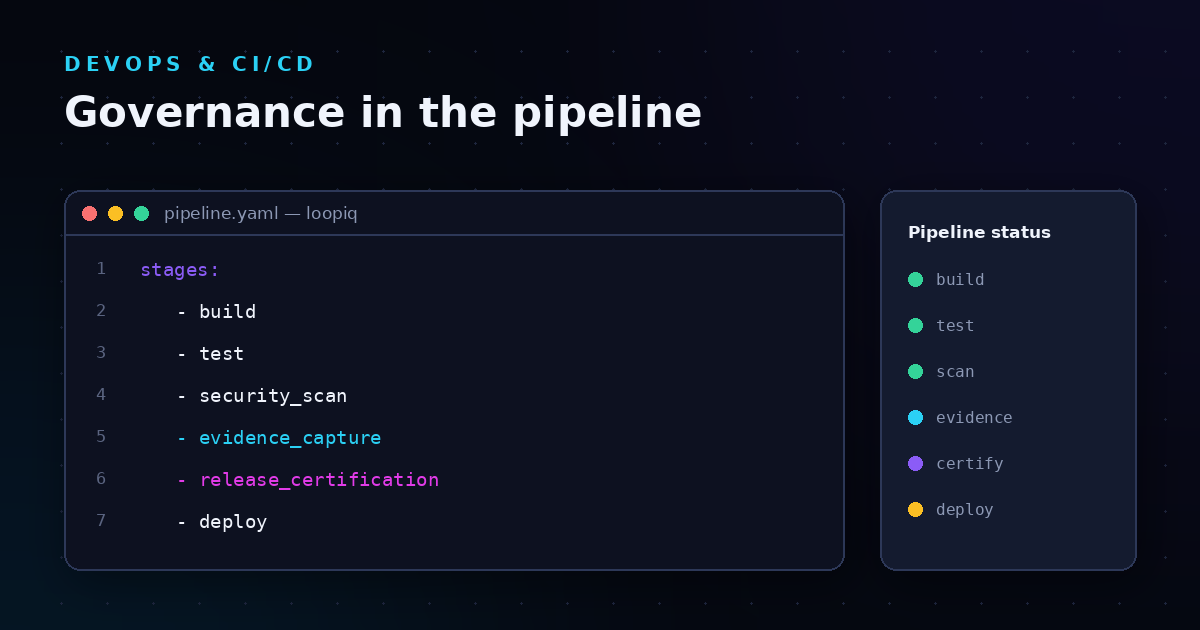
Enforcement happens at integration points where your tools connect. A unified SDLC platform acts as the orchestration layer that ensures policies apply regardless of which underlying tool performs the work.
Key enforcement points include:
Rigid policy enforcement without exception handling creates bottlenecks. Your system needs a documented process for handling legitimate exceptions while maintaining audit trails.
Exception handling should include:
AI agents are increasingly performing engineering tasks: generating code, running tests, triaging alerts, and even making deployment decisions. Governing these agents requires the same rigor you apply to human engineers—plus additional controls for autonomous actions.
Every AI agent needs defined boundaries that specify what actions it can and cannot take. These boundaries should be explicit, documented, and enforced by your platform.
Agent boundary definitions include:
Every action an AI agent takes must be logged with the same detail as human actions. Your audit trail should show what the agent did, why it decided to take that action, and what inputs informed the decision.
LoopIQ gives you controlled and governed use of external AI agents across your engineering workflows. Every agent action creates an auditable record that shows the decision path from input to output.
Your engineers may want to use AI assistants you haven't vetted. A governance framework for bring-your-own AI agents helps you balance innovation with control.
Key governance controls include:
Audit-ready releases come from audit-ready processes. When your development workflow captures evidence automatically, every release is defensible without extra preparation work.
Evidence collection should happen as a side effect of normal work. When a developer commits code, the commit metadata becomes evidence. When tests run, the results become evidence. When someone approves a deployment, that approval becomes evidence.
This approach requires:
A release evidence package bundles all the proof points for a specific release. This package should be automatically generated and available on demand.
Release evidence packages typically include:
Defensibility means you can explain and justify any release decision months or years after the fact. Your evidence must be complete enough that anyone reviewing it can understand why the release was approved.
Questions your evidence should answer:
Governance without measurement is just hope. You need metrics that show whether your governance controls are working and where improvements are needed.
Track how often your policies are followed and how often exceptions are granted. High exception rates may indicate policies that need adjustment.
Key metrics include:
Measure how prepared you are for audit requests. These metrics show whether your evidence collection is working.
Key metrics include:
Governance should enable delivery, not block it. Track whether your governance controls are adding value or creating bottlenecks.
Key metrics include:
DORA's software delivery performance metrics—deployment frequency, lead time for changes, failed deployment recovery time, and change failure rate—pair naturally with governance metrics. Together, they show whether you're delivering software safely, quickly, and compliantly.
Poor governance implementations slow deployment frequency. Good implementations maintain or increase it. Track how your governance changes correlate with deployment frequency changes.
Approval workflows add time to your delivery process. The goal is adding just enough time for proper review without creating unnecessary delays. Monitor where lead time increases after governance changes.
Governance controls should not slow incident response. Your policies need emergency procedures that maintain compliance while enabling rapid recovery.
Implementing governance in a unified SDLC platform follows a structured process. Each step builds on the previous one, creating a foundation for audit-ready releases.
Document your existing governance controls and identify gaps. Map your current tools and workflows to understand where evidence is created and where it gets lost.
Assessment activities include:
Based on your regulatory obligations and organizational needs, define what governance must accomplish. Prioritize requirements that address your highest risks.
Requirement definition includes:
Choose a unified SDLC platform that meets your requirements. Configure integrations with your existing tools and define your initial policy set.
Configuration activities include:
Start with one application or team and expand gradually. This approach lets you refine your governance implementation before scaling.
Migration steps include:
Governance requires ongoing attention. Establish processes for policy maintenance, metric review, and system improvements.
Operational processes include:
Learning from others' mistakes saves time and frustration. These common pitfalls derail governance implementations.
Starting with complex policies creates resistance and delays. Begin with essential controls and expand based on experience. You can always add policies later; removing entrenched policies is harder.
Governance that makes developers' jobs harder will be circumvented. Design workflows that fit how your team actually works rather than forcing them into artificial processes.
Governance is an ongoing capability, not a project with an end date. Budget for ongoing maintenance, training, and improvement from the start.
Governance that exists outside your delivery process will always lag behind. Embed governance controls directly into your development workflows so compliance becomes automatic.
Enterprise DevOps governance in a unified SDLC platform is no longer optional for mid-market and enterprise engineering organizations. Your auditors expect it. Your customers assume it. Your competitors are implementing it.
The right platform makes governance a natural output of software delivery rather than a burden layered on top. Look for solutions that capture evidence automatically, enforce policies at every integration point, and generate audit-ready reports on demand.
LoopIQ unifies the entire software delivery lifecycle into one AI-powered workspace that automates compliance evidence collection, reduces tool sprawl, and helps engineering teams ship faster without audit chaos. When you're ready to turn governance from a roadblock into an accelerator, a unified SDLC platform gives you the foundation to make it happen.
A unified SDLC platform consolidates planning, development, testing, deployment, and compliance into one connected system. Instead of using separate tools for each phase, you work in a single environment that maintains data continuity across the entire software development lifecycle.
LoopIQ is an AI-powered platform that unifies DevOps, ITSM, compliance, and audit management into one workspace, giving your team end-to-end traceability without tool sprawl.
Traditional compliance relies on periodic audits and reconstructed documentation. Automated compliance captures evidence in real-time as work happens, making your organization audit-ready at any moment.
With LoopIQ, compliance evidence generates automatically as a byproduct of your team's daily work—no separate documentation steps required.
Prioritize policy enforcement automation, approval-chain traceability, evidence trail generation, multi-toolchain integration, and AI agent governance capabilities. The platform should reduce governance overhead, not add to it.
LoopIQ delivers all five capabilities with one-click evidence generation and real-time visibility into your compliance posture.
Governing AI agents requires defined boundaries, permission controls, action auditing, and revocation procedures. Every agent action should create an auditable record showing what happened and why.
LoopIQ enables secure and governed use of external AI agents across your engineering workflows, with full audit trails for every automated action.
Most unified SDLC platforms support major frameworks including SOC 2, ISO 27001, HIPAA, PCI DSS, and NIST SSDF. The platform should map controls to multiple frameworks simultaneously so you don't duplicate evidence collection efforts.
Implementation timelines vary based on your current toolchain complexity and governance maturity. Pilot implementations typically take four to eight weeks. Full organizational rollout may take three to six months, depending on your team size and number of applications.