.svg)
devops
devsecops
compliance

Your CI/CD pipeline produces hundreds of security signals every day. Test results, vulnerability scans, code review approvals, and deployment gates all generate data that matters for compliance. The challenge isn't creating this data—it's connecting it to the releases that auditors will eventually ask about.
For VPs and Heads of Development at regulated software delivery teams, this disconnect creates real problems. Engineers lose time reconstructing what happened during a release. Audit preparation pulls senior developers away from building features. And the gap between shipping software and proving compliance grows wider with every sprint.
This guide shows you how to close that gap. You'll learn what CI/CD security signals matter most for compliance, how to build a release-centered framework that connects signals to evidence, and how platforms like LoopIQ automate this entire process. By the end, you'll have a clear path from pipeline events to defensible compliance proof.
CI/CD security signals are the data points your pipeline generates during the software delivery process. Every time code moves through your pipeline, it creates evidence: who wrote it, who reviewed it, what tests ran, what vulnerabilities were detected, and who approved the deployment.
For regulated teams, these signals answer the questions auditors will ask. Did this release go through proper code review? Were security scans completed before deployment? Who authorized the change to production? The answers exist in your pipeline—if you can connect them to specific releases.
Your pipeline generates several categories of security signals. Understanding each category helps you build a complete picture of release compliance.
Code-level signals include commit metadata, branch protection status, and code review approvals. These show who changed what and whether changes followed your development policies.
Testing signals cover unit test results, integration test outcomes, and end-to-end test status. They demonstrate that code was validated before reaching production.
Security scan signals come from static analysis (SAST), dynamic analysis (DAST), software composition analysis (SCA), and container scanning. These prove you checked for known vulnerabilities.
Deployment signals include approval records, deployment timestamps, environment configurations, and rollback capabilities. They show controlled release processes.
Security tools detect problems. Security signals document what happened. This distinction matters for compliance.
A vulnerability scanner might find a critical CVE in your dependencies. That's useful for security. But for compliance, you need to know: Was this scan part of the release process? Did someone review the findings? Was there an approval to proceed despite the finding, and who gave it?
The signal isn't just "vulnerability found." The signal is the complete record of detection, evaluation, decision, and authorization that connects to a specific release.
Most DevSecOps guidance focuses on shifting security left—catching issues earlier in development. That's valuable, but it misses what regulated teams actually need: proof that each release met compliance requirements.
Auditors don't ask "Did you run security scans?" They ask "Can you show me the security evidence for release 2.4.1 that went to production on March 15th?" If your compliance evidence isn't organized by release, answering this question requires hours of investigation.
Regulated teams typically run five or more separate tools in their delivery pipeline. Each tool stores its own data in its own format in its own location. When an auditor asks about a specific release, someone has to:
Pull code review records from your version control system. Find test results in your CI platform. Locate vulnerability scan reports in your security tools. Track down approval emails or Slack messages. Correlate timestamps to figure out which data belongs to which release.
This process takes days. It pulls your most experienced engineers away from productive work. And it introduces risk—what if you miss something, or present evidence from the wrong release?
A release-centered framework flips the model. Instead of storing evidence by tool, you organize evidence by release. Every security signal gets tagged with the release it belongs to at the moment it's generated.
When an auditor asks about release 2.4.1, you don't investigate. You retrieve. The code reviews, test results, security scans, and approvals are already connected. You can produce a complete evidence package in minutes instead of days.
LoopIQ implements this approach by acting as compliance infrastructure inside your delivery lifecycle. It connects delivery signals to releases automatically, generating release certification trails that link objectives to measurable results.
Not every signal matters equally for compliance. Your framework should prioritize signals that directly address regulatory requirements and contractual obligations.
Start by listing the frameworks that apply to your organization. SOC 2, ISO 27001, HIPAA, PCI-DSS, FedRAMP, and industry-specific regulations each have different evidence requirements.
For each framework, identify the controls that relate to software development and deployment. SOC 2 CC8.1 (Change Management), for example, requires evidence that changes are authorized, tested, and approved before implementation.
Create a matrix connecting your CI/CD signals to compliance controls. For each control, identify which signals can serve as evidence.
Change authorization might map to pull request approvals, JIRA ticket links, and deployment gate sign-offs. Testing requirements might map to test execution logs, coverage reports, and pass/fail status. Security scanning might map to SAST results, SCA reports, and vulnerability remediation records.
For each control, specify the minimum evidence required for a release to be considered compliant. This definition becomes your release certification criteria.
Example: For change authorization, complete evidence might require a linked requirements ticket, at least one code review approval, passing CI status, and deployment approval from a release manager.
Configure your pipeline to capture evidence at the moment it's generated, not after the fact. When a code review is approved, that approval should automatically attach to the release. When tests pass, those results should bind to the release immediately.
LoopIQ handles this by embedding compliance tracking into your daily delivery workflow. It captures approvals and quality signals bound to releases through certification, making documentation effortless while you ship.
A solid compliance architecture has three layers: signal generation, signal collection, and evidence assembly. Each layer needs specific capabilities to support release-centered compliance.
This layer consists of your existing CI/CD tools: version control, CI platforms, security scanners, and deployment systems. The goal isn't replacing these tools—it's ensuring they produce signals in a format you can collect.
Key requirements at this layer include:
Webhook capabilities to push events in real-time. API access to pull historical data when needed. Consistent event formats or documented schemas. Timestamp accuracy with timezone information.
This layer aggregates signals from multiple tools and correlates them to releases. It's where the "release-centered" part happens.
Your collection layer needs to:
Receive signals from all source tools without becoming a bottleneck. Correlate signals using release identifiers (version numbers, Git tags, deployment IDs). Store signals immutably so evidence can't be modified after the fact. Index signals for fast retrieval during audits.
This layer packages signals into auditor-ready documentation. When someone requests evidence for a release, this layer produces the compliance dossier.
Effective evidence assembly includes:
Templates aligned to specific compliance frameworks. Automatic formatting of technical data for non-technical reviewers. Version control of evidence packages. Export capabilities in standard formats (PDF, JSON).
Your pipeline likely includes several security tools. Here's how to connect each category to your compliance framework.
Your version control system contains critical compliance evidence: who changed what, when, and with whose approval.
Configure branch protection rules to require reviews before merging. Enable commit signing to verify author identity. Set up webhooks to emit events for commits, pull requests, and merges. Store the association between merge commits and pull request approvals.
Your CI platform runs tests and builds. It knows whether code passed quality gates before deployment.
Structure pipelines with explicit compliance checkpoints. Store build artifacts with metadata linking them to source commits. Emit events for pipeline status changes. Configure deployment gates that require explicit approval.
SAST, DAST, and SCA tools produce vulnerability findings. For compliance, you need to show findings were reviewed and addressed appropriately.
Integrate scanners into your pipeline so scans run automatically. Configure scan results to include severity classifications. Implement workflows for reviewing and accepting findings. Track remediation timelines for critical vulnerabilities.
Deployment tools control what reaches production. They're essential for change management evidence.
Implement approval workflows for production deployments. Log all deployment activities with timestamps and actor information. Maintain rollback capabilities and document when they're used. Track environment configurations through infrastructure-as-code.
Automation is what makes release-centered compliance sustainable. Without automation, evidence collection becomes another task engineers resent and neglect.
Your automation should follow these principles:
Capture at the source. Evidence is most accurate when captured at the moment it's created. Don't rely on after-the-fact reconstruction.
Bind to releases immediately. As soon as a signal is captured, associate it with the relevant release. Don't batch this processing.
Preserve decision context. Record not just what happened, but the state of the world when decisions were made. What vulnerabilities were known? What was the test coverage? Who was available to approve?
Make evidence immutable. Once captured, evidence shouldn't change. This protects against accusations of tampering.
LoopIQ creates automatic release certification trails linked to objectives and measurable results. This enables real-time audit readiness instead of audit-season panic.
The platform ingests compliance and security metrics from your existing tools, mapping them to objectives for proactive risk management. Security findings from sources like GitHub integrate directly into release evidence, eliminating the extra effort of stitching audit stories together afterward.
For regulated teams, LoopIQ produces per-release compliance evidence automatically. A single click generates a compliance evidence dossier immediately after release—no engineering hours spent assembling documentation under deadline pressure.
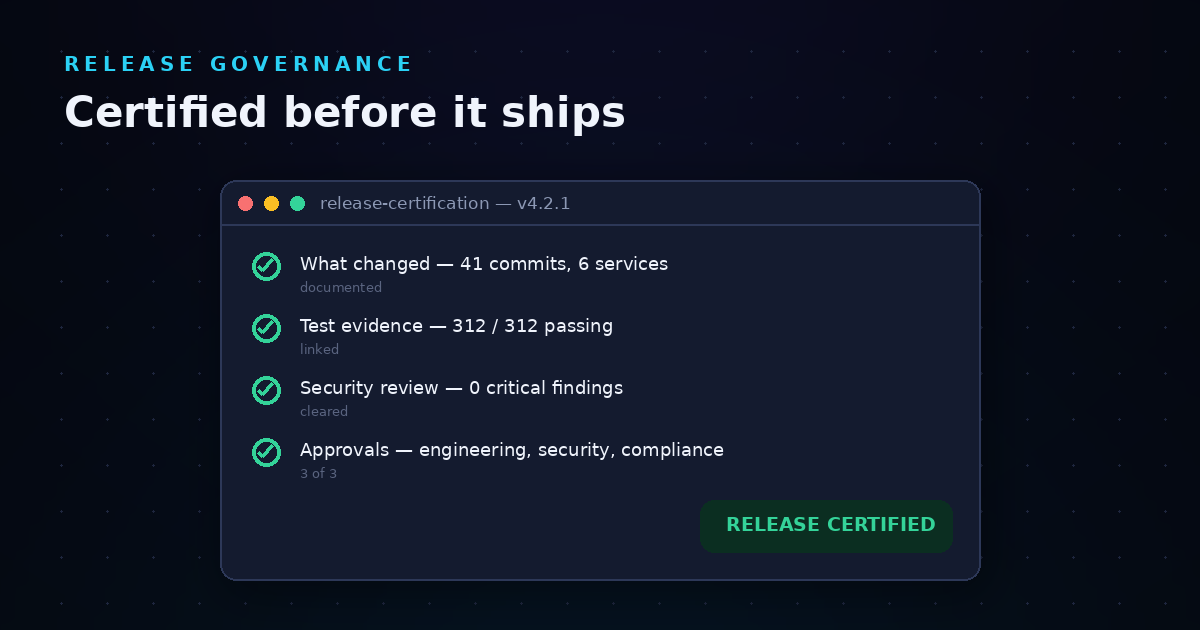
Release certification is the formal process of verifying that a release meets your compliance requirements before it ships. It's the checkpoint where signals become evidence.
Your certification requirements should specify:
Required signals: Which signals must be present for a release to be certifiable? At minimum, you likely need code review approval, passing tests, security scan completion, and deployment authorization.
Signal quality thresholds: What constitutes "passing"? 80% test coverage? Zero critical vulnerabilities? All blockers resolved?
Exception handling: How do you document exceptions? If a release ships with a known issue, what approval is required and how is it recorded?
Certification authority: Who can certify releases? What level of review is required for different release types?
Certification gates are pipeline checkpoints that verify requirements before allowing deployment. They operationalize your certification criteria.
Effective gates should:
Block deployment automatically if requirements aren't met. Clearly communicate what's missing or failing. Support override workflows for authorized exceptions. Log all gate evaluations and their outcomes.
When a release fails certification, your process should document:
What requirement wasn't met. Whether the issue was remediated or accepted as an exception. Who made the decision and when. What the risk assessment concluded.
This documentation is valuable compliance evidence. It shows your process works—you caught an issue and handled it appropriately.
Documentation for auditors has different requirements than documentation for engineers. Auditors need clear, organized evidence that answers specific questions without requiring technical expertise to interpret.
Auditors typically want to verify:
Process adherence: Did you follow your documented procedures? If your policy says code requires two approvals, can you show two approvals for each release?
Control effectiveness: Do your controls actually prevent or detect issues? Can you show examples where controls caught problems?
Evidence completeness: Is there a clear record for every release? Are there gaps or unexplained exceptions?
Temporal consistency: Do timestamps make sense? Did approvals happen before deployment? Were security scans completed before release?
A well-structured evidence package for a single release might include:
Release summary: Version, date, scope, and owner. What changed and why.
Requirements traceability: Links between release items and requirements tickets. Proof that changes were planned and approved.
Code review records: Who reviewed what, approval timestamps, and any comments or discussions.
Test evidence: Test execution results, coverage metrics, and pass/fail status.
Security attestation: Scan results, vulnerability status, and remediation records.
Deployment authorization: Who approved deployment, when, and with what conditions.
Post-deployment validation: Any verification performed after release.
Compliance evidence often needs to be available years after a release ships. Your storage strategy should account for:
Retention periods required by your compliance frameworks. Access controls preventing unauthorized modification. Backup and disaster recovery procedures. Format longevity—will you be able to read this evidence in five years?
LoopIQ preserves the state of the world at decision time for audit defensibility and leadership trust. This approach ensures documentation remains meaningful long after a release ships.
Compliance tracking works best when it's invisible to developers. If engineers have to do extra work for compliance, they'll skip it when deadlines get tight.
Your goal should be evidence capture as a byproduct of normal work. When a developer creates a pull request, opens a JIRA ticket, or runs tests, compliance evidence should generate automatically.
This requires:
Tool integrations that don't require manual tagging or annotation. Workflows that capture evidence without additional steps. Dashboards that show compliance status without requiring investigation. Alerts that surface problems before they become blockers.
Developers should know whether their work is compliance-ready without asking. Build visibility into existing interfaces.
Show compliance status on pull requests: "This PR is missing security scan results." Display release readiness in deployment dashboards: "Release 2.4.1 is 85% certified—missing QA sign-off." Send proactive notifications when evidence is incomplete: "Deploy blocked: no code review approval."
Your pipeline should enforce compliance requirements automatically. If a release isn't ready, it shouldn't be deployable.
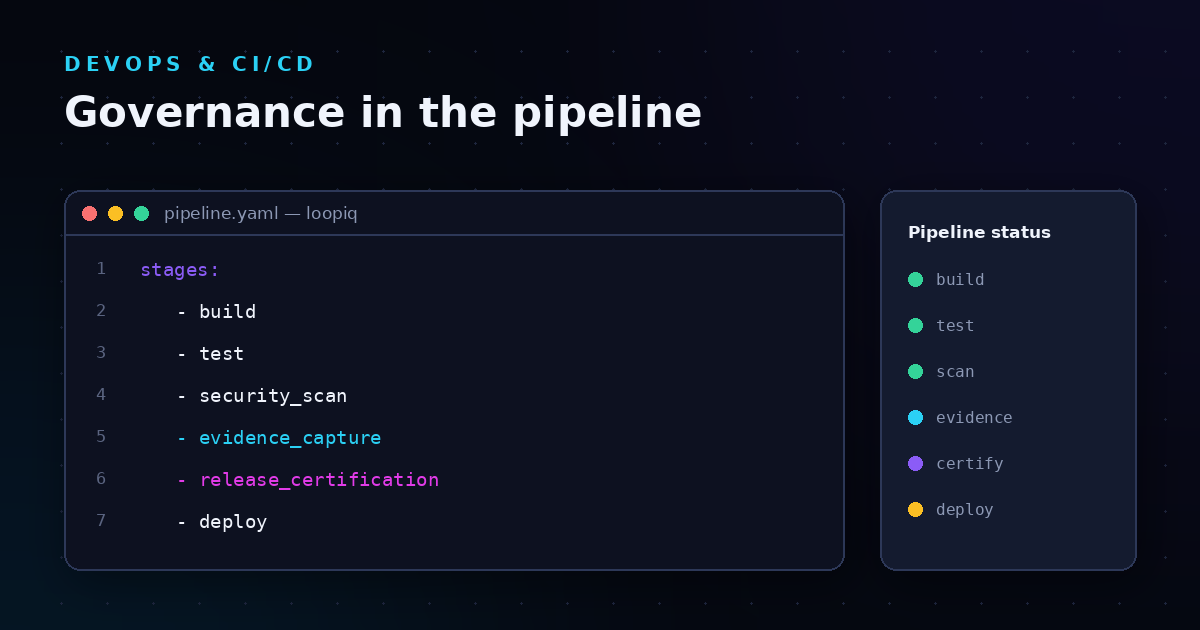
Pipeline stages might include:
Evidence check: Verify all required signals exist before proceeding.
Quality gate: Confirm signals meet your thresholds.
Certification gate: Require explicit approval for production deployment.
Evidence packaging: Generate the release evidence dossier automatically.
You can't improve what you don't measure. Track metrics that show whether your compliance tracking actually works.
Certification rate: What percentage of releases pass certification on the first attempt? Low rates suggest unclear requirements or inadequate tooling.
Evidence completeness: For a sample of releases, what percentage have complete evidence? Gaps indicate process failures.
Time to audit response: When auditors request evidence, how long does it take to produce? This should be minutes, not days.
Compliance incidents: How often do audit findings relate to release evidence? Repeated findings suggest systemic issues.
Review metrics regularly to identify improvement opportunities:
If certification rates are low, investigate why. Are requirements unclear? Are tools failing? Are developers skipping steps?
If evidence completeness varies, look for patterns. Which teams have gaps? Which release types? Which time periods?
If audit response takes too long, examine your evidence retrieval process. Is data hard to find? Is assembly manual? Are exports difficult?
Teams often make predictable mistakes when implementing CI/CD compliance tracking. Knowing these pitfalls helps you avoid them.
When compliance is a parallel workstream instead of an embedded capability, evidence gets neglected. Teams ship software first and document later—or not at all.
Fix: Embed compliance checkpoints directly into your delivery pipeline. Make compliance evidence a byproduct of shipping, not an afterthought.
Reconstructing what happened after a release is error-prone and time-consuming. Timestamps don't align. Details get forgotten. Evidence gaps appear.
Fix: Capture evidence at the moment it's created. Tag it to releases immediately. Never rely on reconstruction.
When each tool maintains its own evidence silo, assembling a release picture requires manual correlation across systems.
Fix: Implement a collection layer that organizes evidence by release. Make release the primary key for all compliance data.
When compliance is owned by a separate team, developers don't see it as their responsibility. Evidence quality suffers.
Fix: Give developers visibility into compliance status. Make compliance gates part of the delivery process they already own.
Capturing every possible signal creates noise that obscures important evidence. Auditors don't want thousands of pages—they want relevant proof.
Fix: Map signals to specific compliance controls. Capture what's required, not everything possible.
Once you've implemented basic compliance tracking, these advanced strategies can increase efficiency and reduce risk.
Instead of checking compliance at release time, monitor compliance signals throughout development. Flag issues early when they're cheap to fix.
LoopIQ uses AI-driven insights to deliver explainable, predictive compliance intelligence with real signals. This shifts your posture from reacting to compliance gaps to preventing them.
Build workflows for common exception scenarios. If a security scan finds a low-severity issue that doesn't block release, automate the documentation and approval process.
This keeps humans in the loop for risk decisions while reducing the administrative burden of documenting those decisions.
Analyze compliance data across releases to identify patterns. Which teams consistently pass certification? Which release types have the most exceptions? Which controls generate the most false positives?
These insights help you tune your process for efficiency and effectiveness.
If you use a GRC (Governance, Risk, Compliance) platform, feed your release evidence into it. This gives compliance teams visibility into engineering activities without requiring them to access engineering tools.
LoopIQ supports existing GRC tools by feeding structured audit-ready artifacts without replacing them. This creates a bridge between engineering workflows and compliance management.
Connecting CI/CD security signals to compliance tracking isn't a one-time project. It's an operational capability that evolves with your delivery practices and regulatory requirements.
Start with the fundamentals: identify which signals matter for your compliance obligations, implement capture at the source, and organize evidence by release rather than by tool. These foundations make everything else possible.
Then automate relentlessly. Every manual step is a place where evidence gets lost, timestamps drift, and audit readiness degrades. Platforms like LoopIQ embed compliance tracking directly into your delivery workflow, generating audit-ready evidence as a natural byproduct of shipping software.
The goal isn't compliance for its own sake. It's building the capability to ship software confidently, knowing you can prove what happened and defend your decisions—whether the question comes tomorrow or two years from now.
CI/CD security signals are data points generated during software delivery that relate to security and compliance. These include code review approvals, test results, vulnerability scan findings, and deployment authorizations.
Each signal represents an event or decision in your pipeline that auditors may ask about later.
Security scanning detects vulnerabilities in your code. Compliance tracking documents what your team did about those findings.
A scanner tells you there's a critical CVE. Compliance tracking records that you found it, evaluated it, and made an informed decision to remediate or accept the risk with proper authorization.
LoopIQ connects delivery signals to releases automatically, generating release certification trails that link objectives to measurable results. It captures approvals and quality signals bound to each release.
The platform produces a one-click compliance evidence dossier immediately after release, eliminating the engineering hours typically spent assembling audit documentation.
SOC 2, ISO 27001, HIPAA, PCI-DSS, and FedRAMP all include controls related to change management and software development.
These frameworks require evidence that changes are authorized, tested, and approved before production deployment—exactly what your CI/CD pipeline documents.
Retention periods vary by framework. SOC 2 typically requires one year. HIPAA requires six years. PCI-DSS requires at least one year.
Check your specific compliance obligations and contractual requirements. When in doubt, retain evidence longer rather than shorter.
Existing CI/CD tools generate the signals you need. The challenge is correlating those signals to releases and organizing them for audits.
LoopIQ ingests compliance and security metrics from your existing tooling, mapping them to objectives without requiring you to replace your current tools.
Deployment approval is permission to push code to production. Release certification verifies that all compliance requirements have been met.
A release might have deployment approval but fail certification if required evidence is missing. Your pipeline should gate deployment on both.
Emergency releases still need compliance evidence—you just capture it differently. Document the emergency justification, the abbreviated review process, and any post-release remediation.
The key is recording what happened and why, even when normal processes are compressed. This proves your team made informed decisions under pressure.