.svg)
devops
devsecops
compliance

QA leaders in regulated enterprise teams face a unique challenge: finding software that supports test workflows, release governance, and compliance requirements all in one place. When your organization must meet strict audit standards, the typical patchwork of disconnected tools creates gaps in traceability and adds hours of evidence assembly work.
This guide walks you through everything you need to know about selecting SDLC workspace software that fits QA leadership priorities. LoopIQ delivers a compliance-native SDLC platform that captures audit-ready evidence automatically, giving your team end-to-end traceability across the entire software delivery lifecycle. You'll learn what criteria matter most, how to evaluate platforms for regulated environments, and what questions to ask during your selection process.
By the end, you'll have a clear framework for making an informed decision—one that keeps your engineers focused on building quality software rather than chasing down compliance paperwork.
SDLC workspace software brings together the tools and processes your team uses throughout the software development lifecycle. Instead of switching between separate systems for planning, coding, testing, and deploying, you work from one connected system that maintains context across every phase.
For QA leadership, this consolidation means your test activities stay linked to requirements and user stories. When a defect appears, you can trace it back to the specific feature, code change, and test case involved. This traceability becomes critical when auditors ask you to demonstrate how a release was validated.
The right workspace software also captures decision context at the moment decisions happen. You won't need to reconstruct approval chains or hunt through email threads months after a release ships.
Regulated industries—healthcare, finance, government, and others with strict compliance requirements—demand proof that your software meets quality and security standards. Traditional tool sprawl makes this proof difficult to produce.
When your testing tools are disconnected from your release management system, you lose the chain of evidence linking test results to what actually shipped. This gap forces QA teams to spend days assembling audit packets from multiple sources.
A unified SDLC platform addresses this by creating an inspectable evidence trail automatically. Every test execution, every approval, and every deployment decision gets captured in one place.
Each disconnected tool in your stack creates a potential break in your evidence chain. Test results live in one system. Code reviews exist in another. Deployment approvals might be scattered across chat messages and emails.
When audit time arrives, your engineers stop shipping features and start reconstructing what happened. According to research on SDLC tools, engineering teams lose substantial productive time to compliance documentation tasks that could be automated.
The compliance velocity tax—the slowdown caused by evidence gathering—becomes visible only when you measure how much engineering time goes toward paperwork instead of product work.
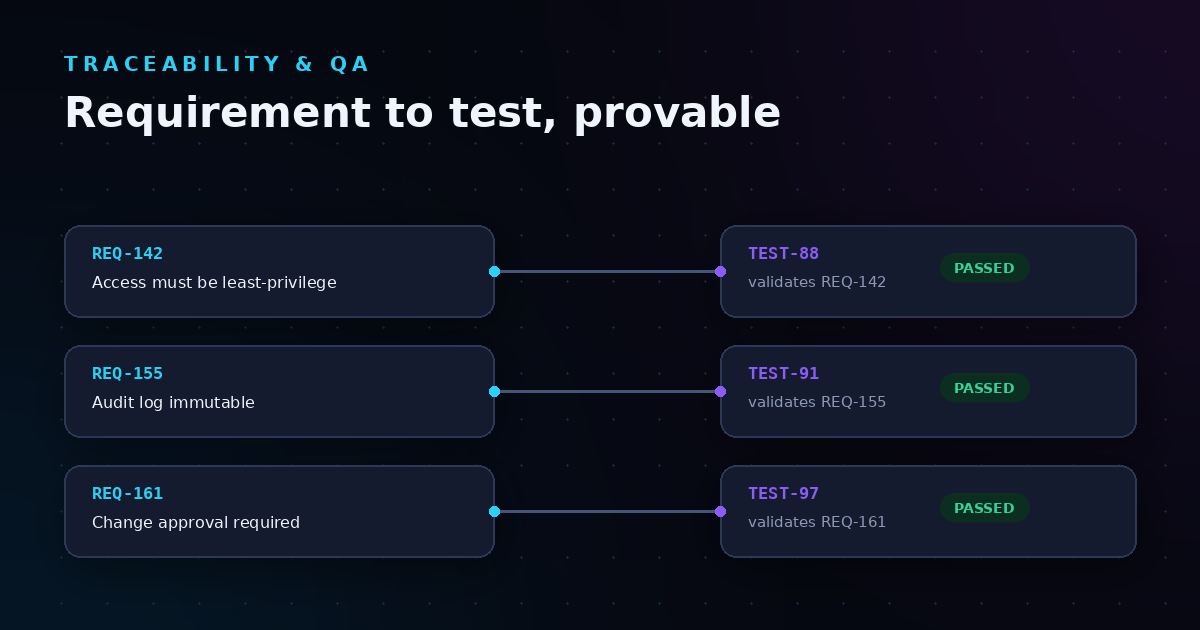
Complete traceability connects every artifact in your delivery pipeline. You should be able to follow a requirement from its initial specification through design, implementation, testing, and release.
Look for platforms that support bidirectional links. If a test fails, you need to see which requirements are affected. If a requirement changes, you need to identify which tests need updating.
LoopIQ maps enterprise documentation to SDLC topology, preserving trust and context across your entire software delivery process. This structural approach ensures documentation stays connected to the work it describes.
Your evaluation should focus on five primary areas: traceability, compliance readiness, test workflow support, release governance, and integration depth. Each criterion carries different weight depending on your specific regulatory requirements.
Traceability isn't just about linking documents. You need a platform that creates connections automatically as your team works, not one that requires developers to manually create links after the fact.
Ask potential vendors: How does your platform capture relationships between requirements, code commits, test cases, and releases? Can I generate a traceability matrix on demand without additional configuration?
The ideal platforms create this web of connections as a byproduct of normal development activities. Your team shouldn't need to do extra work to maintain traceability.
Compliance evidence collection has traditionally been a reactive scramble before audits. Modern platforms flip this model by generating evidence as work happens.
LoopIQ connects delivery signals to releases and maps metrics to compliance objectives, creating release certification trails automatically. This approach shifts audits from emergency projects to structured reviews with evidence ready on demand.
Evaluate whether a platform captures approval chain evidence with verifiable identity. You need to prove who approved what, when, and why—not reconstruct it from memory later.
Your SDLC platform should support the full testing lifecycle: test planning, case management, execution, defect tracking, and coverage reporting. Shallow test support forces you to maintain separate testing tools and lose the integration benefits.
Look for automated test execution capabilities that tie results back to specific builds and releases. Coverage visibility helps you identify gaps before they become audit findings.
Consider how the platform handles different testing types. Does it support unit tests, integration tests, performance tests, and security scans? Can you aggregate results from multiple test frameworks?
Release governance ensures that software meets your quality standards before reaching production. For regulated teams, this means enforcing gates that can't be bypassed without proper approval.
Key governance features include configurable approval workflows, release checklists linked to compliance requirements, and automated checks that validate conditions before deployment proceeds.
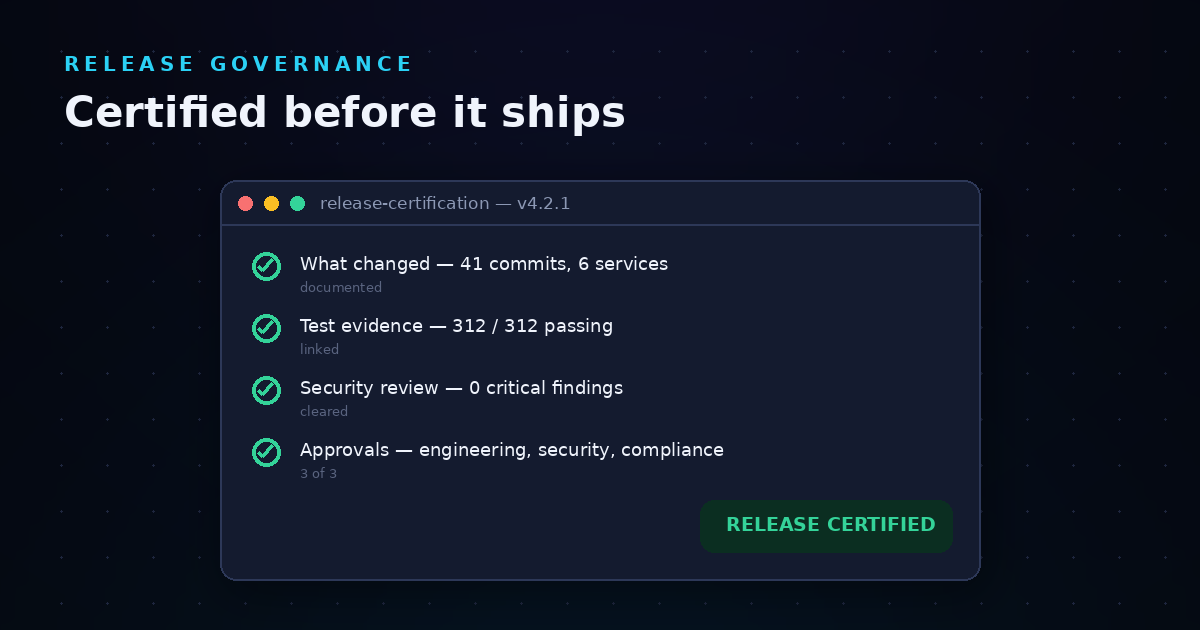
LoopIQ's intelligent release certification reviews evidence and flags gaps before releases ship, giving you confidence that nothing slips through without proper validation.
No platform replaces everything overnight. You need integrations with your current CI/CD pipelines, source control systems, and security scanning tools.
Evaluate the depth of available integrations. Surface-level connections that only sync basic data won't give you the traceability benefits you need. Look for integrations that maintain context and create meaningful links between systems.
LoopIQ connects existing tools to give you a unified release view and preserve decision context, letting you keep the tools your team already knows while gaining the benefits of a unified workspace.
Compliance readiness goes beyond having a "compliance module." You need to understand how deeply compliance capabilities integrate with daily development activities.
Built-in compliance means audit-ready documentation captures itself from the work your team already does. You don't toggle into a separate "compliance mode" or fill out additional forms.
The platform should map your regulatory requirements to specific controls and automatically collect evidence that those controls are being followed. When an auditor asks about your change management process, you can show the actual approval records—not a policy document describing what should happen.
This is what compliance-native means: compliance as workflow woven into every activity, not a periodic checkbox exercise.
Audit response time matters. The faster you can produce evidence, the less disruption audits cause to your engineering schedule.
Look for one-click compliance evidence dossier generation. You should be able to pull together everything related to a specific release—requirements, test results, approvals, security scans—without hunting through multiple systems.
LoopIQ reduces audit preparation from weeks to a structured download, giving IT auditors verified evidence on demand while your engineers stay focused on shipping.
Different industries face different compliance requirements: SOC 2, HIPAA, FDA 21 CFR Part 11, ISO 27001, FedRAMP, and others. Your platform should understand these frameworks and map your activities to their specific requirements.
Pre-built compliance mappings accelerate your setup, but customization matters too. You may have internal policies or customer-specific requirements that go beyond standard frameworks.
Verify that the platform supports evidence export in formats your auditors expect. Some auditors want spreadsheets; others need specific report structures.
QA leaders need more than basic test case management. Your platform should support the full complexity of enterprise testing while maintaining the traceability that compliance demands.
Test planning should link directly to requirements. When stakeholders ask which requirements have test coverage, you should answer instantly—not after an analysis exercise.
Test case versioning ensures you know exactly which version of a test validated which release. This matters when defects appear months later and you need to understand what testing was done.
Execution history gives you trend data: which tests fail frequently, which features have unstable coverage, and where to focus improvement efforts.
Your automated tests likely run through CI/CD pipelines using frameworks like Selenium, JUnit, or Cypress. The SDLC platform should ingest these results and connect them to the broader delivery context.
Integration depth matters here. You need more than pass/fail counts. The platform should link specific test failures to code changes, making it clear exactly what broke and why.
LoopIQ's AI-driven testing tools auto-generate test suites and predict failure points, helping you expand coverage without proportional increases in test maintenance effort.
Defect tracking for regulated teams requires more than status fields. You need a complete history: when the defect was found, how it was triaged, what fix was applied, and how the fix was verified.
Link defects to the test cases that found them and the requirements they affect. This bidirectional linking helps you assess impact when making release decisions.
Audit trails on defect records prove that your team followed proper processes. You should see who changed what fields, when, and why—without relying on screenshots or email threads.
Release governance isn't bureaucracy—it's the structure that lets you ship with confidence. For regulated teams, governance gives you the proof that your releases meet required standards.
Configurable approval workflows let you enforce different processes for different release types. A hotfix might require different approvals than a major feature release.
Gates should be enforceable, not advisory. If a security scan hasn't passed, the deployment shouldn't proceed—regardless of schedule pressure. Your platform needs technical controls that back up your policies.
Rollback capabilities with audit trails prove you can respond to production issues while maintaining compliance. You need records showing what was rolled back, when, and who authorized it.
Release evidence captures the state of your delivery at a specific point in time. Months or years later, you can answer exactly what was validated and why a release was approved.
LoopIQ creates automatic release certification trails linked to objectives and measurable results, giving you audit readiness for every release without additional effort from your team.
Evidence should include test results, security scan outputs, approval records, and links to the specific code versions deployed. This complete picture defends your releases long after they ship.
Deployment automation reduces human error while maintaining governance controls. Look for platforms that integrate release approvals with deployment pipelines.
The deployment should pull context from your workspace: which requirements are included, which tests passed, who approved the release. This context flows through to your deployment records.
LoopIQ's AI systems recommend optimal deployment strategies and automate rollbacks, reducing deployment risk while keeping governance records intact.
Vendor selection for regulated teams involves more than feature checklists. You need confidence that the vendor understands compliance requirements and will support your audit needs.
Start with traceability: "Show me how a requirement connects to its tests, code changes, and release. Can I generate this view without preparation?"
Ask about evidence generation: "How does your platform capture compliance evidence automatically? What does an auditor see when they request release documentation?"
Probe integration depth: "How do you connect with our existing CI/CD pipeline? What data flows between systems, and how is context maintained?"
Challenge their governance claims: "Show me how approval workflows are enforced. Can an engineer bypass a required approval?"
Vendors serving regulated industries should demonstrate their own compliance credentials. Ask about their security certifications and data handling practices.
Request references from customers in your industry. A vendor might have a great platform but limited experience with your specific regulatory requirements.
Review their documentation for compliance-specific guidance. Do they offer implementation templates for common frameworks? Do they give guidance on configuring the platform for regulatory requirements?
A proof-of-concept should test your specific scenarios, not generic demos. Bring real requirements, actual test cases, and representative compliance scenarios.
Test traceability with your data. Import requirements and create the links you'd need in production. See how easy—or difficult—it is to maintain that traceability over time.
Validate evidence generation by simulating an audit request. Can you produce the documentation your auditors would expect? How long does it take?
Many organizations make selection mistakes that become apparent only after implementation. Learning from these common pitfalls saves you time and rework.
A long feature list doesn't guarantee the capabilities work together. Platforms with acquired components often have integration gaps between modules.
Focus on workflows, not features. Ask vendors to demonstrate your actual use cases end-to-end, not a series of disconnected feature showcases.
The unified platform promise requires actual unification. Data should flow automatically; traceability should build naturally. If maintaining connections requires ongoing effort, you haven't found a truly unified solution.
Integration capabilities often look better in sales presentations than in reality. Surface-level integrations might sync status but lose critical context.
During evaluation, dig into what specific data transfers between systems. Can you maintain traceability links through integrations? Do compliance records include data from connected tools?
According to industry analysis of SDLC tool integration, organizations frequently underestimate the effort required to achieve meaningful integration between platforms.
Some platforms market compliance features that don't meet regulatory scrutiny. "Audit trail" might mean basic logging, not the evidence chain auditors expect.
Ask specific questions about approval chain capture with verifiable identity. How does the platform prove that the person who approved a release was actually that person?
Review how evidence is protected from tampering. Compliance evidence needs integrity controls—you must prove records weren't modified after the fact.
Implementation success depends on planning that accounts for your team's specific needs and existing processes. A phased approach typically works better than big-bang adoption.
Data migration from legacy systems requires careful mapping. Determine which historical data you need in the new platform and which can remain in archived systems for reference.
LoopIQ makes migrating from legacy trackers less painful by connecting existing tools to give you a unified release view while you transition at your own pace.
Plan for a parallel period where both systems run together. This overlap lets you validate data accuracy and gives your team time to build confidence in new workflows.
QA leaders need different training than individual testers. Focus on reporting, traceability views, and compliance workflows rather than day-to-day test execution.
Build internal champions who can support ongoing adoption. Platform expertise shouldn't depend entirely on vendor support resources.
Create workflow documentation specific to your processes. Generic vendor training covers features; your team needs guidance on how those features apply to your regulatory requirements.
Define success metrics before implementation begins. Consider traceability coverage, audit preparation time, evidence assembly effort, and engineer satisfaction with workflows.
Baseline your current state so you can demonstrate improvement. How long does audit preparation take now? How many engineers get pulled from feature work for compliance tasks?
Track adoption metrics that show whether the platform is actually being used as intended. High license counts mean nothing if teams work around the system.
SDLC platforms continue to evolve, with AI capabilities expanding what's possible for compliance automation and testing efficiency.
AI can identify compliance gaps before they become audit findings. By analyzing patterns across your delivery data, intelligent systems flag anomalies that might indicate process violations.
LoopIQ's AI-powered system operates on complete development context for smarter automation, learning from your workflows to suggest improvements and surface potential issues.
Predictive compliance—understanding risk before releases ship—becomes possible when you have unified data and AI capable of analyzing it.
AI agents performing engineering tasks create new governance challenges. How do you audit decisions made by automated systems? How do you maintain approval chains when AI initiates changes?
LoopIQ supports governance of AI agents performing engineering work, ensuring that automated actions leave audit evidence just as human actions do.
Platforms that ignore AI governance will leave gaps in your compliance posture as AI-assisted development becomes more common.
Choosing SDLC workspace software for regulated enterprise teams requires evaluation across multiple dimensions: traceability, compliance readiness, test workflow support, release governance, and integration capabilities.
Start with your specific regulatory requirements and work backward to the features that support them. A platform designed for compliance-native operation will serve you better than one with compliance bolted on afterward.
LoopIQ delivers a unified intelligent workspace where compliance evidence captures itself from the work your team already does. Your engineers stay focused on building quality software while audit-ready documentation maintains itself in the background.
The right platform turns compliance from an engineering burden into a structural advantage—proof that your team delivers quality software with the governance your industry demands.
End-to-end traceability ranks highest for QA leadership in regulated environments. You need automated connections between requirements, test cases, code changes, and releases.
This traceability enables impact analysis when changes occur and delivers the evidence chain auditors expect.
LoopIQ generates compliance evidence automatically as your team works. Instead of reconstructing what happened before audits, you have release certification trails ready on demand.
This approach eliminates the time engineers spend on evidence assembly and audit preparation tasks.
Ask vendors to show traceability in action: "Connect a requirement to its tests, code, and release without preparation." This reveals whether traceability is built-in or requires ongoing effort.
Follow up with compliance evidence questions: "Show me what an auditor sees for a specific release."
Implementation timelines vary based on scope and complexity. A phased approach—starting with core workflows and expanding over time—typically takes three to six months for initial deployment.
Plan for parallel operation with existing tools during transition.
Integration capability varies significantly between platforms. Look for integrations that maintain context and create meaningful links, not just surface-level data synchronization.
LoopIQ connects existing tools to give you a unified release view while preserving decision context across systems.
Release governance ensures software meets quality standards before deployment. It includes configurable approval workflows, quality gates, and enforcement controls that prevent unapproved releases.
For regulated teams, governance delivers the structural proof that your releases followed required processes.
LoopIQ supports governance of AI agents performing engineering tasks. Automated actions leave audit evidence just as human actions do, maintaining your compliance posture as AI-assisted development grows.
This capability becomes increasingly important as AI tools take on more engineering responsibilities.
Regulated teams need bidirectional traceability: requirements link to tests, tests link to code changes, and code changes link to releases. Every connection should be automatic, not manually maintained.
The platform should generate traceability matrices on demand without additional configuration.