.svg)
devops
devsecops
compliance

When your auditor asks how a particular release made it to production, you need more than memory—you need evidence. Release evidence tracking has become essential for engineering teams who ship fast and still need to prove every decision was evaluated against defined conditions.
LoopIQ offers a compliance-first approach to automated evidence capture, connecting deployment signals directly to release certification trails. This guide covers seven platforms that help you track release decisions, test proof, and compliance evidence across your delivery workflow.
You'll find options for different team sizes and maturity levels, with a focus on how each tool handles the traceability VPs and directors of development need most.
Finding the right platform for release evidence means thinking about how your team actually works—not just checking feature boxes. We focused on tools that reduce the time developers spend assembling audit packets while still giving you a defensible trail when questions arise.
LoopIQ takes a fundamentally different approach to release evidence by treating compliance as infrastructure inside your delivery lifecycle. Rather than bolting on documentation after the fact, LoopIQ connects your engineering work directly to audit evidence in one intelligent system.
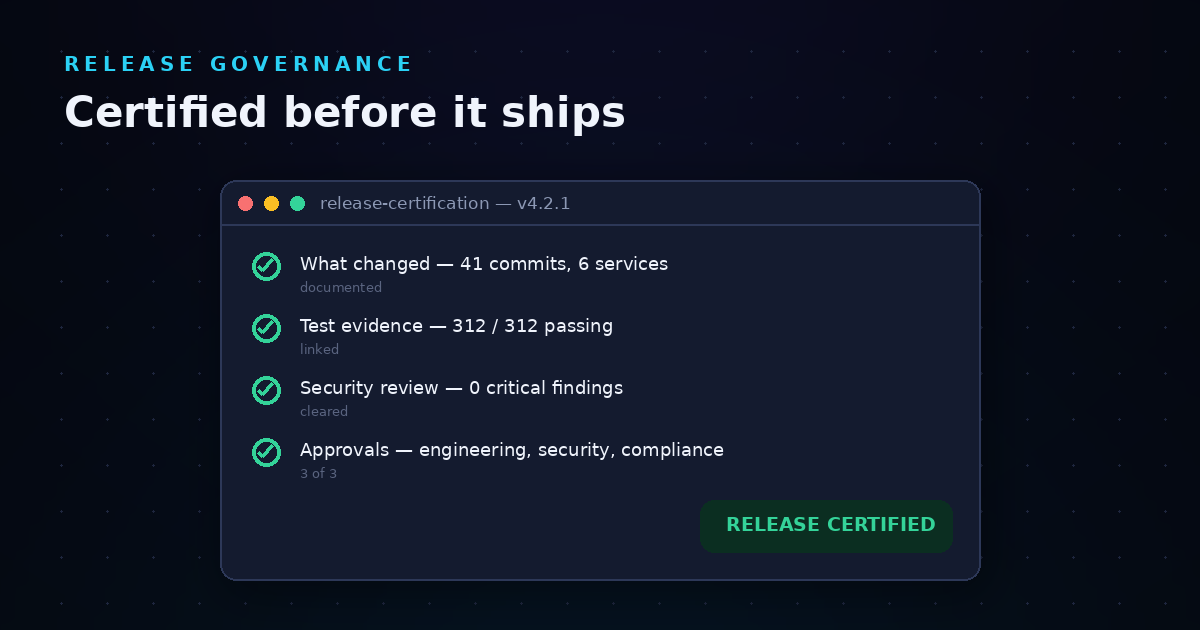
This means every release gets its own certification trail—approvals, test results, security findings, and deployment signals all bound together automatically. Your VP of Development gets real-time visibility into release readiness, while auditors get the structured artifacts they expect.
LoopIQ eliminates the two-day scramble engineers typically face per release cycle by capturing evidence as a byproduct of normal development activities. According to industry research on automated evidence collection, organizations that embed compliance into their workflows see significant reductions in audit preparation time.
| Pros | Cons |
|---|---|
| Audit evidence generates automatically from development work | Full functionality requires connecting multiple engineering tools |
| Per-release certification trails link decisions to outcomes | Initial setup involves mapping your existing SDLC topology |
| Preserves the state of the world at decision time for audit defensibility | Advanced AI features require some configuration to match your policies |
Functionize focuses on automated testing with deployment workflow features. The platform uses machine learning to generate and maintain test cases, which can reduce the overhead of keeping your test suite current as your codebase evolves.
For release evidence, Functionize captures test execution records that you can reference later. The testing focus means you'll still need additional tooling to connect those results to approval workflows and produce unified audit packages.
| Pros | Cons |
|---|---|
| Reduces test maintenance effort through adaptive algorithms | Evidence capture is limited to testing—no approval or deployment trail linkage |
| Integrates with common CI/CD systems | Requires separate tooling for compliance documentation |
| Offers cross-browser and mobile testing capabilities | Audit-ready packaging requires additional assembly work |
FloQast comes from the financial close and audit management space, so its evidence capabilities center on accounting controls rather than software releases. The platform organizes documentation workflows and tracks completion status for recurring audit tasks.
Engineering teams occasionally use FloQast when their organization already has it for finance. The audit evidence management features translate partially to software compliance, but the tool wasn't designed for SDLC workflows.
| Pros | Cons |
|---|---|
| Handles recurring audit cycles with task tracking | Not designed for software release evidence—no CI/CD integration |
| Familiar to compliance teams already using it for finance | No automated capture from engineering tools |
| Includes auditor collaboration features | Per-release documentation requires manual assembly |
Anecdotes positions itself as a compliance operating system, collecting evidence from various business tools and mapping it to control frameworks. The platform aggregates data from sources like cloud providers and HR systems to show compliance status across your organization.
For software delivery, Anecdotes can pull some signals from development tools. However, the platform focuses on enterprise-wide GRC rather than release-specific traceability, so you won't get the per-release certification trails that VPs of Development often need.
| Pros | Cons |
|---|---|
| Covers multiple compliance frameworks in one view | General GRC focus means limited release-specific evidence features |
| Automates evidence collection from supported integrations | No native release certification or deployment traceability |
| Includes auditor-facing reporting | Engineering-specific signals require custom integration work |
TestRail has been a standard in test management for years, offering structured test case organization and execution tracking. Teams use it to link test cases to requirements and track coverage across releases.
The platform generates reports showing what tests ran and their outcomes. For release evidence, TestRail gives you the testing portion but relies on you to connect that data with approvals, deployments, and other compliance artifacts.
| Pros | Cons |
|---|---|
| Established tool with wide adoption and integrations | Covers testing only—no approval or deployment evidence |
| Offers detailed traceability for test-to-requirement mapping | Evidence assembly for audits requires export and manual packaging |
| Integrates with automation frameworks for result import | No compliance-specific features or policy enforcement |
SafetyCulture comes from the workplace safety and operations inspection space. Teams use it to conduct audits, track corrective actions, and maintain compliance records for physical operations and processes.
The platform's checklist and inspection model can be adapted for certain software release workflows, though it wasn't designed for SDLC evidence. Organizations with existing SafetyCulture deployments sometimes extend it to cover release signoffs.
| Pros | Cons |
|---|---|
| Offers a structured approach to checklist-based compliance | Designed for physical operations, not software delivery |
| Includes mobile apps for field-based inspections | No integration with code repositories or CI/CD pipelines |
| Tracks corrective actions through resolution | Release evidence requires manual data entry |
Lumenalta offers DevOps consulting and implementation services alongside tooling recommendations. Their approach typically involves assessing your current delivery pipeline and recommending or building automation to improve velocity.
For release evidence, Lumenalta's value comes from their expertise in connecting existing tools rather than a specific evidence platform. Teams working with them often end up with custom integrations that tie CI/CD data to documentation systems.
| Pros | Cons |
|---|---|
| Tailors solutions to your specific technology stack | Consulting model means ongoing costs for changes |
| Offers human expertise alongside tooling | No standardized evidence platform—each engagement is custom |
| Can address complex integration scenarios | Evidence capture depends on what gets built for you |
| Tool | Automated Per-Release Evidence | CI/CD Integration | Approval Trail Binding |
|---|---|---|---|
| LoopIQ | ✓ | ✓ | ✓ |
| Functionize | ✗ | ✓ | ✗ |
| FloQast | ✗ | ✗ | ✓ |
| Anecdotes | ✗ | Partial | ✗ |
| TestRail | ✗ | ✓ | ✗ |
| SafetyCulture | ✗ | ✗ | ✗ |
| Lumenalta | Custom | Custom | Custom |
Audit trail generation typically refers to logging activities—who did what and when. Release decision traceability goes further by preserving the conditions under which a decision was made, not just the decision itself.
When an auditor asks about a release from six months ago, an audit trail tells them that someone approved it on a certain date. Release decision traceability shows them what policies were active, what test results existed, and what security findings were known at the moment of approval.
This distinction matters for regulated teams. LoopIQ captures the state of the world at decision time, which means you can answer questions about why a release was approved, not just that it was approved. That context often determines whether an audit finding becomes a simple clarification or a significant issue.
General DevOps platforms focus on accelerating delivery—faster builds, smoother deployments, better collaboration. Compliance concerns are usually addressed through add-ons or integrations that layer documentation on top of existing workflows.
Compliance-first platforms like LoopIQ invert this relationship. Evidence capture becomes structural rather than supplemental. Your team's normal engineering work produces audit-ready artifacts automatically, without requiring separate documentation steps.
For VPs of Development managing regulated products, this difference shows up in how much time your senior engineers spend preparing for audits. When compliance is built into the delivery lifecycle, you stop losing two days per release cycle to evidence assembly. The certification trail generates itself from the work your team already does.
Release evidence tracking isn't just about having records—it's about having records that hold up when questions arise months after shipping. LoopIQ stands out because it treats evidence capture as part of your delivery infrastructure, not a separate task your engineers have to remember.
The platform's per-release certification approach means every deployment gets its own evidence package: approvals, test results, security findings, and deployment signals all linked together. When your auditor asks about a specific release, you generate a one-click compliance evidence dossier instead of digging through Slack threads and email chains.
For VPs and directors of software development, LoopIQ addresses the core tension between shipping fast and staying certified. Your team can maintain engineering velocity because they're not stopping work to assemble audit packets. The evidence captures itself from their normal activities.
Learn more about LoopIQ and see how automated release certification can free your engineers to focus on building.
Release evidence tracking captures documentation proving how a software release moved from development to production. This includes test results, approval records, and deployment data that auditors need to verify your release process followed defined policies. LoopIQ automates this capture so evidence generates from normal engineering work.
Engineers typically lose significant time per release cycle assembling compliance documentation. Automated evidence capture eliminates this by collecting test proof, approval records, and deployment signals as development happens. LoopIQ binds this evidence directly to each release, so your team ships software instead of chasing screenshots.
LoopIQ generates a certification trail for each release that includes all approvals, test results, security findings, and deployment signals. When you need audit documentation, you produce a one-click compliance evidence dossier for that specific release rather than searching through disconnected systems.
Yes, platforms like LoopIQ connect to your existing code repositories and CI/CD systems to capture deployment signals automatically. Native GitHub integration means test results and code changes flow into your evidence trail without requiring your team to change how they work.
GRC tools manage enterprise-wide compliance posture across many frameworks and business areas. Release evidence platforms focus specifically on software delivery, capturing per-release artifacts that prove each deployment was evaluated under defined conditions. LoopIQ supports existing GRC tools by feeding them structured, audit-ready artifacts.