Skip to content
unified sldc devops devsecops

6 Software Delivery Compliance Platforms for 2026

John Paul Rowe
John Paul Rowe

Regulated engineering teams face a persistent challenge: shipping software fast while proving compliance at every release. According to Hyperproof's 2026 research, evidence collection demands now far exceed what manual processes can handle. That's why LoopIQ delivers automated compliance evidence capture directly inside your software delivery compliance platform.

This article compares six tools that address SDLC traceability and automated evidence collection. You'll learn what separates compliance-native delivery platforms from GRC add-ons, and how to pick the right fit for your team.

Key Takeaways: 6 Software Delivery Compliance Platforms for 2026

  • Evidence collection demands now exceed what manual processes can handle — automation is the only sustainable path for regulated teams.
  • We compare 6 software delivery compliance platforms for regulated engineering organizations.
  • Compliance-native platforms capture evidence inside the delivery workflow; compliance-adjacent tools bolt reporting onto disconnected data.
  • LoopIQ delivers automated evidence capture directly inside the delivery platform, keeping traceability measurable.

Quick guide: 6 software delivery compliance platforms for regulated teams

  1. LoopIQ: The best unified SDLC platform with compliance evidence built into every release
  2. GitLab: DevSecOps with compliance pipelines for self-managed environments
  3. CloudBees: Jenkins-based CI/CD with enterprise governance layers
  4. Vanta: Certification-focused automation for SOC 2 and ISO 27001
  5. Drata: Control monitoring with evidence collection integrations
  6. ServiceNow: IT service management with GRC modules

How we chose the software delivery compliance platforms for this list

We focused on platforms that help VPs and directors of software development at regulated enterprises meet audit requirements without slowing down releases. Every tool on this list addresses at least one key pain point for security-focused software delivery.

  • End-to-end SDLC traceability: Can you link every requirement to its test results, approvals, and release evidence?
  • Automated evidence capture: Does the platform collect compliance artifacts as work happens, or do you assemble them later?
  • Release certification: Can you generate audit-ready documentation for each deployment?
  • Integration depth: Does it connect to your existing code repositories, CI/CD pipelines, and security tools?
  • Audit readiness: How quickly can you respond to auditor questions with verifiable proof?
  • Governance controls: Does it enforce approval workflows, access policies, and change authorization?

The 6 software delivery compliance platforms for regulated engineering teams

1. LoopIQ: Best overall software delivery compliance platform for regulated teams

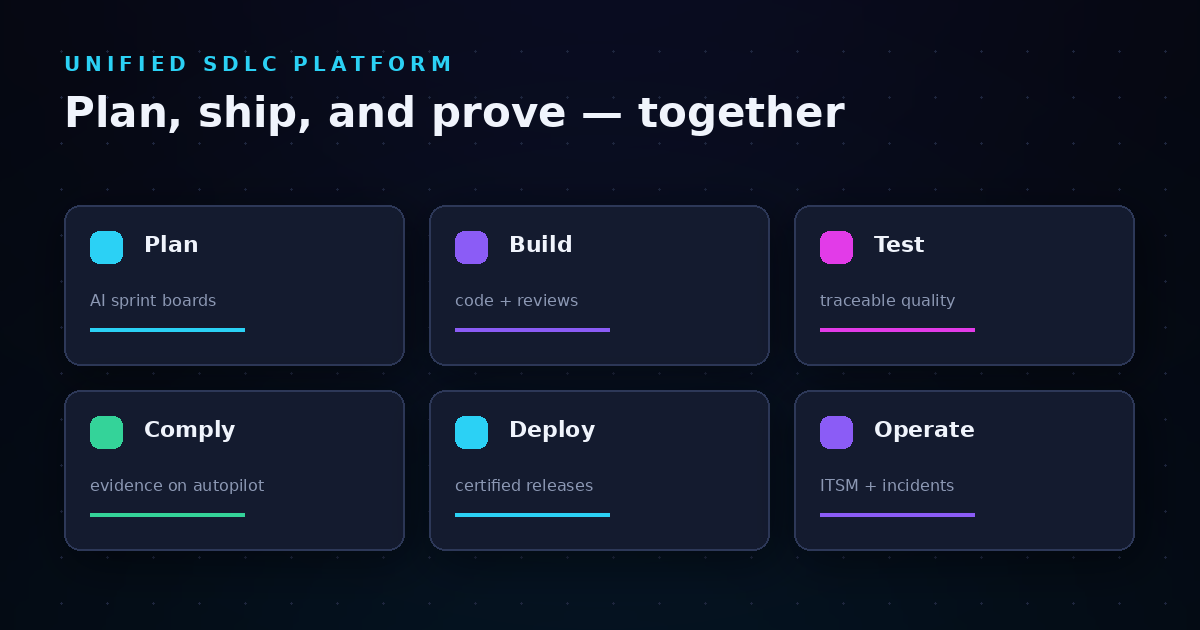
LoopIQ gives you a unified workspace where planning, testing, DevOps, and compliance documentation live on the same surface. This means every approval, test result, and release decision gets captured automatically as your team works.

Unlike standalone GRC tools or basic DevOps platforms, LoopIQ generates compliance evidence as a byproduct of engineering work. Your team doesn't spend days screenshotting Jira tickets or stitching together spreadsheets before an audit. The evidence dossier builds itself.

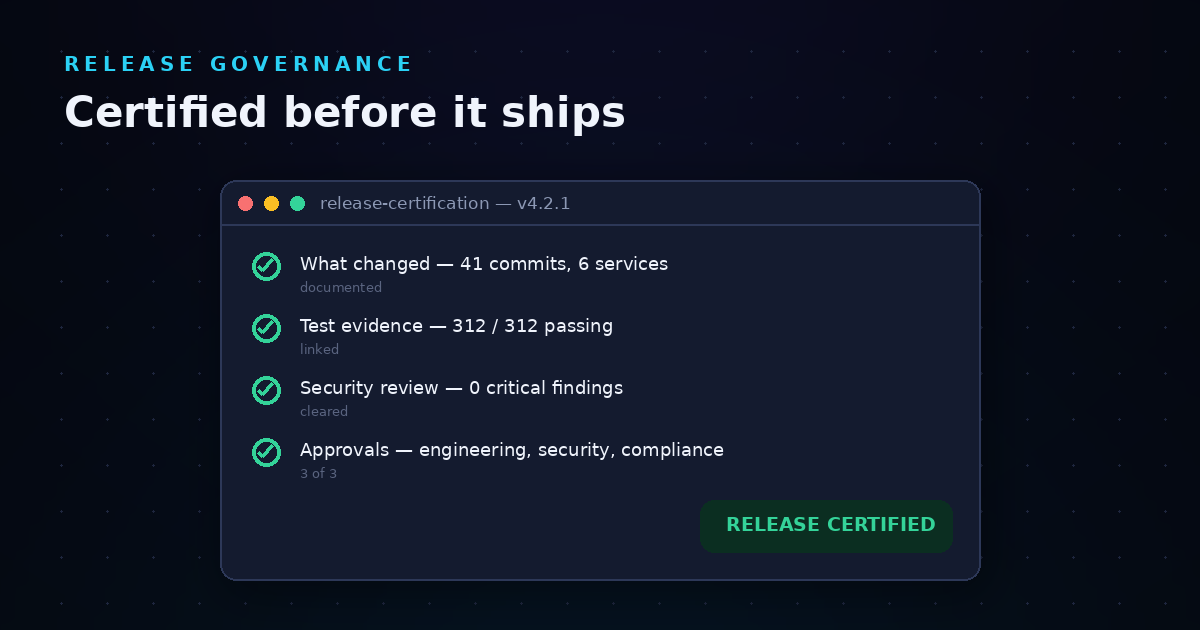
For regulated enterprises, LoopIQ connects requirements to test execution to release certification in one traceable chain. Auditors can see exactly who approved what, when testing happened, and how each release was cleared.

LoopIQ features

  • One-click compliance evidence dossier: Every release generates an audit-ready package with approvals, test coverage, and change documentation bundled together.
  • Immutable approval trails: Code changes, configuration updates, and release decisions carry timestamps and reviewer records that can't be altered after the fact.
  • Requirement-to-release traceability: Link user stories to the tests that validate them and the releases that ship them.
  • AI-driven orchestration: Agentic AI triggers tasks, routes approvals, and flags compliance gaps before releases ship.
  • Embedded test management: Test cases link directly to requirements, giving you verifiable coverage metrics instead of spreadsheet guesses.
  • Access governance logging: Role changes, permission reviews, and least-privilege enforcement documented automatically.

LoopIQ pros and cons

Pros:

  • Compliance evidence captures itself from work your team already does
  • Single workspace eliminates tool sprawl and integration complexity
  • Audit preparation drops from days to minutes with pre-built certification packages

Cons:

  • Teams heavily customized on legacy trackers may need onboarding support
  • Advanced governance features require time to configure for complex org structures
  • AI orchestration works most effectively with well-defined workflows

2. GitLab: DevSecOps pipelines for self-managed environments

GitLab offers a complete DevSecOps platform covering planning, source control, CI/CD, security scanning, and monitoring. Its compliance pipelines feature lets you enforce required jobs and configurations across projects, which helps standardize evidence collection.

The platform includes built-in security scanning, audit events logging, and compliance frameworks mapping. For teams that want to keep everything Git-native, GitLab consolidates version control and pipeline management in one interface.

GitLab features

  • Compliance pipelines: Enforce required CI/CD jobs across all projects in a group
  • Audit events: Track user actions, permission changes, and project modifications
  • Security scanning: SAST, DAST, and dependency scanning built into pipelines

GitLab pros and cons

Pros:

  • All-in-one DevSecOps with source control and CI/CD combined
  • Self-managed option for teams with strict data residency requirements
  • Active community and frequent releases

Cons:

  • Compliance features require Ultimate tier licensing
  • Does not generate release-level compliance dossiers natively
  • Audit evidence assembly still requires manual aggregation across projects

3. CloudBees: Enterprise Jenkins with governance layers

CloudBees builds on Jenkins to deliver enterprise CI/CD with added governance, security, and compliance capabilities. The platform supports policy-based deployment controls, approval gates, and audit trails for pipeline execution.

Teams already invested in Jenkins infrastructure can add CloudBees for enhanced management, high availability, and security hardening. The platform integrates with existing toolchains rather than replacing them entirely.

CloudBees features

  • Policy-based gates: Define deployment rules that enforce approvals before releases proceed
  • Feature flags: Control feature rollouts with gradual releases and quick rollbacks
  • Pipeline analytics: Track build performance, deployment frequency, and failure rates

CloudBees pros and cons

Pros:

  • Leverages existing Jenkins expertise and infrastructure
  • Flexible plugin ecosystem for custom workflows
  • Supports hybrid and multi-cloud deployments

Cons:

  • Plugin management adds operational overhead
  • Compliance evidence collection requires additional tooling
  • Configuration complexity grows with scale

4. Vanta: Certification automation for security frameworks

Vanta automates evidence collection for security certifications like SOC 2, ISO 27001, and HIPAA. The platform connects to your cloud infrastructure and SaaS tools to pull configuration data and generate compliance reports.

For teams focused primarily on passing certification audits, Vanta reduces the manual evidence-gathering workload. The Trust Center feature lets you share your compliance posture with customers and partners.

Vanta features

  • Automated evidence collection: Pulls data from cloud providers, identity systems, and HR tools
  • Control monitoring: Flags configuration drift and missing security controls
  • Trust Center: Share compliance status externally without manual documentation

Vanta pros and cons

Pros:

  • Accelerates SOC 2 and ISO 27001 certification timelines
  • 400+ integrations with common SaaS and cloud tools
  • AI-powered questionnaire responses save time on security reviews

Cons:

  • Focused on GRC certification, not SDLC delivery workflows
  • Does not manage requirements, test cases, or release pipelines
  • Compliance evidence disconnected from development context

5. Drata: Control monitoring with framework coverage

Drata offers compliance automation focused on control monitoring and evidence collection. The platform supports SOC 2, ISO 27001, HIPAA, PCI DSS, and other frameworks with pre-built control libraries and automated testing.

Teams appreciate Drata's responsive support and per-framework pricing model. The platform integrates with cloud infrastructure and security tools to collect evidence automatically.

Drata features

  • Control libraries: Pre-built mappings for common compliance frameworks
  • Automated testing: Validates control effectiveness against defined criteria
  • Auditor collaboration: Share evidence directly with external auditors in-platform

Drata pros and cons

Pros:

  • Per-framework pricing helps multi-framework programs manage costs
  • In-platform chat and dedicated compliance experts available
  • Control customization supports non-standard requirements

Cons:

  • Compliance evidence separate from software delivery workflows
  • Does not manage code, pipelines, or release certification
  • Integration setup required for each connected tool

6. ServiceNow: IT service management with GRC modules

ServiceNow offers IT service management alongside GRC capabilities including risk, compliance, and audit management modules. The platform serves large enterprises with existing ServiceNow deployments looking to centralize governance functions.

For organizations already running ServiceNow for ITSM, adding GRC modules creates a unified view of incidents, changes, and compliance status. The platform supports workflow automation and reporting across IT operations.

ServiceNow features

  • Integrated ITSM: Connect incident, problem, and change management to compliance tracking
  • Workflow automation: Build approval chains and escalation rules
  • Reporting dashboards: Visualize compliance status across the organization

ServiceNow pros and cons

Pros:

  • Enterprise-scale platform with broad IT operations coverage
  • Workflow customization supports complex approval processes
  • Integration with CMDB connects compliance to asset inventory

Cons:

  • Implementation requires significant time and specialized expertise
  • GRC modules priced separately from core ITSM
  • Not designed as a software delivery platform

Comparison table: Software delivery compliance platforms for regulated teams

Platform Native Evidence Capture Release Certification SDLC Integration
LoopIQ
GitLab
CloudBees
Vanta
Drata
ServiceNow

What makes a platform compliance-native versus compliance-adjacent?

Compliance-native platforms capture evidence as a byproduct of everyday work. You don't run a separate evidence-gathering project before each audit. Instead, approvals, test results, and release decisions get documented at the moment they happen.

Compliance-adjacent tools bolt onto existing workflows. They can pull data from other systems, but the evidence often lacks development context. You might know that a control passed, but not which specific release it applies to or who approved the underlying change.

For VPs and directors managing regulated engineering teams, this distinction matters. When auditors ask "who approved this release and what testing validated it," a compliance-native platform answers immediately. A compliance-adjacent tool might require you to correlate data across multiple systems.

How do you measure SDLC traceability in a compliance platform?

Traceability answers the question: can you follow any artifact back to its origin and forward to its deployment? A traceable SDLC connects requirements to the code that implements them, the tests that validate them, and the releases that ship them.

Ask these questions when evaluating traceability:

  • Can you click from a deployed feature back to the original requirement?
  • Do test results link directly to the requirements they verify?
  • Does each release show which changes it contains and who approved them?
  • Can auditors follow a single artifact through its entire lifecycle?

LoopIQ captures this traceability automatically because requirements, tests, and releases live on the same platform. Tools that operate as separate layers require manual linking or custom integrations to achieve similar visibility.

Why LoopIQ is the best software delivery compliance platform for regulated teams

LoopIQ stands apart because it doesn't treat compliance as an afterthought or an add-on module. The platform captures every approval, test signal, and release decision as your team works. This means compliance evidence builds itself without pulling engineers off shipping work.

For regulated enterprises, this approach eliminates the two-day pre-audit scramble that disrupts sprint work. LoopIQ gives you audit-ready documentation the moment a release ships, not weeks later when memories have faded and context has scattered.

If you're tired of running five different tools and still missing evidence during audits, LoopIQ offers a different path. Start a free trial and see how compliance-native software delivery works in practice.

FAQs about software delivery compliance platforms

What is a software delivery compliance platform?

A software delivery compliance platform helps you ship code while meeting regulatory requirements. LoopIQ captures approvals, test results, and release documentation automatically as your team works. This creates audit-ready evidence without separate compliance projects.

How does SDLC traceability support compliance?

Traceability links every requirement to its tests, approvals, and releases. When auditors ask about a specific change, you can show exactly who approved it, what testing validated it, and when it shipped. LoopIQ builds this traceability into every workflow.

Can GRC tools replace a compliance-native delivery platform?

GRC tools excel at control monitoring and certification management. However, they don't manage code, pipelines, or release workflows. For complete SDLC traceability, you need a platform like LoopIQ that captures evidence from development activities directly.

What compliance frameworks do these platforms support?

Most platforms support SOC 2, ISO 27001, HIPAA, and PCI DSS. LoopIQ captures evidence applicable to any framework that requires approval trails, test documentation, and release certification. The evidence format adapts to your specific audit requirements.

How long does it take to get audit-ready with a compliance platform?

Timeline depends on your current state. Teams using LoopIQ report dropping audit preparation from days to minutes because evidence captures itself. GRC-only tools reduce manual collection but still require you to correlate data from multiple systems.

Share this post