6 Best Software Delivery Platforms for Agile Reporting 2026
Agile status reporting breaks down when visibility stops at tool boundaries. You run sprints in one platform, code pipelines in another, and incidents in a third—but leadership wants a single answer: are we on track? LoopIQ unifies software delivery signals across your entire toolchain to give you that answer automatically.
This list covers six software delivery platforms that help you automate agile reporting and maintain cross-platform visibility. You will learn what each platform does well, where visibility tends to break down, and how to choose the right fit for your reporting needs.
Key Takeaways: 6 Best Software Delivery Platforms for Agile Reporting 2026
- Agile status reporting breaks when visibility stops at tool boundaries — leadership wants one answer: are we on track?
- We compare 6 software delivery platforms on cross-tool visibility and automated agile reporting.
- Reporting effectiveness is measurable: time to answer status questions, data freshness, and manual assembly hours.
- LoopIQ unifies delivery signals across the toolchain to answer status questions automatically.
Quick guide: 6 software delivery platforms for agile reporting
- LoopIQ: The best unified platform for cross-tool visibility and automated compliance evidence
- Jira (Atlassian): Familiar sprint boards with reporting that works at the team level
- GitLab: DevOps pipeline analytics with CI/CD-focused metrics
- Digital.ai Agility: Enterprise agile planning with portfolio-level dashboards
- ServiceNow: ITSM-centric approach with agile development add-ons
- Jenkins: Open-source CI/CD with plugin-based reporting
How we chose software delivery platforms for agile reporting
Picking the right platform for status reporting means looking beyond feature lists. You need tools that connect your delivery signals—sprint progress, pipeline health, test results, and incident status—into a view that makes sense to stakeholders.
Here is what we evaluated:
- Cross-tool visibility: Can you see status across Jira, GitLab, Jenkins, and ServiceNow in one place, or do you need to stitch reports together manually?
- Automated status aggregation: Does the platform pull status updates automatically, or does someone have to chase down updates every week?
- Release-level traceability: Can you tie sprint work to deployments and incidents to understand what actually shipped?
- Compliance evidence capture: Does the platform document approvals, test results, and change authorizations as work happens?
- Executive-ready reporting: Can leadership get the answers they need without requiring a translator or custom dashboard work?
- Integration depth: Does the platform sync with your existing tools, or does it require you to abandon what already works?
The 6 software delivery platforms for agile reporting
1. LoopIQ: Best overall software delivery platform for agile reporting
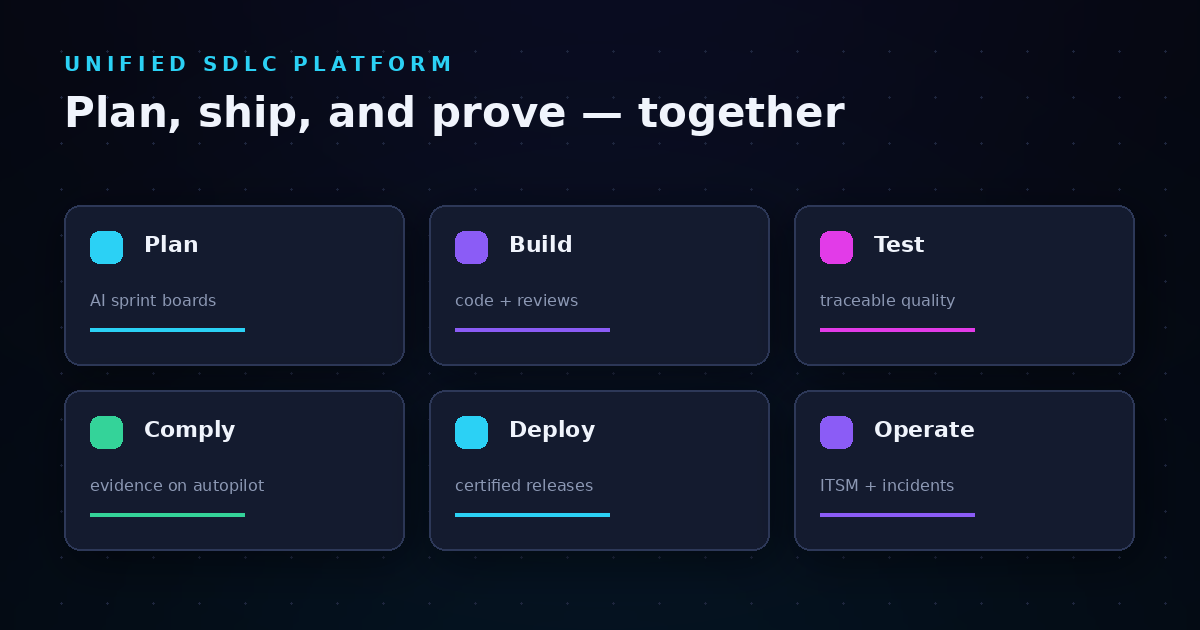
LoopIQ delivers unified visibility across your entire software delivery lifecycle. Instead of forcing you to choose between planning tools, DevOps pipelines, and ITSM systems, LoopIQ connects them all into a single workspace where status reporting happens automatically.
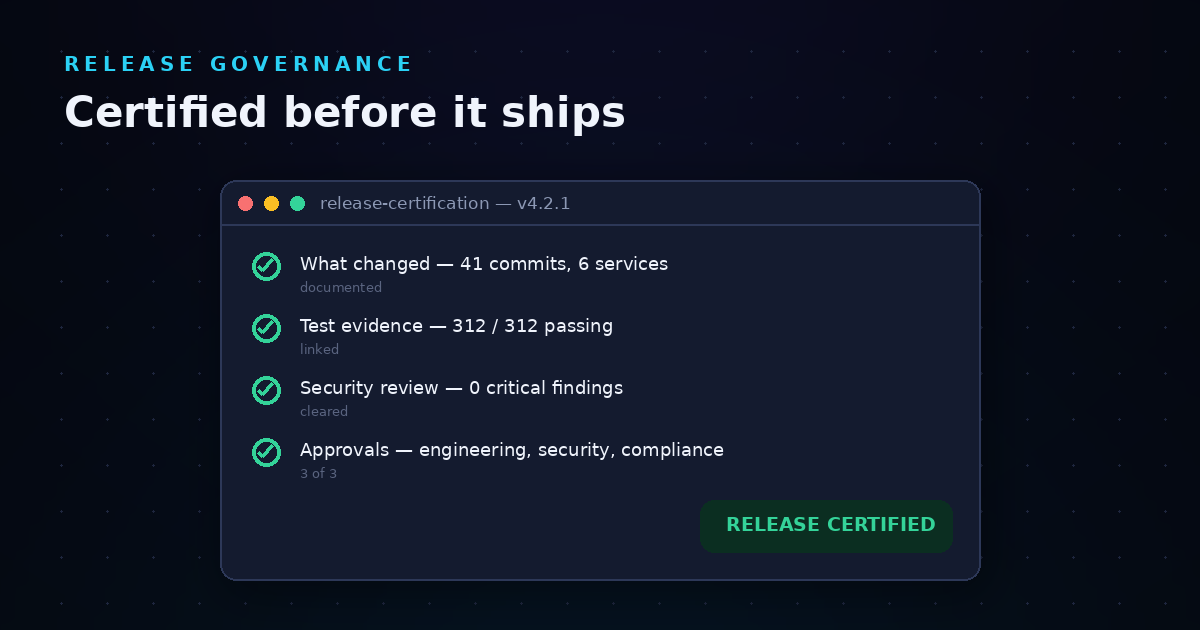
The platform captures delivery signals—sprint completions, code reviews, test executions, deployments, and incident resolutions—as your work progresses. This means status updates reflect reality, not last week's estimate. LoopIQ gives you release certification trails that document what changed, who approved it, and what was validated.
For VPs and heads of development, this translates to confident answers during stakeholder reviews. You can trace any release back to its requirements, tests, and approvals in seconds rather than hours of spreadsheet assembly.
LoopIQ features
- Unified delivery workspace: Planning, testing, DevOps, ITSM, and documentation connected in one platform—eliminating the need to switch between five different tools to understand delivery status
- Automatic evidence capture: Approvals, quality signals, and compliance documentation generate themselves from your existing work, reducing the time spent on audit preparation
- Release certification trails: Every release generates a complete package showing what changed, what was tested, and who signed off—ready for auditors before the release ships
- Cross-tool signal correlation: LoopIQ connects delivery signals from Jira, GitLab, Jenkins, ServiceNow, and other tools to show status at the release level, not the tool level
- AI-driven status intelligence: The platform flags risks, routes approvals, and surfaces blockers automatically so you can act before deadlines slip
- Executive dashboards: Pre-built views answer the questions leadership asks—delivery health, compliance posture, and release readiness—without requiring custom configuration
LoopIQ pros and cons
Pros:
- LoopIQ connects your existing tools rather than replacing them, so your engineering workflows stay intact
- Compliance evidence generates automatically from daily work, removing the pre-audit scramble
- Release-level visibility ties sprint work to deployments so you can answer "what shipped" in seconds
Cons:
- The initial setup requires mapping your existing workflows to the unified model, which takes coordination across tool owners
- Advanced compliance features require configuration based on your regulatory framework (SOC 2, ISO 27001, etc.)
- Full visibility benefits appear after integrating multiple source systems, so single-tool deployments show less immediate value
2. Jira (Atlassian): Familiar interface for team-level sprint tracking
Jira has become the default choice for agile sprint management. The platform offers scrum and kanban boards, backlog management, and sprint reporting that development leads know well. Velocity charts, burndown reports, and cumulative flow diagrams come built in.
Reporting works at the team level. When you need to aggregate status across multiple projects, releases, or deployment pipelines, you will need additional tools or manual consolidation. Jira does not natively connect sprint progress to CI/CD outcomes or incident data from ITSM systems.
Jira features
- Sprint and kanban boards: Visual task management with drag-and-drop workflow control
- Velocity and burndown reports: Built-in charts showing team delivery patterns over time
- Marketplace integrations: Access to apps that extend reporting and connect to DevOps tools
Jira pros and cons
Pros:
- Widely adopted, so onboarding is faster for developers who have used it before
- Sprint-level reporting is available out of the box with no additional configuration
- The marketplace offers add-ons for extended reporting needs
Cons:
- Cross-project reporting requires Premium or Enterprise tiers, or third-party apps
- No native connection between sprint work and deployment or incident data
- Executive dashboards require manual assembly from multiple board-level reports
3. GitLab: DevOps pipeline analytics with CI/CD focus
GitLab combines source control, CI/CD pipelines, and security scanning in one DevOps platform. For agile reporting, GitLab offers value stream analytics that track how work moves from idea to production, including DORA metrics for deployment frequency, lead time, and change failure rate.
The platform works from a code-centric perspective. Sprint planning and backlog management exist but are secondary to pipeline and repository workflows. If your reporting needs center on development velocity and pipeline health, GitLab has useful built-in analytics.
GitLab features
- Value stream analytics: Measures time from issue creation to production deployment across workflow stages
- DORA metrics: Tracks deployment frequency, lead time, change failure rate, and mean time to recovery
- CI/CD pipeline analytics: Shows pipeline success rates, duration trends, and failure patterns
GitLab pros and cons
Pros:
- Unified platform for code, CI/CD, and security scanning reduces tool sprawl for DevOps workflows
- DORA metrics are built in at Ultimate tier, helping you benchmark against industry standards
- Pipeline visibility is automatic for projects using GitLab CI/CD
Cons:
- Value stream dashboards require Premium or Ultimate tiers
- Agile planning features are less mature than dedicated project management tools
- Cross-tool visibility is limited if your pipelines run on Jenkins or other CI systems
4. Digital.ai Agility: Enterprise agile planning with portfolio views
Digital.ai Agility focuses on enterprise agile planning at portfolio and program levels. The platform supports SAFe (Scaled Agile Framework) and offers dashboards for tracking epics, features, and stories across multiple agile release trains.
Reporting centers on portfolio health, velocity trends, and program predictability. The platform offers analytics dashboards for executives, product owners, and scrum masters with role-specific views.
Digital.ai Agility features
- Portfolio-level dashboards: Tracks business initiatives across programs and organizations
- SAFe support: Native support for agile release trains, program increments, and PI planning
- Role-based analytics: Executive, product owner, and team dashboards with metrics targeted to each audience
Digital.ai Agility pros and cons
Pros:
- Built for scaled agile implementations with multiple teams and programs
- Portfolio visibility connects strategic initiatives to team-level execution
- Bi-directional sync with Jira allows hybrid tool environments
Cons:
- Enterprise-focused, which may be more than smaller organizations need
- DevOps and ITSM signals require separate integrations
- Initial configuration requires SAFe or agile framework expertise
5. ServiceNow: ITSM-centric with agile development add-ons
ServiceNow is known for IT service management, but the platform also offers agile development capabilities. You can manage scrum and SAFe workflows, track sprint progress, and connect development work to incident and change management.
The platform shines when you need to bridge agile delivery and IT operations. If your organization already runs ITSM on ServiceNow, adding agile development creates a natural connection between what you build and how you support it.
ServiceNow features
- Agile dashboards: Pre-configured views showing sprint status, velocity, and team capacity
- ITSM integration: Connects development stories to incidents, problems, and change requests
- Digital Product Release: Orchestrates release readiness across development, testing, and deployment tools
ServiceNow pros and cons
Pros:
- Connects agile development directly to ITSM workflows on the same platform
- Change management integration supports compliance-heavy environments
- Useful for organizations already invested in the ServiceNow ecosystem
Cons:
- Agile capabilities require ITSM Pro or higher editions
- Development toolchain (Git, CI/CD) requires separate integration setup
- Platform complexity requires dedicated administrator resources
6. Jenkins: Open-source CI/CD with plugin-based reporting
Jenkins is an open-source automation server used primarily for CI/CD pipelines. For agile reporting, Jenkins offers build and deployment status through its dashboard and various reporting plugins. The platform does not manage sprints or backlogs—it handles what happens after code is committed.
Reporting requires assembling plugins for test results, deployment tracking, and notifications. Jenkins works when you need pipeline visibility and have the engineering capacity to configure and maintain it.
Jenkins features
- Pipeline visualization: Stage views showing build progress and where failures occur
- Test results aggregation: Plugins that consolidate test outcomes across multiple jobs and projects
- Extensible plugin ecosystem: Access to reporting, notification, and integration plugins maintained by the community
Jenkins pros and cons
Pros:
- Open source with no licensing costs for the core platform
- Highly customizable through plugins and pipeline scripts
- Integrates with nearly any development tool through its extensive plugin library
Cons:
- No native agile planning or sprint management capabilities
- Reporting requires selecting, configuring, and maintaining multiple plugins
- Cross-project visibility needs custom scripting or additional tools
Comparison table: Software delivery platforms for agile reporting
| Platform |
Unified Cross-Tool Visibility |
Automated Compliance Evidence |
Release Certification Trails |
| LoopIQ |
✓ |
✓ |
✓ |
| Jira (Atlassian) |
✗ |
✗ |
✗ |
| GitLab |
✗ |
✗ |
✗ |
| Digital.ai Agility |
✗ |
✗ |
✗ |
| ServiceNow |
✗ |
✗ |
✗ |
| Jenkins |
✗ |
✗ |
✗ |
What causes status reporting to break down across platforms?
Status reporting fails when each tool only knows about its own data. Your sprint boards show story completion, but they cannot tell you if those stories deployed successfully. Your CI/CD platform shows pipeline health, but it does not know which sprint the code belongs to. Your ITSM system tracks incidents, but cannot connect them to the release that caused them.
This is the cross-platform visibility gap. According to a 2026 analysis of software delivery visibility, this gap is the root cause behind most project delays—not the team, not the technology, but the distance between what is happening and what leadership can see.
Closing this gap requires a platform that correlates signals across tools. Instead of assembling status from five dashboards, you need one view that shows delivery health at the release level. LoopIQ builds this correlation automatically by connecting your existing tools into a unified delivery graph.
How do you measure agile reporting effectiveness?
Effective agile reporting answers three questions: Are we on track? What is blocking us? Can we prove what shipped? If your current reporting setup requires hours of manual assembly to answer these, you have a process problem worth solving.
Look at these indicators:
- Time to assemble status: How long does it take to prepare a stakeholder update? If it takes more than minutes, automation is missing.
- Accuracy of forecasts: Do your sprint commitments match actual delivery? Consistent gaps suggest visibility into blockers is arriving too late.
- Audit preparation time: How many engineering hours go into audit cycles? This time directly measures how well your platform captures evidence during normal work.
LoopIQ reduces status assembly time by capturing delivery signals automatically. Instead of chasing updates, you review a dashboard that reflects current reality. This frees engineering time for building rather than reporting.
Why LoopIQ is the best software delivery platform for agile reporting
Cross-platform visibility is the core problem in agile reporting, and LoopIQ solves it by design. While other tools focus on one slice of the delivery lifecycle—sprints, pipelines, or incidents—LoopIQ connects them all into a unified view that updates automatically.
LoopIQ generates release certification trails as a byproduct of normal work. Every approval, test result, and deployment decision is captured at the moment it happens. This means audit preparation shrinks from days to minutes, and stakeholder questions get answered with evidence rather than estimates.
For VPs and heads of development who need to know delivery status across multiple projects and tool boundaries, LoopIQ delivers the clarity that fragmented toolchains cannot. You keep the tools your developers already use while gaining the visibility leadership needs.
Ready to close the visibility gap? Start your free trial of LoopIQ and see how automated status reporting works.
FAQs about software delivery platforms for agile reporting
What is a software delivery platform?
A software delivery platform is a system that supports planning, building, testing, deploying, and monitoring software. LoopIQ unifies these activities into one workspace with automatic visibility into delivery status across all phases.
How do software delivery platforms differ from project management tools?
Project management tools track tasks and timelines. Software delivery platforms connect that planning work to code pipelines, test results, deployments, and operational incidents. LoopIQ bridges both—giving you sprint boards and release certification in the same workspace.
What metrics should agile reporting include?
Effective agile reporting tracks velocity, cycle time, deployment frequency, and change failure rate. LoopIQ captures these automatically and connects them to compliance evidence, so you can report both delivery speed and audit readiness from one platform.
Can you automate agile status reporting?
Yes. Platforms like LoopIQ pull status signals from your existing tools—Jira, GitLab, Jenkins, ServiceNow—and aggregate them automatically. This eliminates manual status chasing and ensures reports reflect current reality.
How does cross-platform visibility improve delivery predictability?
When you see sprint work, pipeline health, and incident data in one view, blockers surface earlier. LoopIQ correlates these signals to flag risks before they cause delays, helping you hit release dates more consistently.
.svg)