.svg)
unified sdlc
compliance
audit evidence
Why Compliance Data Goes Stale in Software Delivery

John Paul Rowe
Your engineering team just shipped a release three months ago. Now an auditor asks for the evidence trail, and your compliance data tells a different story than what actually happened. This gap between reality and records is a widespread challenge in regulated software delivery—and LoopIQ helps engineering teams close it by capturing audit-ready compliance from the work they already do.
In this article, you will learn exactly why compliance data degrades over time in fragmented toolchains and what unified SDLC systems do differently to keep your release evidence current and accurate.
Key Takeaways: Why Compliance Data Goes Stale in Software Delivery
- Compliance data becomes outdated when your tools store evidence in disconnected systems without linking it to specific releases.
- Every time your team ships, the gap between development work and audit records widens unless evidence is captured at decision time.
- Regulated teams often run five or more separate tools, creating gaps where compliance evidence ownership becomes unclear.
- LoopIQ connects engineering work and audit evidence in one workspace, generating release certification trails automatically.
- Unified SDLC platforms preserve the state of the world at decision time, so your evidence remains defensible months later.
What Does "Stale Compliance Data" Mean in Software Delivery?
Stale compliance data refers to audit evidence that no longer accurately reflects what happened during a release. This happens when the records stored in your GRC or documentation systems drift from the actual approvals, tests, and decisions your team made.
The core problem is timing. When evidence is reconstructed after the fact—pulled from GitHub, Slack, CI pipelines, and email threads—you are assembling a narrative, not a record. That narrative may have gaps, inaccuracies, or missing context that make it difficult to defend under audit scrutiny.
Why Does Compliance Data Go Stale in Fragmented Toolchains?
Most engineering teams work across multiple disconnected tools. Your planning happens in one system, code reviews in another, testing in a third, and compliance tracking somewhere else entirely. Each tool captures its own slice of the story, but none of them own the complete picture.
When an auditor asks whether a release was continuously evaluated under defined conditions, you need to trace approvals, test results, security scans, and sign-offs back to a single release artifact. In a fragmented setup, that evidence lives in five different places with five different timestamps and no guaranteed connection between them.
The Evidence Ownership Problem
Regulated teams often face a fundamental question: who owns the compliance evidence for a given release? According to research from Cynomi on compliance automation, disconnected processes create reporting gaps and stale evidence because no single system ties policy to outcomes.
When ownership is unclear, evidence assembly becomes an emergency project during audit season. Senior engineers get pulled off shipping to hunt down approvals across Slack threads and reconstruct what happened weeks or months ago.
How Does Toolchain Separation Accelerate Data Decay?
Every handoff between tools introduces a potential break in your evidence chain. When a developer merges code in GitHub, that action may or may not propagate to your compliance tracker. When QA signs off on testing, that approval might live in a spreadsheet that nobody updates after the release goes live.
The decay accelerates with each release cycle. Your team ships faster, but your compliance records fall further behind. Eventually, you are asking auditors to trust documentation that was assembled under pressure rather than captured in real time.
What Happens When Releases Outpace Records?
Modern CI/CD pipelines can deploy multiple times per day. Traditional compliance processes were designed for quarterly or monthly releases. This mismatch creates a growing backlog of undocumented decisions that become harder to reconstruct over time.
LoopIQ addresses this gap by embedding compliance tracking into your daily delivery workflow. Instead of assembling evidence after the fact, LoopIQ captures approvals and quality signals directly into a defensible release trail as your team works.
What Makes Compliance Evidence Defensible Long After a Release?
Defensible evidence has three characteristics: it is captured at the moment decisions are made, it is linked directly to the release artifact, and it cannot be altered after the fact. This is the difference between a record and a reconstruction.
When your evidence lives on the same surface as your engineering work, you preserve the state of the world at decision time. Months later, when an auditor asks about a specific release, you have an immutable record rather than someone's best recollection of what happened.
The Role of Release Certification Trails
A release certification trail connects every approval, test result, and sign-off directly to the release it validates. This creates an audit-ready artifact that answers questions definitively instead of requiring investigation.
LoopIQ generates these certification trails automatically by correlating delivery signals from your existing tools—GitHub, security scanners, testing frameworks—into a unified release view. The result is a one-click compliance evidence dossier available immediately after each release.
How Do Unified SDLC Systems Keep Compliance Data Current?
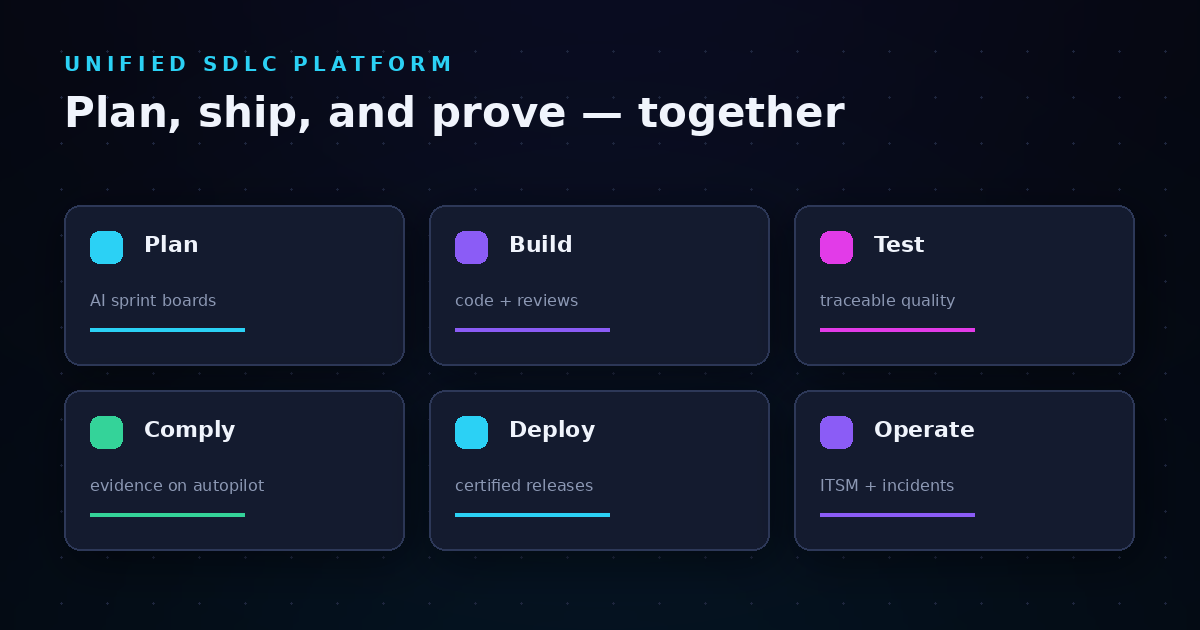
Unified SDLC platforms solve the staleness problem structurally. When your planning, code, testing, and compliance tracking live in one intelligent system, evidence does not have to travel between disconnected databases. It is captured once, linked to the release, and preserved automatically.
This approach treats compliance as infrastructure inside the delivery lifecycle rather than an external checkpoint. Your team does not need to duplicate work by shipping features and then separately documenting compliance—the evidence captures itself from the work already being done.
What Should You Look for in a Unified Platform?
Effective unified platforms offer native integration between development activities and compliance artifacts. Look for systems that capture approvals at the moment they happen, link test results directly to releases, and generate audit-ready documentation without requiring separate workflows.
The goal is to make compliance a byproduct of engineering work rather than a parallel workstream. When your team can produce a complete evidence package with a single click, you have eliminated the conditions that cause data to go stale in the first place.
What Are the Risks of Ignoring Stale Compliance Data?
Stale evidence creates two categories of risk: audit failures and engineering inefficiency. From an audit perspective, outdated records make it difficult to demonstrate adherence to policies and regulations. The burden of proof shifts to your team, often during the worst possible time.
From an efficiency perspective, engineers lose approximately two days per release cycle to evidence collection when compliance tracking is disconnected. That time compounds across your organization and across release cycles, representing a significant hidden cost.
In Summary: Keeping Compliance Evidence Current in Your SDLC
Compliance data goes stale when your tools force a separation between doing the work and documenting the work. Fragmented toolchains, unclear evidence ownership, and after-the-fact reconstruction all contribute to records that auditors cannot trust.
Unified SDLC platforms like LoopIQ offer a structural solution: work and records live on the same surface, evidence is captured at decision time, and release certification trails are generated automatically. This approach keeps your compliance data current without adding overhead to your engineering team.
FAQs About Why Compliance Data Goes Stale in Software Delivery
What causes compliance data to become outdated in software delivery?
Compliance data becomes outdated when evidence is stored separately from the engineering work it documents. Fragmented toolchains, delayed documentation, and unclear ownership all contribute to records that drift from reality over time.
How does a unified SDLC platform prevent stale compliance evidence?
A unified SDLC platform captures compliance evidence at the moment decisions are made, directly within your development workflow. LoopIQ connects delivery signals to releases automatically, so your evidence stays current without separate documentation steps.
Why is real-time evidence capture important for audits?
Real-time capture preserves the state of the world at decision time. When auditors ask about a release months later, you have an immutable record rather than a reconstruction. LoopIQ generates release certification trails that answer audit questions definitively.
How does LoopIQ help regulated engineering teams with compliance?
LoopIQ embeds compliance tracking into daily delivery work, capturing approvals and quality signals into a defensible release trail. Your team can produce a one-click compliance evidence dossier immediately after each release without additional effort.
Can I integrate existing tools with a unified compliance platform?
Yes. LoopIQ connects with your existing tools—including GitHub for change capture, security scanners, and testing frameworks—to correlate delivery signals into a unified release view. This means you do not need to replace your current toolchain to achieve current compliance data.