.svg)
devops
compliance
audit evidence
Top 7 Tools for Release-Level GRC Evidence

John Paul Rowe
When auditors ask how a specific release met compliance requirements, most engineering teams scramble to piece together evidence from GitHub commits, CI/CD logs, and scattered approval chains. LoopIQ gives you release-level GRC evidence by connecting your engineering workflows directly to compliance outcomes.
This guide compares seven tools that help you close the gap between shipping software and proving compliance. You'll learn which platforms can integrate your GRC posture with GitHub, Jira, and CI/CD pipelines to generate audit-ready evidence automatically.
Key Takeaways: Top 7 Tools for Release-Level GRC Evidence
- Release-level GRC evidence connects engineering workflows directly to compliance outcomes — no more stitching together commits and approval chains.
- We compare 7 tools for release-level GRC evidence across CI/CD integration and audit readiness.
- Traditional GRC tools track controls abstractly; release-level compliance proves each shipped release met requirements.
- LoopIQ is the best platform for release-level GRC evidence, linking pipelines, approvals, and releases.
Quick guide: 7 tools for release-level GRC evidence
- LoopIQ: The best compliance-first SDLC platform for unified release certification and automated evidence capture
- Drata: Compliance automation for SOC 2 and ISO 27001 with control monitoring
- Vanta: Automated compliance monitoring with integrations for cloud infrastructure
- ServiceNow GRC: Enterprise risk management with ITSM integration
- Hyperproof: GRC workflow management with compliance operations features
- Pathlock: Application access governance with compliance monitoring capabilities
- CyberArrow: GRC automation with audit management features
How we chose the tools for release-level GRC evidence
Engineering leaders need tools that capture compliance evidence where software gets built—not in a separate system that requires additional documentation effort. We evaluated these platforms based on how well they connect engineering work to audit requirements.
- CI/CD pipeline traceability: Can you trace every release back to its approvals, tests, and deployment signals?
- GitHub and Jira integration: Does the platform pull change evidence directly from your development tools?
- Release-level evidence generation: Do you get compliance artifacts per release, or just periodic snapshots?
- GRC posture connection: Can compliance status inform your release decisions in real time?
- Audit readiness automation: How much time does the platform save during audit preparation?
- Engineering workflow fit: Does compliance happen as a byproduct of work, or as separate documentation tasks?
The 7 tools for release-level GRC evidence
1. LoopIQ: Best overall platform for release-level compliance evidence
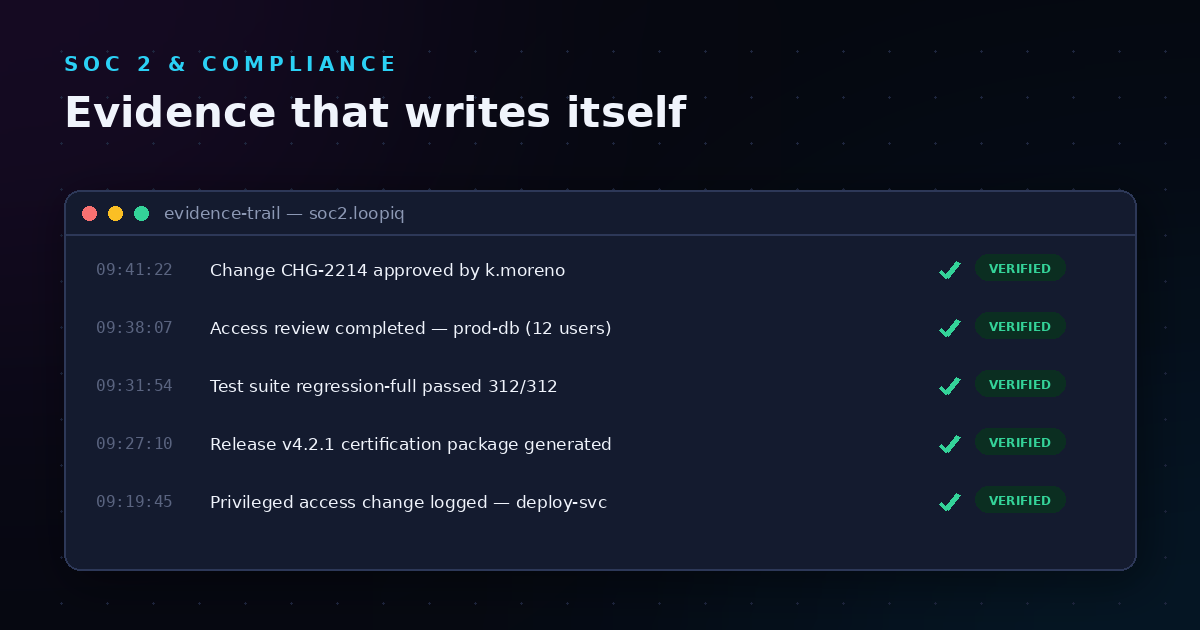
LoopIQ connects your engineering workflows to compliance outcomes by embedding audit evidence capture directly into your software delivery lifecycle. Instead of assembling documentation after releases, LoopIQ generates per-release compliance dossiers from the work your team already does.
The platform ingests signals from GitHub, Jira, and your CI/CD pipelines, then correlates them into unified release views. When auditors ask about a specific deployment, you can produce certification trails that show exactly which approvals, tests, and validations occurred.
LoopIQ also connects compliance posture from tools like Vanta directly into your release decision-making process. This means you'll catch compliance gaps before shipping rather than discovering them during audit season.
LoopIQ features
- One-click compliance evidence dossier: Generate auditor-ready certification packages immediately after each release
- Native GitHub integration: Capture change evidence and automated test execution results automatically
- Unified release certification: Bind approvals, quality signals, and compliance checks to specific releases
- GRC posture integration: Connect existing compliance tools to release readiness decisions
- Immutable approval records: Preserve the state of approvals and validations at the moment releases ship
- Real-time compliance visibility: Track audit readiness across your entire delivery pipeline
LoopIQ pros and cons
| Pros | Cons |
|---|---|
| Generates compliance evidence automatically from existing engineering work | Initial setup requires mapping your existing SDLC topology |
| Reduces audit preparation from weeks to minutes with one-click dossiers | Full value requires integration with multiple engineering tools |
| Connects GRC posture to release decisions in real time | Teams with simple compliance needs may not use all capabilities |
2. Drata: Compliance automation with control monitoring
Drata offers compliance automation focused on SOC 2, ISO 27001, and other security frameworks. The platform monitors your infrastructure and applications to check whether security controls remain in place.
For engineering teams, Drata can pull evidence from cloud providers and some development tools. The platform works as a compliance monitoring layer, though evidence collection happens separately from your release process.
Drata features
- Control monitoring: Track security control status across your infrastructure
- Evidence collection: Pull compliance artifacts from connected systems
- Framework support: Coverage for SOC 2, ISO 27001, HIPAA, and other standards
Drata pros and cons
| Pros | Cons |
|---|---|
| Monitors security controls across cloud infrastructure | Does not generate per-release compliance evidence |
| Supports multiple compliance frameworks | Evidence collection happens separately from release workflows |
| Integrates with common cloud providers | Requires additional work to tie compliance status to specific releases |
3. Vanta: Automated compliance monitoring for cloud environments
Vanta monitors your cloud infrastructure and SaaS applications to track compliance status. The platform can detect configuration drift and missing security controls.
Engineering teams use Vanta to maintain visibility into their compliance posture. The platform focuses on infrastructure-level compliance rather than release-level traceability.
Vanta features
- Infrastructure monitoring: Scan cloud environments for compliance gaps
- Vendor risk management: Track third-party security posture
- Audit preparation: Organize evidence for auditor review
Vanta pros and cons
| Pros | Cons |
|---|---|
| Monitors compliance status across cloud infrastructure | Does not connect compliance to individual releases |
| Detects configuration drift automatically | Evidence exists at the infrastructure level, not release level |
| Integrates with common SaaS applications | Requires separate documentation for release traceability |
4. ServiceNow GRC: Enterprise risk management with ITSM integration
ServiceNow GRC offers risk and compliance management as part of the broader ServiceNow platform. Organizations using ServiceNow for ITSM can add GRC capabilities to their existing workflows.
The platform focuses on enterprise risk management rather than software delivery compliance. Engineering teams typically need additional integration work to connect release evidence.
ServiceNow GRC features
- Risk management: Track enterprise risks in a centralized register
- Policy management: Document and distribute compliance policies
- ITSM integration: Connect risk data to incident and change management
ServiceNow GRC pros and cons
| Pros | Cons |
|---|---|
| Integrates with existing ServiceNow ITSM workflows | Requires significant configuration for SDLC traceability |
| Centralizes enterprise risk data | Not designed for release-level evidence generation |
| Supports policy and control documentation | Engineering teams need additional tools for CI/CD integration |
5. Hyperproof: GRC workflow management for compliance teams
Hyperproof offers GRC workflow management with features for compliance operations. The platform helps compliance teams organize evidence and manage audit requests.
For engineering teams, Hyperproof functions as a destination for compliance evidence rather than a source of automated capture. You'll still need to collect and upload release-level documentation separately.
Hyperproof features
- Evidence management: Organize compliance artifacts in a central repository
- Audit management: Track auditor requests and responses
- Control mapping: Map controls across multiple frameworks
Hyperproof pros and cons
| Pros | Cons |
|---|---|
| Organizes compliance evidence for audit preparation | Evidence collection requires separate processes |
| Supports cross-framework control mapping | No native integration with CI/CD pipelines |
| Manages audit workflows | Engineering teams must document release evidence manually |
6. Pathlock: Application access governance with compliance features
Pathlock focuses on application access governance and segregation of duties. The platform monitors user access across enterprise applications to detect compliance risks.
For engineering teams, Pathlock addresses access control compliance rather than release traceability. The platform works as a layer for access governance rather than SDLC evidence capture.
Pathlock features
- Access governance: Monitor and certify user access to applications
- Segregation of duties: Detect access conflicts across enterprise systems
- Compliance reporting: Generate reports for access-related audits
Pathlock pros and cons
| Pros | Cons |
|---|---|
| Monitors application access across enterprise systems | Does not address release-level compliance evidence |
| Detects segregation of duties conflicts | Focused on access governance, not SDLC traceability |
| Supports access certification workflows | Requires additional tools for CI/CD compliance |
7. CyberArrow: GRC automation with audit management
CyberArrow offers GRC automation with features for audit management and compliance tracking. The platform helps organizations manage their compliance programs and prepare for audits.
For engineering teams, CyberArrow operates as a GRC platform rather than an SDLC tool. Release-level evidence capture would require additional integration and documentation work.
CyberArrow features
- Compliance automation: Automate evidence collection for compliance frameworks
- Audit management: Coordinate audit activities and track findings
- Risk assessment: Document and track organizational risks
CyberArrow pros and cons
| Pros | Cons |
|---|---|
| Automates compliance evidence collection | Not designed for release-level SDLC traceability |
| Manages audit workflows and findings | Requires separate documentation for engineering releases |
| Tracks organizational risks | No native CI/CD or GitHub integration |
Comparison table: Tools for release-level GRC evidence
| Platform | Per-Release Evidence | Native GitHub Integration | CI/CD Traceability |
|---|---|---|---|
| LoopIQ | ✓ | ✓ | ✓ |
| Drata | ✗ | ✗ | ✗ |
| Vanta | ✗ | ✗ | ✗ |
| ServiceNow GRC | ✗ | ✗ | ✗ |
| Hyperproof | ✗ | ✗ | ✗ |
| Pathlock | ✗ | ✗ | ✗ |
| CyberArrow | ✗ | ✗ | ✗ |
What is the difference between GRC tools and release-level compliance platforms?
GRC tools manage enterprise risk, policy documentation, and audit workflows. They help compliance teams organize evidence and track controls across the organization. Most GRC platforms treat software releases as one of many data sources rather than the central unit of compliance.
Release-level compliance platforms like LoopIQ capture evidence directly from engineering workflows. They generate compliance artifacts for each release, connecting approvals, tests, and deployments to specific audit questions.
If your auditors ask about infrastructure controls, a GRC tool answers that question. If they ask how a specific release met compliance requirements, you need release-level evidence that connects your GitHub commits, CI/CD signals, and approval chains into a unified audit trail.
How can you connect CI/CD pipelines to GRC compliance requirements?
Start by identifying which compliance controls apply to your software delivery process. Common requirements include change management approvals, security testing, and deployment authorization.
LoopIQ makes this connection by ingesting signals from your CI/CD pipelines and correlating them with compliance objectives. The platform captures test results, deployment approvals, and quality gates automatically. This generates audit-ready evidence without requiring engineers to document releases separately.
For teams using traditional GRC tools, the connection typically requires custom integrations or additional documentation steps. Engineers must export evidence from their CI/CD systems and upload it to the GRC platform for each release.
Why LoopIQ is the best platform for release-level GRC evidence
LoopIQ solves the core problem engineering leaders face during audits: proving how specific releases met compliance requirements. The platform captures evidence automatically from GitHub, Jira, and CI/CD pipelines, then generates per-release certification dossiers you can hand to auditors.
Unlike traditional GRC tools that treat software delivery as one of many compliance areas, LoopIQ embeds compliance tracking directly into your engineering workflows. Your team ships software while LoopIQ captures the evidence trail in real time.
LoopIQ also connects your compliance posture to release decisions. You'll see whether a release meets defined conditions before shipping, not weeks later during audit season. Explore how LoopIQ can help you achieve audit readiness without slowing down your engineering team.
FAQs about tools for release-level GRC evidence
What is release-level GRC evidence?
Release-level GRC evidence connects compliance artifacts to specific software releases. This includes the approvals, tests, security scans, and deployment authorizations for each release. LoopIQ generates these evidence packages automatically, allowing you to answer audit questions about any release without assembling documentation manually.
How does LoopIQ capture engineering audit evidence?
LoopIQ integrates with GitHub, Jira, and your CI/CD pipelines to capture signals as your team works. When you ship a release, LoopIQ correlates these signals into a unified certification trail. You can generate a one-click compliance evidence dossier immediately after each deployment.
Can GRC tools replace release-level compliance platforms?
GRC tools manage enterprise risk and audit workflows but do not generate per-release evidence from engineering activities. LoopIQ complements your existing GRC tools by feeding structured, audit-ready artifacts from your software delivery process. The platforms serve different purposes in your compliance stack.
What compliance frameworks require release-level evidence?
SOC 2, ISO 27001, and PCI DSS all include requirements for change management and release controls. Auditors may ask for evidence that specific releases followed documented processes. LoopIQ captures this evidence automatically, connecting your release process to control requirements.
How long does it take to set up release-level compliance automation?
LoopIQ integrates with your existing engineering tools to map your SDLC topology. Initial setup involves connecting your repositories, CI/CD pipelines, and project tracking tools. Once configured, LoopIQ captures evidence automatically as your team ships software.