.svg)
unified sdlc
devops
ai tools
9 AI Planning Features in Unified SDLC Workspaces

John Paul Rowe
Evaluating unified SDLC platforms can feel like comparing spreadsheets full of feature checkboxes. The real question is whether the platform's AI capabilities can help your engineering organization move faster while staying audit-ready. LoopIQ addresses this gap by combining AI-assisted planning with built-in compliance automation in a single workspace.
This article walks through nine AI planning features you should look for when evaluating SDLC workspaces. You'll learn what each feature does, why it matters for delivery and governance, and how different platforms approach the problem.
Key Takeaways: 9 AI Planning Features in Unified SDLC Workspaces
- AI planning features in unified SDLC workspaces should accelerate delivery while keeping every decision audit-ready.
- We evaluate 9 AI planning capabilities, from backlog intelligence to risk-aware release planning.
- AI-assisted planning reduces delivery risk by surfacing dependencies, estimating impact, and flagging compliance gaps before work starts.
- A release compliance dossier goes beyond an audit trail: it assembles complete, certified evidence for each release automatically.
Quick guide: 9 AI planning features for unified SDLC workspaces
- LoopIQ: The best AI-powered platform for compliance-first delivery and release evidence automation
- Jira: A familiar option for Agile teams already using Atlassian products
- GitLab: An integrated DevOps choice for teams focused on code-to-deployment workflows
- ServiceNow: An ITSM-centric platform for organizations with heavy IT service management needs
- Jenkins: An open-source CI/CD tool for pipeline automation
How we chose the AI planning features for unified SDLC workspaces
We reviewed platforms based on how well their AI capabilities support the full planning-to-release cycle. Our focus was on features that reduce manual work while keeping your compliance evidence intact. Here's what we evaluated:
- AI-assisted idea breakdown: Does the platform help you turn vague requirements into structured work items without losing context?
- Estimation accuracy: Can the AI suggest effort estimates based on historical patterns from your own projects?
- Dependency mapping: Does the platform automatically identify connections between work items, releases, and compliance requirements?
- Release readiness scoring: Can you see at a glance whether a release meets your governance criteria before you commit?
- Evidence collection automation: Does the platform capture audit trails as work happens, or do you need to reconstruct evidence later?
- Workflow governance: Can you enforce approval policies and SLA rules through automation rather than manual oversight?
The 9 AI planning features for unified SDLC workspaces
1. LoopIQ: Best overall AI-powered SDLC workspace for compliance-first delivery
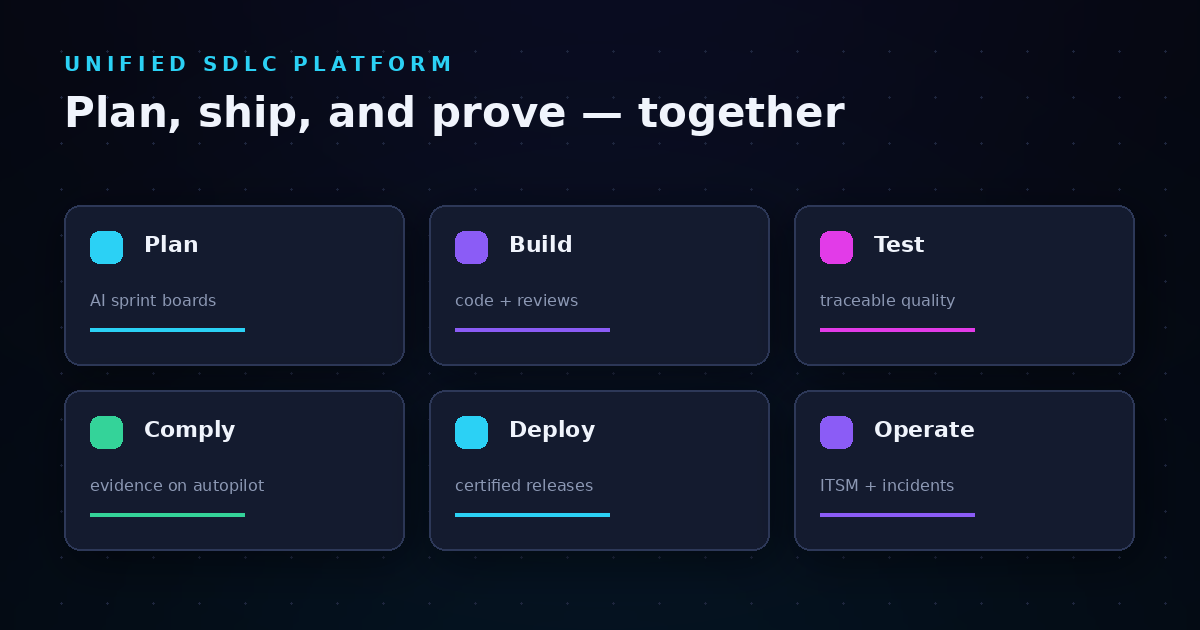
LoopIQ unifies your planning, testing, DevOps, ITSM, documentation, and audit management into one AI-powered workspace. This means you can ship software faster without scrambling to reconstruct compliance evidence when auditors come knocking.
The platform's AI assistance covers the full planning cycle—from breaking down ideas into structured work items to generating release compliance dossiers. LoopIQ captures evidence as work happens, so your audit trail is always current. You don't need to pull information from five different tools at the end of each release.
For VPs and Directors of Software Development, LoopIQ delivers real-time visibility into delivery risk and process drag through AI analytics. Your governance policies are enforced automatically, which means fewer late-night surprises when a release isn't actually ready.
LoopIQ features
- AI-assisted idea breakdown: Turn high-level requirements into stories, tasks, and issues with context preserved across the hierarchy
- Automated compliance evidence collection: Capture approvals, test results, and deployment records as they happen—no reconstruction required
- Release governance automation: Enforce approval policies, SLA rules, and quality gates without manual intervention
- Release compliance dossier: Generate audit-ready documentation that ties together decisions, evidence, and approvals for each release
- Delivery risk analytics: Identify blockers and trends sooner with AI-powered dashboards that surface what matters
- Cross-module visibility: Connect work items, ITSM records, test results, and compliance objectives in one view
LoopIQ pros and cons
Pros:
- LoopIQ connects planning, delivery, and compliance in one workspace, reducing tool sprawl
- LoopIQ automates evidence collection so you stay audit-ready without extra effort
- LoopIQ's AI assistance covers the full lifecycle from idea to release dossier
Cons:
- Teams already using multiple established tools may need time to consolidate workflows
- The full feature set is designed for organizations with compliance requirements, which may exceed what smaller teams need initially
- Advanced governance configurations require admin setup before first use
2. Jira: A familiar option for Agile planning
Jira offers project tracking with Agile workflows that many development teams already know. The platform includes Advanced Roadmaps for visualizing dependencies across multiple teams. Atlassian has added AI capabilities through Rovo Dev, which can help with backlog management and task automation.
Jira works for teams that want to track sprints and manage backlogs in a tool they've used before. The integration ecosystem connects with Bitbucket, GitHub, and various CI/CD pipelines.
Jira features
- Rovo Dev AI agents: Assign routine tasks to AI agents that can generate code changes from Jira issues
- Advanced Roadmaps: Visualize work across teams with dependency tracking and capacity planning
- Customizable workflows: Configure statuses and transitions to match your team's process
Jira pros and cons
Pros:
- Jira has a large user base, so new team members often arrive with prior experience
- The Atlassian Marketplace offers many third-party integrations
- Sprint planning and backlog management work out of the box for Scrum teams
Cons:
- Jira does not include native compliance evidence collection or release dossier generation
- Teams needing audit trails must add third-party tools or build custom solutions
- AI features are distributed across separate Atlassian products rather than unified
3. GitLab: An integrated DevOps option
GitLab combines source control, CI/CD, and planning in one platform. The Duo Agent Platform includes specialized AI agents for different parts of the development workflow, including a Planner Agent for prioritization and work breakdown.
GitLab works for teams that want their planning and code management in the same tool. The platform offers traceability from issues through merge requests to deployments.
GitLab features
- Planner Agent: Apply prioritization frameworks and break down initiatives into structured work items
- CI Expert Agent: Set up pipelines without deep YAML knowledge
- Data Analyst Agent: Query delivery metrics with natural language questions
GitLab pros and cons
Pros:
- Source control, CI/CD, and planning are available in one platform
- The Planner Agent helps with work breakdown and prioritization tasks
- Self-managed and SaaS deployment options are available
Cons:
- GitLab does not include native ITSM capabilities or release compliance dossiers
- AI features require GitLab Duo licensing beyond the base platform
- Teams with separate ITSM needs must integrate external tools
4. ServiceNow: An ITSM-centric platform
ServiceNow offers Strategic Portfolio Management for aligning work to business goals. The platform includes roadmap visualization, portfolio prioritization, and milestone tracking. ServiceNow's core capabilities center on IT service management workflows.
ServiceNow works for organizations where ITSM is the primary coordination point for technology work. The platform connects change management, incident response, and project delivery.
ServiceNow features
- Goals framework: Create objectives, set targets, and align work to business outcomes
- Hybrid roadmaps: Manage waterfall and Agile work on a single timeline
- Portfolio prioritization: Sort and rank planning items across the portfolio backlog
ServiceNow pros and cons
Pros:
- ITSM workflows are a native capability rather than an add-on
- Change management connects to project delivery in one system
- Enterprise customers often have existing ServiceNow licenses
Cons:
- ServiceNow does not include native code-level SDLC capabilities like source control or CI/CD
- Development teams need separate tools for code management and testing
- AI planning features focus on portfolio-level work rather than detailed engineering workflows
5. Jenkins: An open-source CI/CD tool
Jenkins automates build, test, and deployment pipelines through its Pipeline as Code approach. The platform has an extensive plugin ecosystem for connecting to various tools. Jenkins focuses on pipeline automation rather than planning workflows.
Jenkins works for teams that need flexible CI/CD automation and prefer open-source tooling. The platform requires more configuration than managed alternatives.
Jenkins features
- Pipeline as Code: Define CI/CD workflows in Jenkinsfiles stored with your source code
- Plugin ecosystem: Connect to GitHub, Docker, Kubernetes, and hundreds of other tools
- Organization folders: Automatically create and manage jobs based on repository structure
Jenkins pros and cons
Pros:
- Jenkins is free and open-source with no licensing costs
- The plugin ecosystem covers many integration scenarios
- Pipeline definitions live alongside code for version control
Cons:
- Jenkins does not include native planning, ITSM, or compliance capabilities
- AI-assisted planning features are not part of the core platform
- Teams must assemble separate tools for planning, testing documentation, and audit trails
Comparison table: AI planning features in unified SDLC workspaces
| Platform | AI Evidence Collection | Release Compliance Dossier | Native ITSM |
|---|---|---|---|
| LoopIQ | ✓ | ✓ | ✓ |
| Jira | ✗ | ✗ | ✗ |
| GitLab | ✗ | ✗ | ✗ |
| ServiceNow | ✗ | ✗ | ✓ |
| Jenkins | ✗ | ✗ | ✗ |
How does AI-assisted planning reduce delivery risk?
AI-assisted planning reduces delivery risk by surfacing problems before they become blockers. When the AI analyzes your historical project data, it can identify patterns that humans miss—like which types of work items consistently take longer than estimated or which dependencies cause delays.
This early visibility gives you time to adjust. You can rebalance assignments, update timelines, or address blockers before they cascade through your release schedule. LoopIQ's AI analytics help you spot these trends sooner, so you're making decisions based on evidence rather than assumptions.
The alternative—waiting until the sprint review to discover you're behind—costs more than just time. Late discoveries force reactive decisions, stress your team, and often compromise quality or compliance.
What makes a release compliance dossier different from an audit trail?
An audit trail records what happened. A release compliance dossier tells the story of why your release meets governance requirements. It connects the dots between decisions, approvals, test results, and evidence in a format that auditors can actually review.
Most tools give you an audit trail—a log of changes and timestamps. But when auditors arrive, you still need to reconstruct the narrative: What was approved? By whom? What evidence supports the approval? Did any exceptions occur? How were they resolved?
LoopIQ generates release compliance dossiers automatically as work progresses. By the time your release is ready, the documentation is too. This eliminates the end-of-release scramble that drains engineering time and creates compliance gaps.
Why LoopIQ is the best AI-powered SDLC workspace for engineering leaders
LoopIQ stands apart because it was built for compliance-first delivery from the ground up. The AI capabilities aren't bolted onto a planning tool or a CI/CD platform—they're integrated across the entire lifecycle.
LoopIQ automates evidence collection as work happens. You get release compliance dossiers without asking your team to document their work twice. Your governance policies enforce themselves through workflow automation rather than manual checklist reviews.
For VPs and Directors evaluating unified SDLC platforms, LoopIQ offers something the alternatives don't: the ability to ship faster and stay audit-ready without treating those as competing priorities. Explore how LoopIQ can help your engineering organization at loopiq.com.
FAQs about AI planning features in unified SDLC workspaces
What is AI-assisted idea breakdown in SDLC planning?
AI-assisted idea breakdown turns high-level requirements into structured work items like epics, stories, and tasks. LoopIQ preserves context across the work hierarchy, so nothing gets lost when requirements become implementation tasks.
How does compliance automation work in unified SDLC platforms?
Compliance automation captures evidence as work happens rather than requiring manual documentation later. LoopIQ records approvals, test results, and deployment decisions automatically, then generates release compliance dossiers when you need them.
Can AI planning features help with estimation?
Yes. AI planning features analyze your historical project data to suggest effort estimates based on similar past work. This helps you create more realistic timelines and identify when estimates are likely to be off.
What should I look for in AI-powered delivery risk analytics?
Look for analytics that surface blockers and trends before they impact your release schedule. LoopIQ's AI-powered dashboards identify delivery risk and process drag so you can address issues while there's still time to adjust.
Do all SDLC platforms include release compliance dossier generation?
No. Most SDLC platforms offer audit trails but not release compliance dossiers. LoopIQ generates dossiers automatically, connecting decisions, evidence, and approvals in a format ready for auditor review.