.svg)
devops
devsecops
compliance
7 Software Delivery Governance Tools for SaaS Scaling

John Paul Rowe
7 Software Delivery Governance Tools for SaaS Scaling
Scaling a SaaS company means shipping faster, but speed alone creates problems. Release approvals pile up. Compliance evidence gets lost across multiple systems. Audit prep becomes a fire drill. For VPs and Directors of Software Development, the question shifts from "how fast can we ship?" to "how do we ship fast and stay compliant?"
This article breaks down seven software delivery governance tools that help you scale CI/CD, manage releases, and capture compliance evidence. LoopIQ tops our list for its compliance-first approach to unifying the entire software delivery lifecycle.
You'll find evaluation criteria, feature breakdowns, and a comparison table to help you make an informed decision for your engineering organization.
Key Takeaways: 7 Software Delivery Governance Tools for SaaS Scaling
- Scaling SaaS teams need delivery governance that keeps releases fast while compliance evidence assembles automatically.
- We compare 7 governance tools on release approval workflows, evidence capture, and audit readiness for scaling teams.
- Release management connects directly to governance: approval gates, deployment records, and exception handling are your compliance backbone.
- LoopIQ leads for SaaS scaling: compliance-first delivery governance in one workspace, from planning through release certification.
Quick guide: 7 software delivery governance tools for scaling SaaS
- LoopIQ: The best compliance-first platform for unifying CI/CD governance and release evidence
- GitLab: Offers DevSecOps pipelines with built-in policy enforcement
- Jenkins: An open-source option for custom pipeline governance
- Jira: Works as a planning hub that connects to release workflows
- ServiceNow DevOps: Connects change management with developer toolchains
- Kosli: Focuses on SDLC governance and compliance automation for pipelines
- Harness: Includes policy-as-code features for deployment governance
How we chose the software delivery governance tools for SaaS scaling
We looked at tools that help growing SaaS engineering organizations manage release complexity without slowing down delivery. The focus was on platforms that connect development work to governance outcomes, so you can ship confidently while staying audit-ready.
Here's what we evaluated:
- Automated evidence capture: Does the tool collect compliance artifacts as work happens, or do you need to reconstruct them later?
- Release approval workflows: Can you configure approval gates that match your organization's policies without creating bottlenecks?
- Audit trail visibility: When an auditor asks "who approved this change and when?", can you answer in seconds?
- CI/CD integration depth: Does it connect with your existing pipelines and toolchain, or require you to rebuild everything?
- Traceability from planning to production: Can you follow a feature from idea through deployment with a clear evidence trail?
- Scalability for growing engineering organizations: Will this tool grow with you as your team expands from 20 to 200 engineers?
The 7 software delivery governance tools for scaling SaaS
1. LoopIQ: Best overall software delivery governance platform for SaaS scaling
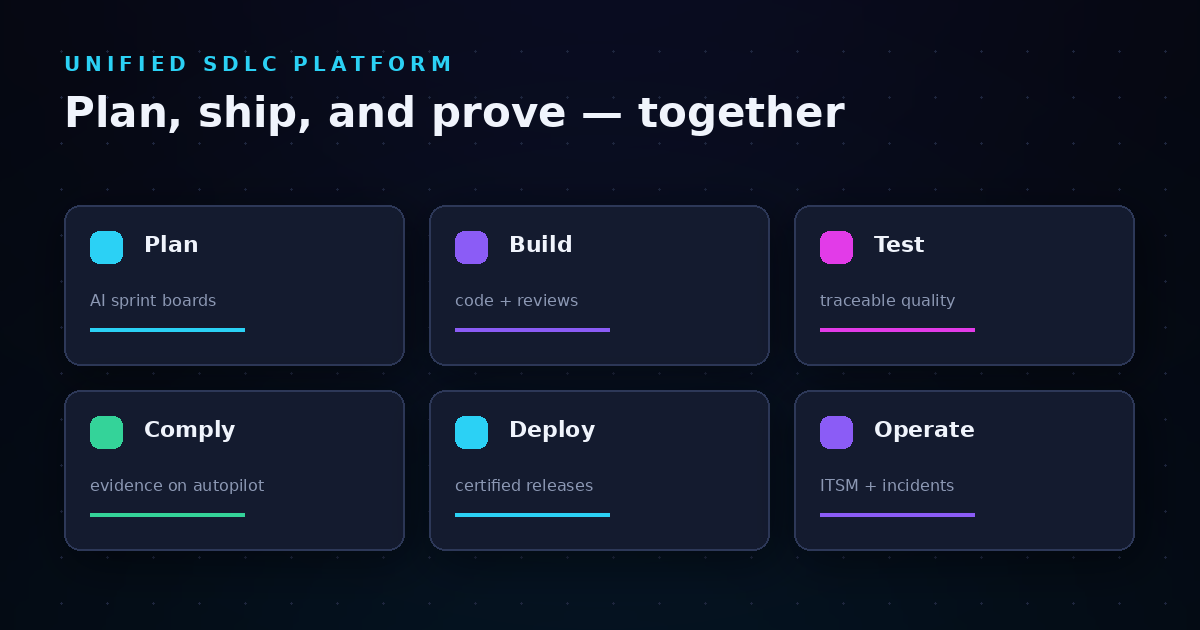
LoopIQ gives you a unified SDLC workspace where planning, delivery, testing, ITSM, and compliance management happen in one place. Instead of stitching together evidence from five different tools after a release, LoopIQ captures approvals, test results, and quality signals automatically as your team works.
What sets LoopIQ apart is its compliance-first architecture. Every story, task, change request, and release certification connects to the same delivery and compliance trail. When audit time arrives, you're not scrambling to reconstruct release history from scattered Jira tickets and spreadsheets.
LoopIQ automates evidence collection for the five questions auditors always ask: change authorization, access governance, test validation, release certification, and incident response. This means your engineering team stays focused on building, while compliance documentation happens in the background.
LoopIQ features
- Automated compliance evidence capture: Every approval, code review, and test execution gets recorded as work happens, giving you audit-ready documentation without extra effort.
- Release compliance dossiers: Each release generates a certification package binding change records, validation results, and approvals into one auditable document.
- AI-assisted release readiness: Get automated risk assessments and readiness checks before you deploy, so you catch gaps before auditors do.
- Unified SDLC workspace: Manage planning, testing, incidents, and compliance in a single platform, eliminating context-switching between disconnected tools.
- Approval policy automation: Configure role-based approval gates that enforce governance without creating manual bottlenecks.
- End-to-end traceability: Trace any release back through every decision, test, and approval that led to production.
LoopIQ pros and cons
Pros:
- Eliminates post-release evidence reconstruction by capturing compliance artifacts automatically
- Reduces tool sprawl by combining SDLC, ITSM, and compliance in one workspace
- Gives you audit-ready documentation before you ship, not weeks later
Cons:
- Migrating from multiple existing tools requires planning, though import capabilities help ease the transition
- The full feature set may take time to adopt if your team is new to unified platforms
- Requires investment in initial configuration to match your specific governance policies
2. GitLab: DevSecOps pipelines with policy enforcement
GitLab combines source control, CI/CD, and security scanning in a single platform. For governance, GitLab offers compliance frameworks that let you define and enforce policies across projects and groups. You can create pipeline execution policies that run specific jobs across multiple repositories.
GitLab's compliance features include protected branches, credentials inventory, and audit logs. The platform supports compliance framework project labels that apply standardized settings across your organization.
GitLab features
- Pipeline execution policies: Define CI/CD jobs that run across projects to enforce security and compliance checks.
- Compliance framework labels: Apply common compliance settings to projects using framework labels.
- Audit event streaming: Stream audit events to external destinations for centralized logging.
GitLab pros and cons
Pros:
- Combines version control, CI/CD, and security in one platform
- Offers granular permissions and protected branch settings
- Includes built-in security scanning tools
Cons:
- Advanced compliance features require the Ultimate tier
- Does not include ITSM or project management capabilities natively
- Evidence collection for audits often requires additional tooling or manual work
3. Jenkins: Open-source pipeline automation
Jenkins is an open-source automation server used by engineering organizations to build, test, and deploy software. Its plugin ecosystem allows you to add governance capabilities like approval gates, audit logging, and release management workflows. Jenkins uses Jenkinsfiles to define pipelines as code.
The Jenkins Templating Engine allows organizations to create governance hierarchies that standardize pipelines across teams. This gives you centralized control while allowing project-specific customization.
Jenkins features
- Pipeline as code: Define build, test, and deployment workflows in version-controlled Jenkinsfiles.
- Plugin ecosystem: Extend functionality with plugins for approvals, notifications, and release tracking.
- Templating engine: Create reusable pipeline templates with centralized governance configurations.
Jenkins pros and cons
Pros:
- Free and open-source with no licensing fees
- Large plugin library for extending capabilities
- Runs on your own infrastructure with full control
Cons:
- Requires significant setup and maintenance effort
- No built-in compliance evidence tracking or audit trail features
- Governance capabilities depend on finding and configuring the right plugins
4. Jira: Planning and tracking with release connections
Jira serves as a planning and tracking hub for software development organizations. While not a governance platform by itself, Jira connects to CI/CD tools to surface development and release information inside issues. The Open DevOps experience feeds build, deployment, and pull request data into Jira issues.
When paired with Jira Service Management, you can connect change management workflows to development work. This creates visibility across development and IT operations, though governance features depend on third-party integrations.
Jira features
- Release tracking: Group work into release versions and track their status across projects.
- DevOps integrations: Connect CI/CD tools to display build and deployment data inside issues.
- Automation rules: Create automated workflows for approvals, notifications, and status transitions.
Jira pros and cons
Pros:
- Widely adopted with a familiar interface for most engineering teams
- Integrates with a broad ecosystem of development tools
- Flexible workflows that adapt to different team processes
Cons:
- Does not capture compliance evidence or generate audit trails natively
- Governance capabilities require additional products or integrations
- Release governance typically requires combining multiple Atlassian products
5. ServiceNow DevOps: Change management for development toolchains
ServiceNow DevOps Change Velocity connects developer tools with ITSM change management. The platform automates change request creation from CI/CD events and applies approval policies based on your organization's rules. DevOps data flows into ServiceNow's change management system.
The integration approach works for organizations already using ServiceNow for ITSM. Change approval policies can auto-approve, auto-reject, or route for manual review based on configurable criteria.
ServiceNow DevOps features
- Change automation: Generate change requests automatically from pipeline events.
- Approval policies: Configure automated approval decisions based on risk and policy criteria.
- Toolchain integrations: Connect with planning, building, testing, and delivery tools.
ServiceNow DevOps pros and cons
Pros:
- Integrates change management with existing DevOps toolchains
- Offers configurable approval policies with automated routing
- Connects to the broader ServiceNow ITSM ecosystem
Cons:
- Primarily focused on change management rather than full SDLC governance
- Requires ServiceNow as the foundation, adding platform complexity
- Does not include code repository or CI/CD execution capabilities
6. Kosli: SDLC governance for regulated industries
Kosli focuses on SDLC governance and compliance automation for organizations in regulated industries. The platform records evidence from CI/CD pipelines and stores it in an immutable ledger. This creates audit trails that connect commits to production deployments.
Kosli integrates with existing CI/CD tools rather than replacing them. The platform generates attestations throughout your pipeline and compares them against defined policies.
Kosli features
- Immutable audit trail: Records pipeline evidence in a tamper-proof ledger.
- Attestation generation: Creates signed records of build, test, and deployment events.
- Policy enforcement: Compares attestations against compliance policies before deployment.
Kosli pros and cons
Pros:
- Designed specifically for regulated industry compliance requirements
- Works with existing CI/CD tools without replacing your pipeline
- Creates immutable records that satisfy audit requirements
Cons:
- Focuses on pipeline governance rather than upstream planning or ITSM
- Does not include project management or test management capabilities
- Requires integration setup with each tool in your delivery chain
7. Harness: Policy-as-code for deployment governance
Harness offers a software delivery platform with built-in governance features. The Policy as Code capability uses Open Policy Agent (OPA) to define and enforce compliance rules. Role-based access controls and audit trails track changes to your deployment configurations.
Harness includes features like log sanitization to mask secrets in deployment logs. The platform records audit events for up to two years, giving you historical data for compliance reviews.
Harness features
- Policy as Code: Define compliance policies using Open Policy Agent for centralized governance.
- Role-based access control: Configure granular permissions at account, organization, and project levels.
- Audit trail: Track changes to resources with historical data retention.
Harness pros and cons
Pros:
- Includes policy-as-code capabilities using the Open Policy Agent standard
- Offers fine-grained role-based access controls
- Retains audit data for extended compliance review periods
Cons:
- Focused on deployment governance rather than full SDLC traceability
- Policy configuration requires familiarity with OPA and Rego language
- Does not natively integrate ITSM or compliance management workflows
Comparison table: Software delivery governance tools for SaaS scaling
| Tool | Auto Evidence Capture | Unified SDLC + ITSM | Release Certification |
|---|---|---|---|
| LoopIQ | ✓ | ✓ | ✓ |
| GitLab | ✗ | ✗ | ✗ |
| Jenkins | ✗ | ✗ | ✗ |
| Jira | ✗ | ✗ | ✗ |
| ServiceNow DevOps | ✗ | ✗ | ✗ |
| Kosli | ✓ | ✗ | ✗ |
| Harness | ✗ | ✗ | ✗ |
What should you look for when evaluating DevOps governance solutions?
Focus on how the tool handles the gap between development work and audit requirements. The most common pain point for scaling SaaS teams is reconstructing compliance evidence after the fact. A tool that captures evidence as work happens eliminates this burden.
Look at how approval workflows integrate with your existing processes. Governance should add control, not friction. If your developers need to leave their workflow to complete approval steps, adoption will drop.
Consider traceability depth. When an auditor asks about a specific production change, can you trace it back to the original requirement, through code review, testing, and approval, in minutes rather than hours? Tools that unify these domains make this possible.
How does release management connect to SaaS governance and compliance?
Release management sits at the intersection of delivery speed and compliance risk. Every release represents a bundle of changes that need documentation: what changed, who approved it, what testing validated it, and what risks were accepted.
For SaaS companies facing SOC 2, ISO 27001, or similar audits, release governance becomes critical. Auditors want to see that you have controls around what goes to production, and that those controls generate verifiable evidence. According to research from Zylo, organizations often underestimate their compliance gaps until audit time.
LoopIQ connects release management directly to compliance by generating release certification packages automatically. Each release captures the full context of changes, validations, and approvals in a single auditable record.
Why LoopIQ is the best software delivery governance tool for SaaS scaling
LoopIQ stands apart because it treats compliance as a natural output of development work, not a separate project. While other tools require you to stitch together evidence from multiple systems, LoopIQ captures everything in one unified workspace.
This approach matters for scaling SaaS teams. As you grow from a few engineers to dozens or hundreds, the coordination overhead of governance increases exponentially. LoopIQ reduces this overhead by connecting planning, delivery, testing, and compliance in a single system. Every decision is traceable. Every release ships with documentation already complete.
The 2025 DORA Report shows that high-performing organizations balance delivery speed with reliability and compliance. LoopIQ gives you the infrastructure to achieve that balance without choosing between shipping fast and staying audit-ready.
Ready to see how LoopIQ automates your compliance evidence? Start your free trial and experience governance that works with your team, not against them.
FAQs about software delivery governance tools for SaaS scaling
What is software delivery governance?
Software delivery governance refers to the policies, controls, and processes that ensure software changes move to production safely and with proper documentation. It covers approval workflows, access controls, audit trails, and compliance evidence collection. LoopIQ automates these governance activities so you can ship faster while maintaining audit readiness.
Why do scaling SaaS companies need governance tools?
As your engineering organization grows, the complexity of releases increases. More engineers mean more changes, more approvals, and more potential compliance gaps.
Governance tools bring order to this complexity. They ensure that every release follows your policies and generates the evidence auditors need to see.
How does LoopIQ differ from traditional CI/CD tools?
Traditional CI/CD tools focus on pipeline execution. They build, test, and deploy your code. LoopIQ goes further by capturing the full compliance context around each release.
LoopIQ connects planning, development, testing, and ITSM in one workspace. This gives you end-to-end traceability that CI/CD tools alone cannot deliver.
Can governance tools integrate with existing development workflows?
Yes, most governance tools offer integrations with common development tools. LoopIQ takes this further by serving as a unified workspace that reduces the need for multiple integrations.
Instead of connecting five tools with complex integrations, you manage work in one platform where governance is built in.
What compliance frameworks do governance tools support?
Governance tools typically support SOC 2, ISO 27001, HIPAA, and similar frameworks. LoopIQ captures evidence for the five key audit domains: change authorization, access governance, test validation, release certification, and incident response.